100 yard flight began
p. 89 · Read in the full issue
Frank Fleming's shaky 100 yard flight began aviation in Fiji
The willing but slightly in
credulous dozen Fijians pushed
and half-carried the tiny, make shift plane a mile outside Suva
township early one morning in
1922. They hadn’t seen a plane before, let alone seen one fly.
Alongside the small procession ran the aircraft’s hopeful owner, a shy, 34-year-old amateur radio “ham” and aircraft mechanic, Frank Fleming.
His eyes hardly left his frail DH6 aircraft for fear an accident might happen to her before he took her into the air.
When the plane reached a large sandbar in front of the present-day Suva Grammar School, it was care fully set on the ground. Warming up her air-cooled engine of about 80 horsepower, took Mr. Fleming several hours, by which time the in comeing tide had made the takeoff area very soggy.
Failed to lift
Nethertheless, Fleming went ahead.
He taxied on the bar, revved, revved again and took off. The two-seater DH6 failed to lift properly. She flew about a 100 yds and careered into the water. Fleming was unhurt, but his plane was badly damaged. The next day he recovered his engine but, discouraged, left the plane to rot.
For Fiji, it was the colony’s first recorded flight, a stout, but un successful effort to enter the air age, a good four years before New Guinea got its first plane in the air from Rabaul. For Mr. Fleming, it was the sad end to weeks of work assembling the DH6, firstly in a large commercial travellers’ room above the old Pusi Loa Loa Cafe, Suva, and later on, in Jones’s Stables, long replaced by the present austere, government buildings.
These days, Fiji’s first pathetic flight is forgotten by all except the handful of people interested in early Islands aviation but when Mr.
Fleming died in 1968 in Suva, at the age of 80, his death reminded
By Ken Mcgregor
many of his efforts to get air services going eight years before they finally did.
Frank Fleming first arrived in Fiji about 1911 and worked for the sail making and chandlers firm of W.
McGowan and Company. In 1913 he joined the post office and was soon transferred from Suva to Labasa where Mr. R. C. Farquhar, who still lives in Fiji, taught him morse code and the job of a wireless operator.
Left for the UK
Nine months later, Mr. Fleming was transferred back to Suva. When the Fiji contingent left for Britain soon after World War I began, he went along and during the war worked as an air mechanic on air craft frames for the Royal Flying Corps, Nearly 10 years before air services did actually start in Fiji, Mr. Fleming was planning to start his own services. His wooden and fabric framed DH6, crated, and in many pieces, arrived on Suva Wharf in March, 1922.
Failure to start the services made Mr. Fleming give up the idea of flying the planes himself but he re mained interested in aviation develop ments and knew most of Fiji’s pioneer aviators, such as Mr. Gordon Fenton (now living in Russell, NZ), Mr. N. S. Chalmers and the NZ captains, Walsh and Upham.
The first air service began operat ing in Fiji about 1933 as Fiji Airways Ltd. It was an offshoot of the successful Guinea Airways of New Guinea. But aviation didn’t take in Fiji as it had in Papua or New Guinea and the service soon folded up.
In 1924 Mr. Fleming had begun a new career as a radio operator for the Fiji Government, often in isolated areas.
About 1940, he, with Mrs.
Fleming, were sent to Canton Island, mid-Pacific, shortly after the US and
Britain began disputing ownership of the remote island because of its stopover value on growing trans pacific air routes. Mr. Fleming repre sented the British Government as administrative officer and wireless operator.
A visitor to Canton found the Flemings living “in a humble shanty made of packing cases” next-door to SUSSOO,OOO Pan American airport installations. When the Flemings were permanently relieved about 1943, Mr. Fleming was off work for several weeks in Fiji recovering from a combination of several illnesses.
Caretaker at
About 1950 the Fiji Government appointed him caretaker of Makuluva Island, a tiny outcrop at the entrance to Suva Harbour. Three years later a tidal wave hit the island and everything was covered except the Fleming’s small house. Characteris tically a loner Mr. Fleming decided to stay when the waters went down and he refused other government offers of jobs elsewhere.
But erosion beat him. A couple of weeks later the house sagged when some groundwork, seriously weakened by the tidal wave, gave wav. The couple moved to nearby Nukulau Island, where Mr. Fleming remained as caretaker until shortly before his dea'h.
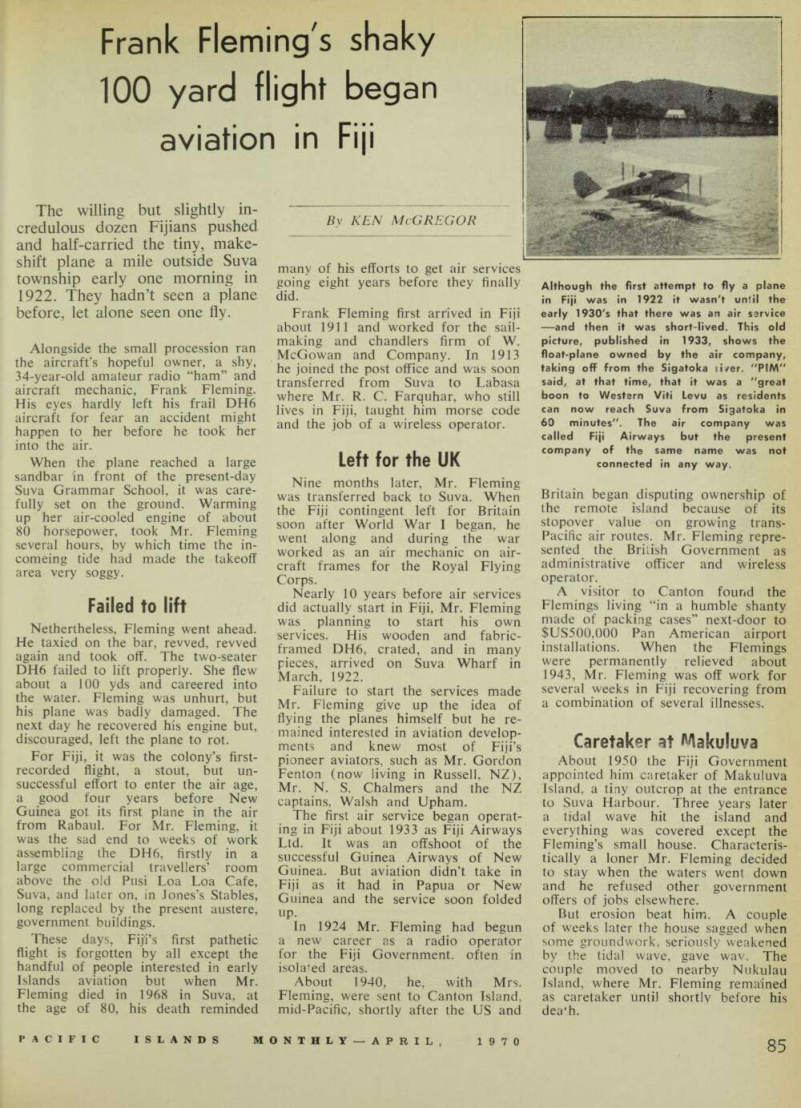
Although the first attempt to fly a plane in Fiji was in 1922 it wasn't until the early 1930's that there was an air service —and then it was short-lived. This old picture, published in 1933, shows the float-plane owned by the air company, taking off from the Sigatoka river. "RIM" said, at that time, that it was a "great boon to Western Viti Levu as residents can now reach Suva from Sigatoka in 60 minutes". The air company was called Fiji Airways but the present company of the same name was not connected in any way.