Magazine Section
pp. 85-87 · Read in the full issue

The mystery megaliths of the Trobriand Islands
By D. K. Holdsworth
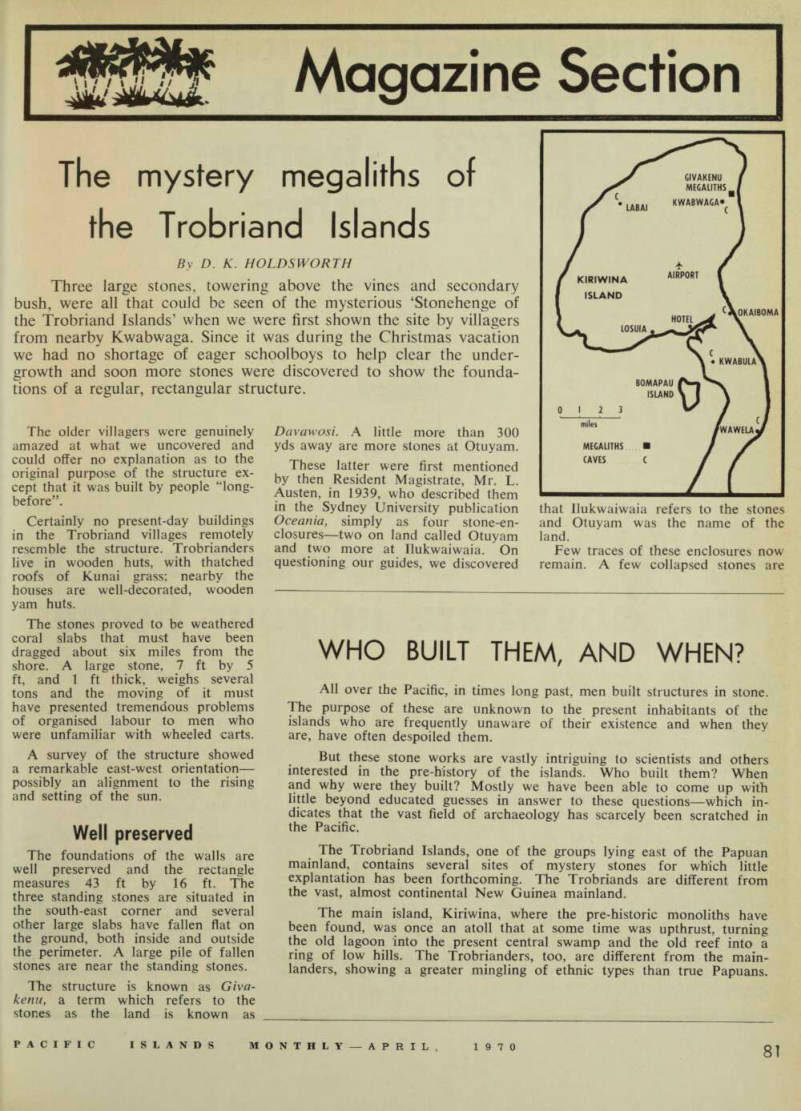
Three large stones, towering above the vines and secondary bush, were all that could be seen of the mysterious ‘Stonehenge of the Trobriand Islands’ when we were first shown the site by villagers from nearby Kwabwaga. Since it was during the Christmas vacation we had no shortage of eager schoolboys to help clear the under growth and soon more stones were discovered to show the founda tions of a regular, rectangular structure.
The older villagers were genuinely amazed at what we uncovered and could offer no explanation as to the original purpose of the structure ex cept that it was built by people “long before”.
Certainly no present-day buildings in the Trobriand villages remotely resemble the structure. Trobrianders live in wooden huts, with thatched roofs of Kunai grass; nearby the houses are well-decorated, wooden yam huts.
The stones proved to be weathered coral slabs that must have been dragged about six miles from the shore. A large stone, 7 ft by 5 ft, and 1 ft thick, weighs several tons and the moving of it must have presented tremendous problems of organised labour to men who were unfamiliar with wheeled carts.
A survey of the structure showed a remarkable east-west orientation — possibly an alignment to the rising and setting of the sun.
Well preserved
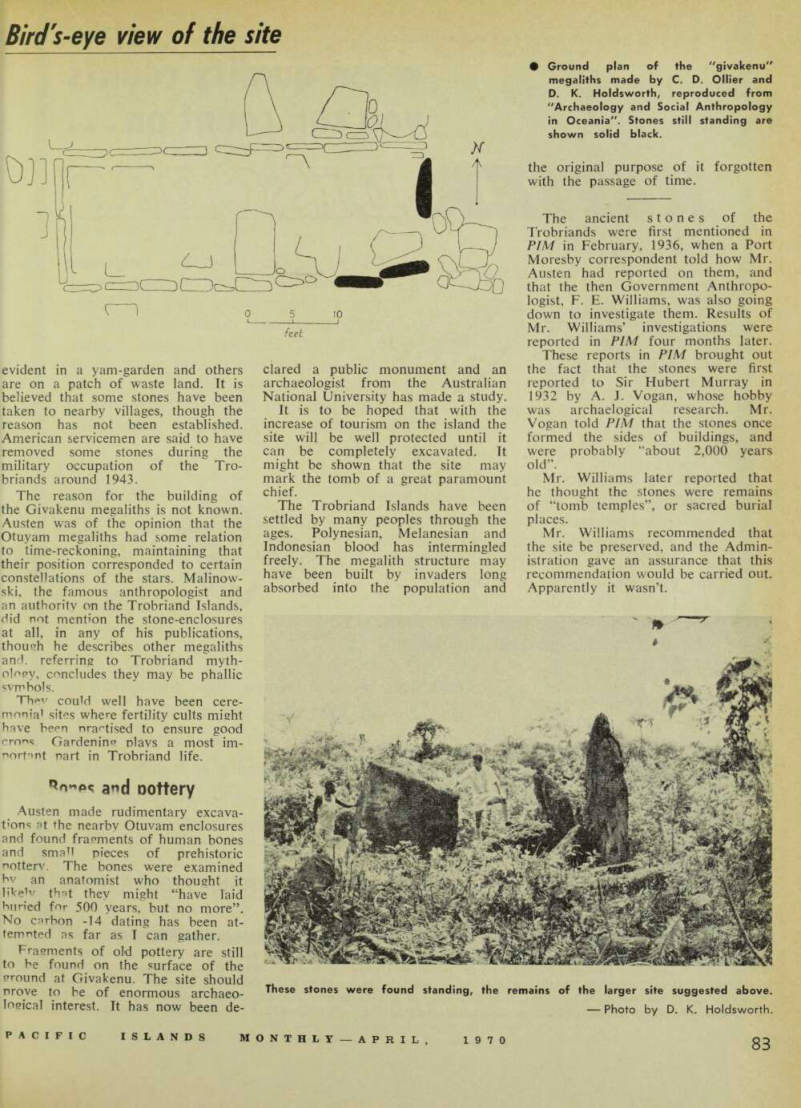
The foundations of the walls are well preserved and the rectangle measures 43 ft by 16 ft. The three standing stones are situated in the south-east corner and several other large slabs have fallen flat on the ground, both inside and outside the perimeter. A large pile of fallen stones are near the standing stones.
The structure is known as Giva kenu, a term which refers to the stones as the land is known as
Davawosi. A little more than 300 yds away are more stones at Otuyam.
These latter were first mentioned by then Resident Magistrate, Mr. L.
Austen, in 1939, who described them in the Sydney University publication Oceania, simply as four stone-en closures—two on land called Otuyam and two more at Ilukwaiwaia. On questioning our guides, we discovered
that Ilukwaiwaia refers to the stones and Otuyam was the name of the land.
Few traces of these enclosures now remain. A few collapsed stones are
Bird's-eye view of the site
evident in a yam-garden and others are on a patch of waste land. It is believed that some stones have been taken to nearby villages, though the reason has not been established.
American servicemen are said to have removed some stones during the military occupation of the Tro briands around 1943.
The reason for the building of the Givakenu megaliths is not known.
Austen was of the opinion that the Otuyam megaliths had some relation to time-reckoning, maintaining that their position corresponded to certain constellations of the stars. Malinow ski, the famous anthropologist and an authority on the Trobriand Islands, did not mention the stone-enclosures at all, in any of his publications, though he describes other megaliths and. referring to Trobriand myth ology, concludes they may be phallic svmbols.
Thev could well have been cere monial sites where fertility cults might have been nractised to ensure good crons Gardening nlavs a most imnart in Trobriand life.
a*d oottery
Austen made rudimentary excava tions at the nearbv Otuvam enclosures and found fragments of human bones and small pieces of prehistoric notterv. The bones were examined bv an anatomist who thought it likeiv they might “have laid buried for 500 years, but no more”.
No carbon -14 dating has been at teirmted as far as I can gather.
Fragments of old pottery are still to be found on the surface of the pround at Givakenu. The site should nrove to be of enormous archaeo logical interest. It has now been de
dared a public monument and an archaeologist from the Australian National University has made a study.
It is to be hoped that with the increase of tourism on the island the site will be well protected until it can be completely excavated. It might be shown that the site may mark the tomb of a great paramount chief.
The Trobriand Islands have been settled by many peoples through the ages. Polynesian, Melanesian and Indonesian blood has intermingled freely. The megalith structure may have been built by invaders long absorbed into the population and
the original purpose of it forgotten with the passage of time.
The ancient stones of the Trobriands were first mentioned in PIM in February, 1936, when a Port Moresby correspondent told how Mr, Austen had reported on them, and that the then Government Anthropo logist, F. E. Williams, was also going down to investigate them. Results of Mr. Williams’ investigations were reported in PIM four months later.
These reports in PIM brought out the fact that the stones were first reported to Sir Hubert Murray in 1932 by A. J. Vogan, whose hobby was archaelogical research. Mr.
Vogan told PIM that the stones once formed the sides of buildings, and were probably “about 2,000 years old”.
Mr. Williams later reported that he thought the stones were remains of “tomb temples”, or sacred burial places.
Mr. Williams recommended that the site be preserved, and the Admin istration gave an assurance that this recommendation would be carried out.
Apparently it wasn’t.
• Ground plan of the "givakenu " megaliths made by C. D. Ollier and D. K. Holdsworth, reproduced from "Archaeology and Social Anthropology in Oceania". Stones still standing are shown solid black.
These stones were found standing, the remains of the larger site suggested above. -Photo by D. K. Holdsworth.