Ponape, 1970: Jets Now Fly Where
pp. 61-65 · Read in the full issue

The Whalers Used To Carouse
• Ponape, which some regard as the most beautiful island in the United States Trust Territory of Micronesia has, at last, got an air strip. But long before the jet age, the island had a lot going for it.
By MARY BROWNING, a former resident
Ponape’s new airstrip and jet service may not result in a tourist stampede, but it’s certain that many people formerly dismayed by the prospect of landing on Ponape Harbour in an ancient Alba tross amphibian plane will now avail themselves of an easier way to see this beautiful island.
In recent years, the island has played host to the usual array of scientists, Trust Territory officials and Peace Corps volunteers, in addition to an occasional tourist or visiting yacht. But this entire collection doesn’t begin to compare with the numbers of foreigners who used to call in for one reason or another.
Ponape is a high island in the grand tradition, and while there are some who say it is second only to Bora Bora, French Polynesia, in beauty, others insist that it is second to no other island and is, in fact, the most beautiful in all the Pacific.
Thick jungle
Jungle—the most extensive rain forest in Micronesia—covers nearly all of the highland interior. The ranges of rugged mountains include several peaks reaching nearly 2,600 feet. Water, in one form or another, seems to be everywhere: the mountain tops are often covered with clouds
and mists; springs, streams and water falls abound.
It was to this beautiful, rich and productive island that nineteenth century ships returned again and again. The traders found that the turtle shell was plentiful and of good quality. The whalers put in after long months at sea for yams, breadfruit, bananas, pineapples, squashes, sago, coconuts, arrowroot and sweet potatoes.
The rain forests provided an ample supply of fine hard woods making extensive ship repairs, or even the building of a schooner, relatively simple.
All of those products of the land are still growing on Ponape and the agricultural potential of the island is apparent. Even with recent successful experiments in growing rice, cacao and pepper added to its other pro duce, however, the potential has hardly begun to be exploited.
In the old days, of course, Ponape didn’t need to advertise its attrac
lions; the business came whether it was wanted or not.
The parade probably began with the San Geronimo, a ship of Mendana’s fleet, which passed by with Pedro Fernandez de Quiros at the tiller in 1595. No one from the San Geronimo went ashore, but other Spaniards from other ships must have, for local legends tell of men in “iron clothes”.
A dream place
The first resident foreigner seems to have arrived in the 1820 s: James F. O’Connell. He wrote a book* about his experience which makes fascinating reading, but is generally regarded as being somewhat un reliable.
Maritime traffic didn’t really get heavy, however, until after Lutice, in the ship Seniavine, had made a survey of the Carolines in 1828. By that * A Residence of Eleven Years in New Holland and the Caroline Islands. Boston: B. B. Mussey, 1841.
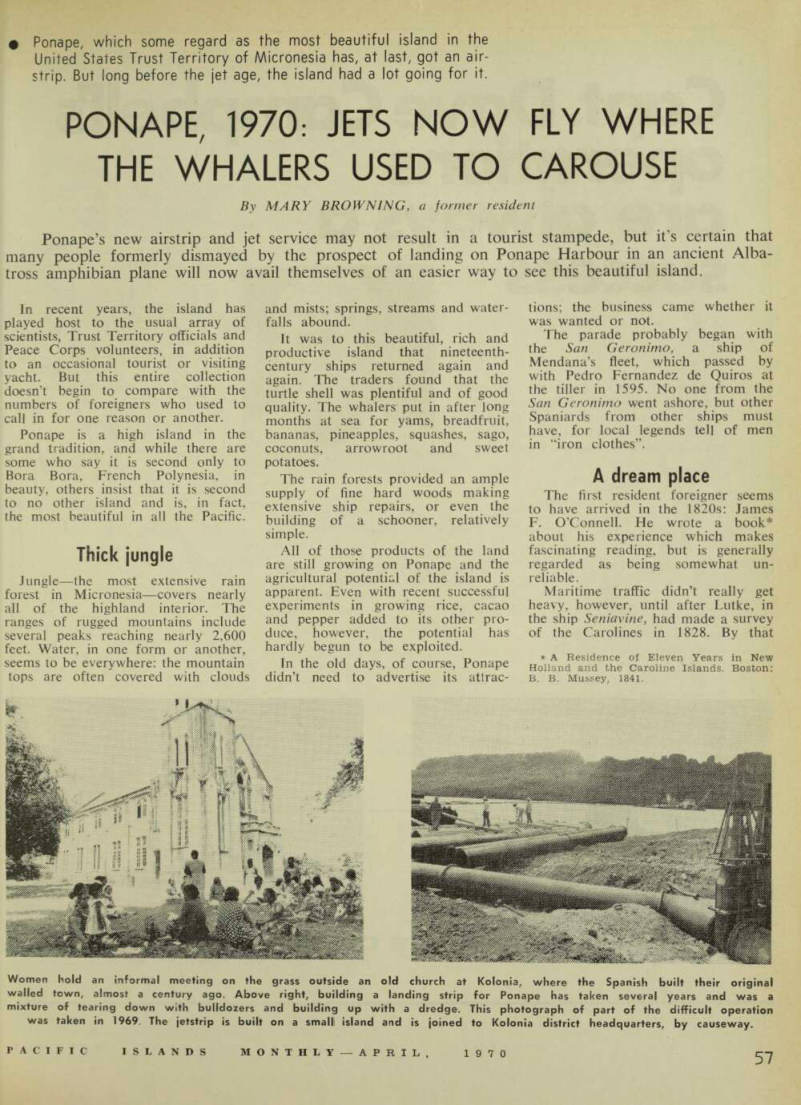
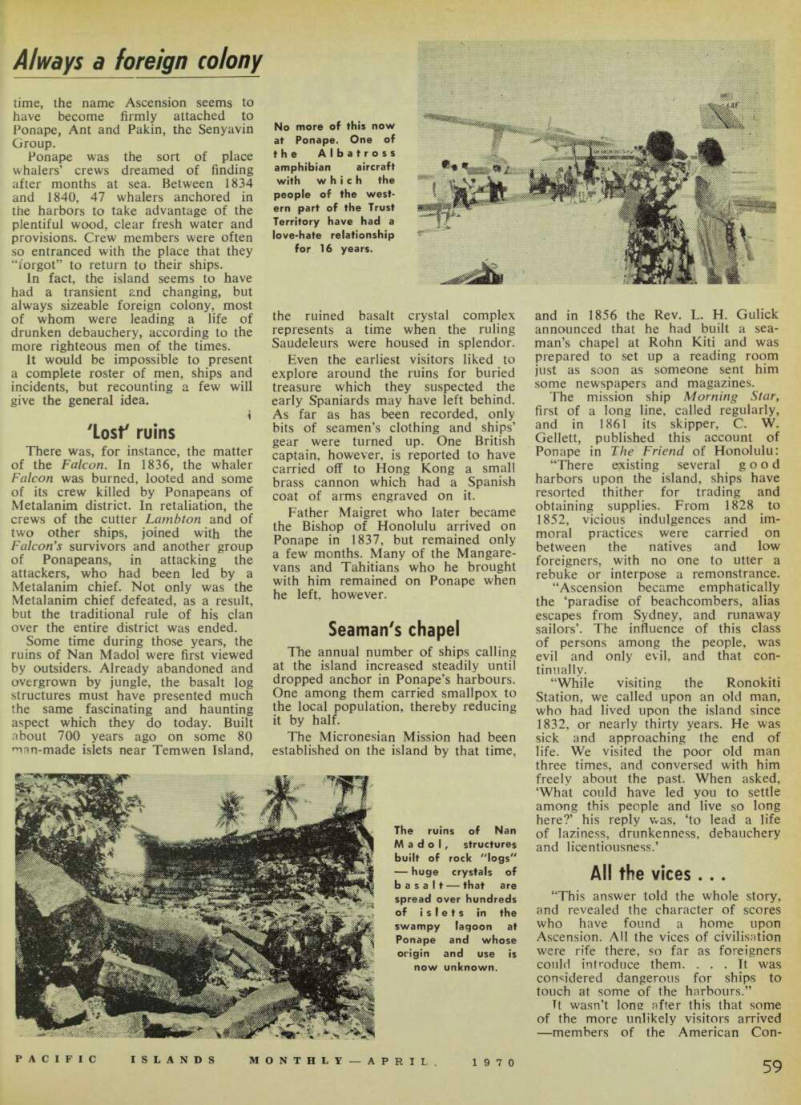
Women hold an informal meeting on the grass outside an old church at Kolonia, where the Spanish built their original walled town, almost a century ago. Above right, building a landing strip for Ponape has taken several years and was a mixture of tearing down with bulldozers and building up with a dredge. This photograph of part of the difficult operation was taken in 1969. The jetstrip is built on a small island and is joined to Kolonia district headquarters, by causeway.
Always a foreign colony
time, the name Ascension seems to have become firmly attached to Ponape, Ant and Pakin, the Senyavin Group.
Ponape was the sort of place whalers’ crews dreamed of finding after months at sea. Between 1834 and 1840, 47 whalers anchored in the harbors to take advantage of the plentiful wood, clear fresh water and provisions. Crew members were often so entranced with the place that they “forgot” to return to their ships.
In fact, the island seems to have had a transient and changing, but always sizeable foreign colony, most of whom were leading a life of drunken debauchery, according to the more righteous men of the times.
It would be impossible to present a complete roster of men, ships and incidents, but recounting a few will give the general idea. \
lost 7 ruins
There was, for instance, the matter of the Falcon. In 1836, the whaler Falcon was burned, looted and some of its crew killed by Ponapeans of Metalanim district. In retaliation, the crews of the cutter Lambton and of two other ships, joined with the Falcon's survivors and another group of Ponapeans, in attacking the attackers, who had been led by a Metalanim chief. Not only was the Metalanim chief defeated, as a result, but the traditional rule of his clan over the entire district was ended.
Some time during those years, the ruins of Nan Madol were first viewed by outsiders. Already abandoned and overgrown by jungle, the basalt log structures must have presented much the same fascinating and haunting aspect which they do today. Built about 700 years ago on some 80 man-made islets near Temwen Island,
the ruined basalt crystal complex represents a time when the ruling Saudeleurs were housed in splendor.
Even the earliest visitors liked to explore around the ruins for buried treasure which they suspected the early Spaniards may have left behind.
As far as has been recorded, only bits of seamen’s clothing and ships’ gear were turned up. One British captain, however, is reported to have carried off to Hong Kong a small brass cannon which had a Spanish coat of arms engraved on it.
Father Maigret who later became the Bishop of Honolulu arrived on Ponape in 1837, but remained only a few months. Many of the Mangare vans and Tahitians who he brought with him remained on Ponape when he left, however.
Seamarks chapel
The annual number of ships calling at the island increased steadily until dropped anchor in Ponape’s harbours.
One among them carried smallpox to the local population, thereby reducing it by half.
The Micronesian Mission had been established on the island by that time,
and in 1856 the Rev. L. H. Gulick announced that he had built a sea man’s chapel at Rohn Kiti and was prepared to set up a reading room just as soon as someone sent him some newspapers and magazines.
The mission ship Morning Star, first of a long line, called regularly, and in 1861 its skipper, C. W.
Gellett, published this account of Ponape in The Friend of Honolulu: “There existing several good harbors upon the island, ships have resorted thither for trading and obtaining supplies. From 1828 to 1852, vicious indulgences and im moral practices were carried on between the natives and low foreigners, with no one to utter a rebuke or interpose a remonstrance.
“Ascension became emphatically the ‘paradise of beachcombers, alias escapes from Sydney, and runaway sailors’. The influence of this class of persons among the people, was evil and only evil, and that con tinually.
“While visiting the Ronokiti Station, we called upon an old man, who had lived upon the island since 1832, or nearly thirty years. He was sick and approaching the end of life. We visited the poor old man three times, and conversed with him freely about the past. When asked, ‘What could have led you to settle among this people and live so long here?’ his reply was, ‘to lead a life of laziness, drunkenness, debauchery and licentiousness.’
All the vices. ..
“This answer told the whole story, and revealed the character of scores who have found a home upon Ascension. All the vices of civilisation were rife there, so far as foreigners could introduce them. ... It was considered dangerous for ships to touch at some of the harbours.”
Tt wasn’t long after this that some of the more unlikely visitors arrived —members of the American Con-
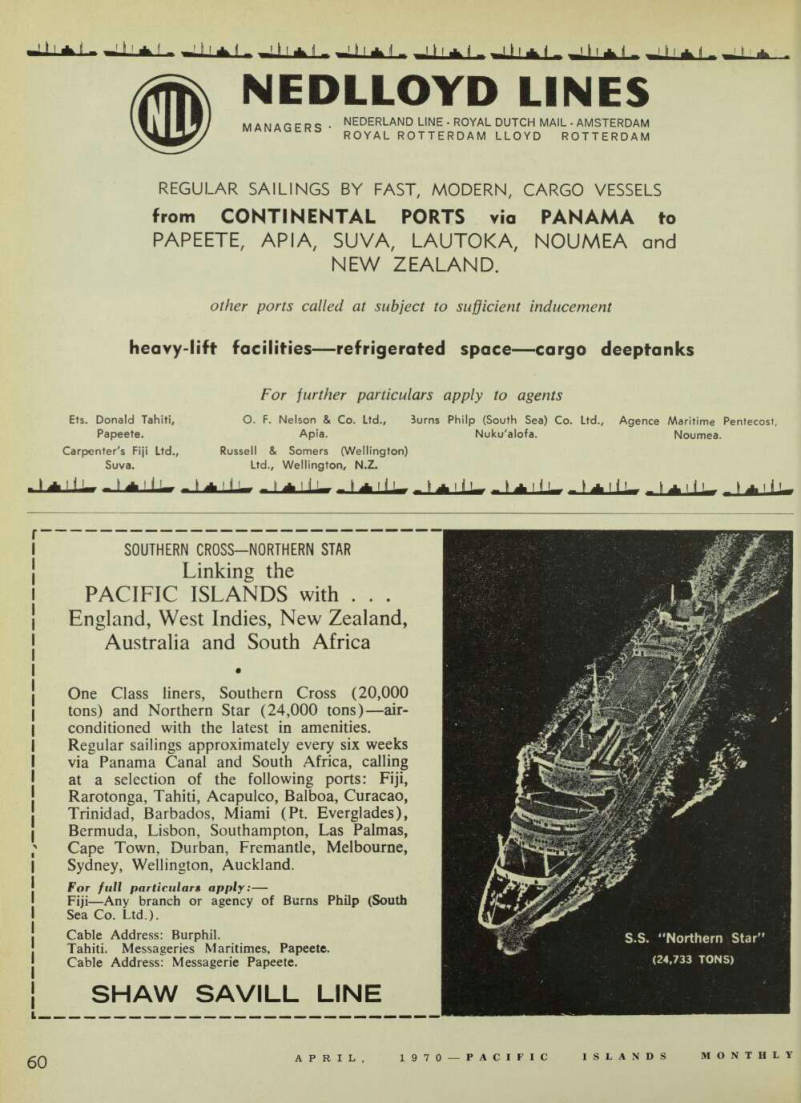
No more of this now at Ponape. One of the Albatross amphibian aircraft with which the people of the west ern part of the Trust Territory have had a love-hate relationship for 16 years.
The ruins of Nan Madol, structures built of rock "logs" -huge crystals of basalt-that are spread over hundreds of islets in the swampy lagoon at Ponape and whose origin and use is now unknown.
Profitable whaling business
federate Navy. The Confederate cruiser Shenandoah had begun its voyage in the Atlantic in October, 1864, under orders to destroy that all-too-profitable Yankee business of whaling.
The Shenandoah took several prizes in the Atlantic, sailed round the Cape, and put in for repairs at Melbourne before heading north.
When she reached Ponape in June, 1865, and found four whalers riding at anchor, she burned them all to the water-line and sailed away. (They were only four of the total thirty-two which the Shenandoah eventually dispatched in this way).
One of the Pacific’s less appealing characters, Capt. Benjamin (Bully) Pease was also hanging around Ponape in the late 1860’s. After Morning Star II had been wrecked in one of the harbours, he absconded with whatever could be salvaged from the ship and burned whatever couldn’t be. When the USS James town called in 1870, she had the duty of arranging transport for Pease’s abandoned crew.
40 Spanish killed
In 1887, when the Spanish decided to take belated but formal control of the island, a man-of-war was sent out with a reported eighty colonists They were definitely not welcome.
In fact, we’re told that 40 of them were killed. The Spaniards did eventually get a walled town built, and established themselves while dislodging, or at least discouraging, most of the British, American and German interests on the island.
The Germans moved back in, in 1898, and survived an unsuccessful revolt by the Sokehs people in 1910.
The Germans were shortly replaced thereafter by the Japanese.
Future airborne visitors will arrive where the Spanish built their walled town, later named Kolonia by the Germans, and where a foreign popu lation of 3,000 lived under Japanese rule.
They will land on Takatik Island, below the high basalt cliff called Sokehs Island Rock (the local “Diamond Head”), and cross the causeway to Kolonia to become the latest in a colourful, if not always distinguished, stream of visitors to Ponape.
And the Ponapeans? Somehow they have endured, in spite of us all.