(as if it could happen!)
pp. 30-137 · Read in the full issue
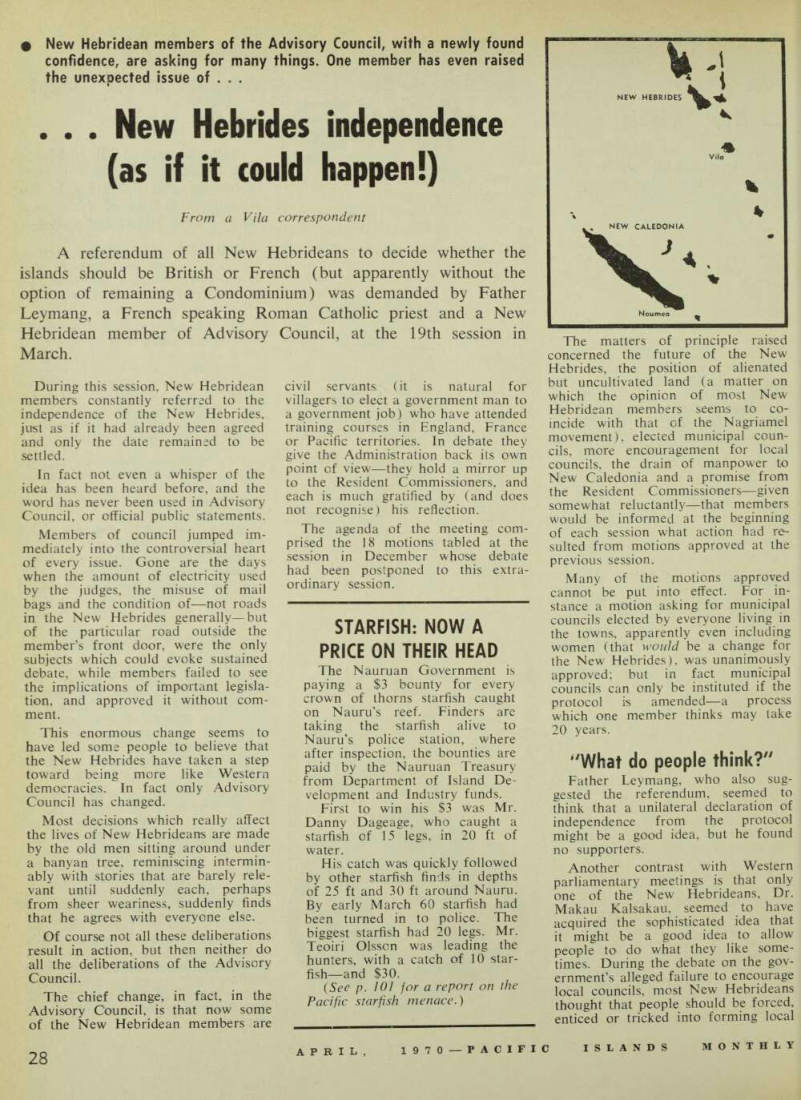
. . . New Hebrides independence (as if it could happen!)
• New Hebridean members of the Advisory Council, with a newly found confidence, are asking for many things. One member has even raised the unexpected issue of . . .
From a Vila correspondent A referendum of all New Hebrideans to decide whether the islands should be British or French (but apparently without the option of remaining a Condominium) was demanded by Father Leymang, a French speaking Roman Catholic priest and a New Hebridean member of Advisory Council, at the 19th session in March.
During this session. New Hebridean members constantly referred to the independence of the New Hebrides, just as if it had already been agreed and only the date remained to be settled.
In fact not even a whisper of the idea has been heard before, and the word has never been used in Advisory Council, or official public statements.
Members of council jumped im mediately into the controversial heart of every issue. Gone are the days when the amount of electricity used by the judges, the misuse of mail bags and the condition of—not roads in the New Hebrides generally—but of the particular road outside the member’s front door, were the only subjects which could evoke sustained debate, while members failed to see the implications of important legisla tion, and approved it without com ment.
This enormous change seems to have led some people to believe that the New Hebrides have taken a step toward being more like Western democracies. In fact only Advisory Council has changed.
Most decisions which really affect the lives of New Hebrideans are made by the old men sitting around under a banyan tree, reminiscing intermin ably with stories that are barely rele vant until suddenly each, perhaps from sheer weariness, suddenly finds that he agrees with everyone else.
Of course not all these deliberations result in action, but then neither do all the deliberations of the Advisory Council.
The chief change, in fact, in the Advisory Council, is that now some of the New Hebridean members are
civil servants (it is natural for villagers to elect a government man to a government job) who have attended training courses in England, France or Pacific territories. In debate they give the Administration back its own point of view—they hold a mirror up to the Resident Commissioners, and each is much gratified by (and does not recognise) his reflection.
The agenda of the meeting com prised the 18 motions tabled at the session in December whose debate had been postponed to this extra
ordinary session.
The matters of principle raised concerned the future of the New Hebrides, the position of alienated but uncultivated land (a matter on which the opinion of most New Hebridean members seems to co incide with that of the Nagriamel movement), elected municipal coun cils, more encouragement for local councils, the drain of manpower to New Caledonia and a promise from the Resident Commissioners —given somewhat reluctantly—that members would be informed at the beginning of each session what action had re sulted from motions approved at the previous session.
Many of the motions approved cannot be put into effect. For in stance a motion asking for municipal councils elected by everyone living in the towns, apparently even including women (that would be a change for the New Hebrides), was unanimously approved; but in fact municipal councils can only be instituted if the protocol is amended—a process which one member thinks may take 20 years.
"What do people think?"
Father Leymang, who also sug gested the referendum, seemed to think that a unilateral declaration of independence from the protocol might be a good idea, but he found no supporters.
Another contrast with Western parliamentary meetings is that only one of the New Hebrideans, Dr.
Makau Kalsakau, seemed to have acquired the sophisticated idea that it might be a good idea to allow people to do what they like some times. During the debate on the gov ernment’s alleged failure to encourage local councils, most New Hebrideans thought that people should be forced, enticed or tricked into forming local
councils in preference to government policy which is to establish them only where people really want them.
Members contrasted the failure of local councils—and New Hebrideans made it appear that local councils were making a last ditch stand in a hostile environment—with the success of co-operatives. However it is easier in Melanesia to establish co operatives; they fit into the tradition by which all the men of the village work together.
Local councils oppose tradition, they require a conception of govern ment concerned with something other than crime and punishment; they compete for authority with chiefs, and are on a regional basis, and so group villagers which are traditional enemies.
Bob Paul, founder of New Hebrides Airways, who is one of the more outspoken members of Advisory Council, deplored the fact that, while Condominium laws reinforce the decisions of local councils, there was no legislation to reinforce the rulings of traditional authority.
"What of the future?"
Like so many people who have lived in the islands for many years, he values the traditional way of life as the Melanesians themselves do.
It was during the debate on local councils that a member asked quite simply, “What is the future of the New Hebrides?” Neither Resident Commissioner refused the prophet’s robe and neither replied with the obvious truth, that “the future is what you make of it”.
The French Resident Commissioner replied in ringing phrases that France’s mission to improve the lot of New Hebrideans was not com pleted. Short of the earthly paradise, this is a truism.
The British Resident Commis sioner’s turn to take up the prophet’s robe came later during a discussion of localisation in the Condominium service. He merely pointed out that there were many steps on the way to independence, first Legislative Coun cil, then a ministerial system, self government and later complete inde pendence.
When the problem of the drain of manpower to New Caledonia for high wages was discussed, New Hebrideans again expressed an authoritarian point of view. The right of man to free movement seemed as easy to brush aside as the protocol, and most New
(Continued on p. 131)
Hebridean members felt that people should simply not be allowed to go to New Caledonia to work.
The only reason produced to justify this restriction seemed to be that statistics of the export of copra would show a reduction—as if the production of copra were an end in itself, without regard to the freedom or welfare of the people, for, and by whom, it is produced. Fortunately this motion was not approved.
It may well be that the time has come when New Hebrideans should stop trying to increase copra produc tion. It has become a New Hebridean habit to plant coconut palms each time land is cleared for a garden, so each year hundreds of acres are lost for the cultivation of food.
There is already so much land under coconut palms that plantations are not cleared or thinned, and the copra is not cut. And every year land hunger increases.
Many of the motions concerned land hunger. Land is a mystique for the peasants—the ownership of land is more important than life or death.
Flying over the New Hebrides one can see island after island which the virgin jungle covers from coast to coast, yet New Hebrideans have only one common anxiety, their land hunger. The island of Efate supports something like 10,000 people, but the island of Bali, in Indonesia, which is roughly the same size, supports more than two million, probably without any great dissimilarity in the stan dard of living.
Family planning
The quaint phrase, “our population is increasing at jet speed” was used in a motion about land, not as one might expect in a motion about family planning. Again Dr. Kalsakau was in advance of his colleagues, in apparently being the only member to see that population control and land hunger are part of the same problem, and to suggest that infor mation about family planning should be made available to New Hebri deans.
It’s because land provides food and shelter that the mystique about land has arisen, not because it can be used for cash crops as an alternative to paid employment. There is ob viously room for everyone in the New Hebrides, and probably will always be if only the government would encourage family planning, and if only the Agricultural Depart
ment would devote the major part of its time to improving methods of subsistence agriculture.
These two elements combined might be the basis of a far-sighted policy which could put an end to the futile and constant bicker ing about land. In these islands, so underpopulated as to be al most empty, believed by some authorities to have supported a popu lation of more than one million in pre-European times, where the soil is extremely fertile, rainfall abundant, ridiculous quarrels about land absorb an undue proportion of government’s time.
The question of land speculation was again touched upon, with the usual lack of moderation. One mem ber even went so far as to describe as honest those who buy land for plantations, with the implication that those who buy land for resale are dishonest.
Big investment
Probably as a result of these re marks it appears likely that the Resident Commissioners will grant retrospectvie parliamentary privilege to members. Land investment for subdivision was also described as un productive, although the company responsible for the Hog Harbour project has invested $300,000 in the New Hebrides and is associated with investments in a hotel, houses and a sawmill.
A debate was held on whether or not New Hebrideans should be ap pointed as magistrates to preside over local courts with jurisdiction over minor civil and criminal cases.
Michael Ala, who has much ex perience on Advisory Council, and has been president of the Aoba Local Council and the New Hebrides representative to the South Pacific Conference, claimed that if such magistrates were not appointed, the Condominium might as well abandon its attempt at governing.
It would appear that the French Residency is opposed to the appoint ment of native magistrates, for reasons which are no doubt valid, but which were not disclosed to Advisory Council.
Finally, during a debate on a motion requesting greater co operation between the three govern ments of the New Hebrides, Father Leymang demanded a referendum; all other members preferred to urge greater co-operation and not “a national race with British and French vying for influence”, as Bob Paul described it.