And why was the Assembly
p. 28 · Read in the full issue
given its head?
From JOHN RYAN, in Port Moresby Has the Australian administration in New Guinea abdicated its power in parliament? Is it consciously testing elected members to see how they will perform without official Government leadership in the House of Assembly? Or is it simply that the Government Leader, L. W. Johnson, who is leaving New Guinea soon, arbitrarily decided in March to let the 84 elected members have their heads for once?
People here are asking these questions after watching the ap parently aimless performance by the Government at the March meeting of the Assembly.
The Government “party” of 10, although grossly outnumbered since 1964, has remained easily in control —because of political know-how and plain “kiap” influence.
There is a potential opposition: The Pangu Pati (nine members) and the unaligned Independent Group (up to 57 members). But the two groups have merely jockeyed con tinuously, and the Independent Group has not formed a recognisable party.
If it did, the Government of P-NG would —in theory anyway shift away from the Government benches.
But that certainly hasn’t happened.
And now, in March, L. W.
Johnson's Government Party has become oddly out of character.
Repeatedly its members left the private benches without guidance, and even established a precedent by actually leaving the chamber. The 84 elected members had to make their own decision on a bill, with the Ministerial and Assistant Ministerial members being left to their own devices on the vote.
It was an interesting exercise in giving the House its head, but it will have to happen repeatedly before the 84 elected members can run parliament as Westminster would like it. I think the solution is thus clear enough: the House must be organised on recognisable political party lines.
Some here think Prime Minister John Gorton has decided to “push”
New Guinea to the limit and to un load constitutional development on to New Guinea shoulders as soon as they are broad enough to carry it.
Canberra has just announced that Ministerial Members are to be given new departmental powers (equal to those of directors of departments) and that the Executive Council now has wide new powers for budget making.
And there is indication that the new ministerial powers are to be real powers—powers that will leave teeth marks around Konedobu. , There were no great moments at the March meeting, but there were some hot sentiments expressed by many members in favour of the reintroduction of hanging and much talking about Bougainville s copper mining, and its secession movement .
Although the “hanging motion”, introduced by Momei Pangial, has been put off until the June sitting, it will take a lot of talking to stop it going through. Southern Highlands member Ron Neville actually advocated public hangings on airstrips as the best way to discourage wilful murder. Present policy in P-NG is to commute death sentences to imprisonment.
The Bougainville “referendum” is unofficial. It has been organised by
Bougainville European, Barry Middlen f isSi among about half of Bougainville’s 60,000 people. The refe rendum has been asking whether Bougainville should secede, go it alone, or join up with the British Solomons. i n the House, the referendum was use d as a basis for demanding reassurance from Bougainville that it would not consider secession if it expected the Administration to keep spending money on the copper project.
Earlier the House had approved a Budget to the tune of some $2O mil lion to meet some of the commit ments on the Bougainville project.
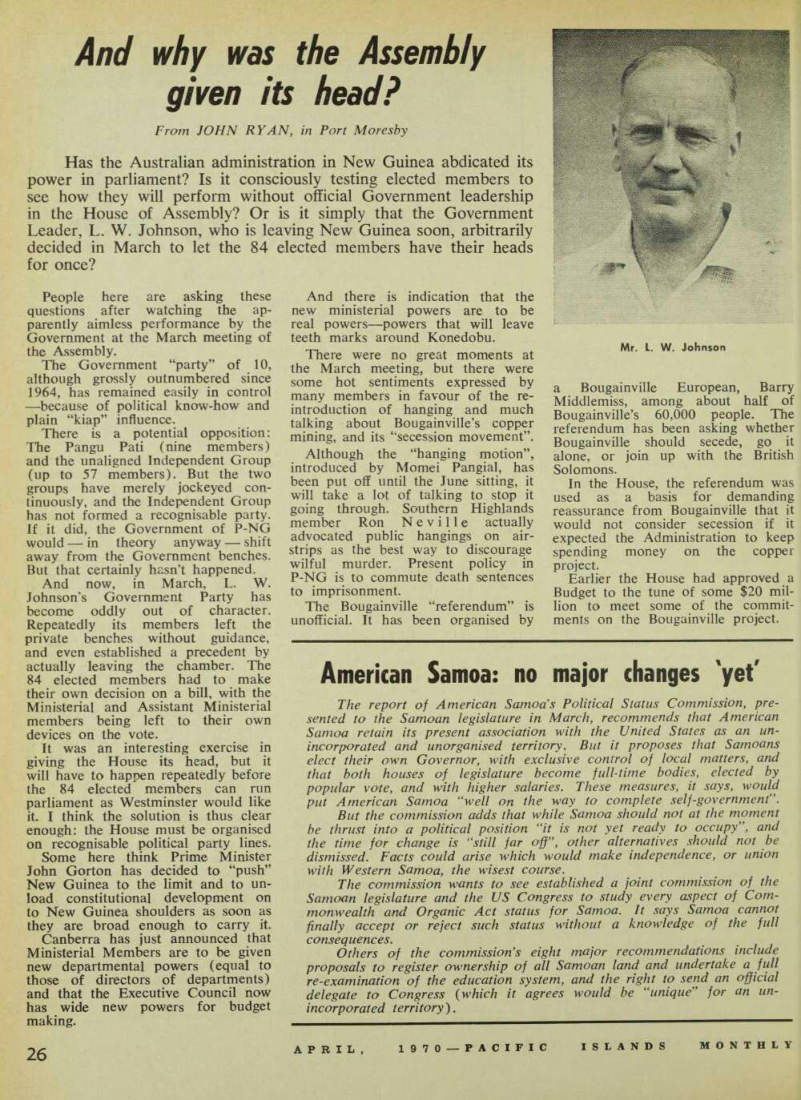
Mr. L. W. Johnson