The Practical Planter
pp. 145-149 · Read in the full issue
What Mechanisation Can Do For
The Cane Growing Industry
• Cane growing is the life-blood of Fiji’s economy—but in other parts of the Pacific, particularly in Papua-New Guinea, it could be developed eventually. Fiji’s cane cutting is still by hand but if territories start from scratch this work could well be mechanised. Australia recently took a look at the very latest in chopper-harvesters in Queensland and this could be the machine for the Pacific.
A demonstration of the 1970 version of the MF2OI self-propelled chopper-harvester at North Eton, Queensland, gave farmers a chance to have a good look at one of the new farms in this area for which an irrigation scheme is proposed in the near future.
Land on the Victoria Plains, an alluvial area of grey soil with a heavy texture which is self-mulching, in some places has such a high re sistance to the penetration of water that it is referred to as “gluepot”.
Farmers in the area who have put down bores get a good response from sugar crops by supplementing natural ranfall with irrigation water.
The owner of the demonstration farm, Ron Ford, was one of the men who settled this area during the major expansion of the Queensland cane industry in 1964. They were plagued by a succession of unusually dry years and some of the lowest cane prices for 25 years. Ron said ;hat he personally felt he had passed ;he turning point this year, and he expected he could make a success of his farm under present economic conditions.
Ron pioneered his 152 acres of almost flat black, self-cracking soil from virgin ground. He has 63 acres assignment and all his crop until this fear had been cut by hand. “This fear hand cutters are going to be very hard to get, and I think I’ll have ;o get a contractor in,” Ron said, rhe region once provided annual em ployment for about 1,400 visiting cane cutters.
Quite a few of the farmers who came to see the MF2OI in action commented on the tremendous strides ;aken by Massey-Ferguson and other manufacturers in meeting the in • Reproduced courtesy of "Power Farming" magazine, Sydney.
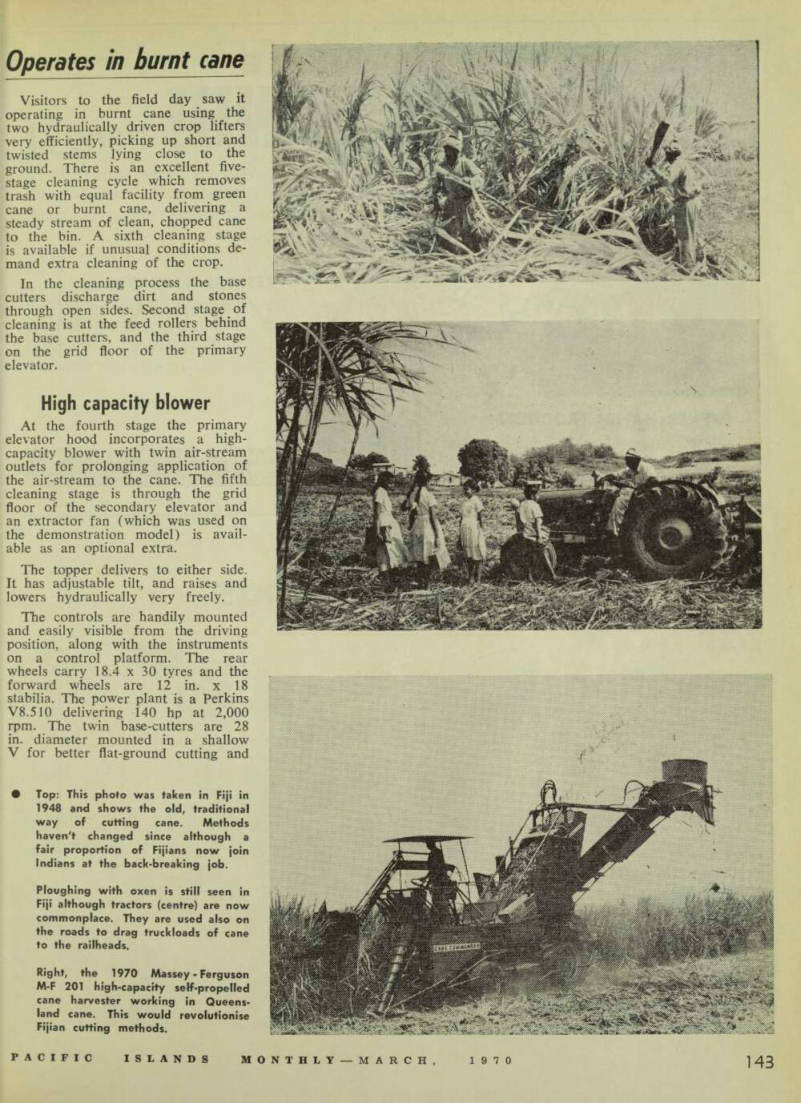
dustry’s need for a rugged, high capacity machine suitable for the professional cane-harvesting contrac tor. The machine that he needs is one that he can work day after day for long hours in all kinds of condi tions, and know that it will keep going. The MF2OI “Cane Com mander” self-propelled chopper har vester is made principally for this market.
Ron Ford was able to provide a small area of thinly-grown Q. 63 green cane and some NCO going about 35 tons to the acre which was
lodged and twisted. These were per haps not ideal conditions to demon strate the capacity of the machine but they were probably the best available after a season of drought in which the mills would take any thing millable in trying to reach their quotas.
The MF-201 is surprisingly fast and manoeuvrable for its size. Driver Bob Warring, of Mackay, commented very favourably on this feature. He said the machine could cut left handed or right-handed and break into a row at any point. (Over)
Operates in burnt cane
Visitors to the field day saw it operating in burnt cane using the two hydraulically driven crop lifters very efficiently, picking up short and twisted stems lying close to the ground. There is an excellent five stage cleaning cycle which removes trash with equal facility from green cane or burnt cane, delivering a steady stream of clean, chopped cane to the bin. A sixth cleaning stage is available if unusual conditions de mand extra cleaning of the crop.
In the cleaning process the base cutters discharge dirt and stones through open sides. Second stage of cleaning is at the feed rollers behind the base cutters, and the third stage on the grid floor of the primary elevator.
High capacity blower
At the fourth stage the primary elevator hood incorporates a high capacity blower with twin air-stream outlets for prolonging application of the air-stream to the cane. The fifth cleaning stage is through the grid floor of the secondary elevator and an extractor fan (which was used on the demonstration model) is avail able as an optional extra.
The topper delivers to either side.
It has adjustable tilt, and raises and lowers hydraulically very freely.
The controls are handily mounted and easily visible from the driving position, along with the instruments on a control platform. The rear wheels carry 18.4 x 30 tyres and the forward wheels are 12 in. x 18 stabilia. The power plant is a Perkins V 8.510 delivering 140 hp at 2,000 rpm. The twin base-cutters are 28 in. diameter mounted in a shallow V for better flat-ground cutting and
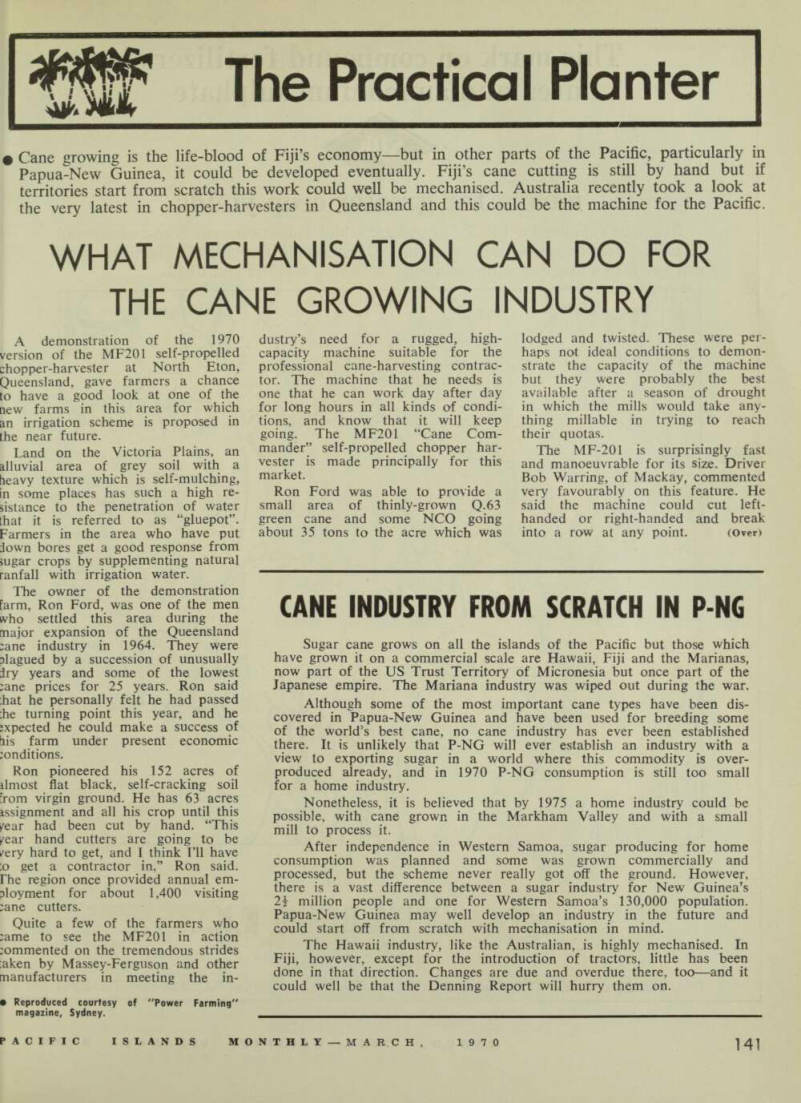
Top: This photo was taken in Fiji in 1948 and shows the old, traditional way of cutting cane. Methods haven't changed since although a fair proportion of Fijians now join Indians at the back-breaking job.
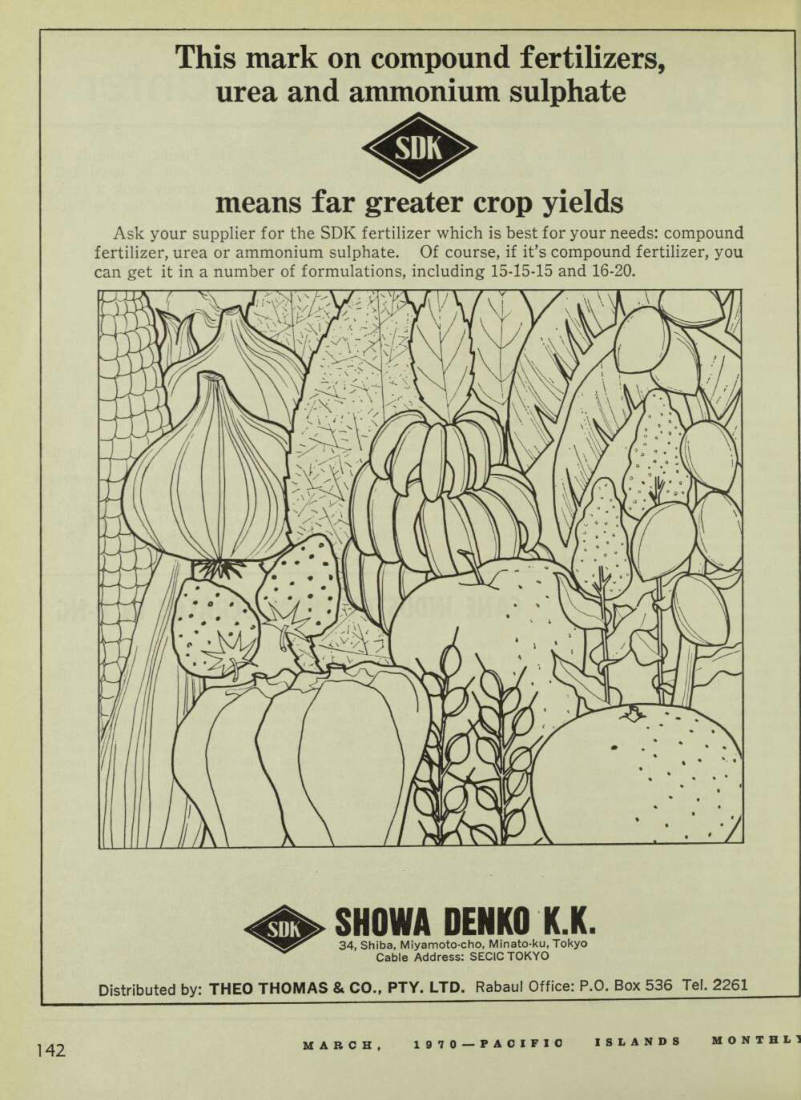
Ploughing with oxen is still seen in Fiji although tractors (centre) are now commonplace. They are used also on the roads to drag truckloads of cane to the railheads.
Right, the 1970 Massey - Ferguson M-F 201 high-capacity self-propelled cane harvester working in Queens land cane. This would revolutionise Fijian cutting methods.
Comfortable seat and wide view
can be adjusted from 2 in. below ground level to 14 in. above. . . , , . ..
Transmission is hydrostatic with speed infinitely variable pom 0-12 mph. The transmission unit is sealed and needs no greasing, while overload valves protect the system at all times. The unit is a Dowmatic 80 hp driving into the MFI7B tractor rear axle There are independent wheel brakes for turning and a hand-brake for parking. For road and field travel the transmission brake operates through the Dowmatic transmission control. There is a foot-operated differential lock. The MF2OI can be turned in 15 ft radius without braking and will turn within 12 ft 6 in. with brakes. ,
Safety devices
Drivers who have to work this machine for long hours will apprecia ' e th ,e seatm B and ‘he wide range of visibility over the crop. A feature that most contractors appreciate on this kind of machine is the MF2OI s safety slip clutch, incorporated ln ‘he drive mechanism of the cutting discs and drive, protecting them when the blade hits an obstruction.
It appears that big-capacity machines like the MF2OI are going to harvest most of Australia’s sugar
crop. Built-in cleaning appears to answer earlier objections to the chopper harvester principle. The big choppers have a tremendous capacity tQ ta^e a cro p q U i c kly without penalties for unclean cane, r ... , , .
The farmer/miller wrangle about chopper cane still goes on, but the mills appreciate the fast supply of cane that can keep them workm S at capacity. The grower appreciates the quick removal of his crop while harvesting conditions are favourable, so that he can get on with his job of planting and growing his next crop, In the MF2OI a general effort has b een made to achieve sustained re liability, protecting against dust and wear by sealing off or by heavy-duty construction. Water and oil radiators are strongly screened against accu mulation of trash. The chopper gear mechanism runs in an oil bath, and is completely sealed against entry of dirt or grit. xhe S pi ra i croplifters on the MF2OI are hydraulically driven and independently controlled. The gather • walls are also hydraulically con tro]led t 0 rai hold press ure down wards and float Tlley have 54 in . en try with adjustable pick-up points, erator of this mac hine who rea|]y cares about the quality of the cane going into the bin, can control the crop lifters according to the lay of the cane with a minimum of dam age to the billets.
Tops fly and a steady stream of chopped cane is delivered from the spout as the Cane Commander gets into a heavier patch of the crop.