Business and Development
pp. 124-130 · Read in the full issue
Norfolk's 1,100 companies— and what they're doing
By Ken Mcgregor
Admirals Holdings Ltd., Anchor Ltd., Bates Ltd., Boston Trust Company Ltd., Cascade Bay Ltd., Dundee Holdings Ltd., Hobart Ltd., Hoylake Holdings Ltd., . . . Before I could note down any more of the intriguing company titles carefully recorded on the wait ing-room walls, an attractive secretary ushered me into the executive suite of a lavishly-refurbished colonial home at Kingston.
It was tax haven, Norfolk Island, 1970, base of 1,100 incorporated companies with worldwide affiliations and Mr. M. H. Mclntyre, solicitor, of Nine Quality Row, Kingston, was the undisputed doyen of company representatives for the island.
A “retired” former senior partner in a Sydney firm of solicitors, Mr.
Mclntyre, with numerous filing cabinets, three receptionists and law and company tax book libraries, represents more companies than any other of the Sydney and Melbourne solicitors in the Norfolk Is. company incorporation business.
He maintains that he represents “several hundred companies”, 70 per cent, of which involve investors from sources outside Australia and Norfolk. They conduct investment in Australia, worth “many millions annually”, from their Norfolk in corporations.
"Accelerating rate"
Mr. Mclntyre is a chain smoker, wears an open-necked sports shirt and a card player’s eyeshade. He says that money from Europe and the US is flowing through Norfolk at an accelerating rate; but that the situation is “well known” to the Australian Commonwealth Govern ment.
Mr. Mclntyre, who mentions names of senior Australian parlia mentarians frequently in discussions, adds that transactions are mostly with countries without double tax agreements with Australia. (The UK, NZ, USA, Canada and Japan do have such agreements).
During a Norfolk trip in February I was unable to find out how much
money is passing through the island per year via its absentee company directors. But there’s no doubt it runs into millions.
Norfolk’s Administrator, Air- Commodore R. N. Dalkin, admitted this but couldn’t produce a figure.
By talking to Administration staff, islanders and solicitors involved with the transactions, I found that new company registrations have dropped to less than half those of 1968 when registrations were over 400 per year.
New registrations
In the 1969-70 financial year (i.e., since July, 1969 to the present), new registrations number about 100—less than half previous rates. Recently they have picked up (in what observers regard as the busy season).
Between January 1 and 6 this year, 45 companies were in corporated Recently, Australian tax people have been closely investigating the mainland affiliations of each new company incorporated. In the past 24 months, four trips, the last two in July and October last year, have been made by government tax men to Norfolk.
Australia’s view is that there is no tax-free status, as such, on Norfolk—the Australian tax laws apply to the island but they exempt income derived by a resident of the island from a source within the ■island. Of course, a company in corporated there, has an income there.
There is a situation here in which companies can attempt _to exploit Norfolk by creating artificial situa tions.
I understand that results of several test cases brought before the Aus tralian Taxation Boards of Review, concerning Norfolk company arrange ments, should be known later this year.
Should the cases go against the companies, it’s likely that investors could move their activities to Nauru or the New Hebrides. It could be that the current company activity in Nauru and the New Hebrides stems from a “sense of doom” on Norfolk.
One view, contrary to that of Mr.
Mclntyre, is that all but five per cent, of the companies incorporated on Norfolk had Australian associations only. Business involved investing, general financing, dividend flows, real estate deals, profits from share trad ing, location of trusts, etc.
Overseas capital
Although there were indications that overseas capital other than Aus tralian could increase sharply, the trend may not have yet swung around from the original Australian associa tions.
An unknown number of the Norfolk incorporated companies are, I understand, not active but they could use the island at a later date.
It could be that they are awaiting the outcome of the tax investigations.
Many companies have found that the main advantage of Norfolk in
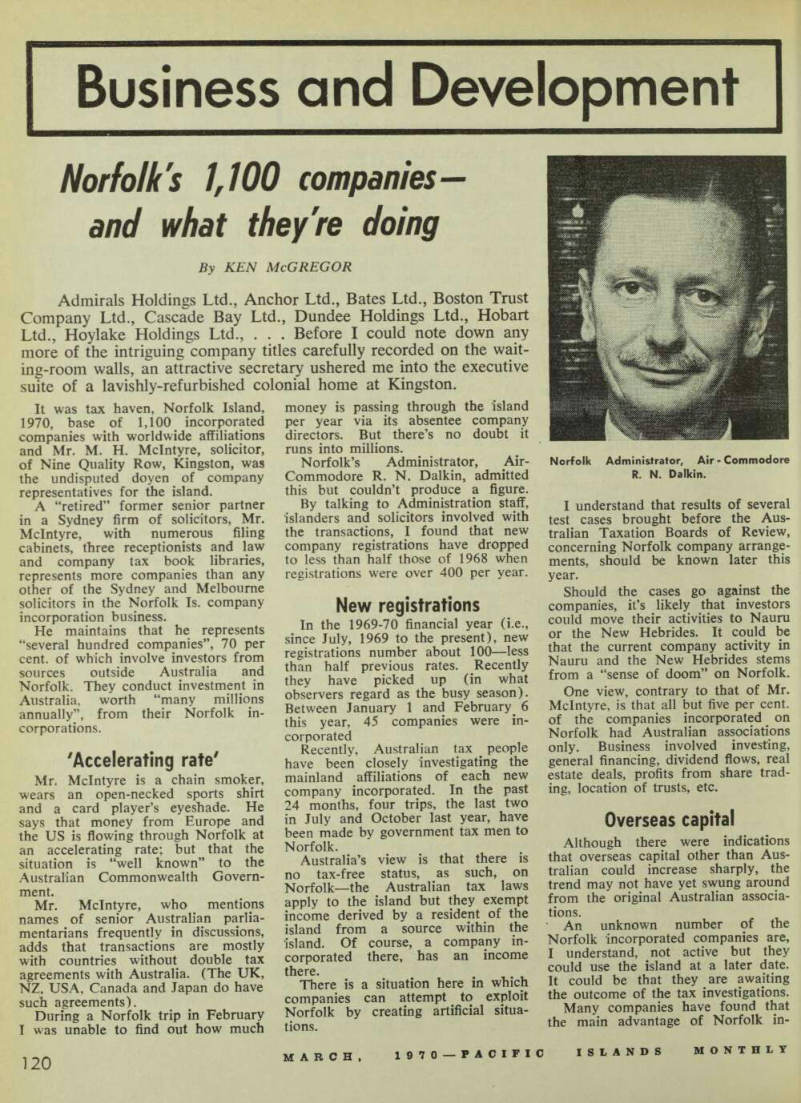
Norfolk Administrator, Air-Commodore R. N. Dalkin.
corporation, is that they don't have to reveal as many details of their activities to the local registrar as they would have to furnish on the Australian mainland.
Work is, however, well advanced on adoption of the uniform com panies act operating on the mainland.
Latest development (with Norfolk’s overseas telephone link-up) could be a Sydney-promoted island stock ex change or the establishment of a branch of a stockbroker on Norfolk.
Who knows?
Japanese take over
P-NG car market
In her backyard, Australia is being whipped by Japanese vehicle makers.
New Guinea, which annually im ports vehicles and parts worth about $l5 million, and growing by 30 per cent, a year, now has Japan as its biggest supply source.
Japanese makers overhauled Aus tralia, formerly NG’s biggest supplier, only in the past two years. Japan, spearheaded by spiralling Toyota sales, is fast reducing Australia’s per centage share of the market.
France and Britain are losing out too, to a market which, via govern ment taxes, favours no country.
The same 35 per cent, import duty affects all imported vehicles, but be cause of extremely high freight rates between Australia and NG, Aus tralian assembled or manufactured vehicles are expensive and uncom petitive to similar imports.
With one exception, little seems to be underway to prevent a virtual Japanese takeover of the NG market.
The exception is, of course, PNG Motors, the Moresby-based British vehicle distributor, which plans to design and assemble in NG a “bastard” utility car, similar to the Mini-Moke.
First off, PNG hopes to assemble Mini-Mokes in Moresby, in Septem ber this year. NG’s own car is to roll off its NG production lines in “about two years time”, according to its managing director, Mr. Allan Morris.
However, initial assembly and pro duction dates have already been put back twice and observers feel there could be more delays.
NG’s own car should be unique, when and if it comes to fruition. A plywood body, a motor similar to a current British 1100 cc or 1300 cc engine, no fancy attachments and ruggedness could be all incorporated.
Choosing its name should also be fun.
If vehicle distributors and makers, as well as PNG Motors, take a longer look at the market, they’ll find: • Toyota is leader in both car and commercial vehicle sections. • More commercial vehicles than cars are sold. • Station sedans equal a steady 20 per cent, of all car and station sedan sales combined. • Some distributors are concen trating on commercial, rather than sedan sales. • Ford has been the biggest re cent loser, with Holden, because of expensive NG prices, losing ground to a smaller extent.
Big finance for West
Irian copper mine
American insurance companies and banks will lend Freeport Indonesia, Incorporated, SUSSB million to develop its Ertsberg copper deposit in West Irian.
This follows Japan and West Germany’s commitments to lend $42 million for the $l2O million develop ment (PIM, Feb., p. 120).
Freeport Sulphur of New York
says of the new loan, $4O million is from major insurance groups and $lB million from major banks.
Subject to fulfilment of “various con ditions”, including Japanese Govern ment approval of the Japanese financing, production and shipments would commence early in 1973.
No tenders have yet been let for the mine nor has any mention been made of Freeport’s iron ore deposits in the same area.
Silkworm experiments
are progressing
Progress is reported by one of the two territories experimenting with a
silkworm village industry (P/M, Apr., 1969, p. 139).
At Aiyura, in New Guinea’s Eastern Highlands, castor oil bushes have been delivered to villagers, who have presented complete cocoons wLhin two months.
Estimates are villagers in low economy areas could earn $2OO-$3OO a year from the industry and 30 acres of Administration land near Mt.
Hagen have been set aside for silk worm breeding.
Silkworm experiments, with un official advice from Thailand, are understood to be proceeding in the Gilbert and Ellice Islands, under the direction of agriculture officer, Mr.
Ray Harberd.
Helicopter assists in
P-NG mining hunt
A recently acquired helicopter is assisting explorations in New Guinea by American-controlled Mt. Isa Mines Ltd.
Through a wholly-owned sub sidi a r y, Carpentaria Exploration Company Pty. Ltd., operations have centred in the Western Highlands and Sepik River districts, where up to early this year, Mt. Isa held eight prospecting authorities over an area of about 7,910 square miles.
Currently, drilling is near the Frieda River, where a base camp has been set up. Stores and equipment are moved into this area by motorised canoes and river trucks up the Sepik and Frieda Rivers from Ambunti.
Over 140 people from local villages are employed.
An assaying laboratory has been set up at Madang and first samples from the field were expected in Feb ruary. Headquarters remain in Lae, where a senior geologist in charge of operations is based.
Plans for a bigger
slice of Fiji travel
Both Burns Philp and W. R.
Carpenter are planning for a bigger slice of the Fiji travel-agency cake in future. Both, at present, are well behind the colony’s main tour opera tor, Hunts, in terms of activity and profit.
BP’s is standardising all its travel operations under one name. Hibiscus Tours. Carpenters already operates through Macquarie Tours in which it has a major share holding.
Burns Philp’s Fiji plans will cost an estimated $300,000 and will include car-tour expansion through its Avis agency. (WRC is agents for Hertz and Hunts for Mutual).
BP’s current attitude is to invest bi g for long-term results, but Macquarie is investing more modestly, largely through strengthen ing its travel bookings and tour operations, in both the Nadi and Suva areas.
Hunts, Macquarie and Hibiscus are all expected to expend much of their energies on the American market, of which Hunts has the lion’s share at present. To this end, BP has already set up an office in Los Angeles, at an annual cost of $lOO,OOO. Mr. Ernie Forde is in charge.
To cope with growth of business, BP travel agency employees have in creased from 110 to 160 since 1968.
Staff growth is expected to accelerate if large scale advertising in Australia and the US pays off.
Macquarie, under its Fiji manager, Mrs. Mae Cox, has 19 employees in its Nadi and Suva offices. Its Hertz agency now has 43 station wagons and cars available.
Hunts, with financial ties now with BOAC, will also expand tour operations. It is entering bus opera tions and may take up a minor shareholding in a Fiji hotel.
Also, Hunts is considering com puterising Fiji hotel bookings.
Hopefully, all these plans for Fiji will see tourism facilities, improve.
Certainly the competition will mush room a few grey hairs in Suva offices and even leave a couple of smaller operators by the wayside.
Added competition in the Fiji travel industry will come at a time when more co-operation among agents is needed. Many agents say the local association for agents., Softa, has no teeth. Macquarie, parti cularly, will urge Softa to play a bigger part in increasing the industry along professional lines.
Agents, Macquarie feels, could co ordinate on half-day tours of Suva, underwrite local transporters to guarantee bus operations, co-operate on filling seats on air charter flights around Fiji and ensure more charter tourist and fishing boats were avail able on a regular and reliable basis.
General feelings are local tour prices won’t drop and will probably rise, because Hunts, with the biggest fleet of cars and station wagons can get a big proportion of its business from Americans, who don’t mind paying more.
Top banana shipment
—in spite of fire
In spite of mishaps, including a fire on the Moana Roa, an estimated 10,500 cases of bananas were shipped from Rarotonga and Aitutaki to NZ in January.
It was the highest monthly ship ment for many years and reflected the extension of Cook Is. banana growing.
More bananas could have been had from Aitutaki, but the lighter launch broke down and attempts to use small power boats failed.
A privately-owned launch was sent from Rarotonga on the Tagua to assist, and Emori Waka and Peter Steadman, a Moana Roa engineer, had the Aitutaki launch operating at 6 a.m. the day after it broke down.
Shortly after Moana Roa returned to Rarotonga a fire was found in number three hold. The cargo was
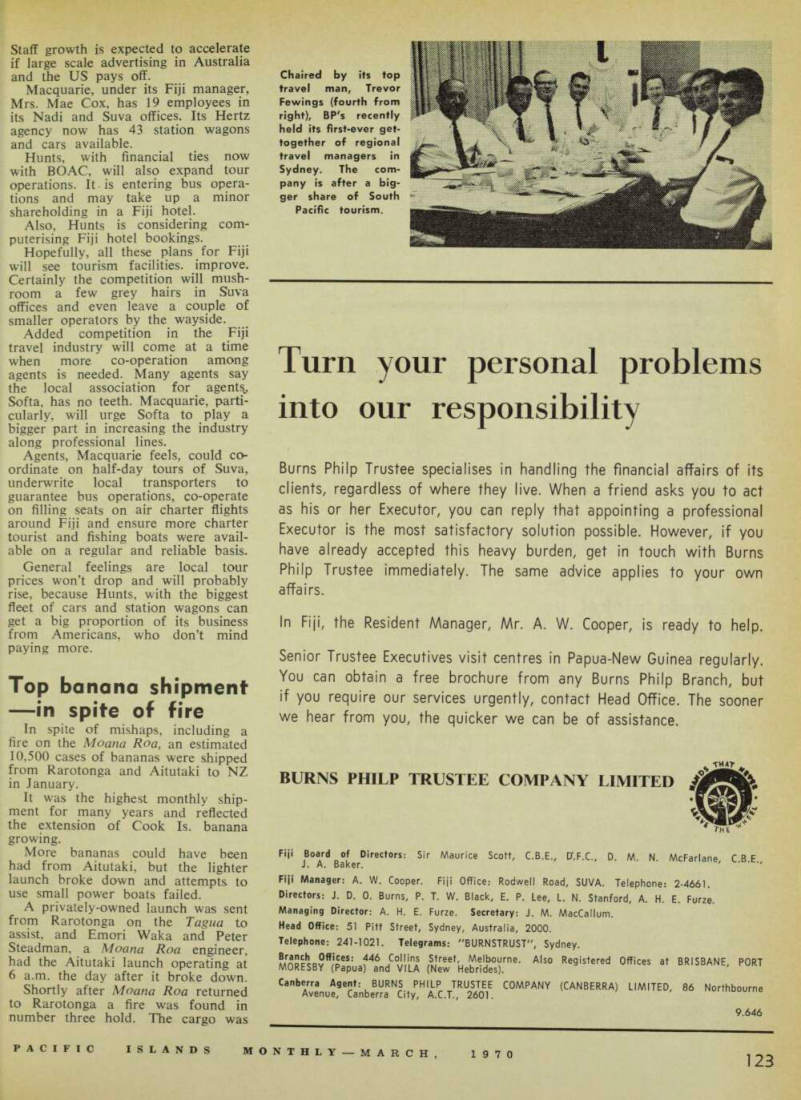
Chaired by its top travel man, Trevor Fewings (fourth from right), BP's recently held its first-ever get together of regional travel managers in Sydney. The com pany is after a big ger share of South Pacific tourism.
discharged from the hold and the fire brought under control. Part of the insulation and fan room were damaged. The fire delayed the vessel by two days.
First P-NG bottle
factory swings
New Guinea’s first factory making glass bottles and fibre containers is now in full swing.
The factory, costing nearly $4 million, was built by New Guinea Containers Pty. Ltd., a subsidiary of Australian Consolidated Industries, on five acres of land at Lae. It is close to the wharf and central for loading and unloading.
Ground work on the factory site began in October, 1968, and by 1970 most of the building construction had been completed. Various machines for the production of glass containers, soft drink and beer bottles and fibre containers were installed The factory, geared for the terri tory’s requirements in glass containers, jugs, soft drink and beer bottles and fibre containers of all types and shapes, will also supply North Queensland.
Already negotiations are underway with West Irian for the factory to supply glass containers, bottles and fibre containers.
Caledonia nickel up
—agriculture down
New Caledonia’s overseas trade registered a marked increase during 1969, according to preliminary figures released by the Department of Customs in Noumea.
Exports were up to 12,733 million CFP (SUSI 27 million) of which all but $1 million was earned by nickel, both ore and processed. But agri cultural exports mainly copra, coffee and trochus, dropped to nearly half last year’s value to register only 5U5432,510.
Overall export values were up 25 per cent, over the 1968 figure of 10,166 million CFP. Main customers were France (6,212 million CFP), Japan (5,649 million CFP. mainly nickel ore). America and Australia also bought small samples of nickel.
Imports last year also reached a record high—l2,o9B million CFP (SUSI2I million), almost 50 per cent, more than the 1968 value of 8,350 million CFP.
With main local primary pro duction restricted to beef, some agricultural crops and fish, most
necessities are imported. France re mains the principal supplier (5,820 million CFP) followed by Australia (1,742 million CFP, mainly food stuffs). America (machinery) and Germany and Japan (cement) are the other principal suppliers.
But all the above values have been affected by price changes, following the 12i per cent, devaluation of the French franc on August 8, 1969. In the meantime, revenue from import duties and export tax has added 2,876 million CFP to the territorial budget, (SUS 29 million).
Expansion in the nickel mining field, bringing increased population and a higher standard of living are main factors accounting for the in creased trade.
BSIP now on open
copra market
First shipment of 1,300 tons of copra from the British Solomons under new open market conditions in the BSIP left Honiara on the Laganbank for Hamburg in Feb ruary.
Regular annual contracts with Unilever, which first began in January, 1958, ended on December 31, 1969, and now the BSIP has to sell all its copra on the open market. In the
last 12 years Unilever has taken the bulk of the BSIP annual copra pro duction, and only a small proportion went on to the open market.
BSIP Copra Board secretary D. S.
Corner hopes that 1970 production will be in the vicinity of 25,000 tons, which was the peak year production in 1964/65.
In addition, Levers plantations in the Russells should continue to ex port, direct to Australia, their annual 4,500 tons. Levers has a special licence and its copra is not handled by the board.
The board has just negotiated a contract with Mitsui to take 6.500 tons of this year’s BSIP production, and the balance will be sold on the open market in London. The Japan ese sale will be based on the average price on the UK market.
Customs fine
for businessman
Sydney businessman Noel Vincent, well known in Papua-New Guinea and the British Solomons, where he is a director of W. D. & H. O. Wills (TPNG) Ltd. and of the Solomon Islands Tobacco Co., was fined $5 in a Honiara court on February 18 on a Customs offence.
He appeared before Mr. W. R.
M, Low, in the Central District Magistrates Court, charged with hav ing on February 16 answered untruly, questions put to him by a Customs officer.
Customs officer Jimmy Habalu alleged that when Vincent arrived in Honiara on a flight from Port Moresby on the 16th, Vincent told him he had nothing to declare. When he examined his baggage he found a set of cutlery, which Vincent said was for the manager’s residence of the Solomon Islands Tobacco Co.
Vincent said he paid S 3 5 for the cutlery but in fact a receipt showed he had paid only $26.
The cutlery was dutiable, but the manager of the tobacco company, who was at the airport to meet Vincent, refused to pay the duty unless he saw the Comptroller of Customs personally. The cutlery was impounded.
Vincent told the court that he had declared the cutlery and that he himself had produced it to the Customs officer. He said he had been through the Honiara airport three or four times a year, and had previously paid tax, and had been seen by the same Melanesian Customs officer.
Imposing the fine, the Magistrate said he accepted the evidence of the Customs officer as correct.
Trade Briefs
• Normal production of man ganese ore from mines on Viti Levu, Fiji, resumes in March, Southland Mining Ltd, says. Production was interrupted in mid-December by the wet season and continued only at a reduced rate. The company has acquired an option over an iron ore sands area near Sigatoka on Viti Levu’s Coral Coast and post-initial exploration is continuing. • Ampol Exploration Ltd., Aus tralian petroleum company, is the surprise party in the consortium which will explore for oil on and offshore in Tonga. Not even men tioned in applicants, Ampol will take up an 11 per cent, share in drilling.
Other consortium members are Shell, BP, Aquitane, Gulf Oil and Republic Mineral Corporation of Texas (in association with Australia’s Albrohos and Longreach groups). • With hopes of making Fiji an important exporter of textiles com peting against Japan and Hong Kong, an Auckland-based firm, Sonny Elegant Knitwear Ltd., will invest over SNZI million to set up the colony’s first textile factory at Ba, north Viti Levu. Production will start later this year in leased premises while work begins on building the factory. Hopes are 470 people will be employed. • Norfolk Island and Byron Bay Whaling Co. Ltd. (in liquidation), which has been reconstructed into a clothing group, Neater Fashions Ltd., still has a subsidiary registered on Norfolk. Called Norfolk Island Whaling Pty. Ltd. it is dormant and hasn’t operated for eight years since whaling finished on the island.
A Neater Fashions spokesman said this company had “substantial losses” and could be “reactivated at a later date”. • Despite strong opposition from New Guineans who don’t want any more mining exploration work in their area, a new Australian minerals explorer, Buka Minerals NL, says it will go ahead with plans to explore 3,000 square miles in Bougainville and Buka for copper. Buka Minerals has a 40 per cent, share in two ex ploration applications over the NG areas. • Highland Gold Development NL, which was recently listed on Australian stock exchanges, has re
ported a lode formation in the north eastern section of the NG Highlands con.aining “significant” silver, lead and zinc mineralisation. An adit was being built and additional permit areas covering 148 square miles in the Kainantu district were sought.
So far, the company’s 50 cent shares have sold from 40 to 60 cents. • Air Chemicals NG Pty. Ltd., of NZ, operating in NG’s Highlands for nearly a year, is to add a communi cations plane, “costing between $15,000 and $20,000” to its Aero Commander to expand business, carry out spray jobs and contact clients.
• The Cook Islands Government is considering a proposed SNZ2 million town centre for its capital, Rarotonga. The project includes several stages, the first of which—a tourist authority and a philatelic bureau —has been finished. Next to come are an administrative office block and a parliament building, fol lowed by hotel and waterfront changes. • Japanese motor cycle manu facturer, Yamaha, has jumped in early to supply “works machines” for top riders in the South Pacific Motor Sports Club, obviously with an eye
on the first Papua-New Guinea scramble championships being or ganised for October. Yamaha is conducting an aggressive sales cam paign in the territory. 9 Tourists to Lord Howe Island will now not be charged accommo dation for additional days they are re quired to stay on the island due to the postponement of scheduled flying boat flights as a result of bad weather, aircraft unserviceability, etc., and the Lord Howe Board will not impose tourist charges for these additional days. 9 The Bank of New South Wales is the latest bank to set up house on
Bougainville, New Guinea, to win a slice of the $3OO million develop ment associated with the copper project. The branch opened at Kieta township late last year and first man ager is Mr. W. A. Walters: it follows previous Wales branch expansion at Nauru and Norfolk Island. 9 Mauri Bros, and Thomson, food distributor and minority share holder in Islands trader Burns Philp and Co. Ltd., set up its first resident representative outside Australia and NZ at Lae, New Guinea, in Januaiy.
He’s Mr. Don Houston, who will cover Mauri’s food and food
machinery markets in NG, the Solomons and the New Hebrides. • A poultry producers’ co-operative society has been registered in Tonga and all retailers and wholesalers of eggs have been circularised to notify them of its aims. The society hopes to stimulate production by purchas ing suitable chicken feed and pesti cides in bulk and also to encourage price stabilisation and marketing.
The president is confident the pub lic will co-operate by purchasing sup plies from the society of which the majority of poultry farmers in Tongatapu are members. • The Ministry of Social Services in Fiji is to investigate the soaring sales of contraceptive pills in Fiji after allegations that tourists had been buying them in bulk and selling them at a profit in Australia and New Zealand. It is believed that tourists sell the pills, backed in Fiji with a government subsidy, for as much as $1.75 at home. They cost 20 cents a packet in Fiji.
The first company to reflect Fiji’s coming political change in its name is the Dominion Development Cor poration Ltd., which will operate Fiji’s newest tourist venture —a South Pacific Island cultural centre in Suva.
Shareholders in the company, which has a fully subscribed share capital of $25,000 $1 shares, are the Fijian Investments and Development Cor poration, Hunts Travel Service Ltd. and Mrs. I. F. Watkins, Suva.
News of the cultural centre was released in January. The first stage will comprise five Fijian bures and a Samoan fale on Masima Island in the Veisari River, eight miles from Suva. • Japanese-owned Banno Mining Company of Fiji is continuing searches for copper deposits at Udu Point and Wainikoro, Vanua Levu, Fiji. Its prospecting licences are valid until June. Banno has a SF3 million copper treatment plant at Udu, which was closed last year after copper and zinc deposits nearby proved smaller than thought to justify opera tion of the plant. Nearly 7,000 tons of dry copper ore had been shipped to Japan. • ARC Industries Ltd., Australian reinforcing and wire products group, will build a manufacturing plant at Lae, New Guinea, in an investment “approaching $500,000.” Mr. Kenneth Cox, ARC’s chairman, said his company’s business to NG had “ex panded dramatically” and ARC was “beating the Japanese.” It was hoped to begin production in March, 1971.