Polynesia's first
p. 104 · Read in the full issue
ambassador to England
When Captain Cook’s two ships Resolution and Adventure called at the island of Huahine
in 1773, Captain Furneaux, the
commander of the Adventure, took on board a Tahitian youth who was carried back to Eng land.
The Tahitian’s name was Ma’i.
But when asked his name, he said “O Ma’i”, meaning “it is Ma’i”, and as Furneaux and his companions did not understand that the “o” was not part of his name, he was ac cordingly known as Omai.
Omai was the first Polynesian to be taken to England, and he proved to be a first-class ambassador for his country. He reached England just at the time when the educated classes were steeped in the theories about noble savages of the philo sopher Jean Jacques Rousseau.
Real live savage
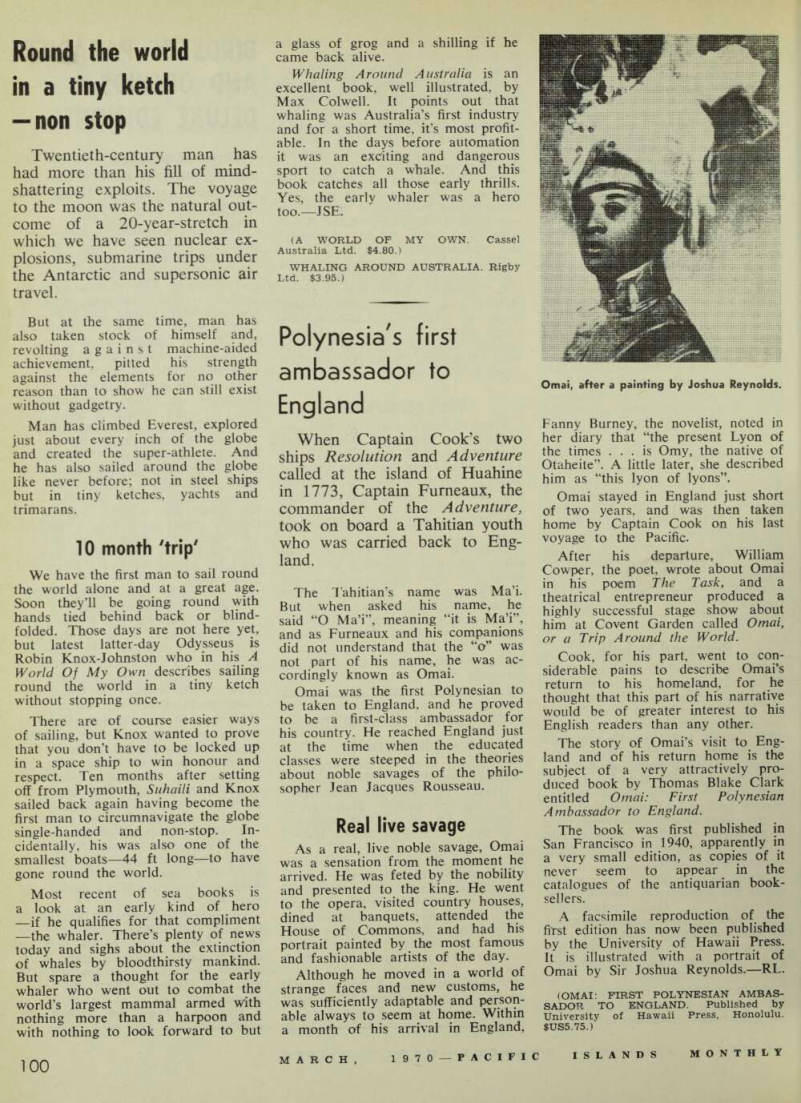
As a real, live noble savage, Omai was a sensation from the moment he arrived. He was feted by the nobility and presented to the king. He went to the opera, visited country houses, dined at banquets, attended the House of Commons, and had his portrait painted by the most famous and fashionable artists of the day.
Although he moved in a world of strange faces and new customs, he was sufficiently adaptable and person able always to seem at home. Within a month of his arrival in England,
Fanny Burney, the novelist, noted in her diary that “the present Lyon of the times ... is Omy, the native of Otaheite”. A little later, she described him as “this lyon of lyons”.
Omai stayed in England just short of two years, and was then taken home by Captain Cook on his last voyage to the Pacific.
After his departure, William Cowper, the poet, wrote about Omai in his poem The Task, and a theatrical entrepreneur produced a highly successful stage show about him at Covent Garden called Omai, or a Trip Around the World.
Cook, for his part, went to con siderable pains to describe Omai’s return to his homeland, for he thought that this part of his narrative would be of greater interest to his English readers than any other.
The story of Omai’s visit to Eng land and of his return home is the subject of a very attractively pro duced book by Thomas Blake Clark entitled Omai: First Polynesian Ambassador to England.
The book was first published in San Francisco in 1940, apparently in a very small edition, as copies of it never seem to appear in the catalogues of the antiquarian book sellers.
A facsimile reproduction of the first edition has now been published by the University of Hawaii Press.
It is illustrated with a portrait of Omai by Sir Joshua Reynolds.—RL.
(Omai: First Polynesian Ambas
SADOR TO ENGLAND. Published by University of Hawaii Press, Honolulu. $U55.75.)
Omai, after a painting by Joshua Reynolds.