New Hebrides-A South Seas Nassau!
pp. 63-69 · Read in the full issue
O Buying up land by foreigners in the South Pacific for hotels and vacation homes has snowballed recently.
"PIM" takes a look at the latest trends and how people are reacting to them.
From a special correspondent in Vila The prospect of the New Hebrides becoming an accommodation address for international big business while colonies of wealthy Americans live in lush get-away-from-it-all resorts, was exercising the minds of residents in the New Year, pleasing some and terrifying others.
The disadvantages of being half- French and half-British, or, more correctly, a French territory and at the same time a British one, are frequently evoked, and all the ills of New Hebrideans (sometimes much exaggerated, since they appear a supremely happy people) are sup posed to derive from their extra ordinary government.
Over the past 56 years of its existence, the Condominium’s faults have been glaring, and the advantages of this form of government well concealed from the casual observer.
These advantages are: • The New Hebrides are the onl> French islands in the Pacific where land can be bought and businesses owned regardless of nationality; • The New Hebrides are the only British islands in the Pacific where there is no income tax.*
A natural asset
Taken together these two facts form a unique natural asset of the Condominium. They may be crucial in its economic future.
As with many other natural assets it took a sophisticated American business man to discover them. He is Eugene Peacock, representative of the company having the largest American investment in the New Hebrides.
The investment he has supervised is the purchase of three or four plantations in the New Hebrides— at Hog Harbour in Santo, Sakau Island near Santo and a plantation at Devil’s Point near Vila. In all there is a total of around 5,000 acres which is to be resold in small building lots to Americans living in Hawaii, through offices in Honolulu.
The first subdivision at Hog Harbour, which has been renamed Lokalee Beach, is now sold out. It consists of about 1,000 lots and the operation has been going on for little more than one year.
At the beginning of November, 1969, Lokalee Beach Hotel was • There Is no income tax in Australia’s Norfolk Is. or independent Nauru.
opened. It has 24 rooms, is extremely elegant and will certainly be an asset to the tourist facilities of the New Hebrides. Champagne Beach, just outside the windows of the new hotel, will now be accessible both to the casual tourist and the people coming to inspect the building plots they have bought.
Other real estate brokers have now been attracted to the New Hebrides— an island near Efate, an area over looking Undine Bay with one of the most beautiful views in the New Hebrides, has been purchased, pre sumably for subdivisions. Negotia tions are under way for an island off the south coast of Malekula.
Local reaction to the new invest ments is mainly bewilderment. This land investment differs from tourism mainly because it has not been specifically encouraged (both Admin istration and public are now whole heartedly backing tourist promotion) and the role of the New Hebrides in the Lokalee Beach development has been passive.
The development was announced and advertised in Honolulu, not locally.
Local people are confused and frightened of the next event. If only they understood they would surely welcome this development with open arms. It is the only reasonable reaction for anvone interested in the economic welfare of the New Hebrides.
Growing numbers
Speculation about the future of Lokalee Beach is rife. Serious people —a member of Advisory Council, for instance—sincerely believe that 20,000 people may soon be living in Hog Harbour with similar numbers in the other developments that are likely to follow. The popu lation at Hog Harbour would then be equal to a quarter of the present population of the New Hebrides (80,000). It is feared that this number of foreigners would have a very great political effect.
This is wild speculation; these rumours are absurd and it is high
time they were brought into the open to be denied.
As a maximum fixed by the deeds of sale, only one house intended for a single family may be built on each of the 1,000 lots. As many people buy several adjacent lots the total number of houses will probably be less. Average occupancy per house is not likely to be more than three.
Only a small minority of the house holders, who do not need to work, are likely to be permanent residents.
In other words the maximum number of Americans likely to be at Lokalee at any one time will be considerably less than 3,000. As they are not permanent residents, they will prob ably not be very interested in the political life of the New Hebrides.
No pot of gold
On the other hand, hopes are just as grossly exaggerated as fears. It is typical of the New Hebrides that everyone should be hoping to make a fortune instead of working to make a living, and many Santo residents feel that the development is the pot of gold at the rainbow’s end.
Land prices in Santo have risen higher than those in Vila in sympathy with prices charged at Lokalee Beach, although it remains extremely un likely that Americans will buy build ing plots outside the developments.
Prices quoted for land on either side of Santo’s main road, which appears to run through a shanty town, are more suitable to Pitt Street, Sydney than a just evaluation of the busi ness to be done in a dreamy little slow-paced frontier town.
Naturally the prosperity of Santo businesses is likely to increase, but not in the immediate future.
Most of the people who have purchased building lots in Hog Harbour have done so as a specula tion. The sales message which proved so successful was not that the New Hebrides was an ideal place to live but was a glittering account of the financial boom coming to the South Pacific.
Another unfounded fear is that
Do you want to be French or British?
the whole scheme may turn out to be a dud, which although it would probably not have any local financial effect, would do the reputation of the New Hebrides a great deal of harm.
Although Condominium legislation is virtually silent on the subdivision of land, this development has been carefully watched by the Hawaii Real Estate Commission whose per mission must be given before any sales can be made and which has sent officials to inspect Lokalee Beach.
The French Administration has alone immediately grasped the favour able financial implications of this development and most American visitors opt to be French protected persons. It is just as well to have an answer ready when asked the astonishing question “Do you want to be French or British?” which is put to new arrivals as part of entry formalities in the surprising Condo minium. [Although the Condominium Pro tocol, under which the New Hebrides set-up functions, provides for French and British residents to retain their own national status, it provides also for citizens of other countries, on arrival, to opt for one or the other government systems under which they will live. It has nothing to do with taking the nationality of that country].
More jobs
It is to be hoped that all New Hebrides residents and the other administrations will also welcome this development when they understand it better. The advantages to the balance of payments, the increases in the number of jobs available to New Hebrideans, the expansion in the market for handicrafts will > be identical with other tourist expansion.
More money than ever before is being spent on tourist promotion, yet visitors and investors at Lokalee Beach are viewed with dismay.
In fact these visitors will avoid the chief disadvantage of tourists. As semi-permanent residents, or visitors bound to return year, they should retain an interest in preserving the character, culture and beauty of the New Hebrides which other tourists do not share. Too often tourists come to admire a culture and finish up destroying it.
Honolulu has been chosen as the best market for the sale of land in the New Hebrides for two reasons.
The first is the fantastic boom in land prices there in the past 10 years
which has created many famous fortunes.
Americans living in Hawaii can be expected to be optimistic about the economic future of other Pacific Islands. The other is the interest Americans living in Hawaii have in Pacific cultures.
Those who build at Lokalee Beach are encouraged to use local materials, which will provide a market for another local crop and employment for those with traditional skills both of which help to preserve the local culture.
Real estate developers will certainly not be the only investors attracted to the New Hebrides once the Condominium’s recently discovered assets are better known—these assets being the fact that foreigners may
own businesses in South Pacific Islands where there is no income tax.
Americans are ready to call any Pacific Island a paradise, when the magic words “tax-free” can be added.
Only a small public relations cam paign will attract more investment to the New Hebrides.
According to rumours which ap pear to stem from the Administra tion, organisations of the type of the Rand Corporation, whose business is knowledge (sometimes called “think tanks”), for whom the choice of location is simply a matter of pleas ing their staff—all of whom would be professional people—are seriously considering coming to the New Hebrides.
Favourable taxes
Financial organisations of the sort that find it useful to have their head office in Nassau, are considering be coming established in the New Hebrides because of the favourable tax situation. At least one shipping line finds it worthwhile to have most of its ships registered in Vila, although they never visit the port. [See letters for another view on that subject.— Ed.] Will the future of the New Hebrides really be a very prosperous one, with international financial organisations employing many people in the towns, “think-tanks”, in towns of their own creating, and villages of vacationing Americans around the more beautiful beaches of the islands?
There are two groups in the New Hebrides who might answer, “No”.
The first is the British Administra tion. The British government has constantly and publicly reiterated its intention of imposing income and other taxes. The French Administra tion is thought to oppose income tax and it is unlikely that the British will be successful.
Investors may scare
However, British statements of intention may be sufficient to scare away investors.
The British in the New Hebrides are conservative. Perhaps when these developments are a little older the British will decide to encourage them, perhaps only their newness is frightening. Let us hope that in the future both Administrations will encourage developments of every sort likely to bring prosperity to these islands, even when they are unconventional.
The other group (without any intention of equating it with the British Administration) which may prevent the New Hebrides from
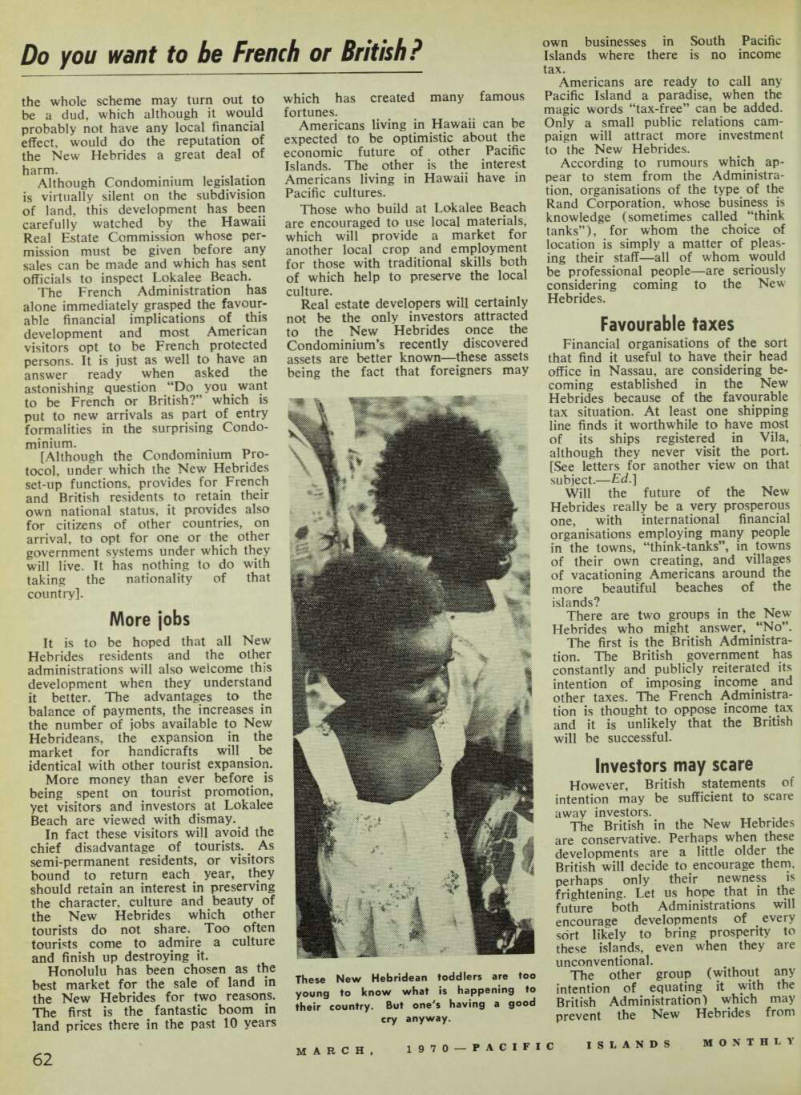
These New Hebridean toddlers are too young to know what is happening to their country. But one's having a good cry anyway.
reaching this economic peak is Na- Griamel, which is said to group 10,000 New Hebrideans in a nationalist movement.
The leader is Jimmy Stevens who promises that New Hebrideans will regain European - owned land not under cultivation, and that the organisation will provide farm machinery for all, markets for traditional crops and the best of both traditional and western worlds.
Na-Griamel and Lokalee Beach can be thought of as symbols racing neck and neck for the future of the New Hebrides. Will international finance, tourism and real estate investments win, so that the New Hebrides will follow the happy example of the islands of the Caribbean?
Or will Na-Griamel flourish and bring with it violence and make the Hebrides follow Africa’s example?
Fiji Island Buy
Robert Hunter, real estate man in the South Pacific, brought off another land coup in Fiji in January when he bought Laucala Island for $1,200,000 from Morris Hedstrom Ltd.
He bought it on behalf of his Fiji-based company, South Sea Lands.
Morris Hedstrom had owned the 3,000-acre freehold island, which is north-east of Taveuni for about 18 years, as a copra plantation.
“This island has fantastic poten tial,” he told PIM. “I’m thrilled with the transaction—we’ll do well on it and we feel the country will do well on it.” He said that a design survey would be carried out, probably in October, and a decision made about the construction of a tourist resort, an airstrip and the subdivision of sites for holiday homes.
“How dense the residential sec tion will be will depend on the survey,” he said, “but we will retain the island flavour of Laucala. The tracts will be resold on the Ame rican market during late 1970 and early 1971.”
Morris Hedstrom will retain a mortgage on the island for several years. Mr. Hunter said the deal would be on a term payment basis and South Sea Lands would take possession of Laucala Island in October.
A 3,500 ft airstrip would be started on the island in October or Nov ember and daily services would be introduced when the resort was ready to open.
“We’re interested in associating
Faster plane coming
with someone else on the resort, but we will certainly retain an interest,”
Mr. Hunter said. “We’ll bring in an aircraft that is faster than our present Beechcraft Baron, and capable of carrying three times the number of people. The flight time from Nadi Airport will be about 55 minutes.”
The remains of several ancient Fijian settlements have been dis covered on Laucala, which at the moment produces a large quantity of copra. About 1,400 acres are pro ducing at present and an additional 700 acres is due to begin bearing soon.
One of its previous owners was the late Mr. Gordon McGowan, a member of a well-known Fiji family.
It has a population of about 100 and there are about 400 cattle.
Tonga Resort
Neiafu, the main town of Vavau (northernmost group in Tonga) may in a few years become a serious rival to the capital, Nukualofa, as a major port of call for tourists to the kingdom.
A Sydney businessman claiming sentimental connections with Vavau is reliably believed to be planning the construction of a 200-room hotel in Neiafu. At least one local business man is working with him, and more local participation will later be invited.
Ultimately the hotel and other facets of the proposed programme will cost STI million. It is possible that tourist accommodation and recreation may spread to the un spoiled little islets in the beautiful Neiafu Harbour, referred to by several travel writers as one of the loveliest natural harbours in the world, and an ideal sanctuary for shipping and small boats during hurricanes.
Visitors to Tonga mostly agree that Vavau is a more untouched place, whose landscape is more picturesque, generally, than the main island of Tongatapu where Nukualofa is sited.
It is strongly believed that the Sydney businessman has already approached passenger lines presently routing ships through Nukualofa to consider calling at Neiafu. All going well, Vavau should also be able to cater for tourists arriving by air— if the government resumes its plans
More natural attractions
to establish an air shuttle service between Fua’amotu Airport on Tongatapu, and Neiafu. (The first airfield on Vavau was closed down after being declared dangerous by aviation experts).
Said an old-time Neiafu resident of the proposed developments: “Vavau of course is the ideal place for tourists coming to Tonga. It’s warmer all year round and has more natural attractions. [A booklet is being prepared on these].
“Tourists will do a lot of good for Vavau, whose people should benefit financially from them. This will mean also a more evenly distributed economy. In the early 1900’s Neiafu was the home of Tongan high society. Tourism may help Neiafu recapture its old status.”
Yasawa Resort
It was announced in Fiji in February that the American-financed company Vacation Properties Fiji Ltd., is expecting to spend around $700,000 on the development of its Fiji resort. The Islander.
Managing director, Mr. Hume Huntley, announced at the same time that it was hoped that work would begin on the first phase of the resort in April.
The Islander is to be built on 65 acres of leased land on the freehold island of Nanuya Levu, in the Yasawas.
Phase one of the development will include 20 accommodation units and an airstrip. Transport to and from the resort is to be by aircraft and the cost of the trip, plus two meals a day and all water and land sports, will be included in the tariff of approximately $6O a day, double room accommodation.
The first stage of work will involve the building of a H-mile road lead ing to the site for the airstrip and the filling in of 7,000 cubic yards of tidal land where the first 20 units will go. They are expected to be open by April, 1971.
Eventually there will be 50 units —3B with two beds, 12 with four beds—and three self-contained homes, available for lease at an executive level.
To solve the problem of water and save the expense of a water
engineering survey, the company has decided to buy two de-salinators, costing about $35,000 each.
Vacation Properties Fiji Ltd. was formed initially by senior Pan- American pilot, Mr. Robert Bragg and about 15 other airline personnel.
There are now about 30 investors in the company.
The 2,000 acre Valavala estate at Natewa Bay on Vanua Levu, Fiji, has been bought by an Americanbacked real estate company. The estate, formerly owned by New Zealander, Mr. J. Rankin, will be half sub-divided into holiday home sites and half developed for forestry. (Over)