Tongans really benefit
p. 32 · Read in the full issue
A 10 year wait—then only top Tongans really benefit
By our Nukualofa correspondent
uao „ i • It s almost a year ago since Sir Richard Ramage arrived in Tonga, via the Ministry of Overseas Development, to undertake a review of civil service salaries.
An adjustment of salaries has been long overdue —10 years since the last —despite a recommendation by a 1958 Report that, as a matter of policy, one should be undertaken every five years. But, in the absence of an effective watchdog in the group (like a parliamentary opposition or organised unionism) and with wide spread unemployment, it has been rather more convenient for the gov ernment to overlook the case for state employees where less than 15 per cent, of the population is affected.
Sir Richard had to face up to numerous changes which had taken place, since his first visit, as well as the creation of new posts. A number of these, he found, had passed from expatriates to Tongan nationals, such as Head of the Medical Services and the important Ministries of Education and Finance.
While this gradual takeover of posts was inevitable and will probably be complete within another 10 years, the Salaries Commission also found a disturbing tendency in the number of civil servants benefiting from various activities outside office hours.
More cadets like this
Cases of this sort are said to have increased considerably within recent years, due to the poor wages in the public service and the fact that there is no regulation against secondary employment among their ranks.
A few examples of the salary structure during the last 10 years will come as a shock to today’s affluent society. A junior clerk started at $240 a year and would finish 20 years later, if he was lucky, as a first class clerk with a maximum of $BBB a year. Others who started at $240 were drivers, survey and broad casting technical trainees, able sea men, laboratory and medical assis tants, handymen, cooks and telephone operators; but their maximum was much lower than that of a senior clerk.
The hardworked medical and teaching professions were poorly paid. The vast majority of doctors, head teachers and staff nurses were
pegged at below $1,500 while the Superintendent of Police reached his maximum at $1,440. A labourer never progressed beyond a $1 a day.
The reason given for this depressed wage structure has been the low financial situation of the country tied to a banana-copra economy. Yet the feeling has persisted that government unwittingly, condoned a situation it should never have done for 10 long years, if it had any respect at all for the loyalty of its employees.
That public money had been frittered away in a manner that neglected the benefit of the workers, is a well known fact. Yet these same workers kept on with their pittance, hoping that, one day, their lot would be improved. It has, but in a way that has left a trail of dissatisfaction, particularly among the lower and middle groups who form the majority of the civil service.
On the revised scale, their mini mum and maximum have increased, on the average, from under 10 per cent, to 12 per cent. Sir Richard made provision in his review for a 10 per cent, rise in the cost of living over the past 10 years since the last
revision of salaries. In the absence of any price-index statistics whatsoever, he admitted this figure was only an “inspired guess”.
The top boys, however, received a far better deal. Whether it was always due to their greater respon sibility and qualifications or a fair amount of glib talk as well, they received increases ranging from 10 per cent, to 38 per cent., with one case over 100 per cent.
It was the Superintendent of Police who more than doubled his salary, going from $1,440 to $3,300. The rest of the force are wondering whether it was a typist’s error.
First time post for
r**> it.* •
Fiji politician
Mr. Wesley Barrett, Alliance Mem ber of the Legislative Council for the Eastern and Central constituency, has succeeded Mr. H. P. Ritchie as Fiji’s Minister for Finance. He is the first politician to hold the post.
Announcing the appointment on February 18, a government spokes man said it appeared likely that the introduction of the 1971 budget and certainly the development plan for the next five years will take place under an independent government.
It was therefore felt that the elected representative who will be Minister of Finance at that time should assume office as soon as possible. Mr. Ritchie is a permanent member of the British Overseas Civil Service.
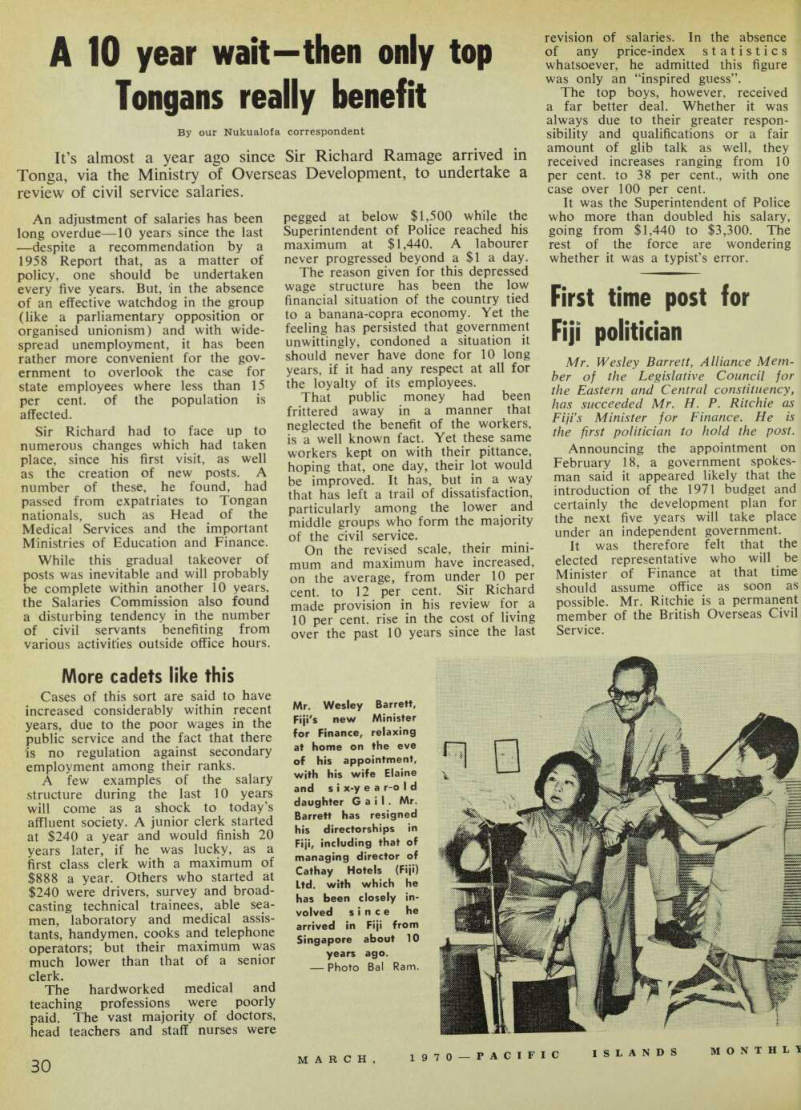
Mr. Wesley Barrett, Fiji's new Minister for Finance, relaxing at home on the eve of his appointment, with his wife Elaine
and six-year-old
daughter Gail. Mr.
Barrett has resigned his directorships in Fiji, including that of managing director of Cathay Hotels (Fiji) Ltd. with which he has been closely in volved since he arrived in Fiji from Singapore about 10 years ago. -Photo Bal Ram.