MILI goes on a spending spree
pp. 115-120 · Read in the full issue

MILI, the US Trust Territory’s shipping company, has chartered a 1,980-ton Norwegian passenger-cargo vessel, Fanafjord, for four years. She’s scheduled to begin services in April on the Far East run and her initial calls will be Kaohsiung (alternate
voyages )-Japan-Saipan-Guam-Yap-Koror.
Fanafjord has a top speed of 12 knots, large hatches, wide decks and reefer space; she accommodates 10 people in five cabins. Fixed on bare boat charter, she’ll have a Micro nesian crew, excluding her Norweg ian master, first officer and first en gineer.
Gunners Knot, another MILI ship, was to re-continue service in the Marshalls from late January after drydocking and “facelifting” in Japan. Passenger accommodation is for 12.
The company recently bought, for an undisclosed price, a 310 ft. self contained copra barge, called BHI, due to go into service about May.
BHI could be quite an innovation for collecting copra at hard-to-get-to calls in the Islands, not merely Micronesia.
She can load as well as discharge bulk copra by means of two rever sible “vacuuvators” powered by her own plant. She draws copra from a ship’s hold or shoreside warehouse and then blows it into either of two compartments, where it can be stored and eventually loaded by reversing the process.
With a capacity of about 1,200 tons, BHI can be towed from island to island, collecting copra from small deposits, or remain at anchor waiting for small ships to come to her.
When full, BHI then goes along side the export vessel and discharges copra into the bigger vessel’s holds at the rate of 120 tons per hour.
The copra handlings at Majuro, Marshalls, are expected to be greatly improved by the newcomer.
MILI has made another recent acquisition a 130 ft. cargo tug Hecate, whose initial job will be to tow BHI to Micronesia from San Francisco.
Ship Problem From
Aust. To Samoas
Infrequent Bank Line sailings out of Sydney have partly relieved losses of up to $3 million feared by Australian exporters to both Samoas, Fiji and Tonga, following the ending of the Union Steam
Ship’s Waimate service to this area from Australia last year.
Union pulled Waimate off the run, leaving only the Tongan Copra Board’s Niuvakai operating, because of lack of all round support and non-existent return cargo.
The Fleetbank made a special trip late last year and the Laganbank was expected on a similar voyage in February.
Foodstuffs, mostly flour, rice and sugar, have been stockpiled in Syd ney waiting for delivery and recent big loadings of explosives aboard the Niuvakai for Emperor Gold Mines, Asau Harbour and Nukua lofa have taken up valuable space aboard this small vessel.
Exporters in Sydney see the situ ation temporarily relieved but still fear they could lose up to S 3 million in sales to others, especially New Zealand.
Sports Boat De
Luxe For Fiji
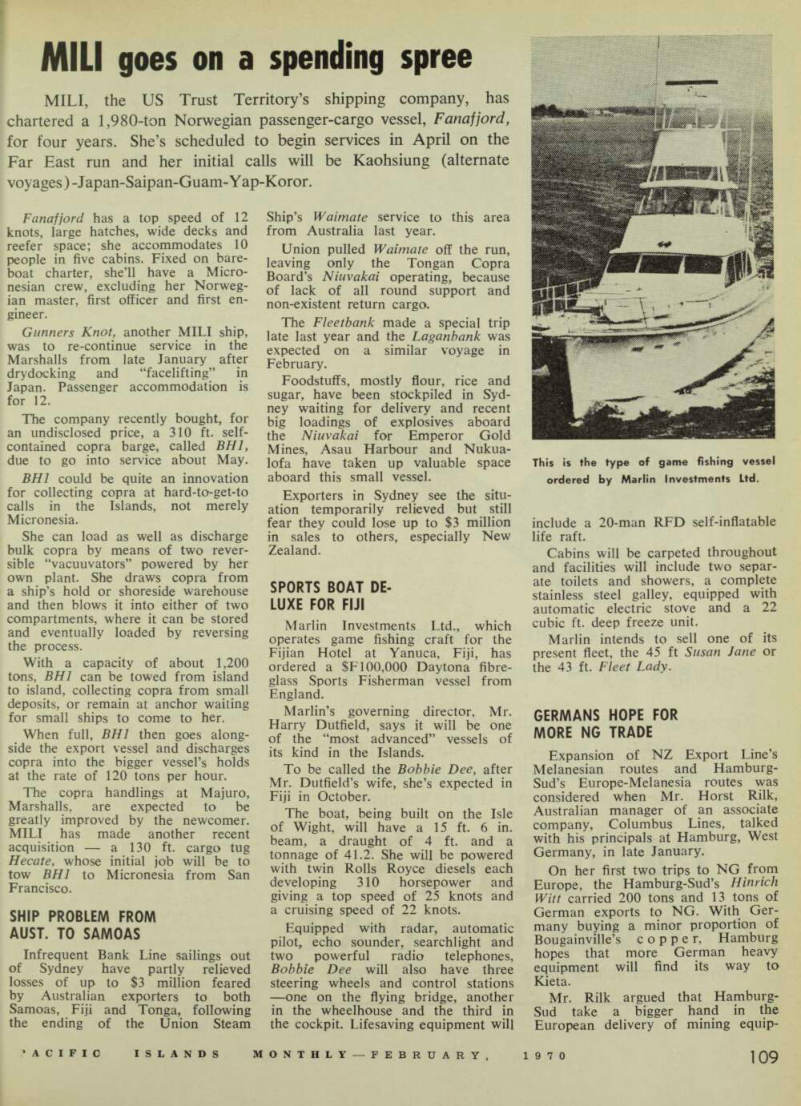
Marlin Investments Ltd., which operates game fishing craft for the Fijian Hotel at Yanuca, Fiji, has ordered a SFT 00,000 Daytona fibre glass Sports Fisherman vessel from England.
Marlin’s governing director, Mr.
Harry Dutfield, says it will be one of the “most advanced” vessels of its kind in the Islands.
To be called the Bobbie Dee, after Mr. Dutfield’s wife, she’s expected in Fiji in October.
The boat, being built on the Isle of Wight, will have a 15 ft. 6 in. beam, a draught of 4 ft. and a tonnage of 41.2. She will be powered with twin Rolls Royce diesels each developing 310 horsepower and giving a top speed of 25 knots and a cruising speed of 22 knots.
Equipped with radar, automatic pilot, echo sounder, searchlight and two powerful radio telephones, Bobbie Dee will also have three steering wheels and control stations —one on the flying bridge, another in the wheelhouse and the third in the cockpit. Lifesaving equipment will
include a 20-man RFD self-inflatable life raft.
Cabins will be carpeted throughout and facilities will include two separ ate toilets and showers, a complete stainless steel galley, equipped with automatic electric stove and a 22 cubic ft. deep freeze unit.
Marlin intends to sell one of its present fleet, the 45 ft Susan Jane or the 43 ft. Fleet Lady.
Germans Hope For
More Ng Trade
Expansion of NZ Export Line’s Melanesian routes and Hamburg- Sud’s Europe-Melanesia routes was considered when Mr. Horst Rilk, Australian manager of an associate company, Columbus Lines, talked with his principals at Hamburg, West Germany, in late January.
On her first two trips to NG from Europe, the Hamburg-Sud’s Hinrich Witt carried 200 tons and 13 tons of German exports to NG. With Ger many buying a minor proportion of Bougainville’s copper, Hamburg hopes that more German heavy equipment will find its way to Kieta.
Mr. Rilk argued that Hamburg- Sud take a bigger hand in the European delivery of mining equip
This is the type of game fishing vessel ordered by Marlin investments Ltd.
ment for Caledonia’s $1 billion ex pansion of its nickel industry over the next five years.
The equipment will mostly come from Europe because of Common Market ties; Australia and NZ are expected to concentrate on food stuffs, clothing and housing supplies.
New Contract For
Santo Wharf
Mr. Louis Chaumont, director of the Port of Noumea, and Captain J. I. Dalby, traffic manager, Marine Department, Fiji, have recommended to the New Hebrides Condominium Government that the contract with Societe Portuaire, to operate Santo Wharf, be cancelled.
They have asked that a new con tract be drawn up, tenders be called and operations of the successful ten derer be extensively reviewed annu ally.
These are the final conclusions of the marine authorities, who, at the request of the local government, in quired into the operation of Santo Wharf, the condominium’s number two port, in mid-1969, following many complaints about stevedoring, storing and berthing operations at the wharf since 1964.
During course of the recently published inquiry into the wharfs operations, Societe Portuaire, which has exclusively operated all the wharf’s functions since it won its initial 18-month contract in early 1958, was severely criticised.
Charges against this French com pany included excessive charging, unnecessary damages to cargoes, poor supervision of stevedores, lack of a real wharf master, incompetent workers, prolonged delays to cargoes either waiting for shipment or de livery to local importers and a general deterioration in all services.
The inquiry was told the concrete piled wharf was completed in 1958 at a cost of $1,124,559; berthing length was 439 ft. Societe Portuaire was the successful tenderer to oper ate its stevedoring operations.
Because of lack of agreement between French and British Adminis trations, the contract was never re newed, but Societe Portuaire, being a French-registered company, re tained its exclusive stevedoring rights because under French law the terms of contract were considered to con tinue until it was formally terminated.
Tenderers for operation of the wharf, presuming the inauiry’s recom mendations are approved, are expect ed to include a bid from Burns Philo (New Hebrides) Ltd.
Bp's To Sell
"Braeside"
The sale of Burns Philp and Co.
Ltd.’s flagship Braeside was imminent in late January. A Manila-based shipping company was at Madang, New Guinea, considering making an offer under $500,000.
PIM understands BP’s will accept the offer but run the 21-year-old 5,867-ton veteran to NG once more afler her January run.
Meantime, BP’s is looking for a modern, 6,000-ton freighter. In January it turned down an offer to buy, for $2 million, a ship similar to the two Bulgarian freighters Karlander will use on its Gove run.
BP’s felt these ships were too slow (about 13 knots).
When it gets the ship it wants, BP’s will sell its 2,600 tons, 15-year old Tulagi, which services the New Hebrides and Solomons.
Shipping Briefs
9 It’s reported in New Guinea a 23 ft long hovercraft capable of carrying 10 passengers is being built in Tasmania for service in NG waters later this year. A company called Cushioncraft Services has been formed in NG and Air Cushion Vehicles Australasia Pty. Ltd., of Tasmania, has won a contract to build the craft, for delivery in NG in March. • New Hebrides resident, Mr.
Manuel Balesaga, of Tanna, found an unsinkable aluminium 12 ft dinghy adrift at sea eight miles west of nearby Futuna Island, in the southern Hebrides, recently. There were many limpets attached to the boat, indicating it had been drifting for many days. • One of the Islands’ largest cement barges is nearing completion in Tonga. (Over)
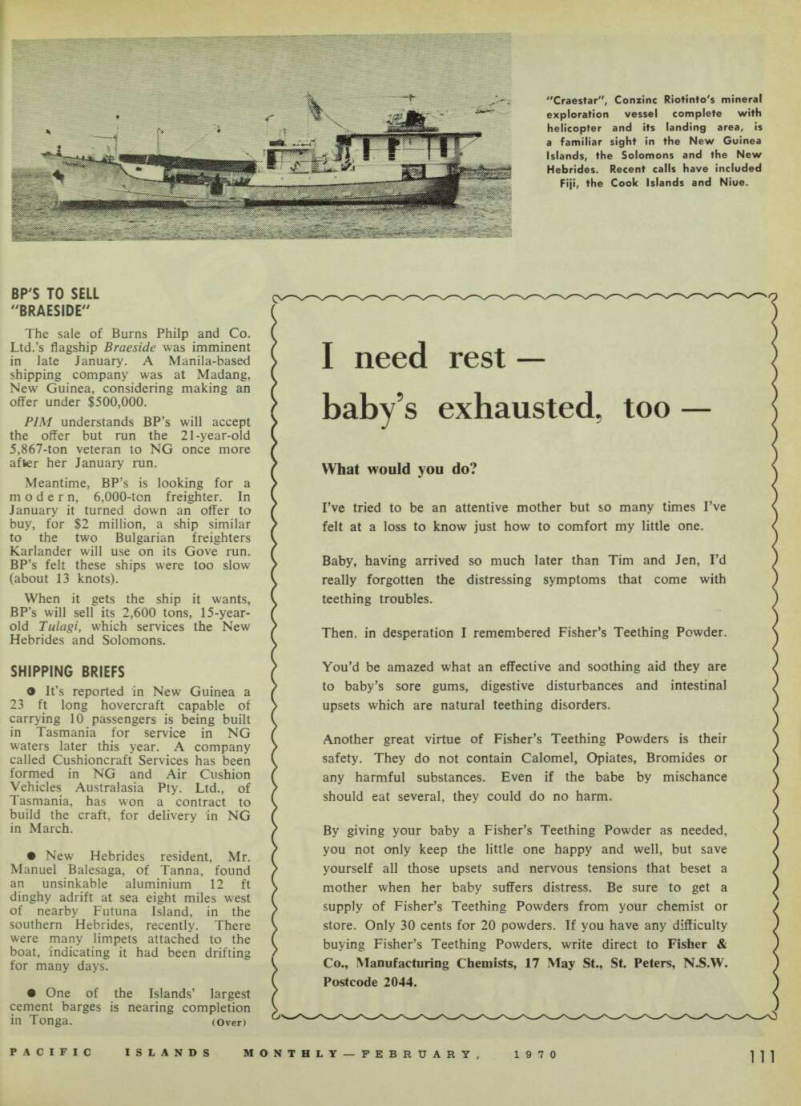
"Craestar", Conzinc Riotinto's mineral exploration vessel complete with helicopter and its landing area, is a familiar sight in the New Guinea Islands, the Solomons and the New Hebrides. Recent calls have included Fiji, the Cook Islands and Niue.
Designed by Mr. N. Ashton, of Dunedin, New Zealand, and built by Warner Enterprises, it is 52 ft long and 15 ft wide.
It has a corrugated bottom to give extra strength and the cement throughout is about 1 in. thick with no stiffening. It is made from Fiji river sand and cement.
If this new enterprise proves successful, possible buyers would be the Tonga Copra Board and Tonga Produce Board for inter-island trans port of their products. • After 28 years’ service in New Guinea and Solomons waters, the trader Abel Tasman is being broken up in Madang. She will be used as an extension to the Madang wharf.
Tasman’s owners have included the Australian Army, Angau, the NG Administration, Captain Jim Donald and finally, Madang businessman, Mr.
Licc'iardo. • It’s hoped the much-delayed clearing of Western Samoa’s Asau reef will be stepped up with a re cently-announced New Zealand Gov ernment loan of SNZISO,OOO.
Clearing of a navigational channel at Asau is essential for ocean-going vessels to enter Asau and load timber from the multi-million dollar Savaii Potlatch project. • Karlander NG Line Ltd. started a direct Sydney and Brisbane cargo service to Honiara in January with the trader Slidre Timur. The vessel will service Honiara only and offer a 25-day service. Karlander has been servicing Honiara for some time, but with an indirect run via NG ports. • Mungo, a 4,800-ton Dutch-built French vessel, called at Rarotonga in mid-December with 920 tons of general cargo and Christmas mail for the Cooks. It was a special call, because of the New Zealand shipping strike which had delayed cargoes. • Steamships Trading Co. Ltd.’s biggest coastal trader, State Sarawak, went into service in Papuan waters in January.
The 136 ft 305-ton vessel, only 12 months old, was built in Singapore for rutile mining in Australia. How ever, her part-owner, wealthy Queens land businessman Mr. Mark Foyster, changed plans late last year and sold her to Steamies for an undisclosed sum.
When her registration is transferred from Australia to Port Moresby Steamies intend renaming her Papuan Explorer and working her up the
Fly River, in association with American explorer, Kennecott, which has a major copper find behind the Upper Fly.
Her draught is small, under 7 ft, and she can carry big amounts of general goods, particularly kerosene, and copra. • Nauru has set up legislation providing for the salvage of derelict wrecks. A Receiver of Wrecks is to be appointed. The Republic will claim per cent, of the net sale value of the wreck where the true
owner is found; if he’s not found within a year of the wreck being delivered to the receiver, the hand ling fee will be 10 per cent, of net value, after deducting any costs of receivership. • Santa Teretia, mission ship of Roman Catholic headquarters for the Gilberts, at Tarawa, went aground on a reef off Nauru in early January.
Early efforts to refloat her failed.
Several years ago she went aground on a reef off Nanumea, Ellice Islands, but on that occasion she was refloated the same day.
• Gunner, 1,000-ton freightei (formerly Mary Clare), was on a one-trip charter in January to Gibbs Bright and Co. Pty. Ltd., to pick up logs at New Britain, NG, and deliver them to Brisbane. Gunner's agents, Danish firm Weco Shipping Australia Pty. Ltd. had the ship previously on a three-month chartei to Fitzgerald Pty. Ltd., of Brisbane, who put her on a couple of trips to Port Moresby last year. • Messageries Maritimes will re place its passenger-cargo vessel Imerina, a familiar sight in New Caledonia and the New Hebrides over the past 18 months, with a slightly smaller vessel, Slembe.
Slembe will initially go on the Sydney-New Caledonia-New Hebrides run but she’ll also “tramp” to Islands ports when cargoes warrant it. • A recent rundown of the percentage of cargoes carried by ship ping companies from Australia to New Guinea shows the big three close together. Burns Philp, with big shares of Rabaul and Madang ship ments, had 30 per cent.; China Navigation, doing best at Moresby and Madang, had about 1 per cent, less and AWPL, best at Lae, was three points below China Nav.
Karlander had 13 per cent; others, 4 per cent. • While Fiji-based Korean fishers NAM HAE 250 and 276 were berthed in Nukualofa for repairs ( PIM , Jan., p. 105) three similar vessels were sighted off Fuamotu, southern Tongatapu, recently.
A correspondent on nearby Eua stated that at the same time five Korean fishing vessels were offshore.
Next morning three had left, pos sibly those seen at Fuamotu, but another joined the Eua pair.
The correspondent boarded one of the vessels and was told that all were sheltering at Eua to miss storms reported by weather stations to be approaching the area where they were fishing.
Two more vessels joined the three already there and their departure coincided with that of the two berthed at Nukualofa.
It seems that Pago Pago and Fiji based fishers are taking advantage of Tonga’s impotence to patrol her territorial waters. One would imagine they are also taking advantage of Tonga’s best fishing grounds and that some salutary measures are overdue.