land or face trouble
pp. 71-74 · Read in the full issue
Tonga's nobles must return land or face trouble
• The controversy over Tonga's political and social future con tinues in PlM's pages. In April, journalist John Griffin started it all off by suggesting that educated young commoners were dissatis fied with King Taufa'ahau's monarchy. By July, Dr. Joe Fanamanu in PlM's pages declared that "as long as there are Tongans, there will be monarchs to rule them." The silence has been broken since then with letters defending both attitudes. Now Tongan journalist SIO MAGISI takes up the cudgel.
I am neither an apostle of doom nor a stirrer of hostility, but these are some of the facts about Tonga which provoke the ques tions being asked by many of the more educated and younger people.
The face of Tonga, especially Nukualofa, has changed markedly over recent years and the place is not today exactly a dreamy Utopia where lovely people snail along the streets. Businesses have sprouted up all along the main avenues and people are being awakened to the advantages of trading and selling. In deed in the past few years the out side world has moved into Tonga.
The level of education and political awareness today is at a new peak, but one is tempted to ask: “Where is it all leading?”
There is one result of the impact of Western culture and civilisation, education and relative affluence which cannot be avoided—the change in social values.
Too much brainwashing
Too many Tongans have been brainwashed into believing that blind humility and unseeing allegiance will open the door to eternal glory.
Generations of Tongans have been told that they must do this and must do that for royalty, nobles and their elders.
This is breaking down among the younger people. Many would today sooner sell their crops at the market and their handicrafts to the tourists than give them free to the nobles.
Many young and old are today questioning the worth of such tradi tions as kai pola or feasting, and the wearing of the ta’ovala, or the soft woven mat around the waist as a mark of respect.
Why kill 100 suckling pigs and 50 chickens to be eaten in one day?
Why not kill off one a day over a longer period? If the occasion is
to commemorate something, why not sell the food and give the money to the guest of honour?
Tongans haven’t the most plentiful supply of protein (despite the talk about the quantity of fish in Tongan waters), so why be so wasteful with meat? A young man who recently returned from three years’ study over seas said the only obstacle to his marrying his sweetheart was that his would-be in-laws wanted him to “make a big kai” on the wedding day.
“If they are so keen to celebrate,” he told me, “why don’t they bring all their gifts and give them to us so that we may have a better start to our married life, instead of knock ing us off our feet before we even start?”
He still hasn’t married her and says he won’t unless her parents change their minds. People like him are what Tonga needs today!
As for the ta’ovala. True, it is a good thing to preserve its wearing as a mark of respect. But no one should be forced to wear it against his wishes, as is often done today.
It is strange that while Tonga’s constitution bars any trading on Sun days, the Dateline Hotel bar is open seven days a week, and many of the top officials go there (or used to anyway, until they realised that drinks cost less elsewhere) for a relaxed Sunday afternoon drinking session.
If the law apparently can turn a blind eye to this, why not allow smaller stores to open Sundays for the sale of necessities such as bread, soft drinks and ice cream? Must people continue to sneak into the bakeries on Sundays to buy a loaf of bread?
It is also strange that while the
law of the land is supposedly applic able to all in Tonga, indigenous Tongans are not allowed to swim on Sundays while foreigners or palangis are allowed.
Many people today still say that the government belongs to the king and nobles —Ko e fonua foki ’o Tupou mo hou’eiki —but I also know others who want more say in what goes on —commoners who curse their representatives in parliament when they side with the nobles instead of with the people. Four or five years ago not a single soul dared express dissent.
The nobles today are losing the respect of many and that includes the king. Up till only a few years back, all commoners would collapse and sit cross-legged on the ground when they saw the monarch’s car approach ing. They did so automatically.
Many still do today, but several times recently 1 have witnessed members of King Taufa'ahau’s motor cycle escort telling pedestrians and other road-users to move to the side and stop, or sit, until the head of state passed.
Why don’t the people do so of their own free will? Because in many people’s minds the road is for all and no one should be forced off the street without good reason.
Everyone is born equal, so we like
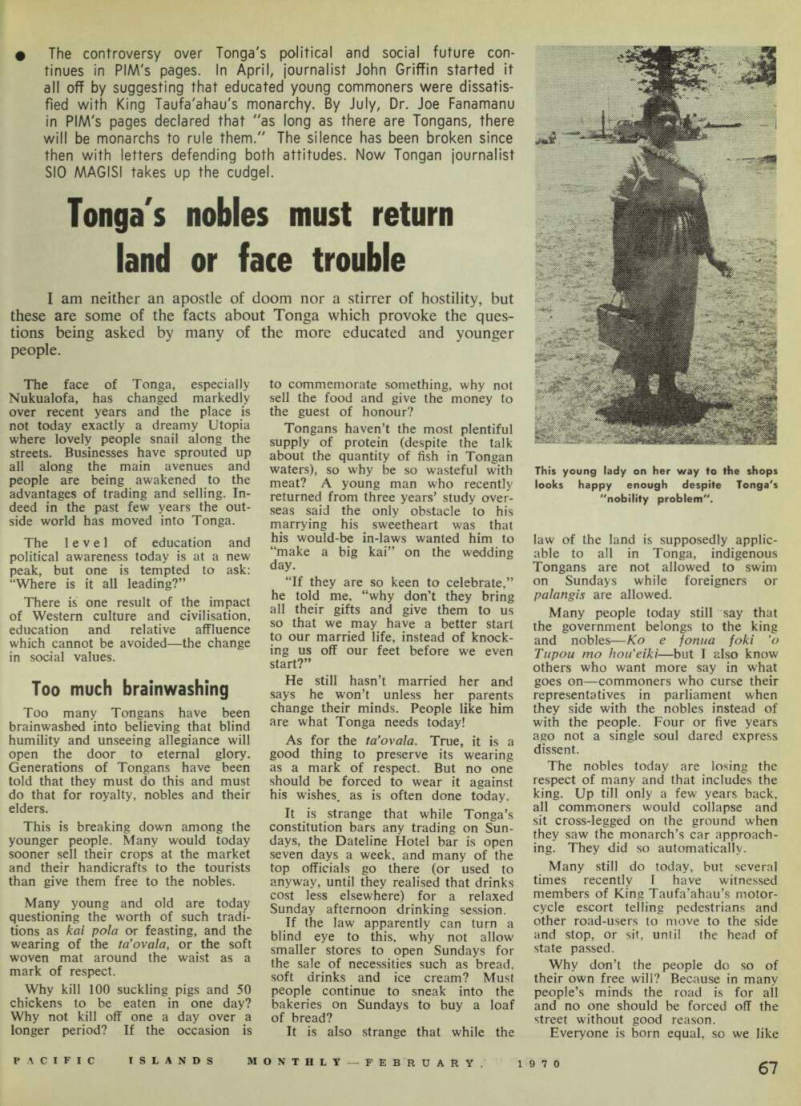
This young lady on her way to the shops looks happy enough despite Tonga's "nobility problem".
More equal than
to think. But some are born more equal than others. This was evident at a parade of floats at the malae grounds adjoining the royal palace in Nukualofa. It was attended by King Taufa’ahau and Queen Mata’aho.
Many Tongans wanted to get a better view of what went on. Proud mummies wanted to see their smiling children on the floats; youths and young ladies wanted to see their sweethearts; and many wanted to take pictures.
But no, they were told to sit on the ground the whole time. A high ranking police officer loudly threatened to throw in gaol people who wanted to stand to get a better view.
Why force the locals to sit while every two-bit yachtsman and beach comber from foreign lands can stomp around freely?
It is a long-established custom to sit in the presence of royalty and superiors . but many people now question the worth of the tradition.
I admit that it would be harmful if all Tongan customs were to be done away with overnight, but some are not right, and these should be re moved as soon as possible.
The land problem
What if young people have more money in their pockets, what will they do in their leisure time? It is true some have land or their fathers’ which they could work, but some don’t have any at all. There are adults who don’t even have land to farm for themselves.
Idle land in the hands of the nobles today could be more profitably used by many commoners. I know the government is supposedly trying its best to give all those eligible their dues.
The land problem in Tonga is a dicey one.
One economist told me: “The nobles are very much in a dilemma. They will either have to share out their land, much of which is idle any way, and work only that which they can manage. Or they can hold on to their land for ever while many go without, and thus contribute to un rest which will inevitably accrue.”
Either way, the nobles stand to lose something. As I see it, they must be prepared to give away all the land they don’t or can’t culti vate. It is a hard decision, but it is the only honourable way out. To hang on to everything regardless would be folly.
The logical solution seems to be the abolition of the poll tax and its replacement by a land tax.
That way those with large land holdings who cannot work them profitably, will be forced to surrender part, to be shared out to those with out land. If on the other hand the nobles would still want to hold on to their land, they would be forced to put the land to better use, thus increasing its productivity.
The enforcement of the poll tax is unfair. Why should every male over 16 have to pay poll tax when many don’t even have any land by which to earn that money, and there aren’t enough jobs for them to get the money to pay it? Some steal to pay it off.
There is substance in the com ment of a young man as related by Mr. Griffin: “The nobles and royalty treat us like dogs sometimes . . ~” the emphasis being on the word sometimes. Which is to say that not all the nobles and royalty are bad to us commoners all of the time.
Much of Dr. Fanamanu’s article is
No one should behave like this, let alone leaders and would-be leaders.
I venture also to disagree with Dr.
Fanamanu when he said he was cer tain “there are no facts whatsoever to justify their discontent with the royalty and nobility”, and that “scientists have found that a popula tion that clamours for drastic change is a population of misfits.”
Most commoners in Tonga would surely agree that the first statement is at least too sweeping. As for the second, I think it can be looked at from another angle. Are people who want change always misfits? Or can it be that the circumstances and en vironment in which they live are in need of change so the people will enjoy a better life?
US emigration
Not long ago most everyone preached that Tongans should stay home and build up their country.
Most fervently in favour of this were church leaders and ministers. But only recently a large congregation
correct, but may I venture to disagree with his claim that “a noble, if in volved in an argument, is usually quiet and diplomatic and shows a high degree of patience and toler ance,” whereas a commoner “will argue at the top of his voice. . .
I have been to the hotel many times and seen at least four nobles and nobles’ heirs argue and talk like angry dogs, behaving in an uncouth manner. They didn’t seem to have much patience and saw no obstacle to shouting down their opponents or in one way or another try to win an argument unfairly.
was told by a man just back from the United States that they should all try to emigrate there.
Many others agree off the pulpit.
Even the patient and enduring church folk are beginning to think that Tonga is not quite the promised land, an idea inculcated in them by their forefathers.
Tongan stowaways must rank among the most spirited and per sistent in the world, taken on a per capita basis. Methinks it is not for mere adventure!
Most of the more unyielding and case-hardened stowaways are hauas
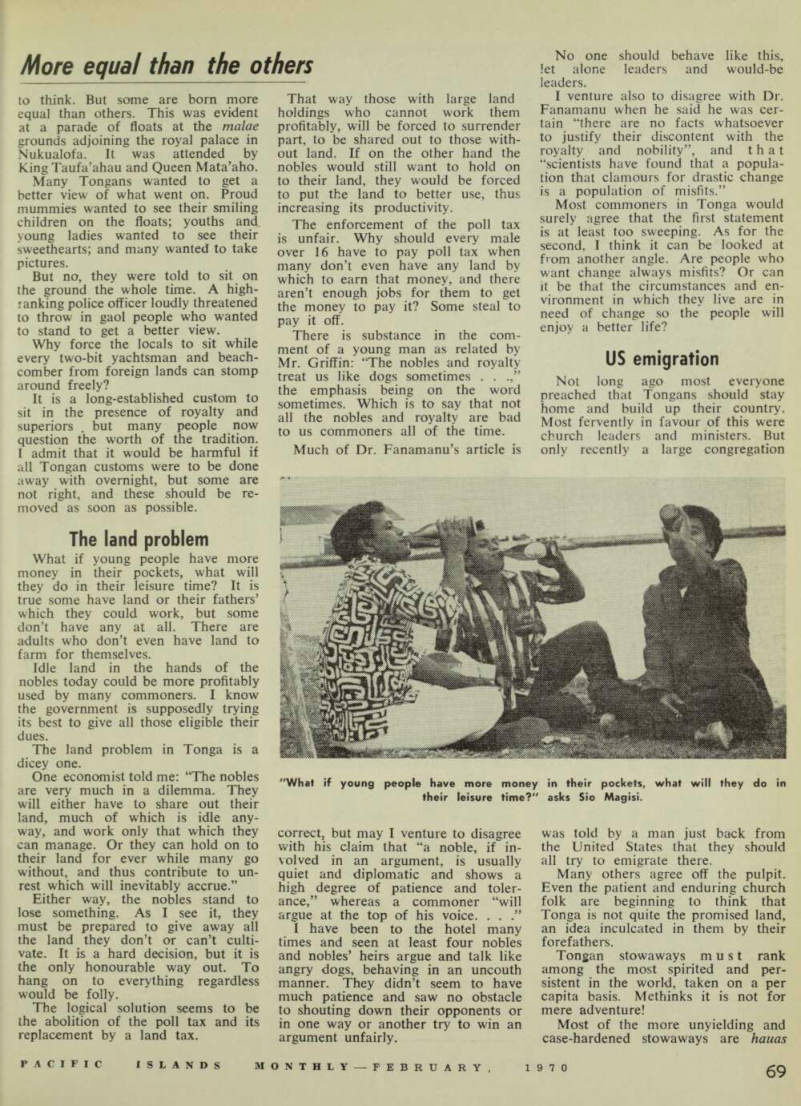
"What if young people have more money in their pockets, what will they do in their leisure time?" asks Sio Magisi.
Don't like the land
or hangabouts with no jobs. Many of them say openly they don’t like working the land but would willingly take up a town job. So they continue to hang around saloons and beg out side the main stores from the customers.
Which leads to the question of un employment. If anyone says Tongans are subsistent farmers and therefore don’t really need jobs, why then did 57 people apply for the one $5-a-week junior clerk vacancy recently adver tised by the government.
One does not really have to look hard to find discontented people even in the civil service.
Civil servants’ chagrin is often mentioned among themselves, but none or few dare inform the author ities. Most probably because they fear losing their jobs and the social and economic implications which will follow; or perhaps because they have been brainwashed into accepting blind loyalty and quiet suffering at all times under all circumstances.
But this is changing slowly as more indigenous Tongans return from over seas studies, training and so on. It is sad, however, that many of these return bristling with new ideas on improvement and reform, only to give way to pressure from parents and others, especially older people.
Now is the time
Some get in well with the author ities, get a good salary and succumb to their demand for the maintaining of the status quo, thus forgetting their own desires for reform.
One young teacher with a degree from New Zealand told me; “Now is the time for our government to start introducing changes according to the needs of today. These older people holding the reins today will die off in a relatively short time. If they don’t start carefully delegating authority gradually to their young successors, but hold on as long as possible, what will happen when they die? It’s anybody’s guess.
“Parliamentary representation should be dealt with in a similar manner.
Continue with unequal representation and a time will come when the pot will boil over.” There are seven nobles representing 33 nobles, while the same number represent about 79,000 commoners.
Labourers on the wharf and other places are talking more often of go ing on strike to get wage increases.
Said one: “All we need is a leader.
The only way to get increased pay
is to strike. Look at what strikes achieve for workers overseas. But the trouble in Tonga is the over abundance of labour.
“While many would agree to strike, others will come in and work for even lower wages. But I think if someone starts a union of workers, we would be quite a force.”
Nobody likes to think these things are found in Tonga. Nobody likes to think they exist anywhere. Nobody wishes Tonga to lose its placidity, its warm benign people. Nobody wants the archipelago to go down in history as the last outpost of Polynesian royalty. No well-adjusted person likes to see dissatisfaction or violence in the land.
But to say that Tonga is Utopia is to do ourselves a gross injustice.
To say that Tonga will undergo a drastic change in leadership in five or 10 years is also probably wishful thinking. One can only hope that the leaders will modify their stand, not just for the sake of doing so, but in order to suit the needs and thinking of tomorrow’s leaders and followers in the new environment in which they will live.