* Footnotes
pp. 53-54 · Read in the full issue
After the resounding silence of both of Australia’s major political parties on Niugini during the recent federal elections, Mr.
Whitlam’s kite-flying, coat-trailing tour of the territory is to be welcomed. Whatever may be thought of his proposed target dates for home rule and independence, his stance is at least preferable to Mr. Barnes’ cherrystone policy ( sometime, never, and in the meantime I’m king of the castle).
Mr. Barnes has given us at various times three different formulae “when they want it”, “when they ask for it”, and “when they’re ready for it”. Even when it has been decided who “they” are, there can still be three different answers.
The plain fact is that there seems to be no likelihood at all that Niu ginians can agree among themselves on this issue. There are the right wingers who don’t want target dates at all, the left-wingers who want early target dates, and the middle-of the-roaders who, while reluctant to commit themselves to the dates they want, think that targets must be set now to ensure that progress towards them may be made.
I no longer support, as I once did, the view that the people of Niugini should be left to decide this issue for themselves. I now believe that Aus tralia, as the administering power, has both the right and duty to fix target dates for us, and I believe that if it doesn’t exercise this right and execute this duty internal dis sension on the issue may well become so acute as to lead to strife and even to fragmentation. Already the left-wingers are charging the right-wingers with being colonialist stooges, while the right-wingers are accusing the left-wingers of trying to “bagarap” the country. The fact that the cleavage is to a considerable extent, though not entirely, a regional one makes it all the more serious.
Surely right
To say that in this matter the numerical majority (in practice a Highland majority) must prevail is unrealistic, and Mr. Whitlam was surelv right in rejecting the idea of a referendum. National unity cannot be achieved in this way. But if both radicals and conservatives were faced with a target date set by Australia as the administering power, there is a good chance that they would be
able to get together amicably to work out a modus operand! for the change.
On the question of independence I am inclined to agree with those who say “Let’s see how we get on with home rule first before we make up our minds about independence”.
It cannot be too strongly stressed that the administering power is Aus tralia, not the Liberal-Country Party Coalition nor the ALP. One might have hoped that those who are so fond of telling us that we are not yet mature enough to govern our selves would themselves show enough maturity to evolve a national non party policy on Niugini. How can we be expected to plan intelligently for our own future when that future depends on the swing of the party political pendulum in Australian elections fought on issues uncon nected with Niugini? The introduc tion of home rule for Niugini should be related to circumstances in the Niugini legislature, not to those in the Australian legislature.
Long standing expectations that the so-called “Independent Group” in the House of Assembly would soon become a narty have recently taken a more definite form with a promise of help from the Australian Country Party, and the announcement by Ministerial Member for Public Health, Tore Lokoloko (made oddly enough in Singapore on his way back from a visit to the U.N. and a world
tour), that a party is about to be formed and that it will have a voting strength of 70 in the House.
Mr. Lokoloko’s estimate is almost certainly over-optimistic. But his party (or is it Wally Lussick’s party?) may well be able to com mand a majority in the House. If it can do this, there does not seem to be any good reason why it should not take over the Government benches from the official members.
Even if it doesn’t actually ascend the throne it will become the power behind the throne, and if it is able to retain its majority at the 1972 elections it will hardly be possible to continue to withhold the outward trappings of power from a party already exercising its realities.
The possibility of an intriguing double irony therefore opens up be fore us. The conservatives in the House, who have consistently opposed early home rule, may themselves forge the instrument by means of which it will be secured. For on the one hand effective self-government is impracticable without a majority party or coalition of parties in the House, and on the other the estab lishment of such a majority will speedily render the withholding of self-government impossible.
The second irony is that Mr.
Whitlam’s promise of home rule in 1972 may involve a labour govern ment in Australia handing over
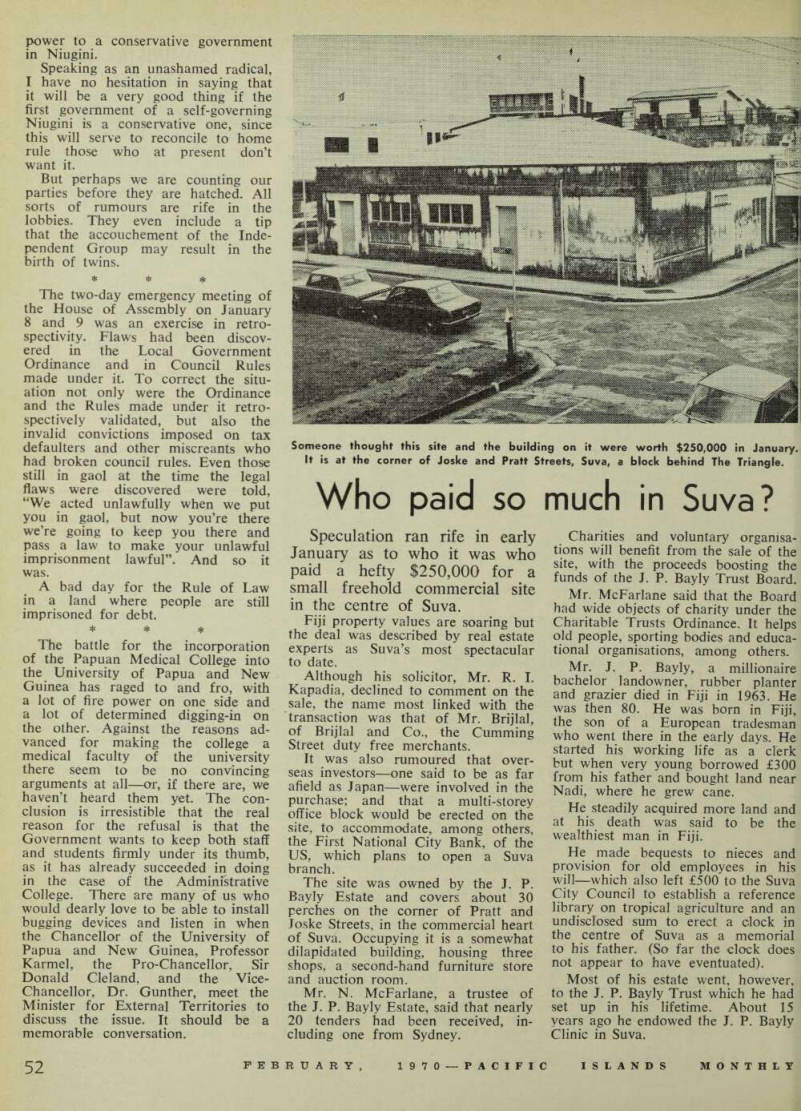
New Guinea poli tician Percy Chatter ton supplies foot notes to the month's news.
power to a conservative government in Niugini.
Speaking as an unashamed radical, I have no hesitation in saying that it will be a very good thing if the first government of a self-governing Niugini is a conservative one, since this will serve to reconcile to home rule those who at present don’t want it.
But perhaps we are counting our parties before they are hatched. All sorts of rumours are rife in the lobbies. They even include a tip that the accouchement of the Inde pendent Group may result in the birth of twins. * * * The two-day emergency meeting of the House of Assembly on January 8 and 9 was an exercise in retro spectively. Flaws had been discov ered in the Local Government Ordinance and in Council Rules made under it. To correct the situ ation not only were the Ordinance and the Rules made under it retro spectively validated, but also the invalid convictions imposed on tax defaulters and other miscreants who had broken council rules. Even those still in gaol at the time the legal flaws were discovered were told, “We acted unlawfully when we put you in gaol, but now you’re there we’re going to keep you there and pass a law to make your unlawful imprisonment lawful”. And so it was.
A bad day for the Rule of Law in a land where people are still imprisoned for debt. * * * The battle for the incorporation of the Papuan Medical College into the University of Papua and New Guinea has raged to and fro, with a lot of fire power on one side and a lot of determined digging-in on the other. Against the reasons ad vanced for making the college a medical faculty of the university there seem to be no convincing arguments at all—or, if there are, we haven’t heard them yet. The con clusion is irresistible that the real reason for the refusal is that the Government wants to keep both staff and students firmly under its thumb, as it has already succeeded in doing in the case of the Administrative College. There are many of us who would dearly love to be able to install bugging devices and listen in when the Chancellor of the University of Papua and New Guinea, Professor Karmel, the Pro-Chancellor, Sir Donald Cleland, and the Vice- Chancellor, Dr. Gunther, meet the Minister for External Territories to discuss the issue. It should be a memorable conversation.