Lost without
pp. 48-49 · Read in the full issue
trace!
• Papua-New Guinea is one o> the most dangerous flying countries in the world, with its 15,000 ft mountains, steep gorges and dense jungle. Bu' pilots are essential in some areas where the entire economy still rests on aviation. The island's flight record is pretty good considering the route passenger miles flown—but this is the latest aviation tragedy as told by JOHN RYAN from Port Moresby.
For Cecil Randall, one oj Papua-New Guinea’s most ex
perienced pilots, flying danger
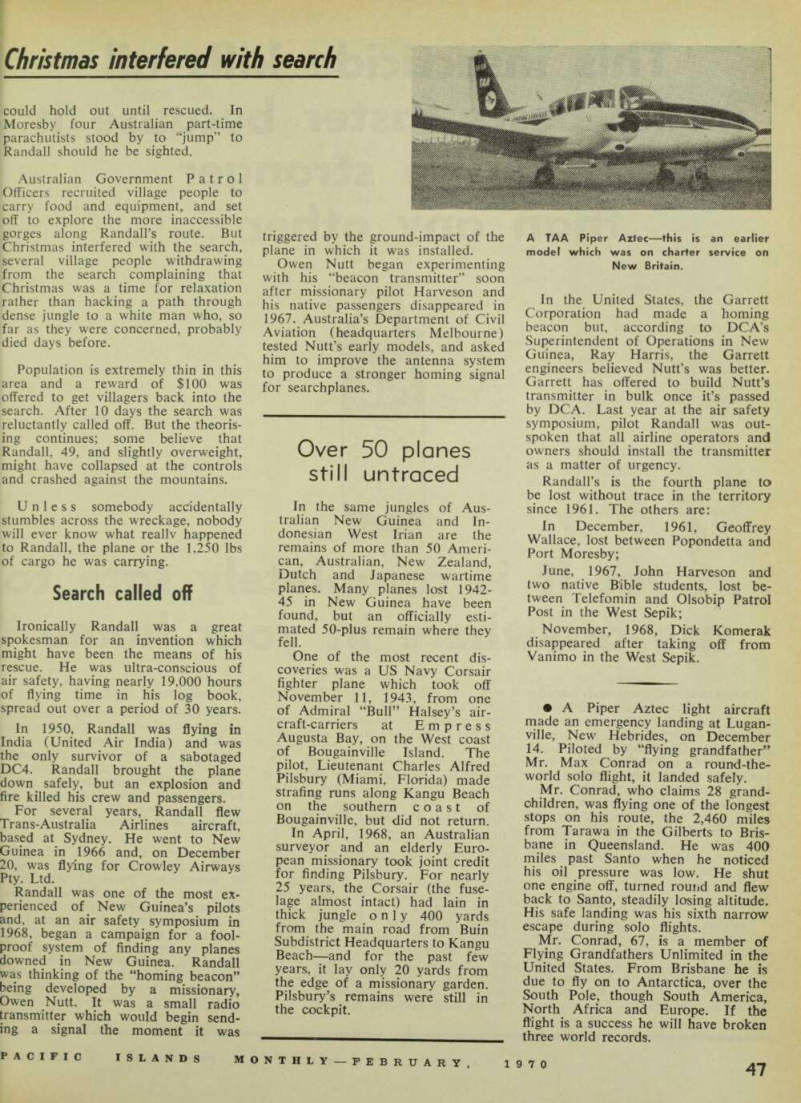
ously was just routine. But or December 20 last year he tool! off on a fateful flight in his twin-engined Aztec Pilot to fh from Yalamet, on the Huge Peninsula, 15 miles through z 12,000 foot gorge to the patro! station of Kabwum. He hasn’l been seen since and neither has
his plane.
For the next 10 days up to 2C aircraft with volunteer pilots anc observers scanned the mountair country around Kabwum anc Yalamet. Australian army helicopters from Igam Barracks near Lae, were brought in, some of them flown b} pilots with recent experience ir Vietnam.
Some of the gorges in the mountair search area were so “tight” that fixed wing aircraft sometimes had to pul] out for fear of collision and furthei deaths. The helicopters searched the more difficult areas, hoping for signs of broken trees or the glint of metal, Two hundred miles away in Pori Moresby, search co-ordinator Stanley Richardson knew Randall had re cently taken a jungle-survival training course, and the search going on the ground in the hope that Randall had come down safely and
Christmas interfered with search
could hold out until rescued. In Moresby four Australian part-time parachutists stood by to “jump” to Randall should he be sighted.
Australian Government Patrol Officers recruited village people to carry food and equipment, and set off to explore the more inaccessible gorges along Randall’s route. But Christmas interfered with the search, several village people withdrawing from the search complaining that Christmas was a time for relaxation rather than hacking a path through dense jungle to a white man who, so far as they were concerned, probably died days before.
Population is extremely thin in this area and a reward of Sioo was offered to get villagers back into the search. After 10 days the search was reluctantly called off. But the theoris ing continues; some believe that Randall, 49, and slightly overweight, might have collapsed at the controls and crashed against the mountains.
Unless somebody accidentally stumbles across the wreckage, nobody will ever know what reallv happened to Randall, the plane or the 1,250 lbs of cargo he was carrying.
Search called off
Ironically Randall was a great spokesman for an invention which might have been the means of his rescue. He was ultra-conscious of air safety, having nearly 19,000 hours of flying time in his log book, spread out over a period of 30 years.
In 1950, Randall was flying in India (United Air India) and was the only survivor of a sabotaged DC4. Randall brought the plane down safely, but an explosion and fire killed his crew and passengers.
For several years, Randall flew Trans-Australia Airlines aircraft, based at Sydney. He went to New Guinea in 1966 and, on December 20, was flying for Crowley Airways Pty. Ltd.
Randall was one of the most ex perienced of New Guinea’s pilots and, at an air safety symposium in 1968, began a campaign for a fool proof system of finding any planes downed in New Guinea. Randall was thinking of the “homing beacon” being developed by a missionary, Owen Nutt. It was a small radio transmitter which would begin send ing a signal the moment it was
triggered by the ground-impact of the plane in which it was installed.
Owen Nutt began experimenting with his “beacon transmitter” soon after missionary pilot Harveson and his native passengers disappeared in 1967. Australia’s Department of Civil Aviation (headquarters Melbourne) tested Nutt’s early models, and asked him to improve the antenna system to produce a stronger homing signal for searchplanes.
In the United States, the Garrett Corporation had made a homing beacon but, according to DCA’s Superintendent of Operations in New Guinea, Ray Harris, the Garrett engineers believed Nutt’s was better.
Garrett has offered to build Nutt’s transmitter in bulk once it’s passed by DCA. Last year at the air safety symposium, pilot Randall was out spoken that all airline operators and owners should install the transmitter as a matter of urgency.
Randall’s is the fourth plane to be lost without trace in the territory since 1961. The others are: In December, 1961, Geoffrey Wallace, lost between Popondetta and Port Moresby; June, 1967, John Harveson and two native Bible students, lost be tween Telefomin and Olsobip Patrol Post in the West Sepik; November, 1968, Dick Komerak disappeared after taking off from Vanimo in the West Sepik. • A Piper Aztec light aircraft made an emergency landing at Dugan ville, New Hebrides, on December 14. Piloted by “flying grandfather”
Mr. Max Conrad on a round-the world solo flight, it landed safely.
Mr. Conrad, who claims 28 grand children, was flying one of the longest stops on his route, the 2,460 miles from Tarawa in the Gilberts to Bris bane in Queensland. He was 400 miles past Santo when he noticed his oil pressure was low. He shut one engine off, turned round and flew back to Santo, steadily losing altitude.
His safe landing was his sixth narrow escape during solo flights.
Mr. Conrad, 67, is a member of Flying Grandfathers Unlimited in the United States. From Brisbane he is due to fly on to Antarctica, over the South Pole, though South America, North Africa and Europe. If the flight is a success he will have broken three world records.
A TAA Piper Aztec —this is an earlier model which was on charter service on New Britain.