The Editor's Mailbag
pp. 34-35 · Read in the full issue
"Poranui" Stranding
Sir.—l have just read your article on the stranding of the vessel Poranui (p. 24, January), and 1 am dismayed at the disparaging way in which you have reported this news item.
To some readers your article would suggest some lack of ability and responsibility on the part of Cap tain Rusden. In fact, nothing could be further from the truth. As brokers for the sale of the vessel, we are able to state that having just com pleted survey, the vessel was ex tremely well found and properly manned. As New Zealand managing agents, we know Captain Rusden to be a careful and prudent operator who has lost heavily with the series of unfortunate strandings, and particularly in the case of Poranui, which was fully booked for several months ahead.
Rather than ridicule, this man deserves and no doubt will receive from “seadogs”, some measure of sympathy and admiration for his ability to bounce back. Please, no more articles in this vein, they create the wrong impression and can do a great deal of harm to a man who has done much to develop trade in the Pacific Islands.
(Capt.)
S. Oates.
Trans Pacific Marine Ltd., Auckland, NZ.
Where's Button?
Sir, —Several histories of World War II in the Pacific mention a US air base with the code name of “Button” that played a major part in the invasion of Guadalcanal. The location is always given simply as “Espiritu Santo”.
Does anyone recall more exactly where “Button” was? In particular, I wonder if it was the same as the present commercial field on the south end of the island, also listed (in air line timetables) simply as “Espiritu Santo”.
I have talked to veterans here but they do not remember their geo graphy well enough. I also failed to get an answer during a very brief stop at the present field.
Albert C. Andrews.
Berea.
Ohio, USA.
Where Time Really Ends
Sir, —On a recent trip from Tahiti to Australia I stayed for a few days at Tonga’s Dateline Hotel. Not to go into details about the so-called “Friendly Islands”, I found services provided very inadequate.
“Tonga, where time begins”, one reads as one enters the hotel, but instead it should read “Tonga, where time ends”, because time begins east of the International Dateline— and Tonga is west of it. There might be no other place where the clock shows a later time than in Tonga, but time, that means every day, begins east of the dateline, so Tonga is the place where time ends—and it really does!
Hans G. Allies.
Elizabeth Bay, Sydney, NSW. • Mr. Allies is scientifically right.
By decree, not geography, the date line is “bent” around Tonga— probably as an old colonial device to keep it in the same time zone as Fiji which did the bending in 1879 so that western Fiji would not be 24 hours behind eastern Fiji. Now that Tonga has shaken off all the colonial shackles it perhaps should consider bending it back again.
The Royal Annulment
Sir, —It was world wide news when Joshua Liava’a, a 21-year-old Tongan commoner, married the lovely Tongan Princess Mele Siuilikutapu, daughter of the Pre mier, Prince Tu’ipelehake. Everyone likes such a romance and it was a top story in Sydney featuring a full length photo of the smiling princess in her wedding gown.
However, Princess Mele has been lured back to Tonga and reports have it she is virtually a prisoner there. Liava’a has a letter from her smuggled out of the palace to verify this.
I ask, what kind of disgraceful affair is this? Why is everybodv so silent and secretive on the matter?
It is surprising that in this day and aee, in Tonga suoposedty cahed the “friendly” islands, this shameful thing should occur. A happy mar riage broken up for vague and shadowv reasons Liava’a, a close friend of mine.
is a student at the Auckland Uni versity doing his scholarship from the: Tongan Government, but since he dared to marry a royal princess hi& very future is in doubt. He is bothi helpless and rightly indignant andi mystified.
Certainly, there must be many people besides myself who are asking, what is the full story and explanation behind the kidnapping of Liava’a’s bride?
Alilia Langi.
Sydney, NSW.
Sir, —I refer to your article in PIM, January, regarding the annul ment of the marriage of the royal princess, Siuilikutapu, and Siosiua Liava’a.
Many hearts were touched by the story of “the princess and the pauper” and by the deep love obviously shared by Liava’a and his princess.
Tonga is way behind the times in some of her old-fashioned cus toms and laws, which should have been changed years ago. Princess Margaret of England, to name jusl one, married a commoner (just £ photographer) without interference from her family or her people. Man} other European princesses have mar ried the man of their choice outside their own royal circle.
As a Tongan and fellow universit} student of Liava’a’s, I wish to sa} I am but one of many Tongans whe certainly do not support the annul ment. In fact, some of us con sider it a disgraceful thing, and an not afraid to say so plainly.
Joe Fotu
Bondi Junction, Sydney, NSW.
Sir, —I was stunned and shocke< when I read your article abou Tonga’s princess and the dissolutioi of her marriage. It is incompre hensible that such a thing coul< happen and the custom is both to< harsh and void of pity.
The princess surely is a free citizei quite able to make her own choio and decision and the man she chosi seems to be a decent, clean livin; man.
I can only state that my opinioi of Tonga has gone down a lot sine reading the almost unbelievable pro clamation issued by the King o Tonga. If the matter were not ver serious and a young girl’s happines at stake, the whole thing would b laughable.
(Mrs.) R. D. Finlayson.
Paddington, Sydney.
Delayed Happening
Sir, —John Ryan’s article "In New Guinea it’s been a happening poli tical month” (“ PIM", Dec., p. 22) says: “The ministerial vehicle (in Australian political colours) took to the road on November 19 when the six native MHA’s called Ministerial Members were given departmental status equal to the directors. And if MHA’s and directors squabble behind the wheel, the Administrator, Mr. D.
O. Hay, is in the back seat to settle arguments,”
This is interesting in comparison with your May editorial (p. iii) which reads: “Under last year’s amendments to the Papua-New Guinea Act, which is the territory’s consti tution, the seven Ministerial Members in the 94-member Assem bly have far more authority than any of them has yet taken.
“They are empowered (your italics) to exercise joint authortiy with the departmental heads and to initiate and formulate policies.
If they can’t get their departmental head to agree on a matter they can refer it to the Administrator for decision.”
I would be interested in hearing your comments on these two articles in the light of which it would appear that the Canberra decision of November was not such “a momen tous political move”. Or was it?
Julienne Pullman.
RabauL P NG. • If our correspondent really wants our comment it's just that in New Guinea happenings, like most other things, take a long time to happen.
Footloose, They Say
Sir, —A friend and I plan to work our way to the South Pacific area before we settle down to our life’s work. I am 23, a graduate of a business accounting school. He is a mechanical engineer. We are still single and footloose and hope to see, enjoy and explore all those lands we have read about Tahiti, Australia, Tonga, the Solomons, New Zealand, Ellice and Gilberts and New Caledonia and all the rest.
I hope that dozens of your readers will write me and tell me something about any or all of these places— or others—so we will have a better knowledge of where to go and what to do.
M. B. Sledge.
1101 Washington St., Macon, Mississippi, 39341. • Whnt an optimist. It's well known that Islands residents never
write letters if they can avoid it.
Mr. Sledge should buy a copy of the “Pacific Islands Year Book" which tells all, including the fact that he'd have to be dead lucky to get a job in Tahiti, Tonga, Gilbert and Ellice and even New Caledonia.
The rest should be easy.
Dr. Laycock's Pidgin
Sir, —I quite enjoyed Dr. Don Laycock’s article on Pidgin {PIM, January, p. 45), at least up to the point when he considered something “so obscene that it cannot even be translated here”. I suggest that he recheck his “indispensable” Mihalic dictionary, only this time look under the K’s. A reasonably natural mis take, if one considers the normal territory-wide fixation in this regard.
Anyway, not to worry; but it is amazing what a small gravy stain can do to louse un an otherwise immaculate white shirt.
James L. Koeser.
Angoram, New Guinea.
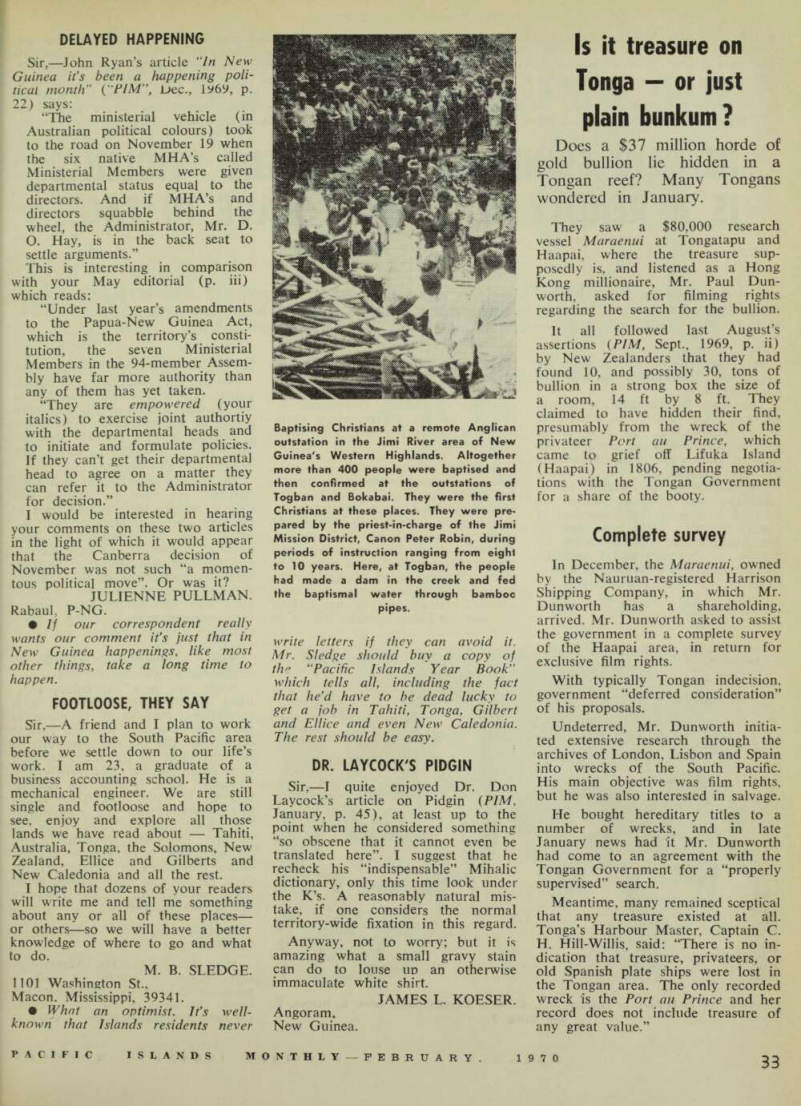
Baptising Christians at a remote Anglican outstation in the Jimi River area of New Guinea's Western Highlands. Altogether more than 400 people were baptised and then confirmed at the outstations of Togban and Bokabai. They were the first Christians at these places. They were pre pared by the priest-in-charge of the Jimi Mission District, Canon Peter Robin, during periods of instruction ranging from eight to 10 years. Here, at Togban, the people had made a dam in the creek and fed the baptismal water through bamboo pipes.