for Australian party politics
pp. 29-30 · Read in the full issue
New Guinea becomes battlefield for Australian party politics
• New Guinea has been over-exposed in Australia in the last month, due to the coat-trailing visit of Opposition Leader Whitlam and the continuing controversy over the Mataungan Association. One result of it all is that many Australians are getting fed up with New Guinea and see in it nothing but potential trouble. It will be Australians who have it in their power to make Mr. Whitlam the next Australian Prime Minister, or withhold that plum. It won't be the Mataungan Assn. This account of the visit from JOHN RYAN in Port Moresby.
Australia’s Labour Opposition Leader Mr. Gough Whitlam has flung down the gauntlet—and New Guinea is to become a “political football” in Australia’s domestic politics.
The ‘gentlemen’s agreement’ tacitly responsible for keeping New Guinea out of ‘hard politics’ by the Liberal, Country and Labour parties has been broken.
Whitlam: “The consensus which existed on New Guinea under Sir Paul Hasluck’s administration has broken down under Mr. Barnes. . .
In polite terms Mr. Whitlam was saying that Labour was reasonably happy with the Liberal-Country Coalition Government’s general New Guinea policies while Sir Paul Has luck was Minister for External Ter ritories (1951-1963) but that since Mr. C. E. Bames took over. Labour’s “hands-off” policy has changed.
It certainly changed dramatically during the Whitlam party’s December 28-January 12 P-NG tour and sparked off a personal row between Whitlam and the Prime Minister, Mr.
Gorton.
Behind the scenes
Throughout the Whitlam tour, two other Labor men, Mr. Kim Beazley (Fremantle, Western Australia) and Mr. W. G. Hayden (Oxley, Queens land), were busy behind the scenes on everything from wages to union and political party growth, to “high handed taking of native land” on Bougainville and on the Gazelle Peninsula of New Britain.
The tour, as it happened: • First stop Daru Island in West ern Papua, where Mr. Whitlam examined the Queensland State border which follows the Papuan coast for 60 miles and, at one point (Kussa Island near Boigu Island), comes within 400 yards of the Papuan beach.
Queensland fixed the border in
1878 and an attempt in 1898 by British New Guinea’s Sir William MacGregor to have it withdrawn 37 miles from Papua’s coast went to the Executive Council, London, but was “lost” in the hurly-burly of Federation (1901) in Australia.
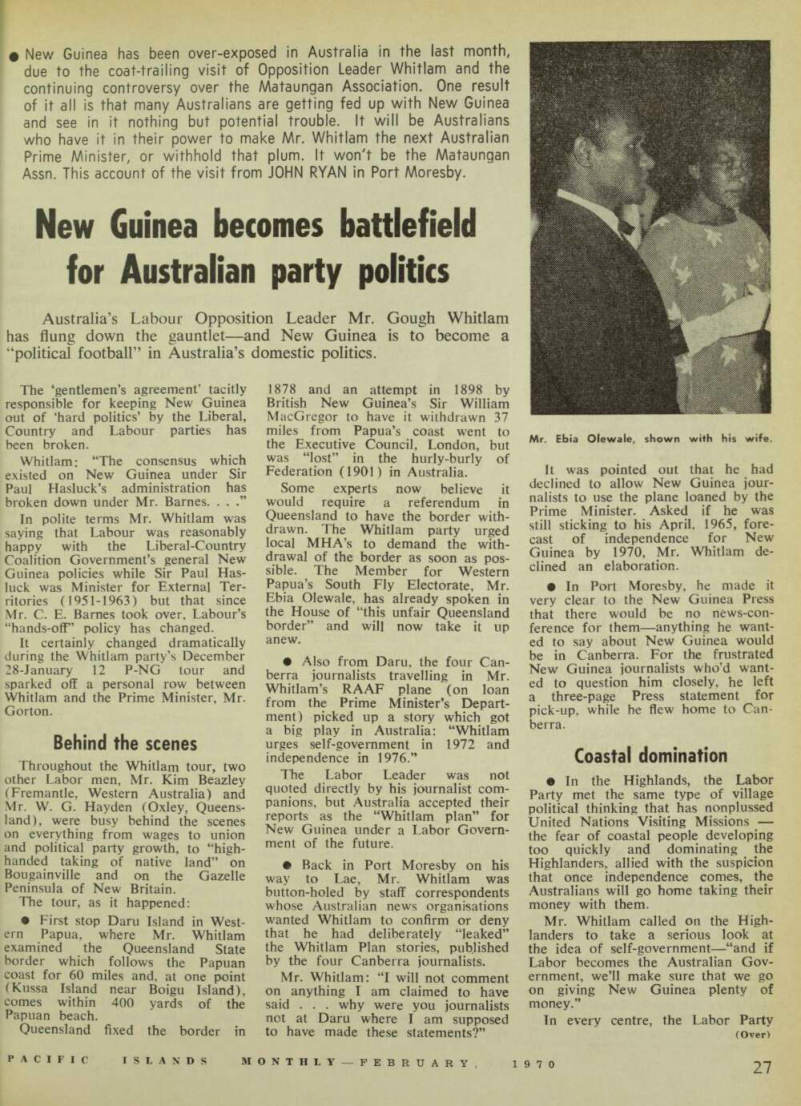
Some experts now believe it would require a referendum in Queensland to have the border with drawn. The Whitlam party urged local MHA’s to demand the with drawal of the border as soon as pos sible. The Member for Western Papua’s South Fly Electorate, Mr.
Ebia Olewale, has already spoken in the House of “this unfair Queensland border” and will now take it up anew, • Also from Daru, the four Can berra journalists travelling in Mr.
Whitlam’s RAAF plane (on loan from the Prime Minister’s Depart ment) picked up a story which got a big play in Australia: “Whitlam urges self-government in 1972 and independence in 1976.”
The Labor Leader was not quoted directly by his journalist com panions, but Australia accepted their reports as the “Whitlam plan” for New Guinea under a Labor Govern ment of the future. • Back in Port Moresby on his way to Lae, Mr. Whitlam was button-holed by staff correspondents whose Australian news organisations wanted Whitlam to confirm or deny that he had deliberately “leaked” the Whitlam Plan stories, published by the four Canberra journalists.
Mr. Whitlam: “I will not comment on anything I am claimed to have said . . . why were you journalists not at Daru where I am supposed to have made these statements?”
It was pointed out that he had declined to allow New Guinea jour nalists to use the plane loaned by the Prime Minister. Asked if he was still sticking to his April, 1965, fore cast of independence for New Guinea by 1970, Mr. Whitlam de clined an elaboration. • In Port Moresby, he made it very clear to the New Guinea Press that there would be no news-con ference for them —anything he want ed to say about New Guinea would be in Canberra. For the frustrated New Guinea journalists who’d want ed to question him closely, he left a three-page Press statement for pick-up, while he flew home to Can berra.
Coastal domination
• In the Highlands, the Labor Party met the same type of village political thinking that has nonplussed United Nations Visiting Missions the fear of coastal people developing too quickly and dominating the Highlanders, allied with the suspicion that once independence comes, the Australians will go home taking their money with them.
Mr. Whitlam called on the High landers to take a serious look at the idea of self-government—“and if Labor becomes the Australian Gov ernment, we’ll make sure that we go on giving New Guinea plenty of money.”
In every centre, the Labor Party (Over)
Mr. Ebia Olewale, shown with his wife.
Highpoint at Rabaul
sought out the known leaders for “pep-talks” on demanding quicker constitutional and political develop ment. In the Highlands, much of the Labor exhortation fell on deaf ears. • It was at Rabaul that Mr. Whit lam reached the highpoint. Address ing several thousand anti-Govemment Mataungan Association Tolai people, he commended Mataungan for its nationalistic fervour in its recent opposition to the Government-backed Gazelle Multiracial Council. Mataun gan, he indicated, was right in what it had been doing—but wrong in re verting on December 7 to violence.
So far as the anti-Mataungan planters, residents and the Gazelle Councillors were concerned, here was Labor Party support for an organisation which had run riot against democratic Government, beaten-up influential leaders among the Tolai people, and drained the Central Treasury (because of police actions) of money vitally needed for general development.
Angrily, the planters cabled Prime Minister Gorton who replied that his Government insisted on law and order with any changes by Mantaun gan, or any other organisation, only through the ballot box. The Prime Minister said Mataungan had been offered a referendum and had refused.
At this point, the old gentlemen’s agreement the “consensus” that Labor speaks of came to an abrupt end.
Labor, said Mr. Whitlam, was not going to stand by and watch the Gorton Government, with ineptitude and lack of respect for village grievances, destroy Australia’s good will in New Guinea.
The sum total of the Whitlam tour: the old rapport between the political parties about the method of developing New Guinea has ended.
Labor is going to make New Guinea a crucial issue in domestic and foreign policy.
Bougainville tragedy
Four men were killed and four were still missing at end of January following a huge landslide of mud and rock on a road being built between Kieta and Panguna, Bougainville, for CRA.
The landslide followed torrential rain.
Those dead are an Australian, an American and two New Guineans. An American, Australian and two other New Guineans are missing.