Only a gust of wind explains 32 air deaths
pp. 26-27 · Read in the full issue
To late January the only apparent cause of the disastrous crash of a Polynesian Airlines DC: near Faleolo airport, Western Samoa, on January 14, was a sudden gust of wind.
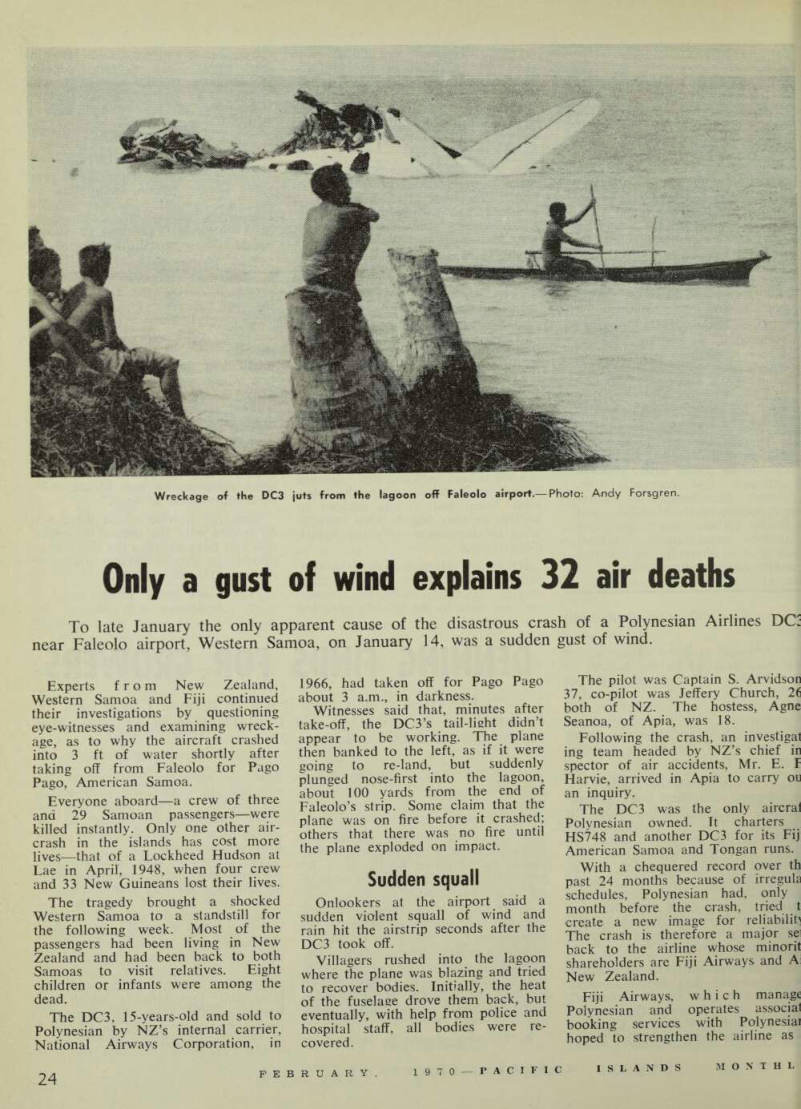
Experts from New Zealand, Western Samoa and Fiji continued their investigations by questioning eye-witnesses and examining wreck age, as to why the aircraft crashed into 3 ft of water shortly after taking off from Faleolo for Pago Pago, American Samoa.
Everyone aboard—a crew of three and 29 Samoan passengers —were killed instantly. Only one other air crash in the islands has cost more lives—that of a Lockheed Hudson at Lae in April, 1948, when four crew and 33 New Guineans lost their lives.
The tragedy brought a shocked Western Samoa to a standstill for the following week. Most of the passengers had been living in New Zealand and had been back to both Samoas to visit relatives. Eight children or infants were among the dead.
The DC3, 15-years-old and sold to Polynesian by NZ’s internal carrier, National Airways Corporation, in
1966, had taken off for Pago Pago about 3 a.m., in darkness.
Witnesses said that, minutes after take-off, the DC3’s tail-light didn’t appear to be working. The plane then banked to the left, as if it were going to re-land, but suddenly plunged nose-first into the lagoon, about 100 yards from the end of Faleolo’s strip. Some claim that the plane was on fire before it crashed; others that there was no fire until the plane exploded on impact.
Sudden squall
Onlookers at the airport said a sudden violent squall of wind and rain hit the airstrip seconds after the DC3 took off.
Villagers rushed into the lagoon where the plane was blazing and tried to recover bodies. Initially, the heat of the fuselage drove them back, but eventually, with help from police and hospital staff, all bodies were re covered.
The pilot was Captain S. Arvidson 37, co-pilot was Jeffery Church, 26 both of NZ. The hostess, Agne Seanoa, of Apia, was 18.
Following the crash, an investigat ing team headed by NZ’s chief in spector of air accidents, Mr. E. F Harvie, arrived in Apia to carry ou an inquiry.
The DC3 was the only aircrai Polynesian owned. It charters HS74B and another DC3 for its Fij American Samoa and Tongan runs.
With a chequered record over th past 24 months because of irregula schedules, Polynesian had, only month before the crash, tried t create a new image for reliability The crash is therefore a major sei back to the airline whose minorit shareholders are Fiji Airways and A: New Zealand.
Fiji Airways, which manage Polynesian and operates associal booking services with Polynesia! hoped to strengthen the airline as
Wreckage of the DC3 juts from the lagoon off Faleolo airport. Photo: Andy Forsgren.
buffer against American interests in the Samoas, rather than as a genuine competitor on the Islands air routes.
Immediately after the crash, Ameri can Samoa’s new Governor, Mr, John Haydon, asked the US Civil Aeronautics Board in Washington to speed up a decision on a US carrier to “supplement” services between the Samoas. American, PanAm, Con tinental and National Airlines in the US have all applied for the route.
In May, 1963, another DC3 of Polynesian Airlines crashed into the sea near Savaii, Western Samoa, soon after taking off from Faleolo. All aboard—two Americans and a New Zealander—were killed and a subse quent inquiry found the “probable cause” was a faulty air stair door breaking loose and hitting the tail structure.
Pending results of the current in quiry, night flying in Western Samoa has been suspended. Polynesian has continued services, with its chartered aircraft, on a restricted basis.
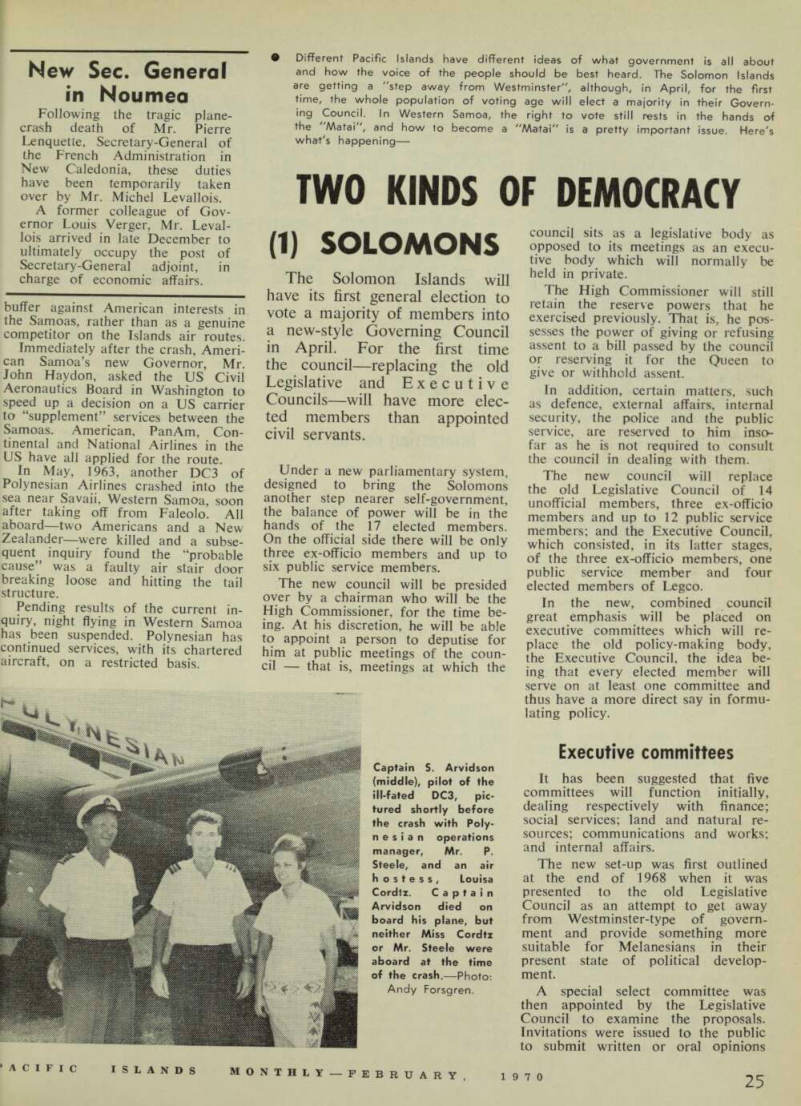
Captain S. Arvidson (middle), pilot of the ill-fated DC3, pic tured shortly before the crash with Poly nesian operations manager, Mr. P.
Steele, and an air hostess, Louisa Cordtz. Captain Arvidson died on board his plane, but neither Miss Cordtz or Mr. Steele were aboard at the time of the crash. —Photo: Andy Forsgren.