The Practical Planter
pp. 135-145 · Read in the full issue

The Right Ways Of Harvesting
And Packing Bananas
From “Banana Production in the South Pacific”, a handbook edited by MICHEL LAMBERT and shortly to be published by the South Pacific Commission.
Whether bananas are handled, packed and shipped by individual growers, co-operative packing houses or government bodies, the treatment the fruit receives should at all times be such that it reaches the consumer in sound, clean and attractive condition. To achieve this result, the basic principles of handling and packing must be considered, and practices from when the bunch is cut, right through all the various handlings to when the fruit is sold in the shop, be careful and gentle.
Bananas for market, particularly sxport markets, need to be grown veil, in well cared for plantations hat are vigorous and kept free from jests and diseases that can affect the ;xternal and internal conditions of 'ruit on the bunch.
As the skin of green bananas is rery tender and susceptible to dam ige and abrasions that develop into msightly blemishes later, fruit at ill times should be handled carefully 0 prevent such damage. These ibrasions also allow free entry of jost-harvest diseases that can ruin ;ood fruit.
Cutting bunches
A bunch that is three-quarters full md hard green is mature enough for my market and can be ripened to 1 high quality product. Cut at this stage of development.
Lower the bunch to a convenient leight to harvest by partly cutting ;hrough the pseudostem approxi nately 5 ft from the ground and allowing the stem to bend down.
Stop the bunch dropping to the ground when cutting from the plant, :arry it carefully; if it has to be laid down, lay it in the shade on green banana leaves or strips of green pseudostem.
Bunch transport
Bunches can be carried in vehicles aver long distances with only very slight damage if proper methods are used. Remember that green bananas
will be marked when in contact with any hard or dry material. The best protective cushions for banana bunches are strips of green pseudo stem, green banana leaves and foam plastic.
When loading into a vehicle, fully line all sides and the bottom with strips of spongy pseudostem; cut back the bunch stalk so that it does not stick into other bunches; lay the bunches on their sides and pack them firmly across the vehicle.
Build the load to several tiers, but lay green banana leaves between each tier. The bunches in each tier should be placed in the hollows be tween two bunches below. The com pleted load needs covering with
pseudostem before firmly tying down with rope to make it a tight compact body and prevent individual bunch movement.
Vehicles carrying bunches should strictly limit their speed according to the road condition. Even on first-class roads motor vehicle speed should not exceed 30 mph when loaded with bunches of bananas.
Packing shed
Bananas will receive better hand ling and be better packed when suit able sheds are available to carry out this work. Banana packing sheds whether they be small or large, manually operated or mechanised, should provide the following;—
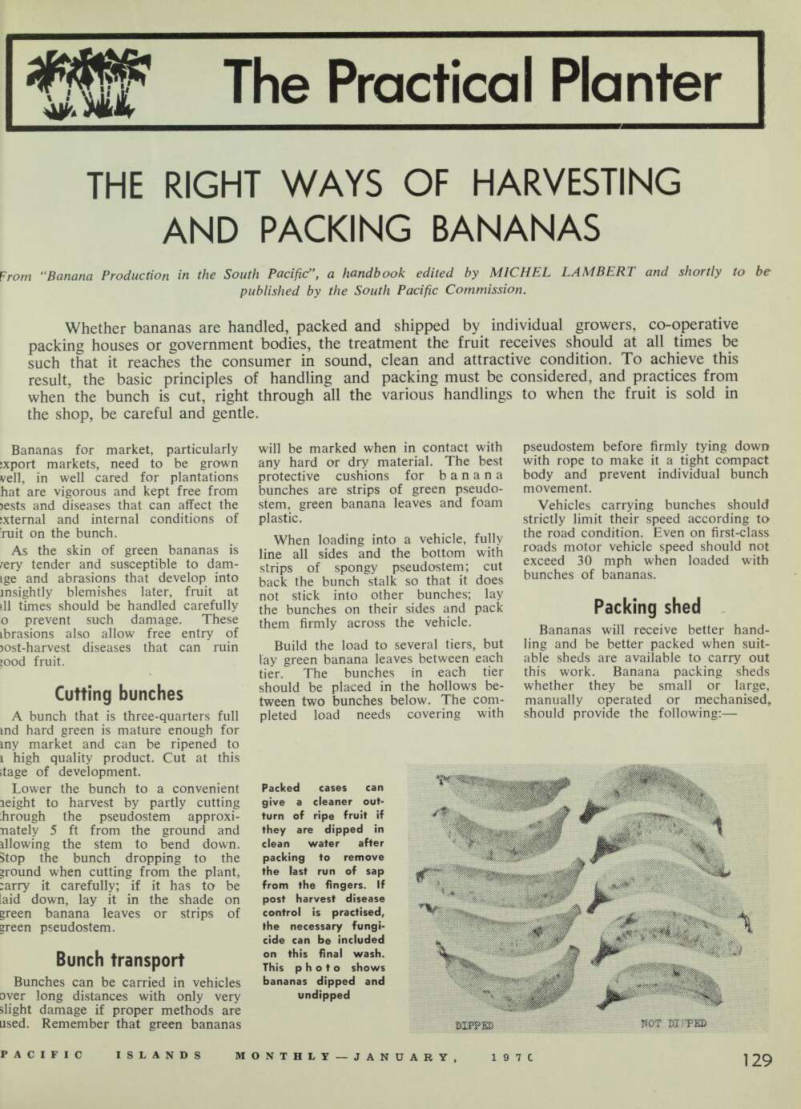
Packed cases can give a cleaner out turn of ripe fruit if they are dipped in clean water after packing to remove the last run of sap from the fingers. If post harvest disease control is practised, the necessary fungi cide can be included on this final wash.
This photo shows bananas dipped and
undipped
Ample space and
• Be located within reasonable distance from where the fruit is grown—within a plantation or ad jacent to it. Fruit can also be trans ported several miles. • Have “all weather” road access to take packed fruit to loading point. • Have ample space and shade to hold bunches brought in for packing. • Have maximum natural air ventilation. • Have sufficient water supply to wash, cool and dip fruit. • Be coloured and designed to re flect heat rather than absorb it.
Colours like white, cream, silver. • Be planned inside to move fruit through the various operations with a minimum of time, movement and handling. • Have a floor that is impervious and well drained. • Have equipment that can be kept clean. • Have space and facilities for stacking packed containers and easy loading for transport.
As most fruit from the territory is packed in singles, the following procedures will produce the best re sults and create the least damage that can later affect the final out turn at the selling point.
Dehanding
Hands can be cut from the bunch with a sharp fine bladed knife. The line on which to cut is naturally and clearly marked on the top side of the cushion of each hand. Follow this line and the fingers can be later broken off without undue wrenching ar damage to the shank of each finger.
It is very important to do this, to assist in the control of “stem end rots”.
Dehanded fruit can be water washed in a vat or on a packing table with hosed water. This operation will remove dirt and other debris such as dead blossoms. Wash off sap that stains and stop the flow of sap. If the water is cool enough, it will re duce pulp temperature when the fruit is drying off.
Sorting and grading
Before the hands are put onto a table for the packers, they should be checked and unsuitable fingers re moved from the hand. These will in clude:— • Dirty fruit. • Undersized fruits. • Mechanically damaged fruit.
• Abnormal fruits in form and shape. • Pest infested or diseased fruit. • Superficially blemished fruit according to the tolerance allowed. • Immature and over mature fruit. • Fruit with damaged shanks and skin stripped ends.
Containers
Whether containers be made of wood or fibre board, they should be:— • New and clean. • Clearly branded on the outside with the correct information. • Securely nailed and closed. • Have no nail points protruding out of the wood. • If wooden cases, lined all round on the inside to prevent shoulder rubbing.
Packing
• Lay the first row of fruits flat on their sides with the stem ends
outwards—use extra care with this row and select fruit that fits tightly and neatly. • The third row is packed tightly, with the stem ends pointing down wards. Take care that the shoulders of the fruit are not rubbed against the case sides. See that the fruit fits down tightly into those in the second row. • Rows from the fourth up to the top have the fruit firmly packed into the spaces between the fruit of the row below. • Pack to above the top of the case so that when the lid is nailed down the bulge will be U in. to 2 in.
The present case in use for New Zea land should hold 72 lb of green bananas. • Use a single ended or doubled ended clamp to nail down the lids and so reduce blemishes and pressure marks to a minimum.
After-packing care
Packed cases can give a cleaner out-turn of ripe fruit if they are dipped in clean water after packing to remove the last run of sap from the fingers. If post harvest disease control is practised, the necessary fungicide can be included on this final wash.
The fungicide is especially im portant in plantations where fruit diseases are prevalent such as Fusarium tip rot, Anthraonose and Cigar end.
Stack cases on their ends, at least until the fruit is dry. At no timd. stack cases with the bulged side down.
Handle cases with care, place them in position, do not drop them. Re member at all times, it is the fruit that has to be protected in the cases and even if the cases can stand rough handling, the fruit cannot. This applies to local carriers, inspectors, waterside workers, market carriers, ripeners and anyone handling bananas prior to sale.
slm. budget for
S. Pacific Commission
The SPC’s budget for 1970 totals $A1,010,281—5890,000 of which has been contributed by the participating governments.
But this year for the first time the SPC has accepted contribu tions from the territories, total ling $24,281 for the general budget and $3,000 for specific projects. The French territories wanted their contributions ear marked for specific purposes.
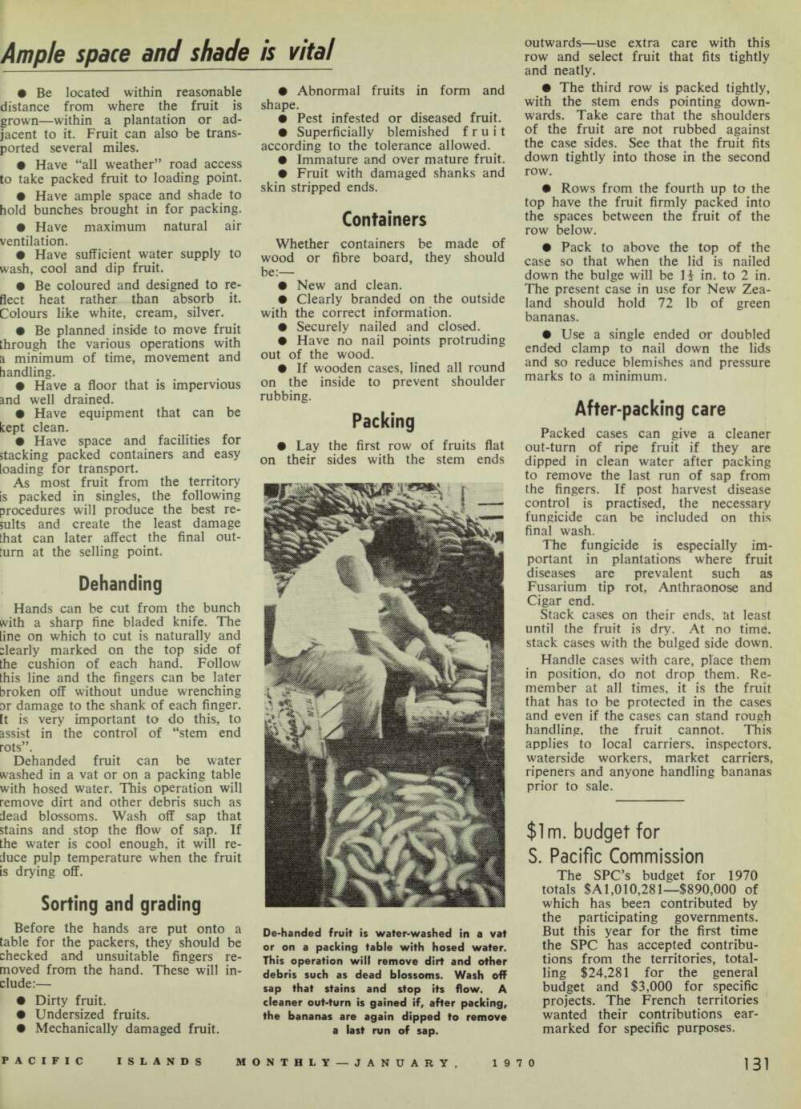
De-handed fruit is water-washed in a vat or on a packing table with hosed water.
This operation will remove dirt and other debris such as dead blossoms. Wash off sap that stains and stop its flow. A cleaner out-turn is gained if, after packing, the bananas are again dipped to remove a last run of sap.
atching sneakers on Nauru There’ll be no sneaking in for free t Nauru’s Social Centre Cimema in iture. The cinema’s management as advised patrons that “sudden iterruptions” of programmes will be lade enabling immediate ticket ispections to be carried out. Inspec ons will only take five to 10 minutes, le management says. irport tax at Tontouta Since November 1, Tontouta inter ational airport in Noumea has im- Dsed an embarkation tax on depart ig passengers.
Airlines using Tontouta have been iarged with the task of collecting le tax, which amounts to 150CFP approx. 5A1.50) for international ;stinations and 80CFP (approx. 3 cents) for travellers to New [ebrides or the Wallis islands.
Noumea Chamber of Commerce, hich now operates the Tontouta irport, is expected to use the tax •wards a SA3 million project to instruct a new passenger terminal, ontouta airstrip has been equipped nee July to take jumbo jets. ursary to study at SPU The New Zealand Government has iproved a bursary scheme to enable :lected students from English speak ig South Pacific territories to study ; the South Pacific University in iiva. It will provide up to 10 jrsaries each year and when the :heme becomes fully operational, ith up to 30 of the students at one me at the university, it will cost Z about $50,000 yearly. nd a scholarship for SPU The Mahatma Gandhi Memorial rust has donated a scholarship for )70 for a Fiji student attending the niversity of the South Pacific to idertake a degree course.
The award was made to com emorate the centenary of the birth : Mahatma Gandhi, which was debrated in 1969.
The Vice-Chancellor designate of ie USP, Dr, C. C. Aikman, said the due of the scholarship would be 500 per year for three years. It ay be awarded to one student only ' it may be divided between two udents living in the Suva area.
This is the first university scholar up that has been provided by con ibutions from the people of Fiji icmselves. atu Penaia retires Fiji’s Minister for Fijian Affairs id Local Government, Ratu Penaia anatabatu Ganilau, who will be itiring on January 2 will be sue
ceeded by Ratu George K. Cakobau.
He intends to retire to his planta tion at Taveuni, having resigned from the Council of Ministers and from the Legislative Council..
Ratu Penaia said he would con sider standing for a Legislative Coun cil seat in the next general election.
He is chairman of the planning com mittee for the Royal visit in March.
'Plenty of money' for NG The Papua-New Guinea Develop ment Bank, set up in 1967, has now made loans totalling $11,241,000.
In its annual report tabled in the House of Assembly, the bank says there have been 1,504 loans, the majority to village people. The highest loan so far to a villager was
South Seas in a nutshell
$28,000 for a cattle project near Kainantu in the Eastern Highlands, The highest to Europeans was about $250,000 for a motel project, and more and larger loans are now being considered.
A bank spokesman says “there’s still plenty of money—in fact we’re going out looking for people.”
Shin wane claim W S ur c • a • f The Public Service Association of Papua and New Guinea has lodged a claim for improved conditions of service for local and overseas officers employed on Administration vessels. The claim, to the NG Public Service Board, seeks overtime allowances and other entitlements.
Produce improvements in Cooks A Coconut and Copra Improvement Association for the Cook Islands has been formed in Rarotonga with Mr. W. R. Hosking, the Cooks acting Director of Agriculture, its chairman. The association will meet monthly and its aims include cooperation between copra exporters and outer islands producers, and increasing production and quality of copnL 6 r m. . .
C3rßenters n°w in wine The W. R. Carpenter Group, with the Austrian Penfolds Wines group, will undertake a $2 million 1,600acre vineyard project, over a five-year period, in the Hunter River Valley of New South Wales. Carpenters will have a two-thirds share in the project, and Penfolds a one-third share.
Rev. G. C. Harris leaves Tonga The man who crowned King Taufa’ahau Tupou IV in 1967, the Rev. G. C. Harris, has just retired from Nukualofa to Melbourne, with his wife.
Mr. and Mrs. Harris had been in Tonga for a total of 15 years. Since 1963, Mr. Harris has been president of the Free Weslyan Church in Tonga as well as the kingdom’s Royal Chaplain.
Mr. Harris is succeeded by the Rev. J. I, Gooderham, an Australian aged 31, married with two children.
Mr. Gooderham has been in Tonga more than two years as chairman of the Haapai and Vavau church districts.
Mr. and Mrs. Harris first went
to Tonga in 1926 and carried out missionary work for eight years be fore being recalled to Australia. They were back in Tonga in 1962, and the following year Mr. Harris was ap pointed president of the Tongan church. It has been a tradition for |f at * e ,5 s °/ F r ,f e , Weslyan Church, Chaplain m T ° nga ’ t 0 act During Mr. Harris’ church ad ministration in Tonga, great progress has been achieved in church * gT ° wth and in t he school system. This in eluded the opening in 1969 of the Hango Agricultural College on ’Eua, and several years ago the opening G f the church’s Tupou High School to which some of the more intelligent students of the Tupou College are being channelled. These students then sit , f ? r t ! le A . ustralian Intermediate and Matriculation, Rose and Swains get a visit - A „ , , „Jw c of p^ erica “ Sam 9 a s 1 T OI ? ell f 1 , e , s ’ se : an jJ Islands, ae , t> een visited by Piper Cherokee a *^U^ ag .?’ Tutuila.
Uninhabited Rose, 173 miles east of Pag ? n ™ g0 ’ asts § iant turtles and a 1920 marker saying “Tliis is American Samoa”. Swains, 240 miles north of Pago Pago, and peopled by the Jennings family, was a 105-minute flight for the plane (operated by South Seas Airways, a charter firm), , . *'llm 0 * volunteers The New Zealand Volunteer Abroad Scheme in November started
Iming in colour, volunteers working i Tonga, Fiji and Western Samoa.
Mr. Peter Cape, of Wellington, üblicity and recruitment officer for r SA, said on his arrival in Tonga lat a 25-minute film would be made nd used to give people a better isight into the work done by olunteers. It would also help in re ruiting new volunteers. The film lould be completed by March.
ebrides airport re-surfacing
Initial work has started on the of the New Hebrides lain airport, Bauerfield, on Efate. .esurfacing will enable jet aircraft ) use the strip. A New Caledonian rm, SCET, has won the works antract and the cost is expected to e about $350,000. Work should nish mid-April.
arotonga land compensation delay
The Cook Islands High Court earing on compensation payments ir additional land taken for Raro )nga airport has been adjourned ntil further evidence can be btained, but the delay will not affect le construction timetable for work i developing the airfield to inter ational standards.
The High Court heard for five ays evidence from applicants asking )r compensation for land, buildings, aconut palms, citrus and other trees nd crops affected by development f the airport. The adjournment was sked for by the Cook Islands idvocate-General because it looked s if there v/ould be big differences etween the report of the New ealand Government valuers and the iews of the owners about the value f the land.
Twenty-nine of the 33 families to
be moved because of the construction of Rarotonga’s international jetport will be re-housed at nearby Tereora, where 13 acres have been leased from the Cook Islands Christian Church as a housing development area.
Work is forging ahead under the energetic direction of Acting Super visor of Housing, Mr, Errol R.
Young, a direct descendant of one of the Bounty mutineers.
Mr. Young is responsible for the designs and construction of all the 29 houses but three which were pre-cut in New Zealand and are being erected by private contractors.
The largest government house has a floor area of 765 sq. ft, and the smallest, 550 sq. ft. They are three bedroom or two-bedroom houses; they have showers, modem kitchens and toilets, all under one roof—a breakway from the traditional Cook Islands style where all units are out side living quarters.
The dwellings have steel-reinforced, concrete block wall and the floors are of poured concrete. The cor rugated iron roofs are mostly gabled, but there are hip roofs. Each costs $NZ2,500, including labour costs, and repayment will be made at $4 or $5 a week.
NG metal factory A $250,000 metal rolling factory, for Lysaght (NG) Ltd., has been opened at Lae, New Guinea. Initial production will include corrugated, and cliplock construction materials.
Lysaght is a subsidiary of John Lysaght Australia, metal supplier, which is currently being taken over by BHP, Australian steelmaker.
NG oil expansion BP (New Guinea) Pty. Ltd. has been incorporated in New Guinea to “distribute and market oil products in the territory”. BP Australia had recently announced plans to spend $200,000 in NG, by building a terminal, a 6,000 ft pipeline and a service station in Port Moresby (PIM, Aug., p. 116). Authorised capital of BP (NG) is $200,000.
Islands exploration
Southland Mining Ltd., buyer of 50 per cent, of the New Hebrides Forari manganese mines (PIM, Oct., p. 121), has placed 180,000 of its 25 cent shares, raising $443,000, to finance, partly, its interest in the mines and also to provide additional funds for exploration in the Hebrides, Fiji, New Caledonia and Africa.
Buyers of the shares are Lloyds Bank
lurope Ltd. and Darier and Cie, both f Geneva, and the Bank of NSW lominees Pty. Ltd., of Australia.
lew service proposed
New Zealand’s energetic Trade Commissioner for the Pacific, Mr. G. 1. McLaren, has proposed a ship ing service from NZ’s South Island > Tonga, Western Samoa and jnerican Samoa. Businessmen in lese territories and in the South dand have approached Mr. McLaren > interest shipping companies. An xport survey was under way in lovember.
agriculture Director resigns
American Samoa’s Director of Lgriculture, Tom Hatakeyama, has esigned his position to join the lawaii Department of Education. In amoa, since 1963, Mr. Hatakeyama fas named director in June, 1967, nd, despite a tiny budget and scant nterest from top government xecutives, proved an able and frank dministrator. That Samoa’s agri ulture remains a mess is hardly Mr. latakeyama’s fault.
Safari "toughest yet"
Drivers in the 3rd Safari Cale 'onien in November for three days lad no hesitation in declaring it the dand’s toughest yet.
Of the 35 cars at the start, only 6 made the finish after driving ,000 miles in approximately 26 iours, with only H hours rest 3i hours in the tourist category).
Australian entries dwindled sharply i the last week, with only three [rivers from Sydney finally arriving, •lone managed to complete the full ourse.
Gilbert Diez and Charles Villard rom Tahiti finished eighth in a lenault RI6TS. Winners were the ame team that carried it off last r ear —French couple Jean-Claude and mcette Ogier, who were invited out rom France by local Citroen agent d. Edouard Pentecost. Again driving i Citroen DS2I, the young French ouple (who married after contesting he Safari together last year) were ollowed by Caledonians in second nd third places.
Edouard Boissery and Jean-Paul 7 rahry drove a Renault RI6TS to inish second, with Raymond Vudinet nd D. Waneukem third in an Opel jT.
Among the eight tourist category Irivers (entitled to omit the most lazardous circuits) the winners were Suy Demene and M. Cyprien in an }pel Kadett B coupe.
Despite the 19 drivers eliminated
y mechanical breakdowns on the fuelling trial in true Automobile lub style, there were prizes for
/eryone when Govenupr Louis
erger came to presentation night; /en champagne and whisky for loyal articipation to Australians Bob [olden and Fred Logan, who came >r the third time, and Doug Stewart ho was participating in his second afari.
Meanwhile, the Caledonian Auto lobile Club, sponsored by Total acifique and La France Australe jwspaper, hopes to hold the 4th afari in January 1971.
fhat people are doing
• Mr. lan J. Mullens, Third ecretary at the Australian Com lission in Fiji, has been transferred ) the Australian High Commission i Lagos, Nigeria. He will be replaced y Mr. John W. Knight, who holds le rank of Second Secretary. He reviously served in New Delhi, and as just completed a course at the ast-West Center, University of [awaii. • Tongan student Sione Filipe, of ukualofa, who is studying at the hurch College of Hawaii, is included i the 1969 edition of the annual Liblication Outstanding College thletes of America. Filipe is >rmerly of the Liahona High School, onga.
Outstanding College Athletes of merica is an annual biographical ampliation featuring the accomplish ients of about 5,000 young athletes ho have proved themselves out ading in sports, campus activities id curriculum. Nominations for ic awards publication are made by ie athletic departments of colleges loughout the US, and criteria for lection includes sports achieve ients, leadership ability, athletic re ignition and community services. • Californian-born Stan Swerdloff, merican Samoa’s newly-appointed isheries Officer, must have one of ie toughest jobs in the territory. The >b: to develop a productive fishing idustry. All previous attempts in :cent years to encourage Samoans to >h commercially by the government ave failed because of the Samoans’ :luctance to leave home for extended sriods. • Mr. Hal Evans, who retired om the Papua New Guinea Admin tration some years ago after 23 ;ars service has been appointed New outh Wales manager and local scretary of Fairymead Sugar Com any, as from January. But he will intinue to manage the operations f A. H. and E, Young, where he as been in charge of that company’s import business for seven years.