Business and Development
pp. 117-121 · Read in the full issue
Giant U.S. Bank
May Put Big
Money In Fiji
The opening of a branch of the world’s second-largest bank (assets, SUS 22 billion) in Fiji by the middle of this year could mean American financing of multi-million dollar “free enterprise” developments in the colony.
Mr. J. P. Murphy, Sydney resident vice-president for New York-based First National City Bank, told PIM this in December.
He said FNCB had access to big US capital. Over 200 of the biggest US industrial companies were customers of his bank. While currently none had interests in Fiji, most would this year be made aware of Fiji’s business prospects through FNCB.
FNCB’s first manager for Fiji, Mr.
Brent Morgan, a 29-year-old bachelor, will file his reports to Sydney, parts of which will then be included in the bank’s monthly reports.
Mr. Murphy said no predictions had been made by FNCB on Fiji’s future economy. The Fiji venture was a “missionary effort”.
"Small potatoes"
However, FNCB, which lost out to the Bank of Hawaii for the take over of the Bank of American Samoa, saw Fiji as a far bigger market than Samoa because of its popula tion and economy. Overseas invest ment in Fiji at present was “pretty small potatoes” compared with what lay ahead.
It was expected FNCB would in future contribute to Fiji Government Loans and also consider supporting development projects in Fiji which had free enterprise characteristics.
There appeared to be many oppor tunities, including opportunities for a
small fleet of jet aircraft, a shipping corporation and a modern pineapple industry.
Mr. Murphy said he had “mixed feelings” over predictions of a com ing tourism boom in Fiji because of the jumbo jets. Air fares were a “deterrent” to big numbers of people visiting Fiji and current fares would have to drop. .A big flow of US investment in Fiji in hotels, industry and retailing was not expected but, Mr. Murphy said, satellite industries associated with tourism, such as plastics and light industries, could attract more American money.
FNCB has operated in India since the 1880’s and many of Fiji’s Indian businessmen would be familiar with the bank’s reputation, he said.
The bank will open in Fiji as soon as premises in Suva can be found; of a staff of 25, 23 people will be hired locally.
The First National City Bank has been licensed for commercial and savings bank business in Suva. It will be the first non-Commonwealth and fifth commercial trading bank in the colony.
Fiji will be the 80th country in which the bank has branches.
Burns defends his
payments policy
At Burns Philp and Co. Ltd.’s annual general meeting in December the company’s chairman, Mr. J. D.
O. Burns, strongly defended his com pany’s bonus and dividend policy to shareholders.
His comments reflected recent criticism that while fellow Islands firm, W. R. Carpenter, pays an annual 20 per cent, dividend on its 50 cents, BP’s pays only 12i per cent, on its $1 shares.
Mr. Burns commented: “With re gard to the 12i per cent, dividend which we are now paying, I often wonder whether our shareholders have considered this in relation to the series of bonus issues the com pany has made.
“To illustrate what I mean—let us take the case of a shareholder with 1,000 shares in 1958. The five bonus issues since then have increased his holding to 2,700 shares in 1969.
“He is now being paid 12i per cent, of his 2,700 shares, amounting to $337.50 which, if related to his original holding of 1,000 shares, would amount to 33f per cent.”
Other points made in Mr. Burns’ address included: • Recent appraisals of lease rents for three allotments at Rabaul, New Britain, had been increased from
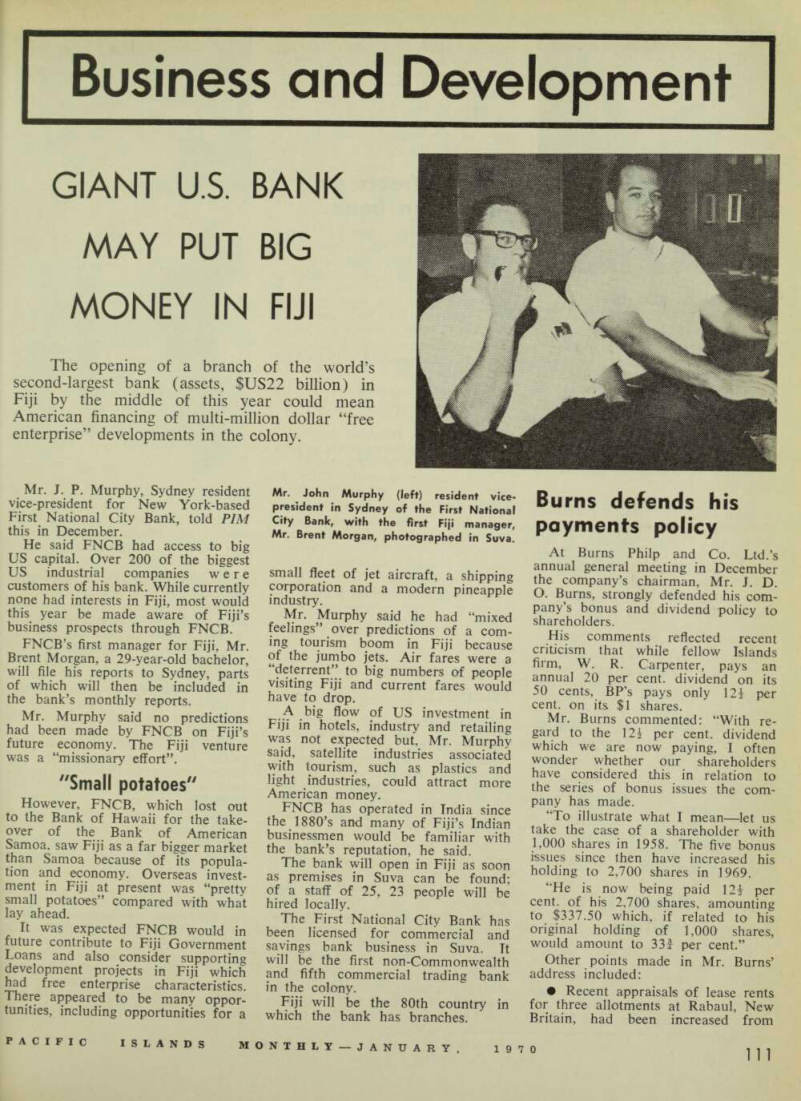
Mr. John Murphy (left) resident vice president in Sydney of the First National City Bank, with the first Fiji manager, Mr. Brent Morgan, photographed in Suva.
$lBO to $4,320 annually—an increase of 2,300 per cent. “For a developing country, continually seeking outside investors, increases such as these are not encouraging, to say the least,” he said. • BP activities in Apia, Western Samoa, were still “seriously impeded” by the existing exchange control regu lations which continued to freeze a “relatively substantial proportion” of BP’s liquid funds.
A two-tier tax system discriminated between local and foreign companies and imposed on foreign companies more tax. It was “difficult to find encouragement” for increased trading, and BP’s operations in this territory would remain “restricted”. • It was “increasingly difficult” to obtain labour on BP’s copra and cocoa plantations. • BP’s had taken a 52 per cent, interest in Nerada Tea Estates Pty.
Ltd., which is trying to grow tea for the first time in Australia, and Choiseul Plantations Ltd., Bougain ville copra and cocoa producer in which BP’s has a large minority in terest, had taken up an eight per cent, interest in Nerada.
Profit for BP’s for the 1968-69 year was $5,668,028, an increase of $518,319, or 10 per cent., on an adjusted figure for 1967-68, This represents an earning rate of 24.9 per cent, on enlarged capital of $23,850,00. Trading, not invest ment, turnover for 1968-69 was $120,690,939.
James Burns left
over a million Mr. James Burns, former chairman of directors of Burns Philp and Co.
Ltd., left an estate of $1,045,194. He died on August 5 last year, aged 87 {PIM, Sept., 1969, p. 55) Mr. Burns requested that $50,000
be left to the Burnside Presbyterian Orphans Homes, Sydney, less any gifts Mr. Burns made to the homes during his lifetime.
Bulk of the estate will go to members of Mr. Burns’ family. His son, David, is chairman of BP’s.
Duty of the estate is estimated at nearly $500,000.
GEIC attracts an
Australian bank
Mr. M. D. Allen, Senior Assistant Secretary to the Gilbert and Ellice Islands Colony Government, told the colony’s House of Representatives at i.s final session last year that an Australian bank (the Bank of NSW, PIM understands) had agreed in principle to open a branch at Tarawa.
The government was also negoti ating or corresponding with the fol lowing enterprises: • A mining exploration company, currently prospecting for minerals in the GEIC. • A firm in Honolulu which had made tentative proposals for exploit ing crayfish on Christmas Island. • A shipping company which had made tentative proposals for a bunkering station at Butaritari. • Four hotel enterprises which had shown interest in hotel enter prises at Tarawa (Tarawa currently has one non air-conditioned 11-room hotel, The Otintai). • A general trading firm in the Solomon Islands which had shown interest in business opportunities in the colony.
Supermarket
friendship
The opening in late January of a SUS2OO,OOO store on Uliga Islet, Majuro, is not just the result of American supermarket expertise and an Islander’s business resourcefulness.
It will be the culmination of the joint efforts of two men of markedly dif ferent backgrounds—Robert Reimers and Powell Mikkelsen.
Reimers, the short, stocky son of an early German pioneer trader in the Marshall Islands and a woman of Jaluit, the former centre of these atolls, at 61 is a former co-op. worker, copra buyer, store manager, supercargo, shipper and manager of a boat-building project.
Born on Jaluit in 1909, he was educated by American missionaries during Japanese ownership of the Marshalls after World War I, and has spent his life around the poor,
scattered coral atolls of the Mar shalls.
Mikkelsen, born in California shortly after his Danish parents migrated to the US, was in the electrical contract ing business in California for 21 years until 1957 when he chucked work and began cruising, full-time, in a 34 ft yacht with his wife, Nyoma.
Aged 55, he’s a mighty 6 ft 4 in. and as manager of the store, towers over its owner, Mr. Reimers.
The pair met in 1966 when Mik kelsen turned up on Majuro and Reimers began making plans to ex pand a store which was small but profitable.
Since then, things have boomed.
Retail turnover is $1.3 million a year, supplies come from Japan (50 per cent.), the US (25 per cent.) and Australia and New Zealand (25 per cent.).
Last year, with Mikkelsen manag ing operations, Reimers began work on the bigger air-conditioned store, “something Majuro could be proud of’. They are using the California based companies, Cal-Pacific Mer cantile Co. and Weber Showcase and Fixture to supply construction materials.
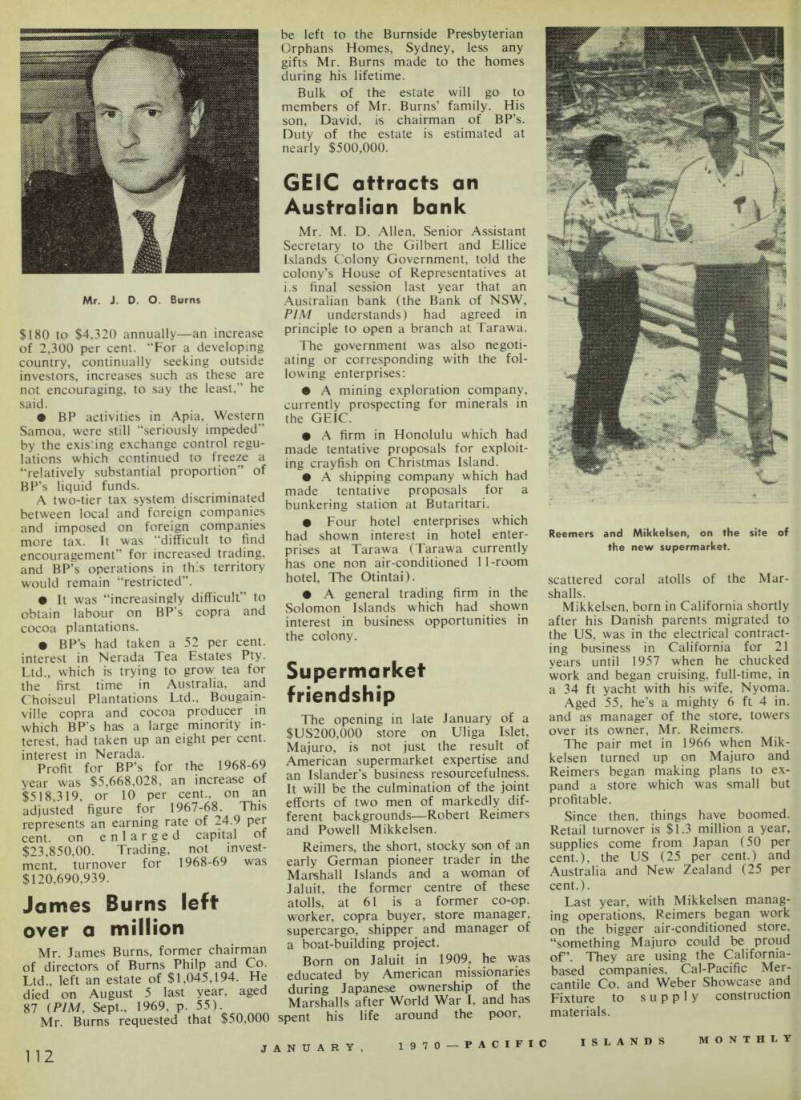
Mr. J. D. O. Burns
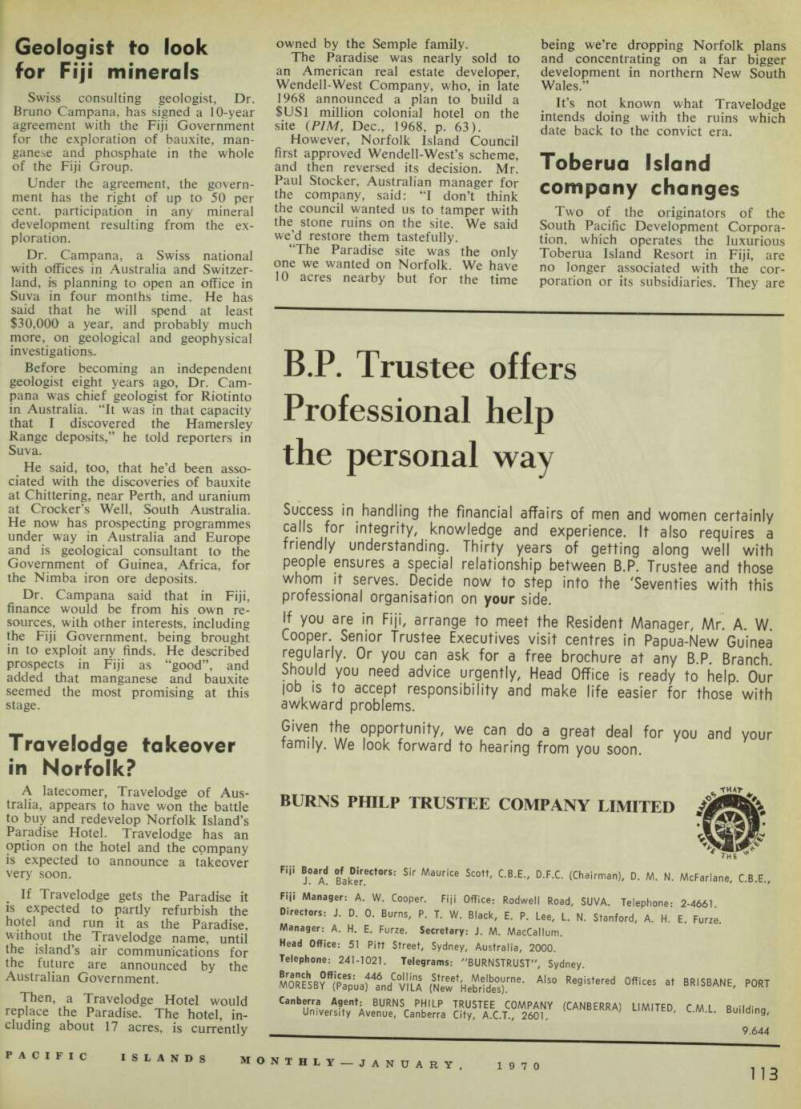
Reemers and Mikkelsen, on the site of the new supermarket.
Geologist 1 to look
for Fiji minerals
Swiss consulting geologist, Dr.
Bruno Campana, has signed a 10-year agreement with the Fiji Government for the exploration of bauxite, man ganese and phosphate in the whole of the Fiji Group.
Under the agreement, the govern ment has the right of up to 50 per cent, participation in any mineral development resulting from the ex ploration.
Dr. Campana, a Swiss national with offices in Australia and Switzer land, is planning to open an office in Suva in four months time. He has said that he will spend at least $30,000 a year, and probably much more, on geological and geophysical investigations.
Before becoming an independent geologist eight years ago, Dr. Cam pana was chief geologist for Riotinto in Australia. “It was in that capacity that I discovered the Hamersley Range deposits,” he told reporters in Suva.
He said, too, that he’d been asso ciated with the discoveries of bauxite at Chittering, near Perth, and uranium at Crocker’s Well, South Australia.
He now has prospecting programmes under way in Australia and Europe and is geological consultant to the Government of Guinea, Africa, for the Nimba iron ore deposits.
Dr. Campana said that in Fiji, finance would be from his own re sources, with other interests, including the Fiji Government, being brought in to exploit any finds. He described prospects in Fiji as “good”, and added that manganese and bauxite seemed the most promising at this stage.
Trovelodge takeover
in Norfolk?
A latecomer, Travelodge of Aus tralia, appears to have won the battle to buy and redevelop Norfolk Island’s Paradise Hotel. Travelodge has an option on the hotel and the company is expected to announce a takeover very soon.
If Travelodge gets the Paradise it is expected to partly refurbish the hotel and run it as the Paradise, without the Travelodge name, until the island’s air communications for the future are announced by the Australian Government.
Then, a Travelodge Hotel would replace the Paradise. The hotel, in cluding about 17 acres, is currently
owned by the Semple family.
The Paradise was nearly sold to an American real estate developer, Wendell-West Company, who, in late an "°. unced , a Pj ai ? to build a •f Id? 1 * 1 ] 10 C 0 hot^-,A° n the site (P/M, Dec., 1968, p. 63).
However, Norfolk Island Council first approved Wendell-West’s scheme, and then reversed its decision. Mr.
Paul Stocker, Australian manager for the company, said: “I don’t think the council wanted us to tamper with the stone ruins on the site. We said We <iu eSt £ re t^l . em tastefully.
The Paradise site was the only one we wanted on Norfolk. We have 10 acres nearby but for the time
being we’re dropping Norfolk plans and concentrating on a far bigger development in northern New South Wales.”
It’s not known what Travelodge intends doing with the ruins which date back to the convict era.
Toberua Island
company changes
Two of the originators of the South Pacific Development Corpora tion, which operates the luxurious Toberua Island Resort in Fiji, are no longer associated with the cor poration or its subsidiaries. They are
Mr. Barclay Wagner, a former director and chairman of directors and Mr. Tom Hill, former president of the company. • r ' Hodsdon, a f °/c me^ eX c eCU ; tive with Burns Philp (South Sea) Co. Ltd., and now the corporation s new vice-president and chief executive, said m Suva in mid-December.
“Mr. Hill and Mr. Wagner are no longer associated with the company in any capacity. A new board of directors is completely reconstructing the company with additional finance, which will spread through the corporation to its subsidiaries m due course”.
Subsidiaries of the corporation
are Storck Cruises Ltd., a Suva dav cruise operator, Consolidated Agencies Ltd., an import and export firm and Suva Aquarium at Walu Mr. Hodsdon said Toberua Island, w hi c h opened in August, 1969, was f u u y booked from mid-December unt ji the end of January. Mr.
Hodsdon was appointed by the 17 American stock-holders and the board directors. jh e new chairman of directors is jyi r Stanley Livingston, Jr., of Rhode island. Other directors include Mr.
James Keresev, of Long Island; Mr.
Jonathon Weld, New York and Mr.
Middleton Gamell, Rhode Island, one of the original directors.
Copra prices highest
since mid-1968
Mr. lan McDonald, chairman of the Papua and New Guinea Copra Marketing Board, gave the following report on December 22: Philippine copra prices on the European market have been extremely buoyant over the past few weeks, with the November average at 5A198.95, compared with October at $188.73. Quotations at present are running around $215 per ton with a tendency to strengthen.
The shortage of copra from the Philippines and Indonesia has no doubt led to active dealings in Europe and prices have, as a result, risen sharply to their highest level since mid-1968.
There are indications that world production of laurics is recovering slightly and, in 1970, could be around 2 per cent, higher than this year, although still well below the record output of 1966.
It is likely that the next two or three months will see a continuation of the present nervous price fluctua tions in copra and edible oils generally, but settling later on to a more steady and possibly lower price level.
Fiji and the Cooks
swap trade ideas
A Fiji trade mission will visit the Cook Islands in April, taking samples of Fijian commodities for display and taking samples of Cooks’ citrus fruit and fruit juice back with them.
This arrangement follows the visit of a Cooks trade mission to Fiji in October last year. The members of the mission, led by Minister of Works and Communications, Mr. W.
Estall, had attended the Ninth South Pacific Conference.
The matter of trade between the territories was sparked off by Mr.
Estall when he told the conference that there appeared to be a reluctance among territorial governments to trade with each other. The Cooks had surplus citrus, yet other terri tories were importing citrus and canned juice. Neighbouring territories were producing commodities which the Cook Islands wanted and were unable to get even on a barter basis.
The Premier of the Cooks arranged for a Cooks trade mission to visit Fiji as soon as the South Pacific Con ference ended.
Shipowner Jean Grand, of New
Caledonia, told the Cooks at Noumea he was after back freight for his Auckland-Tahiti fresh meat run and suggested that the development of a Fiji-Cooks trade could help to fill his ships Moana and Capitaine Cook.
The Cooks mission to Fiji reported that Fiji was interested in obtaining Cooks fruit juice and that Fijians were unfamiliar with Cook Islands mandarins and tangerines, but were willing to assist in displaying them.
It was agreed that the government sponsored Fiji Wholesale Society would liaise between the Fiji and Cooks Governments and would initially handle all shipments between the two territories.
Fiji meat plans
"mean higher prices"
The price of Fiji’s meat could rise substantially if the government goes ahead with its plan to establish a Meat Industry Board and a big new slaughterhouse at Nasinu.
Assistant Minister for Natural Resources, Mr. I. Naisara, said in the Legislative Council in Suva in December that a site at Nasinu had
been approved by a firm of con sultants.
Moving the second reading of a bill to establish the Meat Board, he said the bill was based almost entirely on the recommendations of
Mr. C. L. Harris, of the Queensland Department of Primary Industry. Mr.
Harris studied the meat industry last year at the government’s request.
He suggested a central killing and chilling facility for Suva, but said none of the slaughterhouses in the area was suitable. He recommended the construction of a modern slaughterhouse by the board and compensation for the commercial slaughterhouses which would be put out of business by it.
Only the board’s slaughterhouse would be allowed to operate in the Suva area.
Executives of meat companies who own slaughterhouses in Suva pre dicted price rises if the proposed new slaughterhouse comes into being, “We are unable to accept that the govern ment will be able to operate a slaughterhouse on such terms that it would not lead to an increase on the price of meat to the consumer”, said Mr. H. N. Murray, of Wailekutu Meats Ltd., Suva.
Wailekutu Meats is a partnership of Morris Hedstrom Ltd. (which set up a factory for the production of sausage and small goods) and Burns Philp (South Sea) Co. Ltd. (which concentrates on slaughtering).