Business Is Picking Up
pp. 103-111 · Read in the full issue
For "Moanaraoi"
The Gilbert and Ellice Islands 900ton passenger-cargo ship Moanaraoi, which, besides its basic run of pick ing up copra in the colony, operates to Fiji, Majuro, Marshalls, Santo and Vila, New Hebrides, is making good profits for its owners, the GEIC Wholesale Society.
The added money comes from carrying colony working recruits for plantation and hotel work in the Hebrides, a constant cargo of Aus tralian and New Zealand goods to Majuro and exports, particularly sugar, from Fiji to the GEIC.
Moanaraoi, previously fully re frigerated, has been refurbished to carry more general cargo and she’s also developed a steady cargo of personal GEIC effects to workers in the Hebrides.
The WS has introduced a new accounting system to handle her operations and the society is also profiting by taking over control of several ships previously operated by the GEIC Marine Department.
E&A's ship "Cathay",
which in October will make the first P&O call in the New Hebrides since be fore the war.
are on to make more of the GEIC’s sizeable fleet pay its way.
One disappointment, however, has been the recruiter Ninikoria, which, through engine and technical mishaps, has proved a dear buy for the colony.
Efforts to make her carry big numbers of tourists from Fiji to the GEIC have so far failed. More all round publicity of what accommoda tion she offers, where she calls and what her schedules are, would no doubt help.
Yet Another Ng
Shipping Service
A published report of yet another shipping service to New Guinea from Australia was dubbed “partly in correct and premature” in December, Sydney newspapers in mid-Decem ber carried stories stating that two Bulgarian-built ships, registered in Port Moresby, would operate the service, under Australian Government approval. Karlander (Aust.) Pty. Ltd. was said to be behind the services.
Two new ships for the trade would be built in Australian shipyards and be manned by Australian crews, the reports said.
Karlander told PIM the names of the two companies to operate the services, Australian Territory Liner Service Pty. Ltd. and Papuan Liner Services Pty. Ltd. were correct but other details were not.
PIM understands trade unions based in Australia were behind the “premature” release of the story.
It closely followed rumours that Karlander. which services NG with its own ships, had approached a Hong Kong-based shipper to the territory and asked for freight rates to be in creased 13 per cent.
There are too many ships and too many companies competing on the NG run; this alone is keeping freight rates at their established 1961 level.
At least two companies are losing their percentage share of the trade and making minimal profits and small losses.
Some Bp Ships Have
Even Made A Profit
Some of Burns Philp’s shipping services had even made profits lately, the company’s chairman, Mr. J. D.
O. Bums, said at the annual meeting in December. Some voyages, Mr.
Bums said, which had not made money for “some time” had actually made profits.
He said the company would have to sell “certain ships”. But this was not easy as approvals of governments and unions had to be obtained.
BP’s achieved a “considerable re
duction” in shipping losses in 1968-69. However, he said, whereas BP’s once operated the only service from Australia to New Guinea, this trade was now largely over catered for, as there were no less than 14 vessels of various nationalities com peting for Australian cargoes.
None of these were bound by Australian wage conditions, whereas BP’s had the Moresby under full Australian articles, and its other vessels had Australian deck and engine room officers.
High loading and unloading costs in Australian ports plus congestion at Island ports were a common
expense for all shipowners, but delays were relatively more costly for BP’s with its much higher wages bill.
Mr. Burns said BP’s absorbed a “substantial debit” covering the final accounts of the Malekula, which was sold during 1968-69.
Noumea Traders Buy
Their Own Ship
Dissatisfied with the current Sydney-Noumea service operated by Messageries Maritimes and Societe Maritime Caledonienne, several Noumea traders have bought a 1,100-ton freighter and begun three
weekly services, Noumea-Melbourne- Sydney-Noumea.
The ship, Ville de Noumea, com manded by Captain Jean Helme, carries refrigerated and general cargo and will intensify competition on the Noumea “grocery run”.
The traders have formed a new company, Chargeurs Caledoniens, to operate her and crewed her with Caledonians and Hebrideans.
Foodstuffs and light manufactured goods make money for the shippers to Noumea; backloading to Australia remains the biggest problem. Sydney agents are Hetherington Kingsbury Pty. Ltd.
Hetherington Kingsbury Pty. made an abortive approach to the Lord Howe Island Board, which handles stevedoring and loading facilities at Lord Howe, for a call for the ship at Lord Howe. The board’s reply was that it didn’t consider a second service necessary and wouldn’t support one.
Hetherington had received support from some businessmen on Lord Howe, who have long complained about the service given the island by Capt. Emile Savoie of the Jacques del Mar 11.
However, as Lord Howe doesn’t have a wharf and all cargo is off loaded into lighters, a service is dependent on the support of the board.
Stan Brown Completes
Bougainville Pipeline
Captain Stan Brown, of Brown Marine Ltd., Suva, and a diving team, in December completed a rush job lasting seven weeks to lay three stern moorings and a 2,000 ft steel and rubber underwater fuel line at Anewa Bay, Bougainville.
The work is part of the big de velopments now going on at Anewa Bay, near Kieta on the east coast, as Conzinc Riotinto develops multi million dollar port and town facilities
for its huge copper project in the mountains.
Hornibrooks have currently started to drive piles in the bay for a wharf big enough to take 40,000-ton oil carriers, and hills are being de molished to make way for the wharf approaches and a site for a power station big enough to supply the town and port facilities.
The moorings put down by Captain Brown and his chief diver, Fijian John Roden, are the property of the Shell Company, which has the fuel concession for CRA.
The steel pipeline (only the section
connected with the shore is flexible rubber) is sunk in 120 ft of water.
Immediately after the work was com pleted, the diving team saw the first tanker, the 18,000-ton Horomya, tie up at the moorings and discharge fuel through the lines.
“That area of Bougainville is now a fantastic hive of activity,” said Captain Brown in Sydney in late December, where he was looking at equipment he plans to purchase for underwater cleaning of ships. He plans to provide this service in Suva.
Captain Brown, widely known for his operation of the Maroro cruises in Fijian waters, has virtually given up his cruising activities, because there are now so many commercial demands on his time.
Last year, with the Maroro, he completed successfully a programme of reef blasting in the Lau Group for the Fiji Government, and he expects to undertake a further programme this year.
Shipping Briefs
• China Navigation Company, Hong Kong-based shipper to several Islands territories, is considering starting a monthly run out of Sydney to Brisbane, Noumea, Suva and both Samoas with a vessel, capable of carrying cargo and up to 300 passengers.
China Navigation feels there are many older-age group people pre pared to take an Islands shipping cruise aboard an Islands ship, rather than aboard luxury liners. Meantime, the company’s Australian associate group, Swire and Gilchrist, is con sidering inviting Australian and French equity holding in its own capital to consolidate its Islands operations. • New Guinea’s Directorate of Transport and the Wewak Port Advisory Committee differ over Wewak’s proposed overseas wharf to handle 5.000-ton ships. The com mittee says the wharf won’t handle the ships as wharf depth will only be 19 ft. Transport says minimum depth will be 24 ft and the wharf will handle 5,000-ton ships, such as those operated by China Navigation and Bank Line. © Caledonian trader, Loyaute, lost in cyclone Colleen last February, has now been replaced by a vessel of the same name, bought in Japan.
The agents, Sofrana, are now able to service the off-shore Loyalty
Islands three times a month with 200 tons of merchandise from Noumea, aboard Loyaute. • The former New Zealand vessel Matipo has found more peaceful days in Caledonia after being stranded nine months on the coral reef outside Noumea. It was blown off by cyclone Colleen last February. rrt i . r
D JlSf. vfv
Mr. Athol Rusden by the Caledonian stevedoring company, Societe Le Chalandage, and carries sand to Noumea from He Puen, 20 miles away.
• Ter aka, the Gilbert and Ellice Islands’ marine training school, has been asked to provide 200 qualified seamen during this year for nine shipping companies.
The companies are China Nayiga tion (British), Detjen, Fisser, Columbus, North German Lloyd, Laeist, Blumberg, Nord and Schulte (all West German). It’s the first sign that these shippers will employ 2,000 seamen from the school, up to 1976 (/ > /M D 1969 p 103) v ’ ’ y ' • A new 70 ft tug was recently completed at the Gubbay shipyard.
Santo, New Hebrides. Powered by two diesel engines and manned by a crew of five it will operate in New Caledonia and be used to tow the 198 ft barge launched at Santo mid last year ( PIM, July, 1969, p. 109). • MILI, the US Trust Territory’s shipper, in December refuted what it said were rumours that it is a “front for a San Francisco chartering com pany”. The shipper’s fortnightly bulletin, said it was under-capitalised (paid-up SUSSOO,OOO, turnover, S 4,300,000) and said MILI “took exception” to the talk.
Meanwhile, MILI’s second scow, Jane Gifford, was expected to leave Auckland, NZ, in January for Ponape, Carolines. The first scow, Ethel Wells, was in Noumea, New Caledonia, in early December, with engine trouble, en route to Ponape.
Both will assist lightering opera tions for MILI at Ponape. • The Fiji Government is “pre pared for a loss, but hopes to make a profit” on its construction of a 121 ft tourist ship for Blue Lagoon Cruises Ltd. Mr. Charles Stinson, Fiji’s Minister for Communications, Works and Tourism, said this in December in the Fiji Legislative Council. The ship will cost about 5F156,000 {PIM, Dec., 1969, p. 105). • The biggest inter-island trader in the Solomons recently went into service. She’s the 41-year-old Hans Hinrich, a veteran of the German coastal and river trade, and she will be renamed Elizabeth Anne by her owner, Markworth Shipping Com pany, which has four other ships in the Solomons trade.
• Two South Korean fishing vessels, Hae 267 and 250, operating for the South Pacific Fishing Com
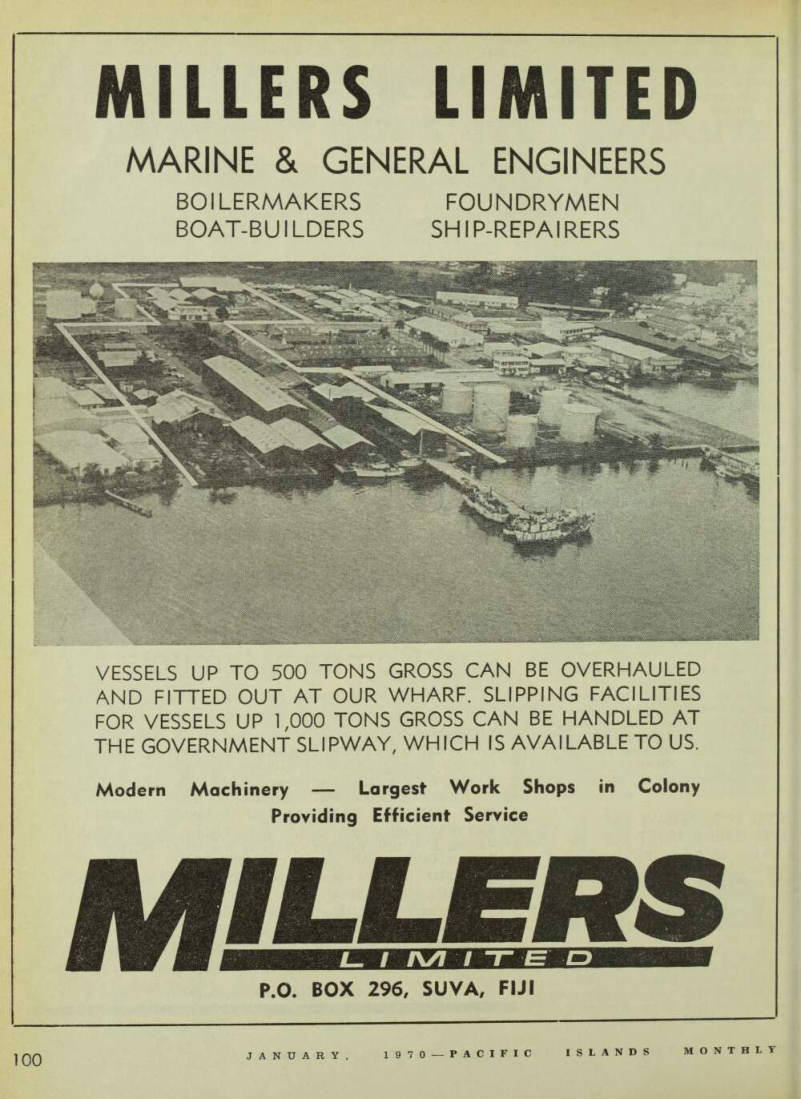
pany at Levuka, called at Nukualofa during December after one of them sustained engine trouble. The two ships sailed later with 75 tons of fish aboard; an average catch for a government vessel such as these would be seven tons weekly. Three other Korean fishing vessels were seen close to- the coast while the vessels were in port. • A SF3 0,000 steel tug, Nalula Malau, was launched in Suva in December for Fiji Forest Industries Ltd. Built by Millers Ltd. the tug will push logs around the rivers and coast of Vanua Levu and tow barge loads of veneer from Labasa to Suva. • The Teledex prospecting ship belonging to the American firm, Teledyne Corporation, has been in Santo, New Hebrides, on a submarine search for oil. After working the waters off South Santo she was due to head for Malekula and Ambrym.
American Samoa's two new utility tugs, "Tavae" and "Toloa", arrived at Pago Pago recently after an 11-day un eventful trip from New Zealand.
Designed and built to withstand rough seas, they went into service soon after to the north coast of the territory's main island, Tutuila, and the outer Manua Islands.