Book Reviews
pp. 90-91 · Read in the full issue
Scholarly caution, but the complete Solomons story
One of the most remarkable aspects of the exploration of the Pacific by Europeans is that although the Solomon Islands were among the first islands to be discovered, exactly two cen turies passed before Europeans saw them again.
As is well known, it was the Spanish exporer Mendana who made the initial discovery. This was in 1568 when he crossed the Pacific from Peru in search of “certain islands and lands” that were thought to exist there and were believed to be wealthy.
The Mendana expedition discovered and examined four of the largest islands in the group—Santa Isabel, Guadalcanal, Malaita and San Cristoval—as well as several smaller ones, then sailed back to Peru after a stay of six months. Mendana made no attempt to found a colony as he had instructions to do, because of the wormy state of his ships, the hostile natives, lack of provisions, distance from Peru, and other reasons.
However, back in Peru, Mendana urged the Spanish king to allow him to go to the Solomons again to found a colony because, he said, there were ample signs of potential wealth and numerous souls awaiting salvation.
Forgotten islands
After a lapse of more than quarter of a century, Mendana was given four ships to go to the Solomons and found his colony. But this time, he got only as far as the isolated islands to the south-east of that archipelago, now known as the Santa Cruz Group.
An attempt was made to found a colony on Ndeni, the main island.
When this failed, the expedition again sailed back to Peru.
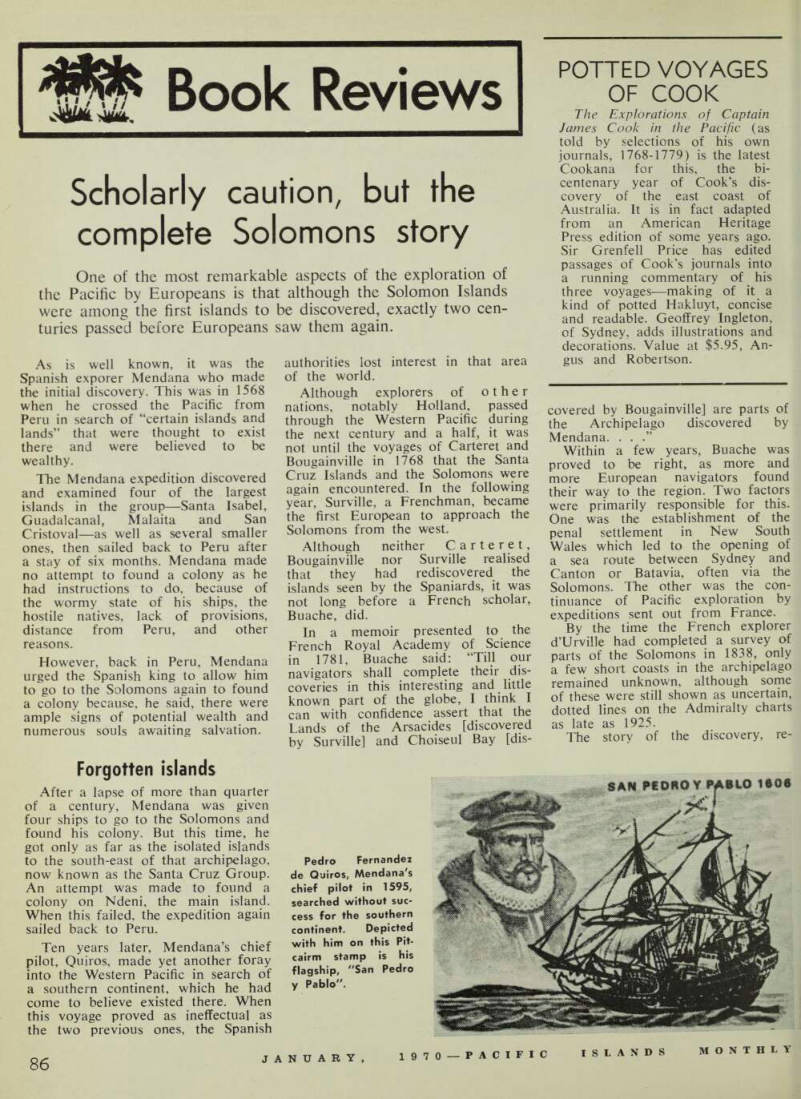
Ten years later, Mendana’s chief pilot, Quiros, made yet another foray into the Western Pacific in search of a southern continent, which he had come to believe existed there. When this voyage proved as ineffectual as the two previous ones, the Spanish
authorities lost interest in that area of the world.
Although explorers of other nations, notably Holland, passed through the Western Pacific during the next century and a half, it was not until the voyages of Carteret and Bougainville in 1768 that the Santa Cruz Islands and the Solomons were again encountered. In the following year, Surville, a Frenchman, became the first European to approach the Solomons from the west.
Although neither Carteret, Bougainville nor Surville realised that they had rediscovered the islands seen by the Spaniards, it was not long before a French scholar, Buache, did.
In a memoir presented to the French Royal Academy of Science in 1781, Buache said: “Till our navigators shall complete their dis coveries in this interesting and little known part of the globe, I think I can with confidence assert that the Lands of the Arsacides [discovered by Surville] and Choiseul Bay [dis
covered by Bougainville] are parts of the Archipelago discovered by Mendana. . .
Within a few years, Buache was proved to be right, as more and more European navigators found their way to the region. Two factors were primarily responsible for this.
One was the establishment of the penal settlement in New South Wales which led to the opening of a sea route between Sydney and Canton or Batavia, often via the Solomons. The other was the con tinuance of Pacific exploration by expeditions sent out from France.
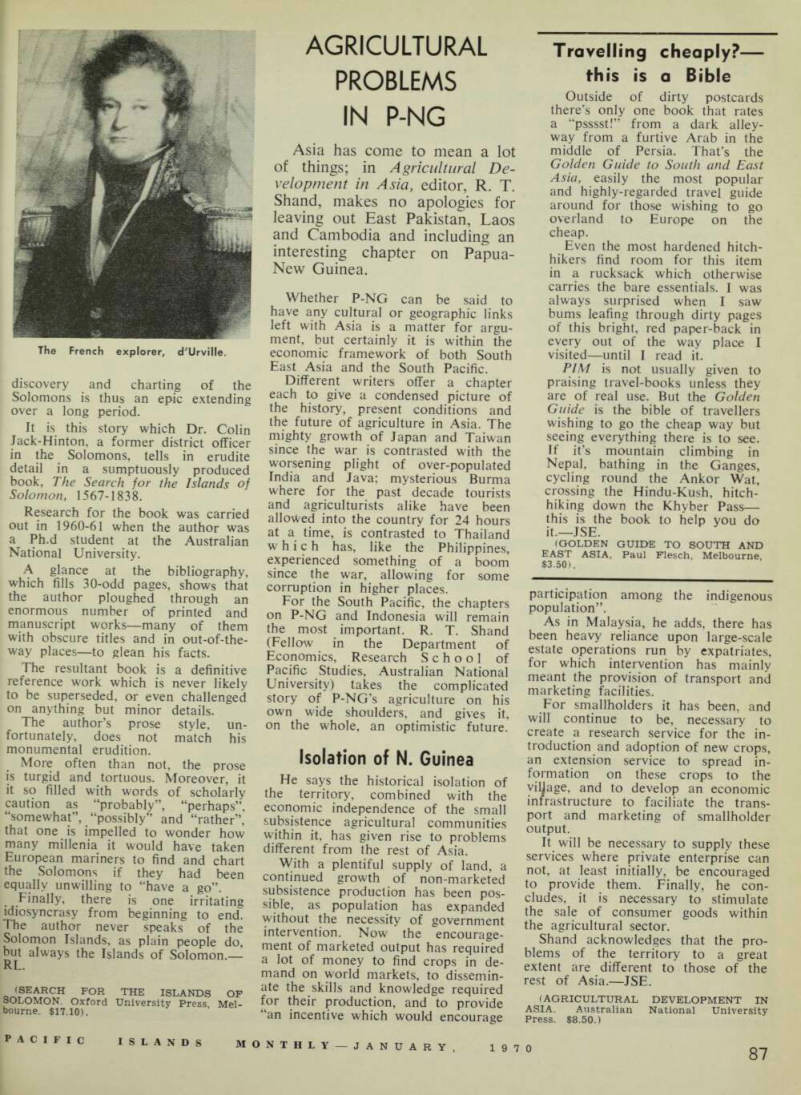
By the time the French explorer d’Urville had completed a survey of parts of the Solomons in 1838, only a few short coasts in the archipelago remained unknown, although some of these were still shown as uncertain, dotted lines on the Admiralty charts as late as 1925.
The story of the discovery, re-
Pedro Fernandez de Quiros, Mendana's chief pilot in 1595, searched without suc cess for the southern continent. Depicted with him on this Pit cairm stamp is his flagship, "San Pedro y Pablo".
discovery and charting of the Solomons is thus an epic extending over a long period.
It is this story which Dr, Colin Jack-Hinton, a former district officer in the Solomons, tells in erudite detail in a sumptuously produced book, The Search for the Islands of Solomon, 1567-1838.
Research for the book was carried out in 1960-61 when the author was a Ph.d student at the Australian National University.
A glance at the bibliography, which fills 30-odd pages, shows that the author ploughed through an enormous number of printed and manuscript works—many of them with obscure titles and in out-of-the way places—to glean his facts.
The resultant book is a definitive reference work which is never likely to be superseded, or even challenged on anything but minor details.
The author’s prose style, un fortunately, does not match his monumental erudition.
More often than not, the prose is turgid and tortuous. Moreover, it it so filled with words of scholarly caution as “probably”, “perhaps”
“somewhat”, “possibly” and “rather”, that one is impelled to wonder how many millenia it would have taken European mariners to find and chart the Solomons if they had been equally unwilling to “have a go”.
Finally, there is one irritating idiosyncrasy from beginning to end.
The author never speaks of the Solomon Islands, as plain people do, but always the Islands of Solomon.—
(Search For The Islands Of
SOLOMON. Oxford University Press Mel bourne. $17.10).
The French explorer, d'Urville.