Faster Than Sound
pp. 59-61 · Read in the full issue
Sydney to Los Angeles in 9i flying hours . . . cruising speed 1,400 mph . . . cost one way $565 (one class). Those could be vital statistics of the world’s first commercial supersonic commercial jet, the Concorde, when it arrives in the South Pacific.
Compare that to the present-day Boeing 707 which speeds at 550 mph, takes 17J hours to cross the Pacific at a first-class price of $664, and you can see the impact the Concorde will have on Pacific travel.
Of the nine international air
carriers now operating through the Islands, five have options on a total of 25 Concordes. And two other carriers almost certain to be in this area by 1974—Japan Airlines and American Airlines—have taken up Concorde options on a total of nine
f *lll • II Concorde wilt nave noise problem
aircraft. There has been a total of 74 options placed on the Concorde, and airlines will make their final de cisions by next year.
The Concorde is being built and developed in co-operation by Britain and France. The British builders are the diversified private enterprise com pany, British Aircraft Corporation, and the French makers are the gov ernment-owned Sud-Aviation.
They are developing a production line jet with a cruising speed of 1,400 mph and seating for about 130 passengers.
BOAC, PanAm and Air France pilots who have flown the Concorde have described it as “accurate”, its Rolls Royce engines “remarkable” and “easy to fly”.
First delivery dates should be mid -1973, and the Concordes ar e scheduled to go into trans-Atlantic service in late 1973, and into Pacific service in 1974.
In the air, 1973?
However, Qantas, which has four Concorde options, could well start trans-Pacific services as its initial Concorde operation, possibly in late 1973.
Other Islands operators, and the numbers of their Concorde options, are; PanAm, eight; Air-India, two; BOAC, eight, and Continental, three.
American Airlines, to start daily trans-Pacific services later this year, has six options, and Japan Air lines, already operating into Aus tralia and expected to start calls into Micronesia, has three options.
UTA, Air New Zealand, CP Air and LAN-Chile have as yet made no moves to go supersonic.
Two stops across Pacific
There are several problems yet to be ironed out with the sleek, swing nosed four-engined jet before it be comes a viable proposition for the airlines and their governments who will pay an estimated $lB million each for them.
The two major drawbacks are noise and range, both of which work to the advantage of the Pacific. The jet’s flight range isn’t as good as a current Boeing 707. Work and testing so far has developed a range of 3,500-4,000 miles, no more.
Therefore the Concorde will need two stopovers, probably Fiji or
American Samoa and Hawaii across the Pacific. Boeings now only stop once on the way to the West Coast.
The 3,500-mile range is sufficient for the route where the Concorde, like the VCIO, will make its initial flights and its biggest money—the Atlantic. London-New York is about 3,000 miles, Paris-New York is only slightly more.
Airlines are asking BAC and Sud-
Another inhibiting factor of the Concorde is that it will be essentially a passenger aircraft; little or no freight will be carried. A slim plane with a conventional interior with two rows of two seats, it is designed to carry mail only.
It will seat between 110 and 144 passengers, depending on agreement between makers and airlines. On a one-class 110 configuration, the front and back room between seats won’t be as much as first-class on a Boeing 707, but will be bigger than economy class on a 707.
Fares are calculated at 15 per cent.
Aviation for a longer range for routes such as the Pacific.
A bigger problem is the sonic boom, generated by the Concorde’s speed of nearly three times that of the Boeing 707, and over twice that of the Jumbo jet.
The supersonic jet could be banned from flying over areas of populated land, limiting its operation to the Atlantic, Pacific, Indian Ocean and North Pole routes. This would make it even more of a proposition over the sparsely-populated South Pacific BAC says the sonic boom will not cause material damage and the com pany doesn’t expect it will prove un acceptable to the great majority of populations.
No room for freight
However, both makers have made the ultra-cautious assumption that overland supersonic flying will be banned. A final decision must be made by international discussion and agreement.
below current first-class fares and passengers are expected to be either businessmen in a hurry or wealthy tourists who can afford the rate above economy rates for the saving in time.
Concordes are projected to make profits on this fare basis on a load ing of between 40 and 45 per cent.
A 65 per cent, load factor will give airlines a per cent, annual re turn on capital.
Airport needs
To accommodate Concordes, air ports need strips of 7,800 ft, which is less than most international strips.
Nadi, Papeete, Noumea, Honolulu and Pago Pago airports are long enough now, and, BAC understands, Port Moresby’s strip will be 10,500 ft by 1974.
The Cooks’ Rarotonga strip—7,soo ft—will fall short. Strengthening of present strips will have to be carried out for Concorde arrivals, but this may already have been done because of the earlier requirements of the Jumbos.
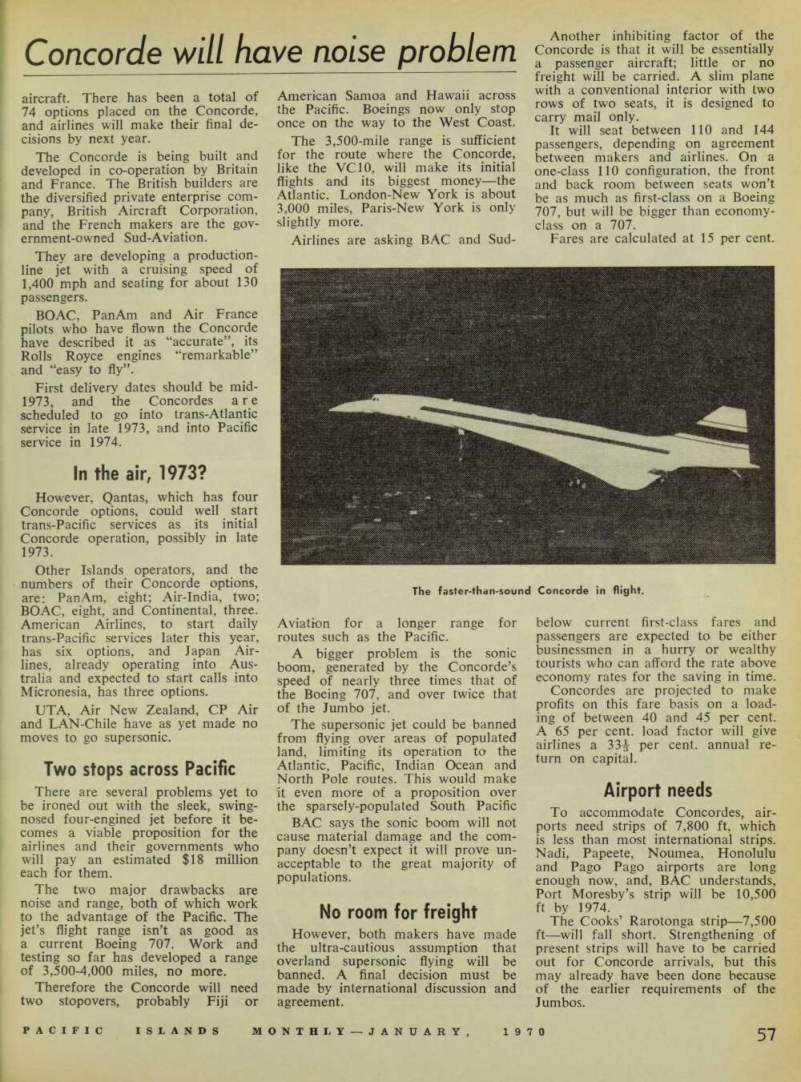
The faster-than-sound Concorde in flight.