Tropicalities
pp. 39-41 · Read in the full issue
Now You See It
And Now You
Don't
When the French Government devalued the franc by 12i per cent, last August, it was generally predicted that this would be of great benefit to French Polynesia’s tourist industry.
Devaluation, the prophets said, would (a) bring more tourists to the territory because the cost of the sojourn would be 12i per cent, less, or (b) it would enable visitors to stay in the territory longer because they would get more for their money.
Did these things, in fact, happen?
Not a bit of it, if we may believe the facts and figures revealed recently by Mr. Henri Bouvier, one of the leading lights in the local Territorial Assembly, and later by the Papeete newspaper, Le Journal de Tahiti.
This, they say, is how the devalua tion scheme went wrong.
In the old days, before devalua tion, hotel rooms and round-Tahiti bus tours, etc., were quoted to American tourists in US dollars.
Thus, a room costing 1,740 Pacific francs was quoted at $20, after con verting at the rate of 87 francs to the dollar.
After devaluation, when the $US became worth 97 francs, the cost of the same hotel room should have dropped to about $18, being 1,740 francs divided by 97.
However, Tahiti’s hoteliers and tourist agents took the view that a $20 room was a $20 room so they upped the price in local currency from 1,740 to 1,940 francs, and applied the same formula to all other prices.
Thus, instead of having to spend less local currency than he did be fore, the American tourist actually has to spend more.
This means, in theory, at least, that French Polynesia’s tourist pro moters are coining even more money than they did before, while the American tourist has lost on the roundabouts what he gained on the swings.
In their defence, the hoteliers and travel agents say that as their rooms and services are very often sold through agents in the United States 12 months in advance, it would serve no useful purpose to lower their prices, at present, in terms of dollars.
If they told their US agents that they only wanted $18 for each $20 room sold, it would be the agents
who would pocket th m , differential, not the tourists, r , * . . _. . .
L . e Ta f ll l su 88 este d that the hoteliers and local agents could get around this problem by making cash refunds to the tourists j n Tahiti This, no doubt, would win friends and influence people, and could be , he foundation of a highly success ful come-to-Tahiti movement.
D . . , But smce no ever has enough n i on^ y ’ no , ma .tter how much he has we .,^ e , lncllnecl to . think the tourists will keep on paying $2O for s i° r ? oms ’ J nd jf will be th e hoteliers wbo keep 1116 cban 8 e -
P'NG's Francis OVU-
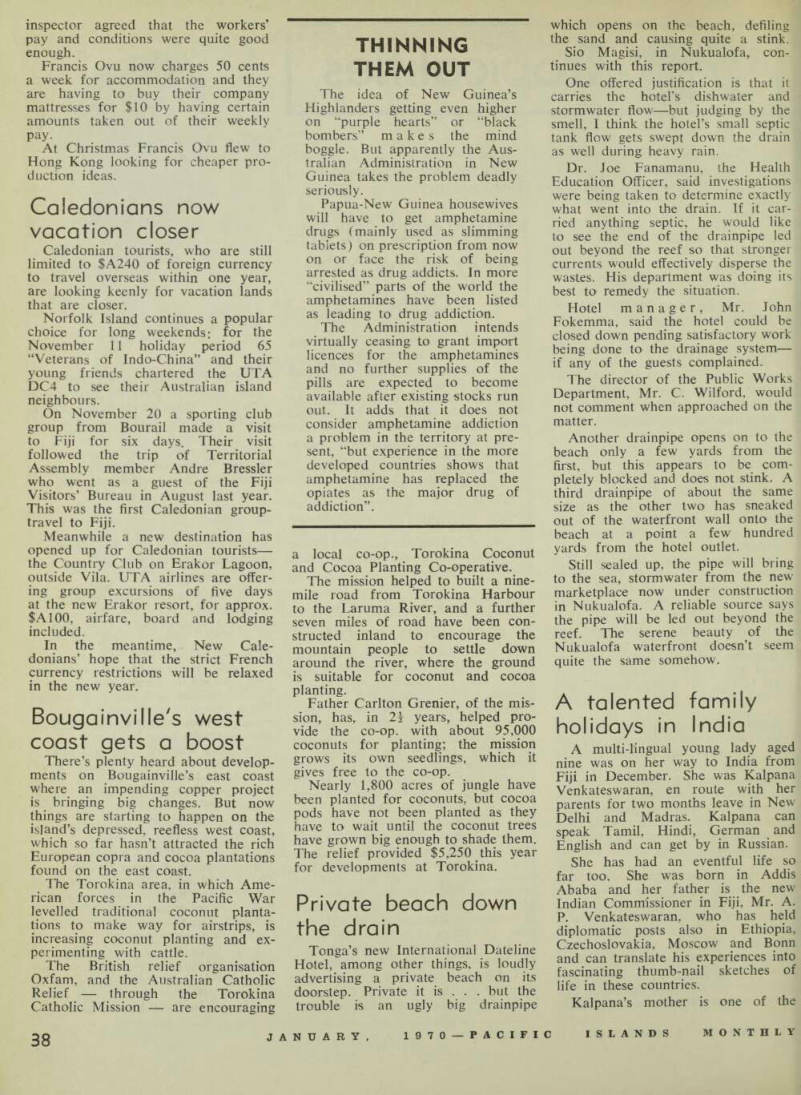
a A m h an wi , th ambition metal orker from the Ult of Papua * s determined to be- , COn J? one . of Guinea’s tiding native businessmen, Francis Ovu, 25, from Bei-Pa near Bereina in the Gulf District, is the ne . w owner-manager of Allied Enter prises Pty. Ltd. in Port Moresby, a small joinery and welding workshop started four years ago by an Anglo- Burmese in the New Guinea depart ment of Trade and Industries, Mr.
Alan Colquhoun, The Administrator, Mr. D. A.
Hay, officially opened Francis Ovu’s new company workshops at suburban Racecourse Road at the end of November, following the granting to Mr. Ovu by the Papua New Guinea Development Bank of a $13,000 loan over six years, the bank taking a 23 per cent, interest in the business and leaving Mr. Ovu 77 per cent.
Allied Enterprises Pty. Ltd. em ploys 15 Papuans and New Guineans, some of them from the original
Welders’ Club, and most of them be cause they don’t have the basic educa tion giving them access to the govern ment’s Idubada Technical school.
Francis Ovu’s factory is turning out low cost furniture including beds and a wide range of playground equip ment, and he is trying to talk the government into giving him a series of furniture contracts worth about million a year. Much of this work is now done by prisoners and, according to Francis Ovu, “This is unfair because it is interfering with private enterprises”.
Francis Ovu has come a long way since leaving his Yule Island (Gull District) classroom in 1962 to train as a boiler maker-welder at Depart ment of Public Works.
“I like being in business on my own,” he says. “I am after two more blocks of land so I can start a store house company to import materials— metal, fittings and rivets and things like that and later on I will start a sheet metal factory.” He has already added 200 ft of roof space to his Port Moresby factory and has leased floor space to a European watch repairer and a European upholsterer.
He is paying his native workers up to SlB a week. “And I have already had a strike,” he said. “They were complaining about their housing and I told them that I was giving them somewhere to sleep including beds and mattresses and they would not get this if they were working for a European company”.
The strike lasted one month and Francis Ovu had to prove, in his own way, that he was not “soft enough to let them get away with it”. He called the Department of Labour and their
Francis Ovu
inspector agreed that the workers’ pay and conditions were quite good enough.
Francis Ovu now charges 50 cents a week for accommodation and they are having to buy their company mattresses for $lO by having certain amounts taken out of their weekly pay.
At Christmas Francis Ovu flew to Hong Kong looking for cheaper pro duction ideas.
Caledonians now
vacation closer
Caledonian tourists, who are still limited to SA24O of foreign currency to travel overseas within one year, are looking keenly for vacation lands that are closer, Norfolk Island continues a popular choice for long weekends: for the November 11 holiday period 65 “Veterans of Indo-China” and their young friends chartered the UTA DC4 to see their Australian island neighbours.
On November 20 a sporting club group from Bourail made a visit to Fiji for six days. Their visit followed the trip of Territorial Assembly member Andre Bressler who went as a guest of the Fiji Visitors’ Bureau in August last year.
This was the first Caledonian group travel to Fiji.
Meanwhile a new destination has opened up for Caledonian tourists— the Country Club on Erakor Lagoon, outside Vila. UTA airlines are offer ing group excursions of five days at the new Erakor resort, for approx.
SAIOO, airfare, board and lodging included.
In the meantime, New Cale donians’ hope that the strict French currency restrictions will be relaxed in the new year.
Bougainville's west
coast gets a boost
There’s plenty heard about develop ments on Bougainville’s east coast where an impending copper project is bringing big changes. But now things are starting to happen on the island’s depressed, reefless west coast, which so far hasn’t attracted the rich European copra and cocoa plantations found on the east coast.
The Torokina area, in which Ame rican forces in the Pacific War levelled traditional coconut planta tions to make way for airstrips, is increasing coconut planting and ex perimenting with cattle.
The British relief organisation Oxfam, and the Australian Catholic Relief through the Torokina Catholic Mission are encouraging
a local co-op., Torokina Coconut and Cocoa Planting Co-operative.
The mission helped to built a nine mile road from Torokina Harbour to the Laruma River, and a further seven miles of road have been con structed inland to encourage the mountain people to settle down around the river, where the ground is suitable for coconut and cocoa planting.
Father Carlton Grenier, of the mis sion, has, in 2i years, helped pro vide the co-op. with about 95,000 coconuts for planting; the mission grows its own seedlings, which it gives free to the co-op.
Nearly 1,800 acres of jungle have been planted for coconuts, but cocoa pods have not been planted as they have to wait until the coconut trees have grown big enough to shade them.
The relief provided 55,250 this year for developments at Torokina,
Private beach down
the drain
Tonga’s new International Dateline Hotel, among other things, is loudly advertising a private beach on its doorstep. Private it is . . . but the trouble is an ugly big drainpipe
which opens on the beach, defiling the sand and causing quite a stink.
Sio Magisi, in Nukualofa, con tinues with this report.
One offered justification is that it carries the hotel’s dishwater and stormwater flow—but judging by the smell, I think the hotel’s small septic tank flow gets swept down the drain as well during heavy rain.
Dr. Joe Fanamanu, the Health Education Officer, said investigations were being taken to determine exactly what went into the drain. If it car ried anything septic, he would like to see the end of the drainpipe led out beyond the reef so that stronger currents would effectively disperse the wastes. His department was doing its best to remedy the situation.
Hotel manager, Mr. John Fokemma, said the hotel could be closed down pending satisfactory work being done to the drainage system — if any of the guests complained.
The director of the Public Works Department, Mr. C. Wilford, would not comment when approached on the matter.
Another drainpipe opens on to the beach only a few yards from the first, but this appears to be com pletely blocked and does not stink. A third drainpipe of about the same size as the other two has sneaked out of the waterfront wall onto the beach at a point a few hundred yards from the hotel outlet.
Still sealed up, the pipe will bring to the sea, stormwater from the new marketplace now under construction in Nukualofa. A reliable source says the pipe will be led out beyond the reef. The serene beauty of the Nukualofa waterfront doesn’t seem quite the same somehow,
A talented family
holidays in India
A multi-lingual young lady aged nine was on her way to India from Fiji in December. She was Kalpana Venkateswaran, en route with her parents for two months leave in New Delhi and Madras. Kalpana can speak Tamil, Hindi, German and English and can get by in Russian.
She has had an eventful life so far too. She was born in Addis Ababa and her father is the new Indian Commissioner in Fiji, Mr. A.
P. Venkateswaran, who has held diplomatic posts also in Ethiopia, Czechoslovakia, Moscow and Bonn and can translate his experiences into fascinating thumb-nail sketches of life in these countries.
Kalpana’s mother is one of the
most beautiful women connected with the Indian diplomatic service.
It is believed that there was deliberate purpose in the selection of an experienced diplomat like Mr.
Venkateswaran for the Fijian post.
New Delhi, some time ago, expressed dissatisfaction with the way in which political events in Fiji had been boiling up between Fijians and Indians to a possible inter-racial crisis.
Since the arrival of the new com missioner on the scene six months ago, much of the bitterness has gone out of inter-racial relations there.
During October-December, there were both formal and informal dis cussions between the Alliance Party (Fijians, Indians, Europeans and other communities) and the National Federation Party (who are mostly Indians). Considerable progress has been made towards the term of a new constitution, to be negotiated with the British Government next year, expected to give Fiji Dominion status.
There may be significance in the fact that Mr. Venkateswaran, while briefly in Australia in December, had a lengthy interview in Canberra with top officials of the External Affairs Department.
The view is held in influential quarters in Fiji that if Fiji is to have national independence, it must enjoy the sympathy and co-operation of Australia and New Zealand.
Four in a chain
for Fiji
By the end of 1970, Fiji should boast four hotels from the luxury Travelodge mould.
Since opening on October 21, 1968, the 140-room Suva Travelodge has been Suva’s greatest hotel drawcard and although work on the $1,250,000 Nadi project was halted several months ago, construction began again in December.
According to the managing director of Travelodge Fiji Ltd., Mr. Colin Thompson, the Nadi plans have been considerably altered: “in order to con form with the zoning regulations of the Department of Transport and Civil Aviation.”
“We’re pleased with the result. It should be an even more interesting building than the original plan,” said Mr. Thompson, adding that he ex pected the project to be complete by December, 1970.
Construction of the $450,000 Savu savu Travelodge is also well under way, with the site having been visited recently by the heads of Travelodge’s vast associated company, the Trust
Houses Group UK Ltd. They were the chairman, Lord Crowther, the deputy chairman, Sir Oliver Chester ton and the managing director, Mr.
J. M. Pickard.
Savusavu, which is to have four storeys with 12 rooms in each, is due to open in March or April, 1970.
Taveuni Travelodge, on the site of the now demolished Garden Island Hotel, is to be completed by Nov ember, 1970.
This operation will consist of 35 rooms plus all the traditional Travel lodge accoutrements.
Astute new SPC
secretary-general
Harry Moors, or Afioga Afoafou vale Misimoa, who takes up his new job as secretary-general of the South Pacific Commission on January 1, carries with him the blessings of his Western Samoan countrymen. They’re pretty proud of him.
When news was passed through the territory of his appointment there was universal pleasure, and one correspondent tells us that even those thought to be Harry’s political enemies were delighted with his honour. Although national pride, he says, had something to do with it, there was also confidence that Harry Moors’ attributes would make him a successful secretary-general—the first Islander to gain this appoint ment.
Says the correspondent: “Harry Moors is astute, has wonderful charm
and is as good an after-dinner speaker as one could hope to find.
“He can also see through anybody, and I doubt whether any bureaucrat or expert, and there seems to be so many of them these days, will be able to put anything across him. He will be a great success.”
Fears from space
Residents of Tonga’s Niuafoou, or Tin Can Island, are still talking about the brilliant fireball which appeared above their homes at the end of November and disappeared with three loud thunderclaps. It turned out to be the Apollo 12 re-entering the earth’s atmosphere after its trip to the moon—but many feared it was an eruption similar to those which caused the island to be evacuated after the war.