Tourism's
pp. 24-26 · Read in the full issue
Many Facets
(1) Tourists And Sunday Observance
Protests flew thick and fast in Tonga in December after the Police Department, in a show of authority and for the first time in recent years, clamped down on taxi, bus and three-wheeled taxi (ve’etolu) proprietors who were flagrantly disregarding the king dom’s Sunday observance laws.
The police law enforcement blitz caught taxi operators and the general public alike by surprise, although warnings against the running of pub lic transport on Sundays had been broadcast over the local radio station for several weeks previously.
Tonga’s Order in Public Places Act prohibits any work on the sab bath including engaging in any trade, buying or selling, gardening, swim ming, any other kind of recreation or sport. . . .
Persons infringing the act are liable to a fine of up to 10 pa’angas or im prisonment with hard labour for up to three months in default.
But the cabinet is empowered to grant permits allowing specific acti vities on Sundays.
Hardest-hit by the police strong arm Sunday tactics were taxi opera tors, although some concerns were also warned against the backyard sell ing of bread.
Two Canadian warships were in port the first day of the intensive police Sunday law enforcement, and sailors found they were unable to hire taxis to return them to their ships when they left the International Dateline Hotel after midnight.
Local residents were also upset when the police told them they could not return home by taxi when they left the hotel after midnight. Others who were already in taxis were emptied out by the police.
One major tour operator in Nukua lofa said he lost over STISO one Sunday because police would not allow him to take 27 visitors on tours of the island of Tongatapu. He was drafting a letter to his overseas counterpart in the tour business ask ing him not to send any tourists to Tonga with Sunday tours in their itinerary. .
Tonga’s Sunday laws, he said, would become a major setback in the country’s drive for more tourists.
He said the Sunday laws were made up at a time when there were no vehicles in the kingdom.
Consensus of opinion among taxi
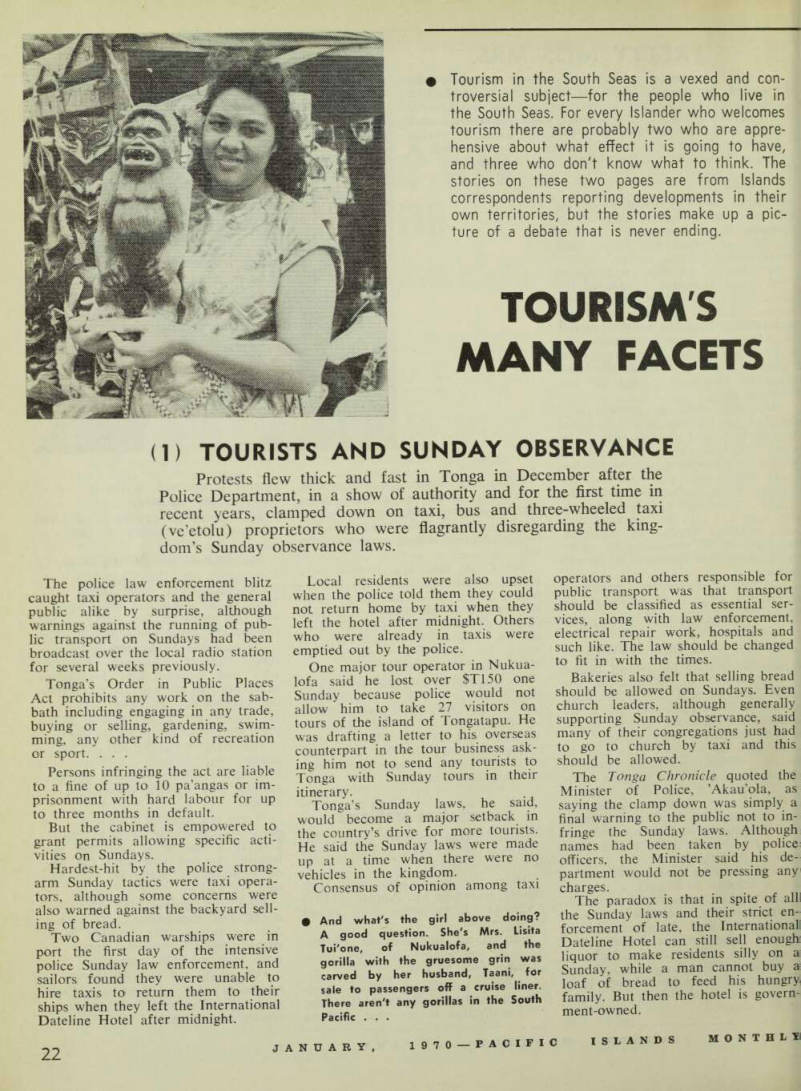
• And what's the girl above doing?
A good question. She's Mrs. Lisita Tui'one, of Nukualofa, and the gorilla with the gruesome grin was carved by her husband, Taani, for sale to passengers off a cruise liner.
There aren't any gorillas in the South Pacific . . .
operators and others responsible for public transport was that transport should be classified as essential ser vices, along with law enforcement, electrical repair work, hospitals and such like. The law should be changed to fit in with the times.
Bakeries also felt that selling bread should be allowed on Sundays. Even church leaders, although generally supporting Sunday observance, said many of their congregations just had to go to church by taxi and this should be allowed.
The Tonga Chronicle quoted the Minister of Police, ’Akau’ola, as saying the clamp down was simply a final warning to the public not to in fringe the Sunday laws. Although names had been taken by police; officers, the Minister said his de partment would not be pressing any charges.
The paradox is that in spite of alll the Sunday laws and their strict en forcement of late, the International!
Dateline Hotel can still sell enought liquor to make residents silly on a; Sunday, while a man cannot buy a loaf of bread to feed his hungry family. But then the hotel is govern ment-owned.
Tourism in the South Seas is a vexed and con troversial subject—for the people who live in the South Seas. For every Islander who welcomes tourism there are probably two who are appre hensive about what effect it is going to have, and three who don't know what to think. The stories on these two pages are from Islands
correspondents reporting developments in their
own territories, but the stories make up a pic ture of a debate that is never ending.
(2) And What's
In It For The
Fijians?
The degree of Fijian partici
pation in tourism concerned
members of Fiji’s Legislative
Council in December, when a bill to establish a Fiji Tourism Commission was debated and
passed.
The question of whether Fijians are receiving their just rewards from tourism, or whether they are being unmercifully exploited for the sake of, what the Chief Minister has re ferred to as, “expatriate profit”, has become a fairly hot issue in Fiji recently.
A recent article in the Alliance backed Fiji Nation newsmagazine in cluded several vignettes meant to illustrate the raw deal tourism hands out to Fijians. Called “The Seamier Side of Paradise”, the article quoted cases of “bitterness” and “deep resentment”, generated either because tradition wasn’t being properly observed or because sufficient pay ment hadn’t been given by employers.
In the Legislative Council debate on the Tourism Commission and Fiji Visitors Bureau Bill, the Opposition Whip, Mr. K. C. Ramrakha took the opportunity of pushing for more Fijian participation, saying it would
“be a tragedy” if Fijians found them selves on the outside of the circle when tourism was Fiji’s number one Chief Minister, Ratu Sir Kamisese Mara, said Fijian participation would be ensured by the appointment of the Mmister for Fl l ian Affairs and Local Government as one of the three ministers who would form the Tourism Commission, He said the “appalling state” which Mr. Ramrakha had said Fijians were be * n 8 reduced to in tourism was the most telling reason why the new Fiji Visitors Bureau Ordinance should not be deferred, Mr w M Barre(t (Alliance> Eastern and Central) agreed that Eijians were not getting their due.
He beHeved the Tourism Commission which the ordinance would place over ,[j e visitors Bureau would ultimately have to assist them. “As I see it, the job of the commission will be to see that tourism is open to everybody in Fiji”, he said (see “Peacock Spenders” p 41) Assistant Minister for Commerce, Industry and Co-operatives, Mr!
Emosi Vuakatagane, complained that either wood-carvers from Fulaga were being paid onl $6 a week f * r k the * were doing at Toorak in Suva. Their emp i oyer was selling their carvings for 526 each, He also said nawanawa wood, used for carving, was being bought up from Fijians in Lau and at Vanua Levu for 10c a foot and sold in Suva for 50c.
(3) 'Prepare To
Defend Your
Women'
Now and again at a sitting of Legislative Council, there is a member who gets up, throws his head back and delivers a speech which reddens the necks of other members, makes the rafters on the roof shudder and generally takes an otherwise hum-drum debate and turns it into a real hum-dinger.
A debate at the December meet ing of Solomon Islands Legislative Council on a Tourist Authority Bill to place controls on tourism in the islands, was one such.
Amid sensible remarks about clauses and submissions, and members yawning in the shadier corners of the chamber, the Director of Education.
Mr. D. Hibbert, got up and said: “I hate tourism, and I loathe tourists” . “We will be subjected to wave after wave of invasion by these 20th century barbarians”.
Pleasure grounds
Having tuned up the members’ ears for the onslaught, he then gave them the meat. “We have the misfortune ... to lie between the two most affluent countries in the world, Aus tralia and the United States, and it will be our fate, and it will be the fate of all Pacific islands, to become the pleasure ground for the people of these countries until such a time as the travel agents manage to take out concessions on the shores of the Sea of Tranquillity on the moon.
“That will be possibly a little sooner than we think and it will cer tainly be the end of all tranquillity.
“We have been told in this coun cil that the tourist industry is one of the major industries of the world; maybe. It has also been inferred that this country is going to get rich from this industry. I think this is claptrap and humbug. What in fact is going to happen is this. These vandals will arrive and even a tourist must have a place to rest his loathly head at night.
“Hotels will be built on your land with foreign capital. They will be managed by foreigners. They will have to be serviced to a certain ex tent by foreigners. The hotels will
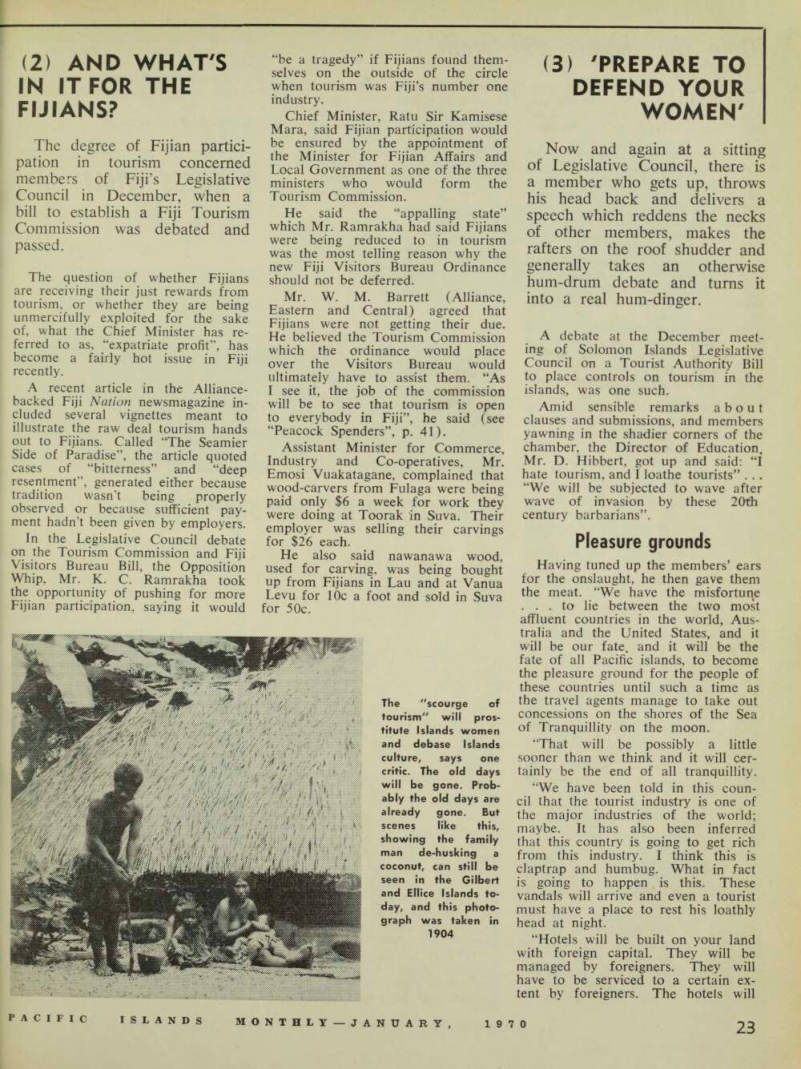
The "scourge of tourism" will pros titute Islands women and debase Islands culture, says one critic. The old days will be gone. Prob ably the old days are already gone. But scenes like this, showing the family man de-husking a coconut, can still be seen in the Gilbert and Ellice Islands to day, and this photo graph was taken in 1904
'Only the dealers will profit'
make profits on which indeed the pro prietors will have to pay income tax.
But the real profits will be out of this country to pay the shareholders abroad.”
Mr. Hibbert told members that tourists would spend most of their spare cash at duty free shops (hav ing paid transport and hotel arrange ments in country of origin) and they would bring no money into the country. “Only dealers and manu facturers would profit”.
To supply these shops, Solomon Islands artists and craftsmen who now produced work of real merit would be encouraged to manufacture, at speed, shoddy and stereotyped work for which the dealers would pay them as little as they could and charge as much as they could.
More expenditure
He continued: “The vested in terests who’ve sunk their money in this industry will bring pressure on the town council to provide better street lighting, more public amenities, and you in this council will be asked be fore very long to expend hundreds of thousands of thousands more dollars to extend Henderson Field still further so that it can take even bigger planes, from the bellies of which will debouch swarms of predatory locusts.
“The hotels, in order to titivate the jaded senses of their customers, will hire troupes of dancing girls who will swing their hips and sway their grass skirts in the faces of the visitors to the tunes of electric guitars strumming out pseudo- Pacific music. ‘These the proprietors will hire in the desperate hope that their clients will sit back in their comfortable chairs drinking even larger quantities of alcohol. It is indeed from the im port duties on the liquor that these people consume that I can see the only real profit coming into this country.”
Without appearing to pause for breath, he went on: “That is what is going to happen, and worse, for I see your beauty spots despoiled, your women prostituted, your culture de based and your art driven back re lentlessly to concentrate on the meretricious.
“There is no escape from this scourge. It will descend on us, but let us do what we can to protect this country and its people from it.
“Many shores of our islands are protected from the depredations of sharks by barrier reefs: let us try
to build out some form of defence to save us from those much more deadly predators. More deadly be cause though the shark occasionally does succeed in seizing some un fortunate victim and devouring it, these predators have the power to de stroy the soul of a people.”
It was quite a speech. Archdeacon
Thompson called it, “a stern warning” . . . which seemed an understatement after the rhetoric. Others felt that the Director of Education was living in the wrong century. The bill to control the future of tourism was deferred by the council.