The Practical Planter
pp. 143-147 · Read in the full issue

Banana Diseases And Their Control
From "Banana Production in the South Pacific ”, a handbook shortly to be released by the South Pacific Commission, edited by MICHEL LAMBERT.
The banana plant is attacked by many diseases. Some of these affect the whole plant, others develop on different parts of the plant and their spread may vary in rapidity and virulence. Losses due to banana diseases are always heavy and they may cause the yields to drop to an alarming degree. Growers, therefore, should always be prepared either to prevent their onset or to check them as they appear.
Leaf Diseases
Two diseases of bananas caused by Cercospora have been reported: “Sigatoka” and “Black leaf streak”.
Sigatoka caused by Cercospora musae was originally recorded in Java in 1902 by Zimmermann. In 1913 the disease became notorious in the Siga toka Valley in Fiji, hence the name “Sigatoka disease”. “Black leaf streak” is similar to this well-known leaf spot, but is more virulent and more difficult to control. It was first observed in Fiji early in 1963 and reported as the most important disease of banana in the Islands.
Sigatoka Leaf Spot
(Cercispora Musae)
Symptoms : Chlorotic streaks ap pear on third to fifth most recent leaves, developing on lower leaves into long and narrow (3.5 x 20-30 mm) necrotic spots with black edges.
With severe infection, large areas of lower leaves may be killed and browned beyond edges of spots. Spots on leaves of young plants are more oval outline.
Black Leaf Streak
(M Ycospha E Reel A Fijiensis)
Symptoms: In Melanesia, Micro nesia and Polynesia the initial symptoms are typical brown to reddish-brown streaks appearing on the second or third leaf from the top.
Young plantations appear to be more susceptible than older ones, possibly because the leaves are produced more slowly. Mature spots occurring in older leaves are 5-10 x 20-30 mm.
Initially they are reddish-brown to black streaks and as the central area of the snot dries out it turns light grey and remains surrounded by a
dark brown or black border with a yellow band between the spot and surrounding green tissues of the leaf.
In severe infections, the time which elapses between the appearance of numerous streaks and the death of the leaf may be only three or four weeks.
The black colouration is far more pronounced than in the case of Sigatoka disease; but mature spots of “Sigatoka” are indistinguishable from “Black leaf streak”.
Cordana Leaf Spot
(Cordana Musae)
Symptoms : Initially the disease appears on the leaf surface as small oval spots later enlarging to pro
minent, pale brown, oval patches with brilliant yellow margin and measuring 2-3 x 4-6 cm. Cordana spots exhibit distinct delicate con centric zonations on the upper surface of the leaf, less distinctly on the under surface.
Large areas of the leaf are destroyed as spots grow together.
Cordana is more prevalent in warm humid climates and occurs generally together with Cercospora leaf spot.
Malayan Leaf Spot
(Ha Ploba Sid Lon Musae)
Symptoms : Initial symptoms are small oval to diamond shaped brown to reddish-brown spots. Mature spots
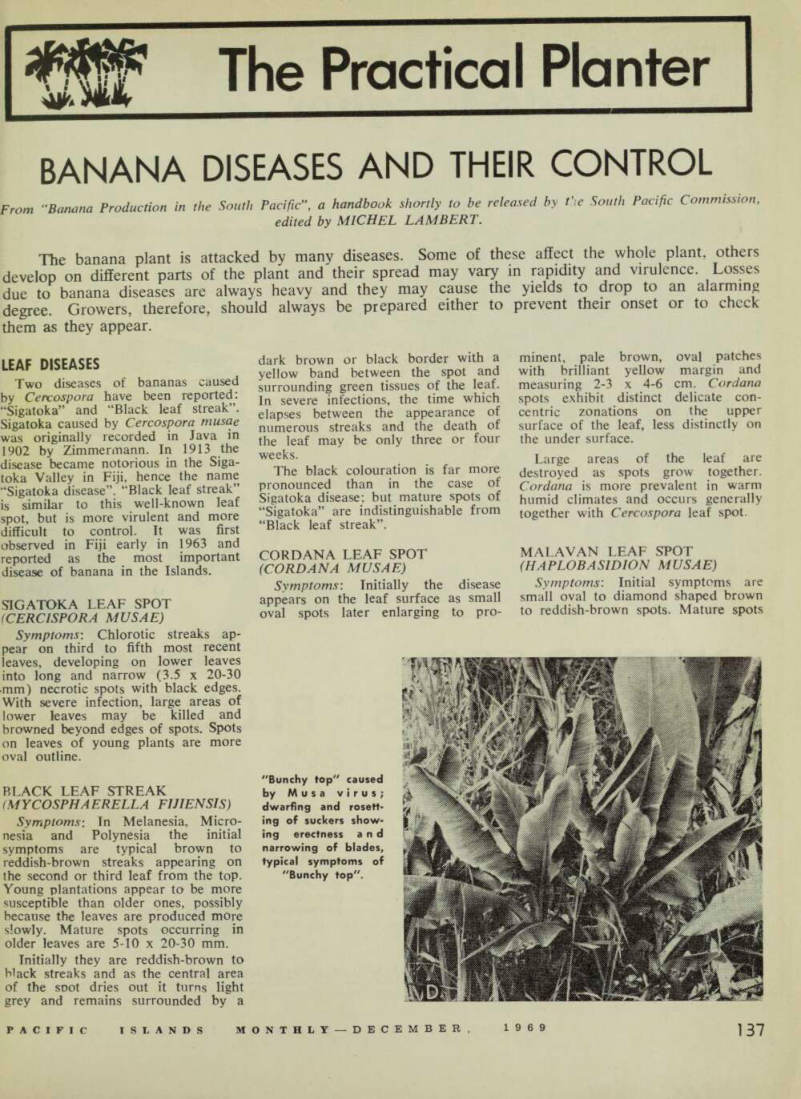
"Bunchy top" caused by Musa virus; dwarfing and resett ing of suckers show ing erectness and narrowing of blades, typical symptoms of "Bunchy top".
enlarge to near perfect shaped diamonds with a dried ashy gray centre bordered by dark relish brown margin The equal sides the diamond shaped spots measure about one cm in length. Malayan leaf spot is favoured by cool, dry con ditions.
Control Of Leaf Diseases
Before attempting to use fungicides, the grower must ensure that his plantation is well maintained and that the appropriate fertilisers are applied to promote quick and vigorous leaf growth.
However, maintenance alone is not sufficient to protect the banana plants from diseases. Commercial chemicals are required and these must be sprayed onto the leaves, both care fully and at regular intervals.
Light medium oils with high un sulphonated residues of more than 94 per cent, provide excellent control of “Cercospora leaf spot” However, in areas where these diseases are a problem the following control measures are recommended: • Summer months (wet season) Spray two gallons of misting oil/ acre every 10 days, or as required.
This will control the leaf spot diseases most active in wet weather. • Winter months (dry season) Spray a mixture of H gallon misting oil, H lb maneb, i gallon water and 75 cc of emulsifying agent/ acre as frequently as required.
The maneb will control “Malayan leaf spot”.
A miscible oil, instead of a misting oil plus emulsifier, may be used.
Rhizome And
Pseudostem Rots
Heart Rot
(Fusarium Monoliforme
and ERWIN IA sp.) Symptoms ; In the early stages the younger leaves are typically yellow or of pale colour, the heart-leaf being almost white and necrotic. The internal tissues of the petiole undergo brown discolouration. The rotting is accompanied by a malodorous decom position of the innermost pseudostem sheaths.
Control: Proper pruning practices usually provide adequate control.
Prune out diseased plants and excess suckers.
Black Head
This disease is caused by the nematodes or eel worm. The most serious kind is the burrowing one (Radopholus similis ) whose larvae burrow into roots where they feed and multiply.
Vascular And
Systemic Diseases
Fusarium Wilt Or
Panama Disease
(Fusarium Oxysporum
F. Cusense)
Symptoms : Yellowing, wilting and drying of leaves in old plants.
Eventual death of individual plants, In younger plants the first symptoms of yellowing and necrosis are visible in the unfurling leaf. A diseased hill is characteristic by proliferation of suckers and absence of bearing plants.
The disease is spread with infected rhizomes.
Control: “Panama disease” is not a problem in the Pacific territories and quarantine regulations properly enforced will keep the disease out of the area. Planting material should be obtained only from areas in which “Panama disease” has never occurred.
Eradication of infected plants is recommended in countries where the disease is present, followed by re planting with resistant or immune varieties.
The Cavendish group of bananas and many cooking varieties are resistant or immune to the disease.
Mosaic Or Infectious
Chlorosis
(Strain Of Cucumber Virus)
This virus disease is transmitted by several aphids.
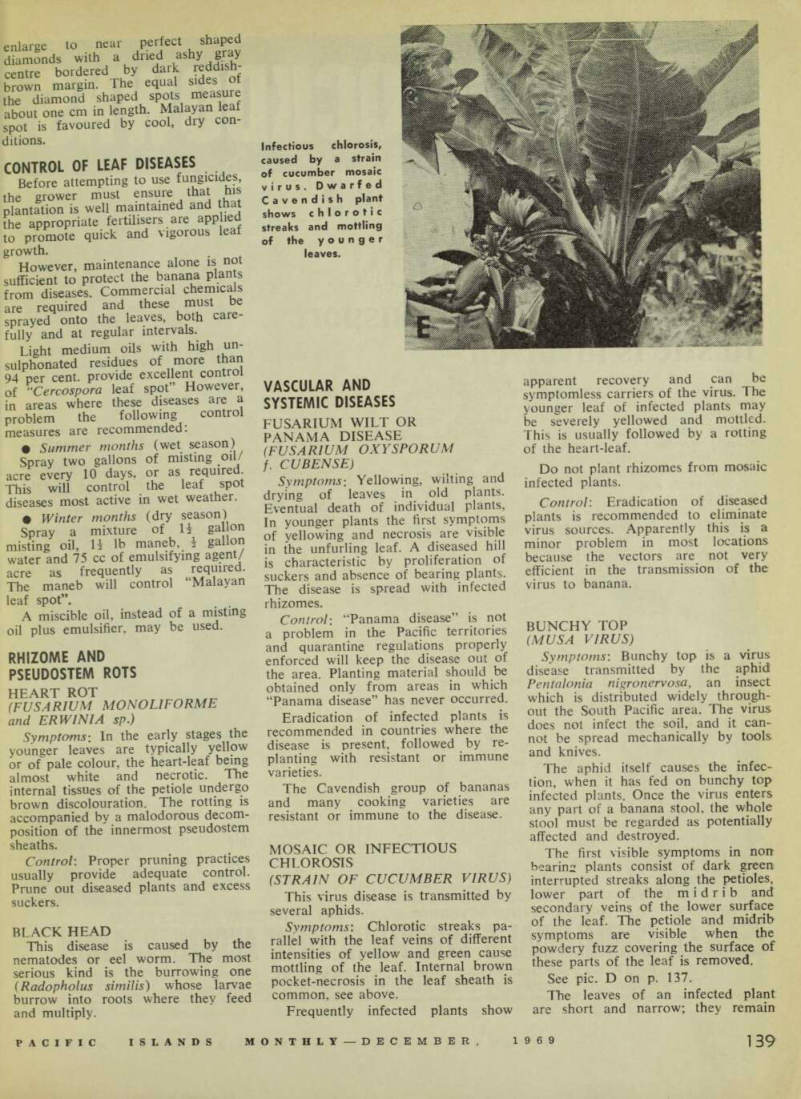
Symptoms: Chlorotic streaks pa rallel with the leaf veins of different intensities of yellow and green cause mottling of the leaf. Internal brown pocket-necrosis in the leaf sheath is common, see above.
Frequently infected plants show
apparent recovery and can be symptomless carriers of the virus. The younger leaf of infected plants may be severely yellowed and mottled.
This is usually followed by a rotting of the heart-leaf.
Do not plant rhizomes from mosaic infected plants.
Control: Eradication of diseased plants is recommended to eliminate virus sources. Apparently this is a minor problem in most locations because the vectors are not very efficient in the transmission of the virus to banana.
Bunchy Top
(Musa Virus)
Symptoms: Bunchy top is a virus disease transmitted by the aphid Pentalonia nigronervosa, an insect which is distributed widely through out the South Pacific area. The virus does not infect the soil, and it can not be spread mechanically by tools, and knives.
The aphid itself causes the infec tion, when it has fed on bunchy top infected plants. Once the virus enters any part of a banana stool, the whole stool must be regarded as potentially affected and destroyed.
The first visible symptoms in non bearing plants consist of dark green interrupted streaks along the petioles, lower part of the midrib and secondary veins of the lower surface of the leaf. The petiole and midrib symptoms are visible when the powdery fuzz covering the surface of these parts of the leaf is removed.
See pic. D on p. 137.
The leaves of an infected plant are short and narrow; they remain
Infectious chlorosis, caused by a strain of cucumber mosaic virus. Dwarfed Cavendish plant shows chlorotic streaks and mottling of the younger leaves.
tiff and erect. They are considerably educed in length.
Infection of older bearing plants auses flower malformations. Small bnormal bunches are produced show ng distorted fingers and necrosis of he lower hands and male inflores ence.
Old infected hills will show pro ileration of suckers with no bearing slants. They are stunted showing irectness and narrowing of blades ind yellowing along the leaf margins :ausing typical resetting.
Bunchy top is a very serious disease vhich can cause heavy losses in the dantation.
Control: First of all, disease-free danting material should be used. *rom then on, constant surveying and nspection of the plantation is neces jary to detect infected plants.
Infected plants should be sprayed vith insecticide and killed with cerosene or 2-4 D To ensure that all •hizomes will be eradicated the hill :an be dug out and the rhizomes cut in small sections before spraying iveedicide.
In conclusion, in a banana planta tion infected with “Bunchy top”, two actions are required: the first is to destroy the infected plants, each of which is a centre of infection, and the second, to eradicate the aphid which is the disease carrying agent.
It should be noted, however, that several varieties which are at present grown in the Pacific territories are fairly tolerant or resistant to “Bunchy top”, the main one among the com mercial varieties being “Veimama”.
Fruit Diseases
Cigar End
(Verticillium Theobromae)
Symptoms: The fungus develops during the period from the inception of flowering to harvesting time. When the flowers fall after wilting, the apex of the young banana is very vulner able to infection and the fungus establishes itself very rapidly.
The type of rot which settles at the extremity of the fruit is often called “cigar end” and may resemble dry rot. In some bunches only a few fingers may be affected but when climatic conditions are favourable all fingers may become diseased.
This is the mos* common fruit disease in the South Pacific territories and is of particular concern to buyers. It is more prevalent during the summer months.
Anthraonose
(Gloeosporium Musarum)
Symptoms: Initial infections occur at flowering time. Circular specks show on the fruit skin. This infection
remains dormant and will resume development when the fruit matures and ripens. When the fruit colours the specks become dark brown to black in colour and expand in diameter as the fruit becomes coloured.
Fusarium Tip Rot
(Fusarium Monoliforme,
Fusarium Lateritium)
Symptoms: This disease is charac terised by tip rotting of very young fruit while they are still small and angular and without starchy flesh.
These fungi can be a serious problem of bananas in transit. Affected fruit become soft, black, and covered with fungal growth cream to pink in colour, see above.
Control Of Fruit Diseases
The growers themselves should ensure the protection of the flowers
in the plantation. Fortunately, effect ive control of leaf diseases through fungicides also provides adequate control of fruit diseases in the field.
For instance, maneb used to control leaf diseases protects the fruit while in the developing stage.
However, if bagging with blue plastic is practised, it is recommended that the bunch be sprayed, before bagging, with mancozeb at the rate of i lb to 2i gal. of water.
The utmost care should be taken when harvesting the bunches as well as in transport from the plantation to the packing sheds where the fruit should be dipped into vats containing a specific treating agent, or washed in plenty of running water.
Finally, the fruit should be handled with great care and packed in well designed boxes so as to protect them from bumping and bruising. This will ensure that high quality fruit is pro vided for export.
Fusarium tip rot, caused by fusarium monoliforme.