Business and Development
pp. 121-127 · Read in the full issue
Australian Investors In A Billion
Dollar Mining Boom In The Pacific
By Ken Mcgregor
Contracts and processing works worth over $2 billion in Islands copper, gold and nickel, mainly in New Guinea and New Caledonia, highlighted an unprecedented string of Islands mineral develop ments in November.
Ore finds, exploration ventures and spiralling share prices for some Islands firms appeared during the month.
Australia’s rejuvenated mining boom was behind most of the news as Australian mining interests ven tured in to South-East Asia, Africa and even Alaska, as well as the Islands.
Four territories—New Guinea, New Caledonia, the New Hebrides and Fiji—are affected but it was New Guinea which provided the highlights.
Firstly, the NG Administration said it would pay $25 million for its share in the Bougainville copper mines. Secondly, Japanese sources reported that the operating company, Bougainville Copper Pty. Ltd., had signed a contract with nine Japanese companies for 1.1 million tons of contained copper over a 15-year period, worth an estimated $1.78 bil lion.
New Caledonia supplied the other big news: over $3OO million of ex pansion of the territory’s nickel industry got moving with the only current supplier, Le Nickel, begin ning its own $llO million expansion with the building of additional plant capacity in Noumea.
Other significant news included decisions of two major Australian companies to mount expensive ex ploration programmes for iron ore and copper around the Papuan coast, a new rich gold vein discovered at Fiji’s Vatukoula mines, a copper find at Manus Island, a nickel find behind Vanimo and best-ever heights on the share markets for two companies deeply committed in Islands minerals exploitations.
Briefly, here are the details: • The P-NG Administration said
it would pay $25 million for its option on a 20 per cent, equity interest, on behalf of the people of New Guinea, in the Bougainville copper project.
Mr. Barnes, Australia’s Minister for External Territories, said the Administration would hold the shares until the people of NG could afford to buy them for themselves.
The project would involve an investment of over $3OO million and was expected to start producting cop per concentrate in 1972.
He did not give any hint as to how NG would pay its $25 million, but under an agreement made in 1967, the Administration has the right to take up the shares in Bougainville Copper Pty. Ltd. at par (which presumably will be 50c).
The territory should be on a “good thing” in investment terms, and then, of course, it also will gain from income tax and other taxes.
$1.78 billion to Japan
• Agreement for a 51.78 billion sale of Bougainville contained copper to Japan was signed in Tokyo in late November—the biggest ever single Island deal. One of its features was provision by two Japanese companies of SUS6O million in finance, half in cash, half in equipment.
Equipment will include crushers.
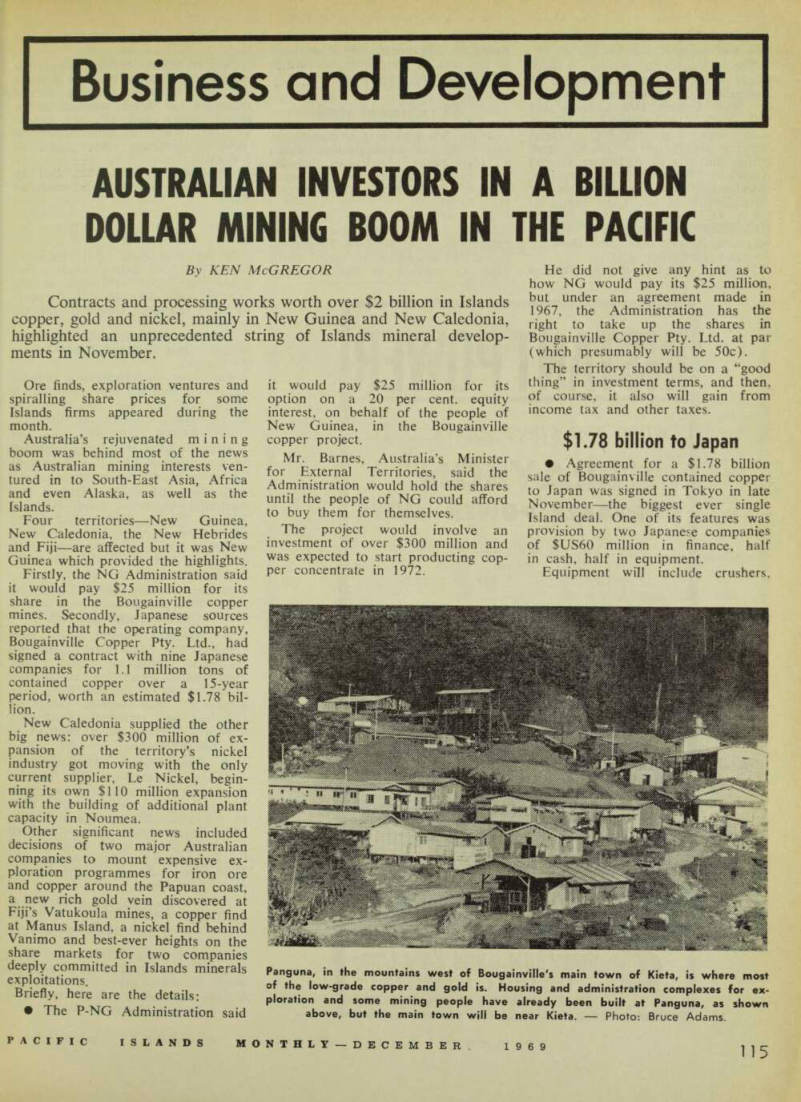
Panguna, in the mountains west of Bougainville's main town of Kieta, is where most of the low-grade copper and gold is. Housing and administration complexes for ex ploration and some mining people have already been built at Panguna, as shown above, but the main town will be near Kieta. Photo: Bruce Adams.
bore mills, flotation cells, generators and prefabricated houses.
The Bougainville project is two thirds owned by Conzinc Riotinto of Australia Ltd. and one-third-owned by New Broken Hill Consolidated Ltd.
However, with the NG Admin istration taking up its 20 per cent, option and the previously-announced American loans for the project, shareholding in the holding company (Bougainville Mining Ltd.) would be CRA, 44.7 per cent,, New Broken Hill, 22.3 per cent., NG Admin istration, 20 per cent, and Bank of America, three per cent.
However, CRA and New Broken
Hill have said their shareholders would be allowed to subscribe about 10 per cent, of the project, so further adjustments later are likely.
$3 million of steel
• In Noumea first shipments of over 7,000 tons of Australian steel— a biggest-ever Australian Islands sale—began arriving on chartered French vessels from Adelaide and Port Kembla.
The structural metal on short delivery from BHP, doubles the capacity of Le Nickel’s Doniambo plant, and represents an order worth over $3 million to the suppliers,
Bernard-Smith PDM Pty. Ltd., of Sydney, Bernard-Smith, builders of large capacity fuel tanks in New Guinea and Fiji, is also building similar tanks for Le Nickel, adjacent to the nickel works and has let out a $400,000 erection sub-contract to Marr Contracting Pty. Ltd., of Sydney.
Expansion work is controlled by Le Nickel’s engineers, Sofresid, of Paris.
Gold find in Fiji
• At Vatukoula, Fiji, Emperor Mines Ltd. said it had struck a rich gold vein which, although in the existing mine area in Fiji, “appears to have escaped detection for 30 years”.
The vein involves the new 166 N lode, first intersected on August 29 last year.
According to Emperor’s annual report, the lode is “a potential major ore source” and does not appear to be connected with any of the pre viously known formations.
Emperor has subsequently upgraded its ore reserves by 225,700 tons of 7.9 material concentration.
At Manus Island, New Guinea, two Australian explorers, Exoil NL and Transoil NL, said they had found two traces of copper. They said an extensive drilling programme will start early next year when two dril ling rigs arrive at the island.
Stream sediment and soil sampling geochemical surveys will be expanded on Manus, the companies said. • Behind Vanimo, in New Guinea’s West Sepik district, came un confirmed reports of nickel traces.
They were found on about 100 square miles of mineral lease land owned by New Guinea Goldfields Ltd. and were reportedly located by scientists working under contract to Mt. Isa Mines Ltd. • From Sydney, Australian Oil and Gas Exploration Ltd., one of Australia’s two oil producers, an nounced a $3.3 million share issue to partly finance investigation of a “possible significant copper-vanadium ore bcdy, 2,000 ft by 200 ft” near the Ormond River, north-east of the MacGillivray Range, in the Central District of Papua.
AOG holds titles and options over 3,400 square miles in three adjacent areas of that part of Papua, east of Port Moresby.
Directors said increasingly more detailed exploratory work would be done in these areas. Two of the leases—Amazon Bay and Amora had only been inspected by air.
• From Sydney, Australian con structor, James Wallace (Holdings) Ltd., announced formation of a new company, James Wallace Exploration Pty. Ltd., to evaluate iron ore deposits in the form of magnetite sand in the Deception Bay area in the Gulf District of Papua.
Subject to the approval of NG’s Administrator, the new company will take up a 50 per cent, interest in prospecting authorities over 2,000 square miles of the Gulf.
Wallace said magnetic sand was the raw material on which New Zealand had based its steel industry. There was demand for it by Japanese steel mills to supplement their fine ores, because of its relatively low cost.
A considerable amount of test work had already been carried out in the Deception Bay area.
Independent assessors recommended a detailed programme of exploration and development and had been retained to carry this out. It is hoped to commence work late this year. • Two firms with Islands mineral interests, saw their shares reach highest-ever peaks in November.
Southland Mining Ltd., mining manganese and looking for gold in Fiji, about to mine manganese in the New Hebrides and with a big equity in an African iron ore project, saw its 25 cent, shares sell for up to 56.40 on Australian Stock Exchanges.
Cultus Pacific NL, with a major interest in the Misima Island, Papua, copper and gold project, saw its 25 cent shares climb to SI.BO.
Canadian moves
• Hopes that there could be a “mini Bougainville” on Misima Island, Papua, grew in November with the news that another Canadian group, Noranda Mines Ltd., through its Australian subsidiary, would join Cultus Pacific NL and Pacific Island Mines Ltd. to evaluate copper traces on the island. Extensive diamond drilling is expected to start early next year. • Mt. Isa Mine Ltd. announced indications of a “copper environ ment” in the Freida River area, 60 miles from the West Irian border, in the West Sepik District of New Guinea. Copper grades were low and exploration was continuing.
More plantings
in the Cooks
A party of 30 copra makers sailed from Atiu in the Cooks to Takutea, 16 miles away, on October 21. They were to stay at Takutea for a month to plant 8,000 young coconuts and
thin out old trees. They expect the new plantation to produce 100 tons of copra a year.
Twelve thousand new citrus trees were planted in private plots on Atiu recently as well as 300 Jaffa orange trees, and the island council and village committees were widening and resurfacing all the roads during October.
In Mangaia, 85,000 cases of pine apples are estimated for this season
beginning in early November; 1J mil lion pineapples had been planted and planting was being continued.
Japan moves into the
P-NG beer market
Asahi Breweries Ltd. of Japan, technical and supervisory backer of New Guinea’s proposed second brewery. Territory United Brewery Ltd., will be given options to take
up a “large parcel” of shares in the brewery “within five years”.
Mr. S. L. M. Eskell, one of TUB’s four directors, told PIM this in late November. He said Asahi, one of the 10 biggest brewers in the world, would also help design the brewery’s first plant at Port Moresby, super vise operations and lend advisors and bottling experts to the plant for five years.
A potential Japanese stake in TUB will increase foreign control of NG brewing. NG’s two brewery plants— at Lae and Moresby—are controlled by South-East Asian interests.
No Australian brewer has an nounced plans to produce NG beer
although canned beer made in Aus tralia reaches the territory. One pos sible development could be a W. R.
Carpenter-Carlton and United Brewery of Melbourne joint brewery at Cairns, Queensland.
TUB’s plant would be built on five acres at Gordon Estate and its first beer would flow by late next year, added Mr. Eskell. No tenders had yet been let for construction of the plant.
The company would aim for 13 per cent, of the NG beer market by the end of 1971. Mr. Eskell said he “didn’t know” if this would mean profits in the first year.
He said TUB would have no
“tied-house” agreements with hotels as in Australia where certain hotels could sell only beer from their as sociated breweries.
However, TUB would initiate “sales agreements” with “certain hotels” (possibly Rabaul’s Cosmo politan, the Goroka and Wau Hotels, the Hotel Cecil, Lae, Burns Philp’s hotels, particularly in Moresby, and the Gateway and the Tapini Hotel).
Mr. Eskell said TUB would be floated on the Sydney Stock Ex change in January. Pring, Dean and Company, Sydney stockbrokers, would underwrite million shares of 50 cents each for a paid-up capital of $1,250,000.
Other members of TUB’s board would be Messrs. Norman White, Cliff Jackson (managing-director of Papuan Airlines, a subsidiary of which owns the Gateway and the Tapini Hotel) and Ken Jones.
Mr. Eskell said Burns Philp (NG) Ltd. would apply for 200,000 shares and Mr. Raymond Lord, a director of Pacific Sporting Pools Ltd. of Nauru, would also be offered shares.
It was undecided if a premium would be added to the 50 cent shares to initial stockholders.
Crown Agents
examine projects
The UK-based Crown Agents may invest about $A3i million in four Islands projects. In November the group wouldn’t disclose what the pro jects were, but did reveal that three of the projects would be in Fiji and cost $3 million and the other would be in Tonga and cost Si million.
Two Crown Agents, Mr. E. A.
Morris of London and Mr. W.
Walter, the group’s Australian and Islands representative, began a tour of Islands’ territories in November to examine these projects.
They said they would also look at property development in the Islands (Crown has announced it is spending $lOO million in property development in Australia).
Mr. Morris said investment propo sitions put to him by Islands’ govern ments would have to be referred to headquarters in London for decisions.
He did not have authority to make investment decisions “on the spot”.
Mr. Walter said the Crown Agents has recently completed a water supply and conservation survey for Nauru. Also his group had the facilities to assist Nauru rehabilitate the areas of its island which were worked out by phosphate mining.
But no approaches had been made by Nauru on a rehabilitation project, and no help had been asked of Crown
Agents to assist the formation of a Stock Exchange in either New Guinea or Fiji.
He added Crown Agents had re cently replaced the New Zealand Government as the purchasing agents for the Government of Western Samoa.
Fiji sea bed search
looks good
Results of a preliminary survey for sea bed minerals in Fiji are pro ving extremely favourable, according to the American exploration com pany concerned, Crawford Marine Specialists.
The company’s project manager in Fiji, Mr. Bill Murdaugh, said some of the survey results were interesting compared with ether favourable areas of the world. For example, he said, the Oregon coast, which was known to contain gold, had lower values than those encountered in Fiji.
Mr. Murdaugh said there were several interesting areas in Fiji which he hoped to analyse further— but added that he was not at liberty to discuss particular target areas.
The company’s headquarters and backers of the venture in America will decide whether it is economically feasible to make further exploration and analysis. Geophysical data and in c ormation about samples assayed in the Crawford Marine laboratory at Walu Bay have been sent to the US for evaluation.
P-NG car retailers
urged, get spares
One of New Guinea’s leading planters and MHAs, Mr. Sinake Giregire of Goroka, has started a move to force vehicle retailers to carry spares for the cars and trucks they sell.
Mr. Giregire, MHA for Daulo in the Eastern Highlands, told the Administrator’s Executive Council in Port Moresby that a good many vehicle owners throughout the ter ritory were immobilised because vehicle agents were just not carrying enough spares.
The slowdown in spares is also affecting the owners of tractors and
farm machines. Sometimes, according
to reports to the Administrator’s Council, vehicles have been off the road for months awaitmg spares. The effect on village and plantation economics has been severe.
New Guinea’s Co-ordinator of Transport. Mr. Gavin McDonnel, has been asked to investigate and the Administrator’s Council might con
sider legislation forcing distributors to carry spares.
Five years ago, an elected Euro pean MHA began circulating a draft bill in Parliament providing penalties for distributors caught by govern ment inspectors without a prescribed level of spares. The draft bill was withdrawn, when government leaders promised to “use their influence” un officially with vehicle distributors.
Bigger profit for
West Samoa Bank
The Bank of Western Samoa made a profit of $W529,985 for the year
ended December 31, 1968, an in crease of nearly 50 per cent, on the previous year’s result. The latest profit is at an earning rate of over 10 per cent, on the bank’s paid-up capital of $280,000. Directors said the better result was due to a significant increase in Samoa’s export receipts and higher earnings on the greater holdings of overseas reserves.
A dividend of 5 per cent, was paid to owners of the bank’s 1,400 $2OO shares (consuming $14,000), $12,000 was added to general reserve and $6,965 was the balance carried forward.
Directors said the bank continued
to be in a sound position with liquid assets at a high level. The bank’s advance policy had continued to be biased strongly towards loan pro posals which could materially add to Samoa’s productive capacity.
Reviewing prospects, deputy chair man Mr. J. F. Earnshaw, said the value of tourism was becoming in creasingly important and with ex pected growth in both primary and secondary production coupled with the anticipated completion of Asau Harbour and establishment of the timber industry in Savaii, Western Samoa’s prospects for 1969 could be viewed with “some optimism”.
Western Samoa looks
to Hawaii
West Samoan Minister of Finance, Fred Betham, returned from an 11 day visit to Hawaii in October con fident that Hawaiian investors will soon be active in this territory.
Highlight of his visit was a luncheon address to the Pacific Busi nessmen’s Forum, attended by more than 100 Hawaiian businessmen in which he said that although Samoa was making considerable effort and progress in development it was obvious that sufficient economic growth was not possible unless more capital was made available from overseas.
Samoa needed investment capital of at least SUS 4 million annually to create 1,300 new jobs every year from 1971 to 1976 to absorb young people who will reach working age.
Mr. Betham said on his return to Apia that his speech was very well received and that the Department of Economic Development had already received inquiries from Hawaiian businessmen regarding proposed in vestments.
Sharp increase
in copra prices
Mr. lan McDonald, chairman of the Papua-New Guinea Copra Market ing Board, gave the following report on the world copra market on November 24: The October average for Philippine copra, delivered weight, UK/Con tinent rose to $A 188.73 per ton com pared with 5A185.39 in September.
It is expected that the November average will out-turn at around SAI93 or possibly higher.
The reason for the sharp increase in prices comes from the lack of sell ing interest at origins. There have also been reports of defaults in near positions from Indonesia.
Generally, availability of copra
has been disappointing this year, par ticularly from the consumer’s point of view. Expectations of increased exports earlier this year were wide in the market and even at the present time production in practically all areas has continued to decline.
However, a sizeable increase in Philippine production is being fore cast for 1970, following the ex pansion in planting during 1960/61.
Excellent seasonal conditions since June this year should also result in increasing production during 1970.
With more copra coming on the market, prices will no doubt be affected, particularly if the Nigerian export supply position on palm
kernels improves, but, for the time being and perhaps for at least the next six months or so, only moderate variations should occur. • Plantations Holdings Ltd., Rabaul, New Guinea-based copra and cocoa grower and trader, made a record profit of 5179,890 for the year ended June 30. Last year’s profit was 570,781. Copra output was 851 tons and cocoa output 189 tons, in 1968-69. During 1968-69 all the issued shares of Rabaul Investments Pty. Ltd., diversified store owner, were acquired. Plantations’ dividend is raised to 10 per cent, and the company’s earning rate increased to 30.4 per cent.