Micronesia, urge Hawaiians
pp. 114-116 · Read in the full issue
Scrap West Coast line to Micronesia, urge Hawaiians
Should Micronesia use goods and supplies from the US West Coast or from Hawaii? This was a major question raised at a recent pre-hearing conference in Honolulu of the forthcoming Micronesia Interocean Line contract Review Board meeting to be held in Saipan in January.
In a move described by MILI a» “most surprising”, a group of Hawaii
manufacturers proposed MILI’s direct West Coast US service to Micro nesia be scrapped.
The Hawaiian people said MILFs ships should be replaced with Flag Line vessels and an “exclusive ser vice” begun from Honolulu to Micro nesia.
They argued that Hawaii could supply most commodities for Micro nesia at “competitive prices”, and other commodities could be brought to Honolulu for trans-shipment to Micronesia.
MILFs comment; “The proposal is not consistent with our understanding of Trust Territory requirements”.
The criticism of MILI was one of several matters raised at the con ference regarding MILFs services.
“Many criticisms and complaints” from various interest groups came from Honolulu and Guam, MILFs fortnightly bulletin said. “Compara tively few” criticisms came from Micronesia, “little” criticism came from Japan and there were no brickbats from the US West Coast.
The Honolulu conference closely
followed the first annual meeting of
Mill
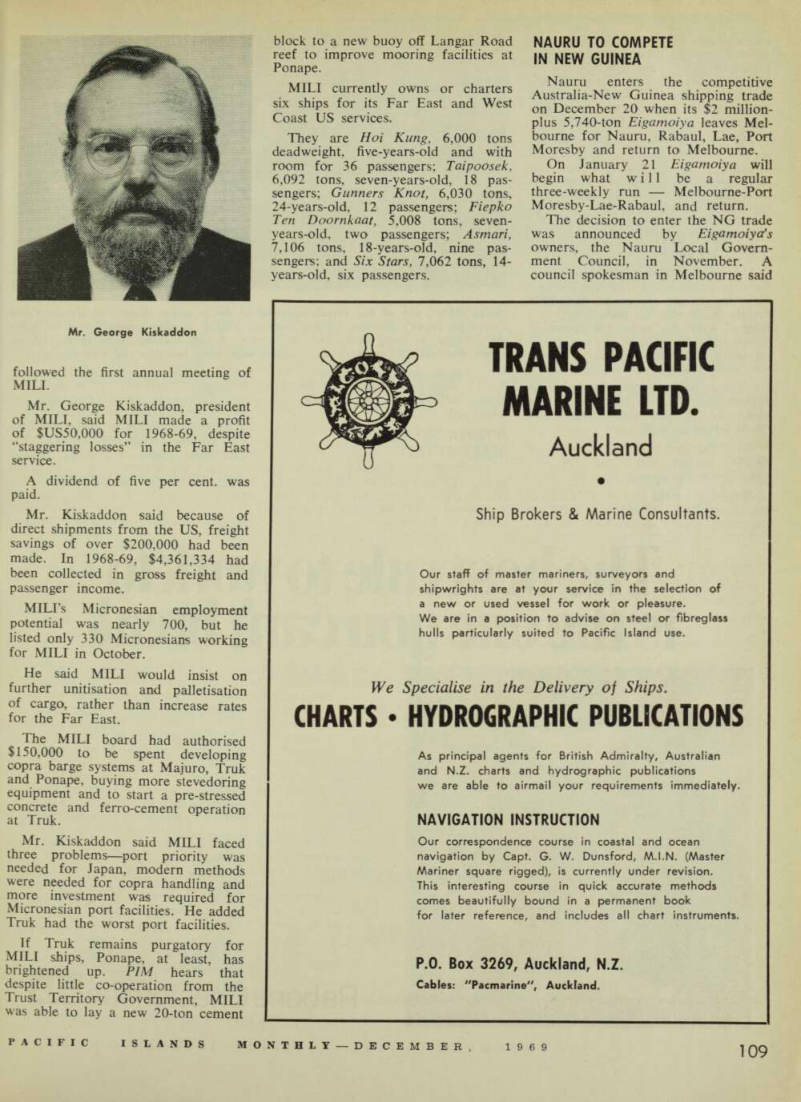
Mr. George Kiskaddon, president of MILI, said MILI made a profit of SUSSO,OOO for 1968-69, despite “staggering losses” in the Far East service.
A dividend of five per cent, was paid.
Mr. Kiskaddon said because of direct shipments from the US, freight savings of over $200,000 had been made. In 1968-69, $4,361,334 had been collected in gross freight and passenger income.
MILI’s Micronesian employment potential was nearly 700, but he listed only 330 Micronesians working for MILI in October.
He said MILI would insist on further unitisation and palletisation of cargo, rather than increase rates for the Far East.
The MILI board had authorised $150,000 to be spent developing copra barge systems at Majuro, Truk and Ponape, buying more stevedoring equipment and to start a pre-stressed concrete and ferro-cement operation at Truk.
Mr. Kiskaddon said MILI faced three problems— port priority was needed for Japan, modern methods were needed for copra handling and more investment was required for Micronesian port facilities. He added Truk had the worst port facilities.
If Truk remains purgatory for MILI ships, Ponape, at least, has brightened up. PIM hears that despite little co-operation from the Trust Territory Government, MILI was able to lay a new 20-ton cement
block to a new buoy off Langar Road reef to improve mooring facilities at Ponape.
MILI currently owns or charters six ships for its Far East and West Coast US services.
They are Hoi Kung, 6,000 tons deadweight, five-years-old and with room for 36 passengers; Taipoosek, 6,092 tons, seven-years-old, 18 pas sengers; Gunners Knot, 6,030 tons, 24-years-old, 12 passengers; Fiepko Ten Doornkaat, 5,008 tons, seven years-old, two passengers; Asmari, 7,106 tons, 18-years-old, nine pas sengers; and Six Stars, 7,062 tons, 14years-old, six passengers.
Nauru To Compete
In New Guinea
Nauru enters the competitive Australia-New Guinea shipping trade on December 20 when its $2 million plus 5,740-ton Eigamoiya leaves Mel bourne for Nauru, Rabaul, Lae, Port Moresby and return to Melbourne.
On January 21 Eigamoiya will begin what will be a regular three-weekly run Melbourne-Port Moresby-Lae-Rabaul, and return.
The decision to enter the NG trade was announced by Eigamoiya’s owners, the Nauru Local Govern ment Council, in November. A council spokesman in Melbourne said
Mr. George Kiskaddon
negotiations were proceeding to buy another vessel, second-hand. It was hoped to put her on the NG run by March next year. The ship is under stood to be the BPC’s Tri-aster, with room for 48 passengers. Price under negotiation is almost SAI million.
The council will be agents for the service in Melbourne; in Sydney and NG the W. R. Carpenter Group will be agents and Carpenters have also undertaken to help obtain backload ing cargo to Australia.
'Havanan' Unfit
To Go To Sea?
Mr. H. T. Doctor, Sydney business man and owner of the 104 ft New Hebrides trader Havanah, told PIM in late November he was “pretty un happy” with the order of detention issued on the trader by the cond minium’s British Marine Super intendent, Captain Robin Bibby.
Captain Bibby issued the order on Havanah at Vila on October 22. He said the 33-year-old trader was “unfit to go to sea”.
Mr. Doctor said he had paid $6,000 earlier this year for the vessel’s annual survey.
Havanah traded out of Vila to the southern Hebrides islands and her detention was costing $lOO a day.
Mr. Doctor said. Her skipper, Mr.
R. A. “Bunny” Warren, and her 12man Hebridean crew were un employed.
Noumea Dry Dock
Ready At Last
The Noumea drydock, which has been held up for over eight years by construction delays, has finally been completed and its first ship was slipped in November.
The dock’s on He Nou, opposite Noumea’s wharves. It is equipped to take vessels under 1,000 tons, up to 212 ft long and 36 ft wide.
After receiving local trader Tiburon HI, Noumea Harbour Master, Mr.
Chaumont, said the dock would service local oceanographic and naval craft, and other islands ships. He also indicated that the tugboat Noumea, being built in France, should arrive in Noumea in February.
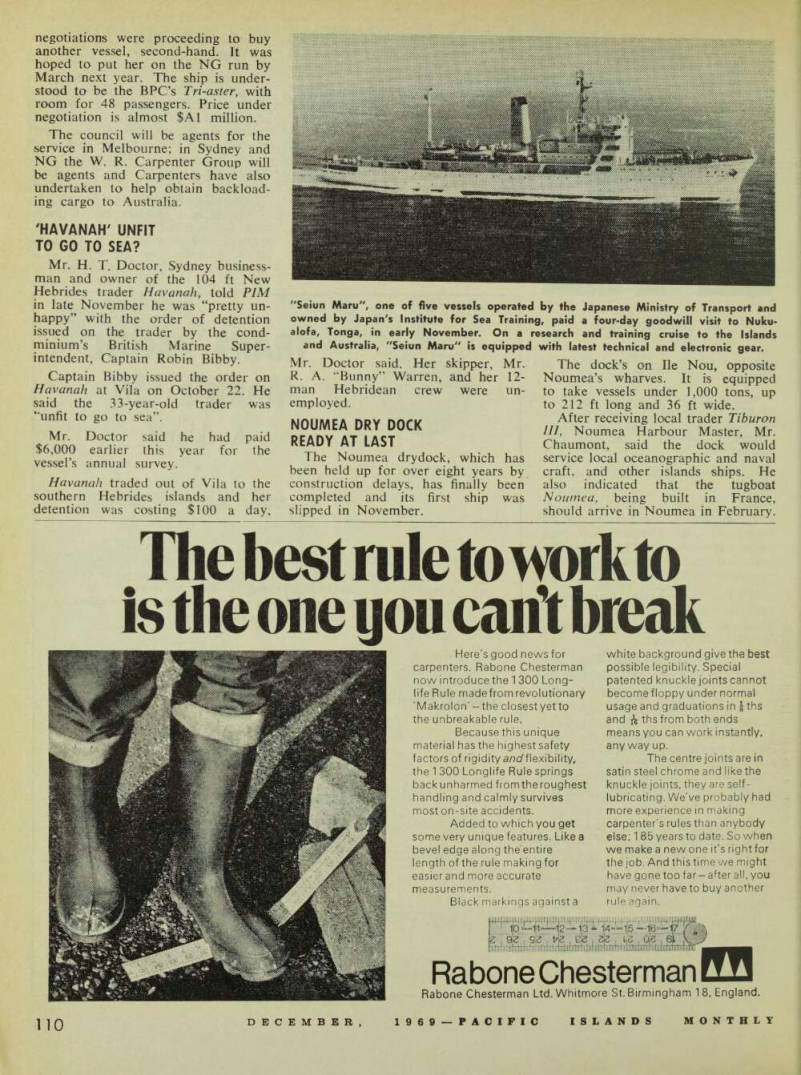
"Seiun Maru", one of five vessels operated by the Japanese Ministry of Transport and owned by Japan's Institute for Sea Training, paid a four-day goodwill visit to Nuku alofa, Tonga, in early November. On a research and training cruise to the Islands and Australia, "Seiun Maru" is equipped with latest technical and electronic gear.