Magazine Section
pp. 85-87 · Read in the full issue
Tahiti's part in taking Christ to New Guinea
By Robert Langdon
Although it is well known that Cook Islands missionaries, sponsored by the London Missionary Society, played a prominent part in the early efforts to evangelise New Guinea, probably few people now know that several Tahitians also took part in that work.
One such Tahitian, whose name has long been forgotten, was “Mr.
Terai”, who worked with the Rev.
James Chalmers in Papua in the early 1880’s. Terai’s name came to light recently when the Pacific Manu scripts Bureau obtained a microfilm copy of the papers of the Rev, J. L, Green, one of the last of the LMS missionaries in Tahiti.
Terai was a friend, and probably a one-time pupil, of Green in Tahiti; and after he and his wife went off to New Guinea as missionaries, they wrote Green and his family informa tive letters on the conditions they found there.
Although the originals of Terai’s letters seem to have been lost, an English translation of a longish letter he wrote from Aloma, Papua, on June 13, 1883, has been pre served among the Green papers, and there is also a translation of portion of an earlier letter dated April 23, 1882.
Working devotedly
The letter of 1883, which is un doubtedly one of the earliest extant accounts of Papua written by a Pacific Islander, reads as follows: Mr. Terai and wife write this letter to you and to your children.
We are well, not suffering from any disease. We are working devotedly that Papua may become its portion.
This is the character of the people.
Some of them will come to our schools just for a day or two, but they will not persevere. They will stay away again for a long time till they have forgotten all they had learned. The children are beginning to read. The great difficulty, how
ever, is the parents will not control their children. They never reprove nor chastise them.
The people have no kind of religious ceremony at their marriages.
This is the course they adopt. The bridegroom takes food and many other things according to his own inclination and presents them to the father of the bride who, in return, gives his daughter, and then the bridegroom takes his bride away to his own home and the matter is settled.
Men's hair long
This is another custom prevailing here. The men let their hair grow long and the women’s hair is cut short. The women cultivate the ground. The men construct the fences enclosing the land, and the women plant and cultivate the food.
The people here have no ovens for cooking their food as we have; but they make vessels for cooking purposes in shape like Tahitian calabashes cut through the middle.
They are very strong. The great enemies of the Papuans are the snakes (poisonous) peculiar to the country and the alligators, which live in the water. The bite of the snake is invariably fatal. As to the water enemy, the alligator, if the savage thing seizes hold of a man’s foot, there is no hope of recovery from its bite. About 40 people have been killed by the snakes and the alliga tors since we came here.
I do not well understand their mode of reckoning time yet, but they have a festivity at their new year.
As the season approaches, the families prepare their garments. A
tree is taken with its branches and carried to the beach and planted there, then they suspend their food upon it. Coconuts and every other kind of food. In the afternoon of the day appointed, the people as semble together from all the villages round about with their clubs in their hands.
In former times they would kill each other. Thus, when the time comes for those who were appointed for the purpose to assemble on the beach, they go in companies, running along until they come to the tree, then they throw their spears at it, so do the people of each company in turn.
Spear each other
But if the people of one village have a grudge against those of another village, they spear each other.
There was no spearing of the people on the occasion when we were present. I stood near the tree and watched the spearing, but there was not one person aimed at.
We have visited the villages around us, and the natives have not molested us. They received us and brought us food. This is another feature of their character. They are not generous people. They do not give away, but they expect everything to
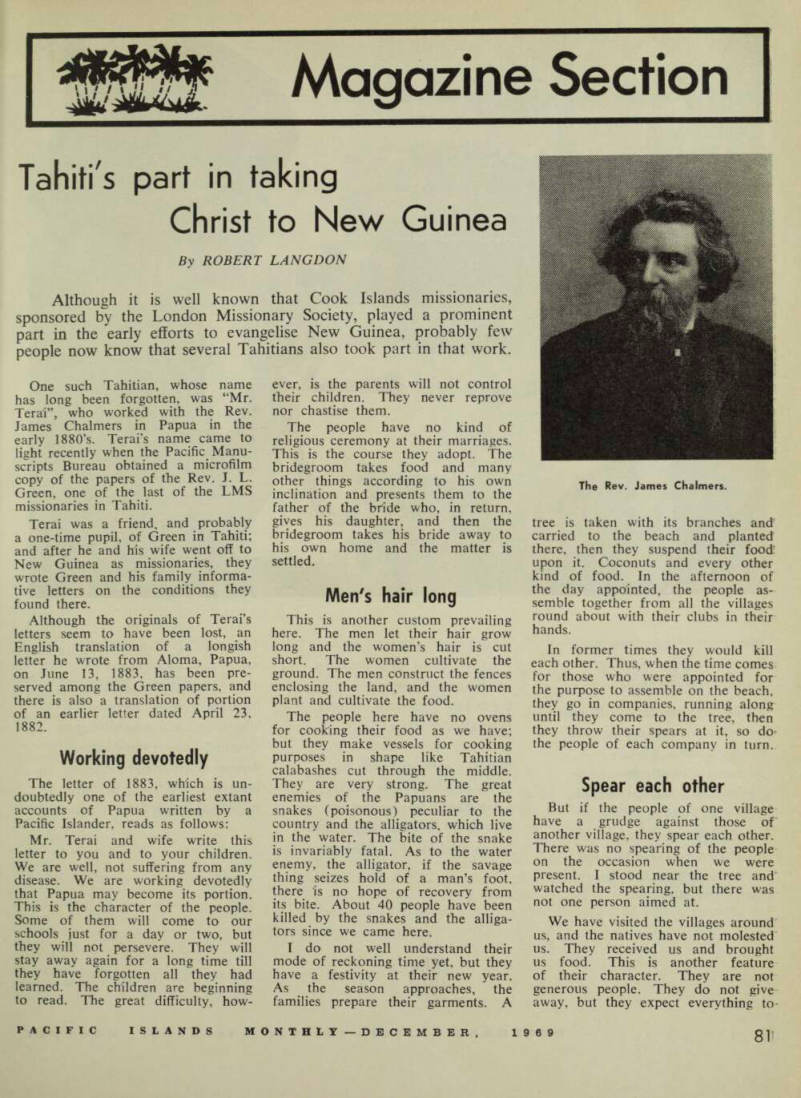
The Rev. James Chalmers.
Word of God
be bought. This is a very ancient custom of theirs.
The word of God is growing in Papua in those parts first occupied.
Mr. Chalmers has a training in stitution. The population is large in every part. The Gods of the people seem to be their ancestors. They petition their ancestors to cause their food to grow, to heal their diseases, and to give them a good supply of fish. They never recognise the Creator of all things in their prayers.
This is all, Terai’s letter concludes.
Terai’s letter is one of several letters from Papua among the Green papers. There are five others from Chalmers to Green written between 1880 and 1884. (There are also four from Chalmers to Green in 1875 from Rarotonga).
One of Chalmers’ letters, written from Port Moresby on October 5, 1880, describes an attack at Keakolo on a Chinese junk in which some of the crew were killed and the missionary teachers acted heroically.
Another, of March 29, 1881, speaks of the motley crowd of missionaries, gold diggers, beche-de-mer fishers and bird and plant collectors who “risk New Guinea proper”.
Leading personalities
Green’s diaries will undoubtedly be of considerable value to historians studying the Tahiti of his day.
Besides containing a running account of matters of church interest (which took Green on frequent trips through out Tahiti and to islands in the Leeward and Austral Groups), there are numerous references to the lead ing personalities of the day—the Godeffroys, Burns, Vienots, Darsies, Branders and Verniers, etc.
Here are a few sample entries from the diaries: • On the evening of the 24th [December, 1876] Mr. Chalmers, in compliance with a special request of Queen Pomare, exhibited his magic lantern in the large building at Paofai. There were at least 400 to 500 persons present. The Queen was delighted with the exhibition. • September 19, 1877 at an interview with the [French] Admiral [two days after the death of Queen Pomare] I was gratified exceedingly with the testimony which he bore of the character of the late Queen. He spoke of her earnest piety and Christian zeal, as proved by the many proofs she left behind her. He was astonished to see the immense no. of notes on Scriptures among her papers, which shew that she left an interest in the religion she professed.
• On Wednesday evening last, the 11th inst., the superior of the Brothers School was caught in the street of Papeete in disguise and drunk. Some of the boys of his own school caught him in the act of contending with some native women. He has left the islands today for San Francisco in the mail. • The English corvette Opal, Captain Robinson, arrived in Papeete harbour on Sunday afternoon at about 3.50. She saluted the protectorate flag on the following morning, but unfortunately the flag was hoisted upside down. The captain, however, discovered it after the salute was fired
and hastened to government house to throw all the responsibility on the French commandant for sending him an imperfect flag. It was not fastened to the cord properly. ® The remains of the late Queen Pomare were transferred from the old vault to the newly erected mausoleum (near the old one) today, November 27 [1879]. A short service was conducted by Messrs. Brun, Vernier and myself. There were about 150 persons present, but sad to record, the king was sadly under the influence of liquor and his con duct was not such as becomes a king and son of the departed queen.