"unique" blue style
p. 71 · Read in the full issue
Cook Is. artist with a "unique" blue style
From W. H. PERCIVAL, in Rarotonga Edwin Shorter, a middle-aged British artist who has lived in Rarotonga for some years, and was formerly in Tahiti, was to exhibit his paintings of Cook Islands and Tahitian life in Wellington, NZ, from November 10 for 18 days.
Most of Mr. Shorter’s paintings depict Polynesian life in Rarotonga and the outer islands of the Cook Group and there are some Tahitian subjects.
There are striking Rarotongan beach scenes of feasts, food markets, and horse racing, set in blue tones against the background of the Pacific. There are typical scenes from the outer Cook Islands—mail being sorted and tossed out to eager islanders; a laden boat shooting the reef on the crest of a wave, while a monthly supply ship lies at anchor in the background.
Hula skirts
There is a sombre scene painted in greys and browns which faith fully depicts the Avarua coast of Rarotonga when it was being battered by the December 1967 hurricane; cheerful scenes of young Cook Islands girls making hula skirts and ’eis on the beach and one a dancing team performing against a dramatic background of Rarotonga’s green and jagged peaks.
Edwin Shorter’s paintings include nude, and semi-nude studies of Tahitian beauties, and there is an impressive historical painting of a big double-hulled canoe being prepared in Rarotonga for the voyage to NZ in 1350. Most of the beach scenes are executed in a decorative blue style which, Edwin Shorter says, is unique.
The collection is as interesting as the man who created it. He studied art at St. Martin’s School of Art, London, and at Heatherlies, a school which produced many dis tinguished artists in earlier decades.
He was trained to play the oboe by an uncle who was a professor of music at two London schools of music, and later he performed in symphony orchestras.
Working as a commercial artist by day and a professional musician at night, Edwin soon realised that he
would have to make a choice between the two occupations—he chose art.
He turned to commercial art to make a living and stuck with it for the next 25 years. Then, after World War 11, he was engaged in produc ing secret and highly complicated illustrations of rocket propulsion air craft and early hydrofoil boats, then in the experimental stage.
As a hobby, he set up a small workshop in which he produced “various gadgets” which he patented.
However, these proved a failure, so he turned to three-dimensional cartoon films with some success.
When a director of Walt Disney’s film interests visited England to advise the Rank Organisation on
setting up a cartoon studio, Edwin Shorter was selected to direct the studio, but he turned the offer down as he considered he would not be fully compensated for giving up his patents, and he had work on hand from leading advertising agencies.
But it was a mistake. He soon found he couldn’t compete with big business, and had to dismiss his small, but carfeully trained staff, and close down.
Gauguin's fuss
Fed up with England and its damp, chilly climate, he went to southern France for almost four years. He returned to England to paint, then visited Tahiti to discover what ’’Gauguin had made all the fuss about”.
Tahiti at that time—before the airport was built—impressed him.
He returned to England to settle busi ness affairs, then returned to Raro tonga, which he had previously visited, to live and paint for his own interest and pleasure.
Being of a naturally inventive nature he searched for a style he could truly call his own. He believes he has found it in his “decorative blue style” which may excite a good deal of interest at his Wellington exhibition.
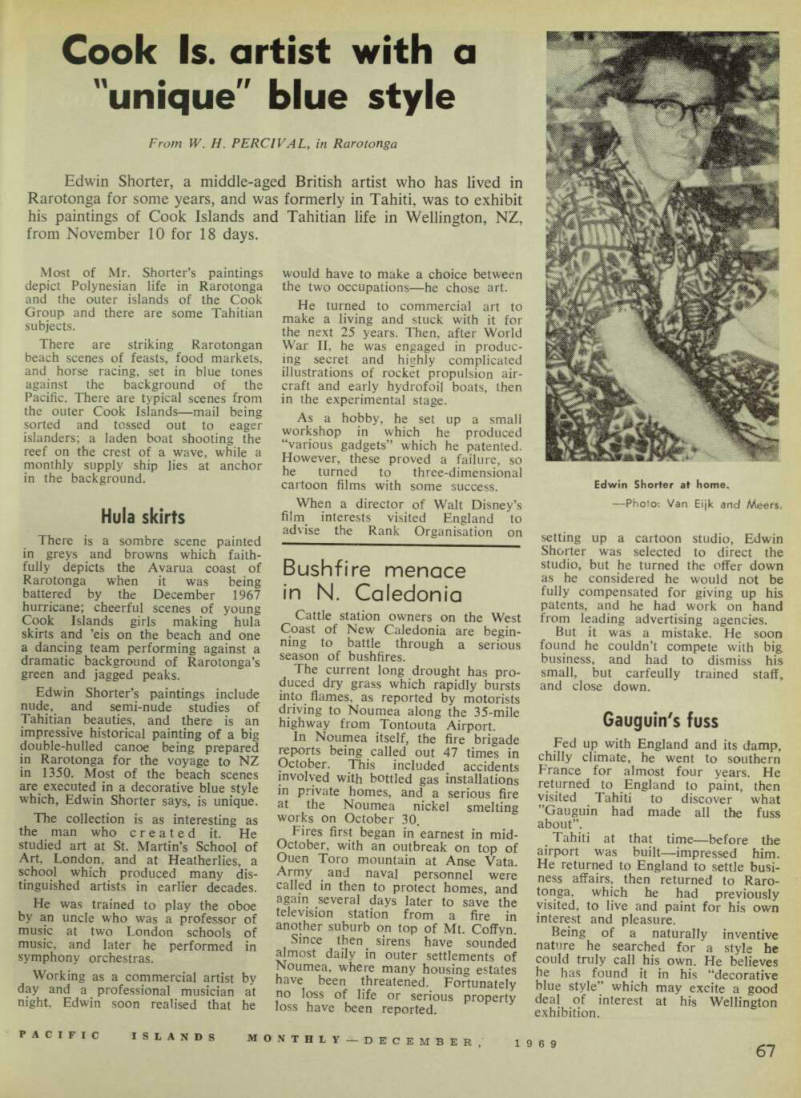
Edwin Shorter at home, Photo: Van Eijk and Meers.