Micronesian island hopping
pp. 61-67 · Read in the full issue


Air age brings a new dimension to Micronesian island hopping
Micronesia, with its year old jet service through the islands, has returned to the balmy days of island hopping by air. John Griffin, an Alicia Patterson Fund winner on leave from the "Honolulu Advertiser", here tells what it is like to drop into Micronesia's myriad islands from the sky.
It began, as most trips do, with a dash to the airport through a modern American traffic jam complete with smog and a helicopter trying to help frustrated Honolulu motorists. Undeveloped islands seem a long way off as you hustle down modem cement corridors into a jet, in this case the three engined Boeing 727 of Air Micronesia, the Trust Territory carrier operated by Continental Airlines.
But there are differences: where travellers to San Francisco and Tokyo usually wear suits, those to Micro nesia come casual in sport shirts, shorts and sandals. And there is an atmosphere about things—the Micro nesian hostess in straw hat and miniskirt, other islanders going home from American schools, the front portion of the plane cabin piled with air freight, and even such fellow travellers as Philippe Cousteau, son of oceanographer-explorer, Captain Jacques with a camera and diving crew going off to Truk to make a TV special on the dozens of sunken Japanese ships there from World War 11.
Also different are the stops. For Air Micronesia’s year-old service has meant a jet-age return of the island hopping and sight-seeing that made trans-Pacific travel an exotic affair in the days of flying-boats and limited range World War II planes. Getting there now is a demonstration of what transportation and communication mean to scattered Pacific islands seeking economic and political viability in a world where they can not remain isolated.
Hardly exotic
It’s expressive to say that all of the Trust Territory’s 97,000 people could fit in a large football stadium.
But more important is the fact you could never get more than a fraction together; for they live in an ocean area of continental dimensions.
The first stop is hardly exotic.
Some 700 nautical miles south-west of Hawaii, Johnston Island is a tree less coral atoll that gained brief note again recently as a stopping point for President Nixon when he watched
the Apollo astronauts return from the moon. Mostly it serves as a missile tracking station. Travellers are warned against using cameras, and, while the jet refuels, are escorted by armed guards into a windowless wait ing room where rows of foreboding air pipes with rubber hoses stick down from the ceiling. “They tell me it’s for debriefing SAC crews,” said one travelling American official.
“But it looks like the gas chamber at Buchenwald”.
1,000 islands
Micronesia begins over an hour later as the jet crosses the ocean boundary of the Trust Territory into the Marshall Islands, two parallel atolls and islands running some 800 miles north from the equator—about 1,000 tiny islands in all, only a fraction inhabited.
As you come down, the pilot calls out some of the sights: “And to the left is Arno Atoll, one of the most beautiful and unspoiled, the kind of place you think of when you drink San Miguel beer,” he says, joking about popular Pacific radio com mercials that make use of exotic settings. Before the trip ends, 1 am to have one of the best days of my life at Arno, but now the atoll seems as unreal as a TV commercial, a vast oval of quiet lagoon enclosed by a narrow wave-washed coral reef, its lush green islets stretching off into the hazy distance of cloud, shadow, and sea.
Majuro, the next atoll, is the Marshalls District centre and “east-
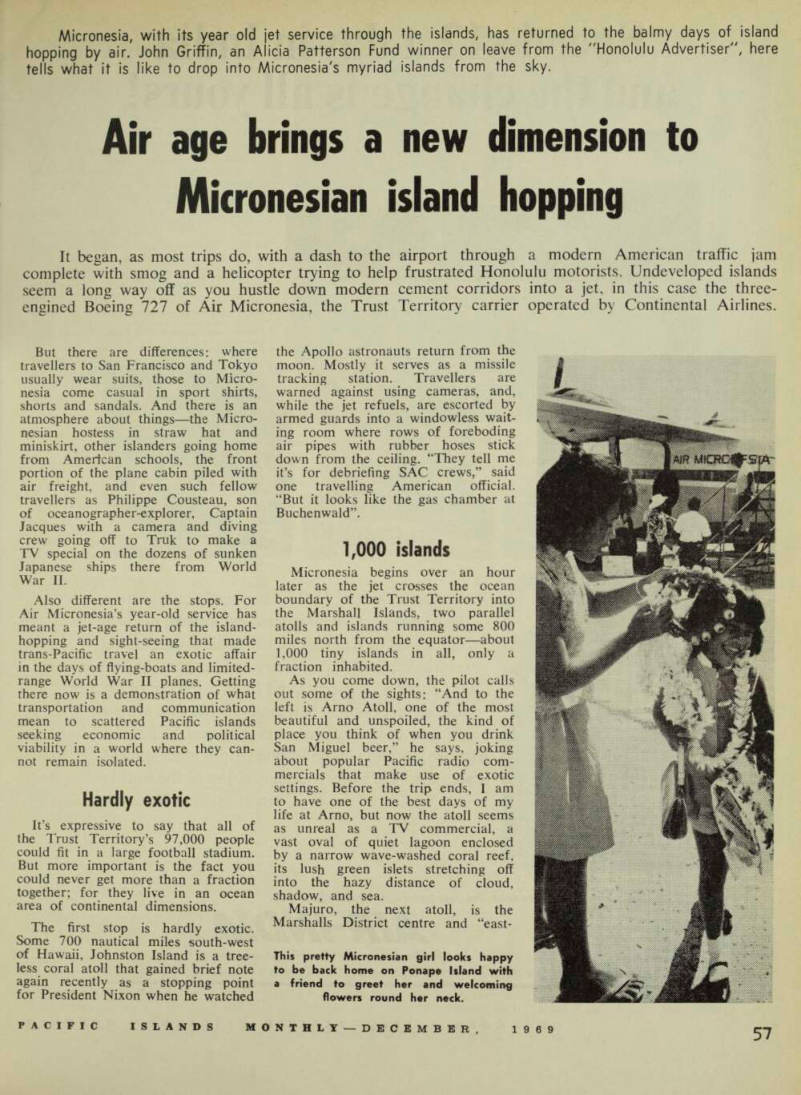
This pretty Micronesian girl looks happy to be back home on Ponape Island with a friend to greet her and welcoming flowers round her neck.
Tropical shanty town
ern gateway to Micronesia”. Here, as elsewhere in the Trust Territory outer districts, there are no straight in landings. The pilot buzzes the coral airstrip to make sure that people, pigs, and other hazards are absent, and passengers get a good look at the tropical shantytown that stretches for miles between lovely vistas of ocean, reef, and deep lagoon.
Palm trees flash by both sides when the plane touches down. There is a roaring cloud of coral and spray as the pilot brakes and reverses the engine on the short strip; it’s safe but still quite a dramatic landing for jaded jet passengers.
In the half-hour stop, many wander off the plane, past the one-room wooden terminal and out under nearby palms to take pictures, sip beer and soft drinks, and chat with fellow passengers or the dozens of local folk who come out to the air field for what locally ranks as a regular social event. In faces, setting, and mood you are clearly and rather suddenly in Micronesia.
World's largest atoll
Out of Majuro, that is true in the plane also, for many Marshallese come aboard, headed for nearby Kwajalein or beyond to Truk and Saipan. Besides serious young officials with attache cases, there are tooth less grandmothers toting big boxes and paper packages, respected chiefs, and young couples hauling several children.
Other less-desirable passengers have been aboard; one crewman told the story of an islander who brought on two live crabs the size of dinner plates. Their claws were tied together and they were in a paper bag, but somewhere enroute they got loose and crawled near the foot of a lady tourist, who almost instantly was standing on her seat and screaming amid general confusion. Quite casually the Micronesian hostess packed them off to the cargo section.
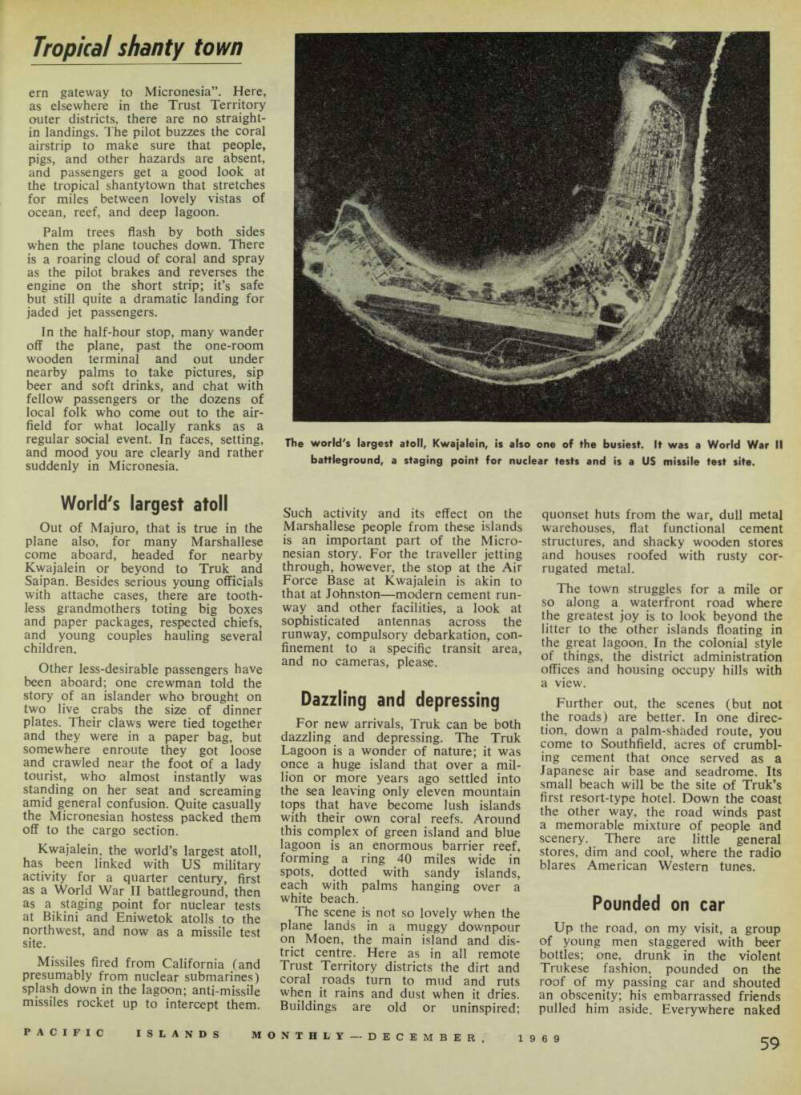
Kwajalein, the world’s largest atoll, has been linked with US military activity for a quarter century, first as a World War II battleground, then as a staging point for nuclear tests at Bikini and Eniwetok atolls to the northwest, and now as a missile test site.
Missiles fired from California (and presumably from nuclear submarines) splash down in the lagoon; anti-missile missiles rocket up to intercept them.
Such activity and its effect on the Marshallese people from these islands is an important part of the Micro nesian story. For the traveller jetting through, however, the stop at the Air Force Base at Kwajalein is akin to that at Johnston—modern cement run way and other facilities, a look at sophisticated antennas across the runway, compulsory debarkation, con finement to a specific transit area, and no cameras, please.
Dazzling and depressing
For new arrivals, Truk can be both dazzling and depressing. The Truk Lagoon is a wonder of nature; it was once a huge island that over a mil lion or more years ago settled into the sea leaving only eleven mountain tops that have become lush islands with their own coral reefs. Around this complex of green island and blue lagoon is an enormous barrier reef, forming a ring 40 miles wide in spots, dotted with sandy islands, each with palms hanging over a white beach.
The scene is not so lovely when the plane lands in a muggy downpour on Moen, the main island and dis trict centre. Here as in all remote Trust Territory districts the dirt and coral roads turn to mud and ruts when it rains and dust when it dries.
Buildings are old or uninspired;
quonset huts from the war, dull metal warehouses, flat functional cement structures, and shacky wooden stores and houses roofed with rusty cor rugated metal.
The town struggles for a mile or so along a waterfront road where the greatest joy is to look beyond the litter to the other islands floating in the great lagoon. In the colonial style of things, the district administration offices and housing occupy hills with a view.
Further out, the scenes (but not the roads) are better. In one direc tion, down a palm-shaded route, you come to Southfield, acres of crumbl ing cement that once served as a Japanese air base and seadrome. Its small beach will be the site of Truk’s first resort-type hotel. Down the coast the other way, the road winds past a memorable mixture of people and scenery. There are little general stores, dim and cool, where the radio blares American Western tunes.
Pounded on car Up the road, on my visit, a group of young men staggered with beer bottles; one, drunk in the violent Trukese fashion, pounded on the roof of my passing car and shouted an obscenity; his embarrassed friends pulled him aside. Everywhere naked
The world's largest atoll, Kwajalein, is also one of the busiest. It was a World War II battleground, a staging point for nuclear tests and is a US missile test site.
Smiling, waving people
children play along the shore, and smiling older folks wave as you pass.
At the end, there is a village under clustered palms where bare-breasted women bathe, men talk pleasantly and crowds of kids pose for pictures.
The scenery can be marvellous, a mixture of mountain, shore, and reef.
But the view also includes over-water outhouses, muddy mangrove flats, junked cars, and just plain rubbish.
More important, of course, are the people you meet and talk with in a few days of wandering around. One of the first I went to see was Tosiwo Nakayama, a Senator in the Congress and one of Micronesia’s best known young political figures. Tosiwo spent several years at the University of Hawaii and has handsome racially mixed looks inherited from a Japan ese father and an outer-island Trukese mother.
Control of land
Tosiwo was both enjoying his family after several hard months of travel with the Congress’ future political status committee and pre paring for the session opening soon in Saipan. He expressed hope that Micronesia’s new status and form of self-government and control of land could be set before any US moves for land for new military bases.
He was disturbed at word the Peace Corps was cutting its pro gramme that provided volunteer lawyers to help the Micronesian Congress and district legislatures. (“From our standpoint it was one of their two or three best programmes”).
And like everyone he wondered about the intent and impact of a new 13-member US Navy Seabee team that arrived with an impressive array of construction equipment and movies which played to 200-300 Trukese every night. “I think the Seabees will show the Micronesians a side of the US military they don’t know, since the image now is one of war”.
He paused and grinned. “You know some of the older people talk about the time when the Japanese came (after World War I). They say there was sort of a Japanese peace corps that came first, then military civic action teams, and finally the troops.
Now they wonder about the Ameri cans”.
So the issues and opinions come up in talks with people; a few other samples:— From an American businessman in
Micronesia for many years: “In all I’m rather proud. People will point out what the Japanese did economic ally, but it was for themselves. I’ll grant you the roads are now terrible and we are without adequate water and electricity after 25 years under the US. But these things are less important than giving people control over themselves. We have developed people and encouraged them to be free. . . .”
From a Peace Corps volunteer on an outside island: “Sure some good people get to college. But it’s still pretty sad to see a couple of dozen bright children graduate from elemen tary school when you know there is only room for eight or 10 of them at the high school on Moen.”
From a local politician: “The
(American) district administrator is new and very active, some say like a bull in a china shop. He has problems with local leaders. . . . The district legislature doesn’t have much power, but the difference now is our speaker and chief can go up to Saipan on the jet and talk with our Congress and the High Commissioner.”
From the young Navy Seabee officer; “We were headed for Vietnam but diverted here. . . . We’re here to do what local leaders ask— roads, docks, water catchments. . . .
Somebody’s named us the Navy’s Peace Corps, but don’t let the men hear that. Actually we have a dif
ferent mission from the Peace Corps.”
From a retired American business man looking for investments; “There are opportunities here, but you would have to be here to baby-sit your money. Actually, the only place ready for big tourism is Saipan. For somebody like me, the surest invest ment is in Guam.”
From a young American Catholic priest: “As the anthropologists say there is form and function in society.
The forms here are obviously chang ing, but whether the function is I don’t know. , . . An American going into a store gets served much slower than he did five years ago. What does that mean? . . . Yet people here are not as strong for change as they might be in some areas of the TT.”
Nearby Fefan is far more rural and less disturbed. Its people are noted for the vegetables and fruit they grow on hillside farms which serve as something of a breadbasket for the district centre at Moen.
I stopped to see a Trukese acquain tance named Faustino, the hotel handyman who commuted daily to Moen. We walked around the shore and hillsides, finally stopping at the Catholic mission to drink from coco nuts and chat with a group of men in the shade by the school. They were not up on recent Micronesian political developments, but they knew a choice would someday be made and were interested.
Battered church
Time and typhoons had battered the home of the absent priest and the stone church, built in the 1930’s when the Spanish clergy still ministered in these islands. “Things were in better condition in the old days,” Faustino said.
If Air Micronesia’s island-hopping route is reminiscent of wartime days, the spur run 380 miles southeast from Truk to Ponape is a throwback to earlier days. All will change soon when the new coral airstrip at Ponape is finally finished. But for now you make the trip in a roaring, rattling seaplane, a Grumman Albatross (SA-16), that splashes down in the Ponape lagoon, taxies up an old Japanese seaplane ramp on a separate island where you transfer to an ancient landing barge (the M Boat) for the half-hour run to the capital of Kolonia.
It’s all quite colourful and charm ing for the visitor, but for those who depend on it the system is full of inadequacies, frustrations, and break downs. It says something about the modern air age that it costs Air Micronesia almost as much on a per mile basis to operate the 15-passenger
The US military is extending its influence in Micronesia, but, for the island farmer, life goes on as normal. Carrying vege tables from his crop, this man lives in San Roque, Saipan.
seaplane as it does the 80-passenger jet.
Ponape is the second largest island in the Trust Territory and capital of a big district that stretches down to include Polynesian islands near the equator. It is a “high” island, beautiful and lush from heavy rains that send dozens of streams crashing off mountain waterfalls and rushing down to the lagoon inside the fring ing coral reef.
Older colonial regimes are remem bered in a moss-covered Spanish wall in Kolonia; in an agricultural station started by the Germans, with im pressive displays of healthy products from green peppers and pineapples to fat pigs, from rice to rambutans; and in the round-the-island road built by the Japanese, which years of neglect, too many floods and not enough funds has reduced in most areas to a memory and a muddy foot path.
Canned confusion
By much testimony, Ponape has some of Micronesia’s best agricultural potential. It could grow two-thirds of the rice now imported for Trust Ter ritory needs or produce tons of rich citrus, but organisation and a dependable ocean transport system are still lacking. A quality pepper growing industry was started but hasn’t found a market. Good cacao is grown, but world prices are a problem.
It says something when the gover ment-run hotel serves canned pine apple and vegetables while the same local products are available in the fresh food market a few blocks away.
Boyd MacKenzie, a Hawaii man with years in the Trust Territory, was new in the job of Ponape district administrator during my visit. Driv ing around the coral-patched streets of the town, he said: “Nothing much has happened here in the way of development for 10 years except the new airport”.
And he might have added that the airstrip represents a costly goof.
Dredged coral used in extending and surfacing was not properly packed for the jet; now valuable time and money is being spent in repacking.
Still there is no doubt the jet age will speed up change in Ponape. Local leaders view the prospect of tourism with mixed feelings, but some of the change will be good in terms of better communication and govern ment interest. There is even hope that a government which can bring jets to this island can eventually re build the Japanese road, opening the way for rural produce to reach the market and shipping.
A drunken young government technician told me in one of Kolonia’s 21 bars: “Before we were a brave people. Now we are becoming like Americans, not brave but okay.”
An at least modest future in tourism for Ponape seems guaranteed by its natural beauty and the fact it is the site of Nan Madol, ruins of an ancient civilisation spread across more than 80 partially man-made islands at the southeast shore of the main island.
One goes by speedboat to this decayed Micronesian Venice, down the shore with the white line of the barrier reef on one side and steep
green mountains with high white waterfalls on the other. Even on a grey day it is beautiful.
Nan Madol sits on tidal flats, and since we arrived at a lower tide it was necessary to wade in knee deep across a mucky bottom rich with eel grass and sea slugs that squish underfoot. It’s worth it, for Nan Madol is a relic with a gateway temple made of huge basalt crystals, black-rock logs piled in buildings up to 40 feet high still standing amid the dark of breadfruit trees, and other vegetation as you wade up the narrow channels in a falling mist with jungle birds calling in the trees.
“Haunting is the word,” I said as we climbed over the rocks of Nan Towas, a temple called “The palace of lofty walls”. I thought of com paring it with the Ankor Wat and other man-made wonders of ancient times.
Wait, wait
We rode the outboard home wear ing masks and snorkels to help breathe in a blinding, stinging rain.
There was a day’s delay in schedule when the pump that fuels the sea plane to Truk on the offshore island broke down; barrels of fuel were rolled out, but we had to wait over night until the water and rust settled.
So at this point what’s a day? You talk to a few more people, read a paperback, drink more beer, and wait. • "Micronesia now linked with Polynesia/' p. 65.
Air Micronesia's air links stretching nearly 5,000 miles between Hawaii and Okinawa.
The 727's at present do not go to Ponape, but a seaplane link up does operate.
A new link is soon to be made with Nauru.