They All Want To Fly Us On The Pacific,
pp. 45-47 · Read in the full issue


But Will It Be Cheaper?
By a staff writer
Air-India, which has operated weekly terminating services to Fiji from Sydney since August 3, 1964, is now after a trans-Pacific route which could go South Pacific, via Fiji. It’s another develop ment in the hotted-up battle for Pacific services, which may—or may not —mean cheaper air fares.
Despite a budget squeeze, Air- India wants at least a twice-weekly frequency across the Pacific with a call on the US West Coast, at Los Angeles or San Francisco.
Three routes are under scrutiny: via Japan and Hawaii, via Hong Kong, the Philippines and Hawaii and via Sydney, Fiji and Tahiti.
Air-India already has rights to operate extra flights into the US. On her proposed South Pacific route the stumbling block is Tahiti. The airline would prefer a call at Tahiti rather than Hawaii because, it feels, it could sell more seats for a French flavoured stop.
In talks so far the French have not made plain what they’d want in return for a Tahiti stopover on Air-India’s South Pacific route. Most likely they would want increased French fre quencies into Kashmir or South India.
Unless some agreement can be made between the French and Indians, Air-India’s trans-Pacific route will be through the North Pacific.
Those closest to the situation are pessimistic of the chances of air rights through Tahiti.
Air India hotels?
It is highly possible that Air-India will at least in the South Pacific be able to begin a twice weekly Sydney- Fiji service early next year. The company’s mid-week daylight flights to Fiji for businessmen and Austra lian holidayers have been popular.
In Fiji, Air-India has been subject to pressure by Indian businessmen and the Indian Bank of Baroda Ltd. to take up a shareholding in local hotel projects. The company has interests in two big hotels in India.
However, it’s unlikely Air-India will back a Fiji hotel. It would rather invest in European hotels and it has already committed much of its limited funds to paying for ordered jumbo jets.
But Air-India is unhappy with the 350-passenger Boeing 747 jumbo jets as the next equipment jump after the 180-190-passenger 707’s, DC9’s and DClO’s. It feels a “middle jet”, with a 220-passenger capacity would be more appropriate, and it is closely watching Air-New Zealand attempts to buy jets of this size from the US.
Air-India’s attempt to enter the South Pacific heightens mounting pressure in the US, Australasia and even Europe that either fares must tumble or charter aircraft companies be allowed on the South Pacific.
Recently, North Atlantic fares dropped dramatically. Return economy flights between London and New York are now 5U5232.20 and between New York and Rome, 5267.
These rates are available at off-peak periods and travellers must stay at least 22 days in Europe or the US.
No cut price
Cut-price trans-Pacific flights are only available in the North Pacific.
US West Coast to Tokyo, Japan, costs SUS4OO (bulk fare) although nearly twice Atlantic rates.
No similar fares are available in
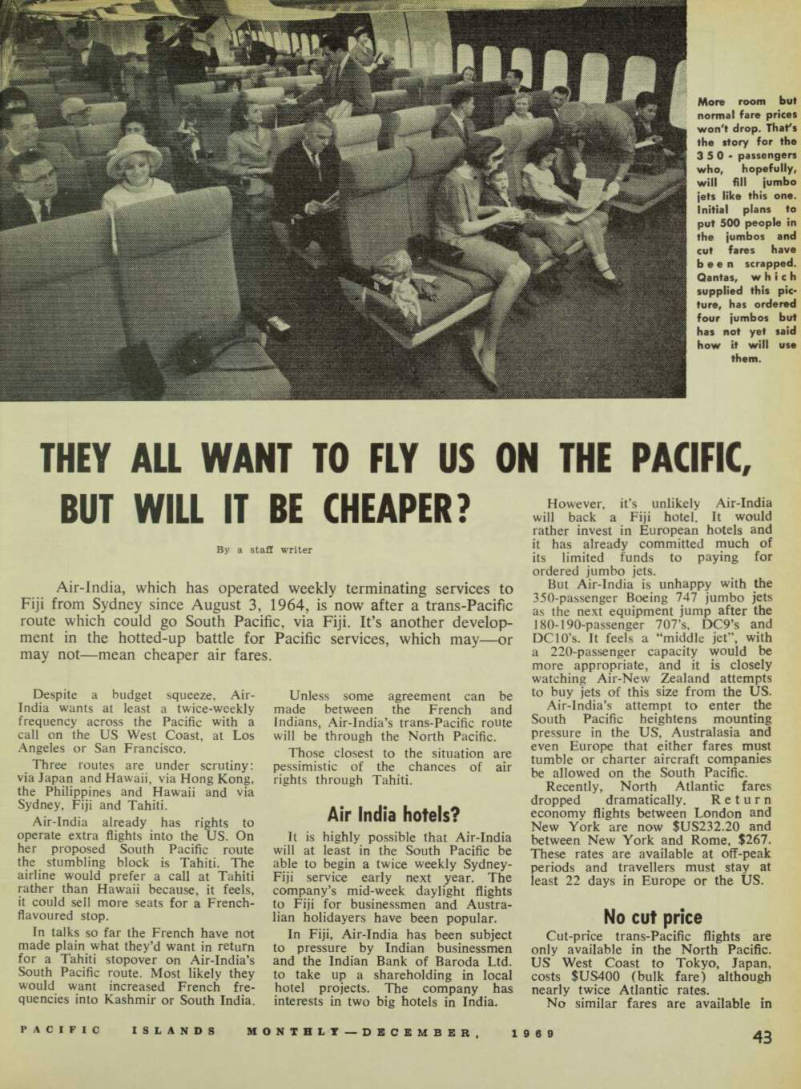
More room but normal fare prices won't drop. That's the story for the 3 5 0 - passengers who, hopefully, will fill jumbo jets like this one.
Initial plans to pot 500 people in the jumbos and cut fares have
been scrapped.
Qantas, which supplied this pic ture, has ordered four jumbos but has not yet said how it will use them.
the South Pacific and no charter air craft companies operate even on a semi-regular basis on this through route.
Of the South Pacific carriers, only PanAm and Canadian Pacific would support big fare cuts. American Air lines might join them, but it won’t start operating until mid-1970.
Air NZ firmly opposes fare cuts, as does the more powerful Qantas.
UTA fears the US threat extremely strongly and feels cheaper fares would over-intensify competition.
With a new US stop (Los Angeles) and new VClO’s, BOAC is an un known quantity. It might side with the Commonwealth carriers, or, because it badly needs increased volumes of passengers to cover its greatly-increased Islands frequencies, it might opt for lower fares.
But are the jumbos going to lower fares? The best hope seems to be that if all the airlines have flights going all the time, everywhere, they’ll eventually realise seats will have to be cheaper to fill those fast—and emnty—magnificent flying machines.
However, I think normal fare rates won’t drop. There’s even the chance they could go up. World airlines are facing severe fund squeezes; all are having to marshal resources to pay for new equipment. They have to order jumbos at $2O million each (current world airline equipment orders at present total over $3 bil lion) and it’s likely airlines will tend to merge, or else pool routes and servicing facilities.
New Australasian regional manager for Air-lndia, Mr. D. P. Mitra. He is based in Sydney, and replaces Mr. Tony Pinto, who recently left Air-lndia after over 20 years with the company, including a long stay in Australia, where he was very popular.
Mr. Pinto is now in Montreal, Canada, working with a Canadian airline.