Caledonia will
p. 31 · Read in the full issue
'be centre of trade boom'
By Ken Mcgregor
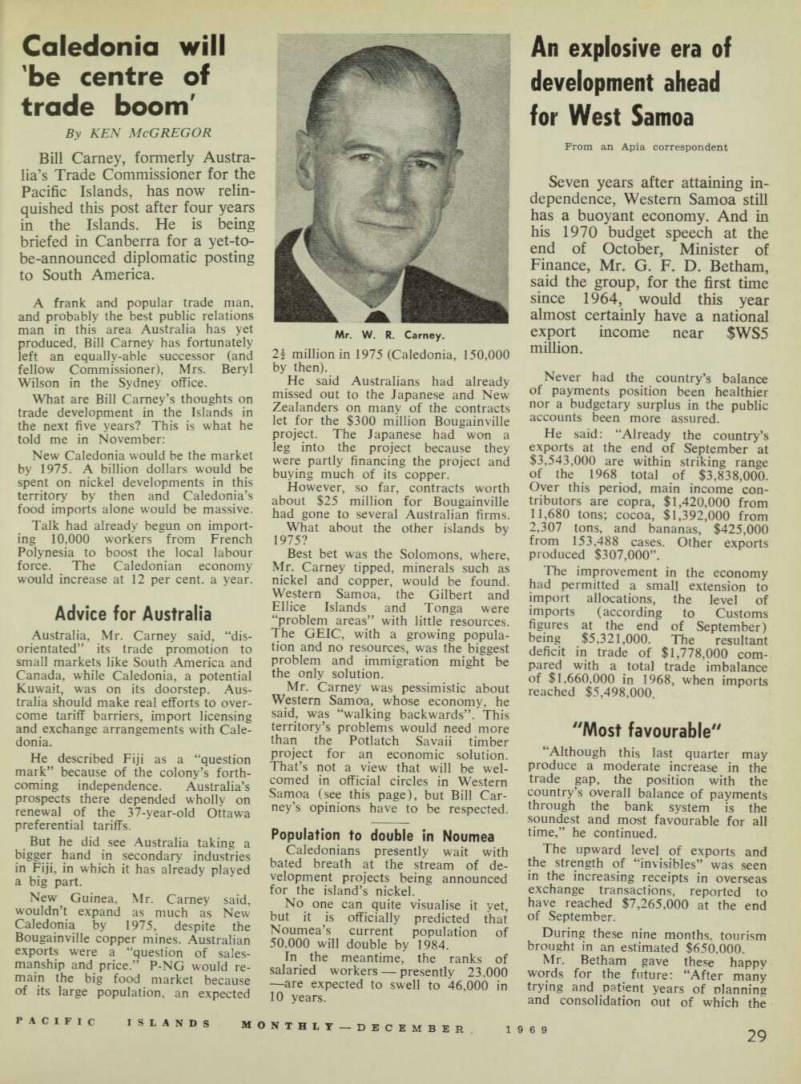
Bill Carney, formerly Austra
lia’s Trade Commissioner for the Pacific Islands, has now relin quished this post after four years in the Islands. He is being briefed in Canberra for a yet-to
be-announced diplomatic posting
to South America.
A frank and popular trade man, and probably the best public relations man in this area Australia has yet produced, Bill Carney has fortunately left an equally-able successor (and fellow Commissioner), Mrs. Beryl Wilson in the Sydney office.
What are Bill Carney’s thoughts on trade development in the Islands in the next five years? This is what he told me in November: New Caledonia would be the market by 1975. A billion dollars would be spent on nickel developments in this territory by then and Caledonia’s food imports alone would be massive.
Talk had already begun on import ing 10,000 workers from French Polynesia to boost the local labour force. The Caledonian economy would increase at 12 per cent, a year.
Advice for Australia
Australia, Mr. Carney said, “dis orientated” its trade promotion to small markets like South America and Canada, while Caledonia, a potential Kuwait, was on its doorstep. Aus tralia should make real efforts to over come tariff barriers, import licensing and exchange arrangements with Cale donia.
He described Fiji as a “question mark” because of the colony’s forth coming independence. Australia’s prospects there depended wholly on renewal of the 37-year-old Ottawa preferential tariffs.
But he did see Australia taking a bigger hand in secondary industries in Fiji, in which it has already played a big part.
New Guinea, Mr. Carney said, wouldn’t expand as much as New Caledonia by 1975, despite the Bougainville copper mines. Australian exports were a “question of sales manship and price.” PNG would re main the big food market because of its large population, an expected
2i million in 1975 (Caledonia, 150,000 by then).
He said Australians had already missed out to the Japanese and New Zealanders on many of the contracts let for the $3OO million Bougainville project. The Japanese had won a leg into the project because they were partly financing the project and buying much of its copper.
However, so far, contracts worth about $25 million for Bougainville had gone to several Australian firms.
What about the other islands by 1975?
Best bet was the Solomons, where, Mr. Carney tipped, minerals such as nickel and copper, would be found.
Western Samoa, the Gilbert and Ellice Islands and Tonga were “problem areas” with little resources.
The GEIC, with a growing popula tion and no resources, was the biggest problem and immigration might be the only solution.
Mr. Carney was pessimistic about Western Samoa, whose economy, he said, was “walking backwards”. This territory’s problems would need more than the Potlatch Savaii timber project for an economic solution.
That’s not a view that will be wel comed in official circles in Western Samoa (see this page), but Bill Car ney’s opinions have to be respected.
Population to double in Noumea Caledonians presently wait with bated breath at the stream of de velopment projects being announced for the island’s nickel.
No one can quite visualise it yet, but it is officially predicted that Noumea’s current population of 50,000 will double by 1984.
In the meantime, the ranks of salaried workers presently 23.000 —are expected to swell to 46,000 in 10 years.
Mr. W. R. Carney.