Fiji will seek to become
pp. 28-29 · Read in the full issue
o British Dominion
From a Suva correspondent With both of Fiji’s leading political parties having agreed to seek full self-government with Dominion status within the Common wealth as the most logical step towards independence, the next question appears to be not whether it will happen, but when?
The popular tip in Fiji is 1971, but there is nothing official.
The important decision to seek Dominion status was taken at a meet ing between the governing Alliance and the opposition National Federa tion Party at private talks in the first week in November.
This was the second set of talks between the two parties, and a third was held in late November, in which the parties tidied up the points of agreement of early November.
All the talks were conducted in a friendly spirit.
Dominion status would give Fiji independence, while still retaining historic links with the Crown and the Commonwealth. Just like Aus tralia and New Zealand.
Governor-General
Suva’s big white house on the hill would be occupied by a Governor- General, and not a Governor, but the real governing would be in Fiji.
Even consdtutional changes would be made in Fiji.
The Queen would be recognised as formal Head of State, but defence, foreign affairs and internal security would not necessarily be the respon sibility of the UK. It would be up to Fiji to seek new defence agree ments.
This plan takes Fiji another step further than the proposal for self government along the lines of that now held by the Bahamas ( PIM, Oct., p. 27). The Bahamas proposal, which was earlier favoured by the Alliance, gave two houses of parlia ment and a Prime Minister, as Dominion status would, but a Gov ernor rather than a Governor- General.
The joint statement issued by the parties following the November 3 meeting said that the Alliance was in favour of full self-government with Dominion status, and the opposition supported independence with a republic status.
It quoted the Opposition leader, Mr. S. M. Koya, as saying:
“We are well aware and appreciate the anxiety in the minds of the Fijian people as to what would happen if we were to go into independence straight away.
“While we are confident that we can manage our own affairs without Great Britain, and enter into separate treaties with nearby independent countries, we feel, in the circum stances, that we will be happy to accept the Alliance proposal for Dominion status.”
He added: “What we say is this: ‘We accept as a first phase of constitutional change, immediate Dominion status—on the lines of Australia and New Zealand—with all its implications’
The stat ement continued: “In consequence of this agreed objec tive of constitutional development- Dominion status certain con sequential adjustments and modifica tions to the present constitution must necessarily follow.
“However, careful consideration was given to the existing constitution chapter by chapter and after dis cussion certain areas of agreement were identified, but it was generally agreed that areas of agreement and those where agreement has not been readily achieved should be further Studied by both sides.”
Now that this fair measure of
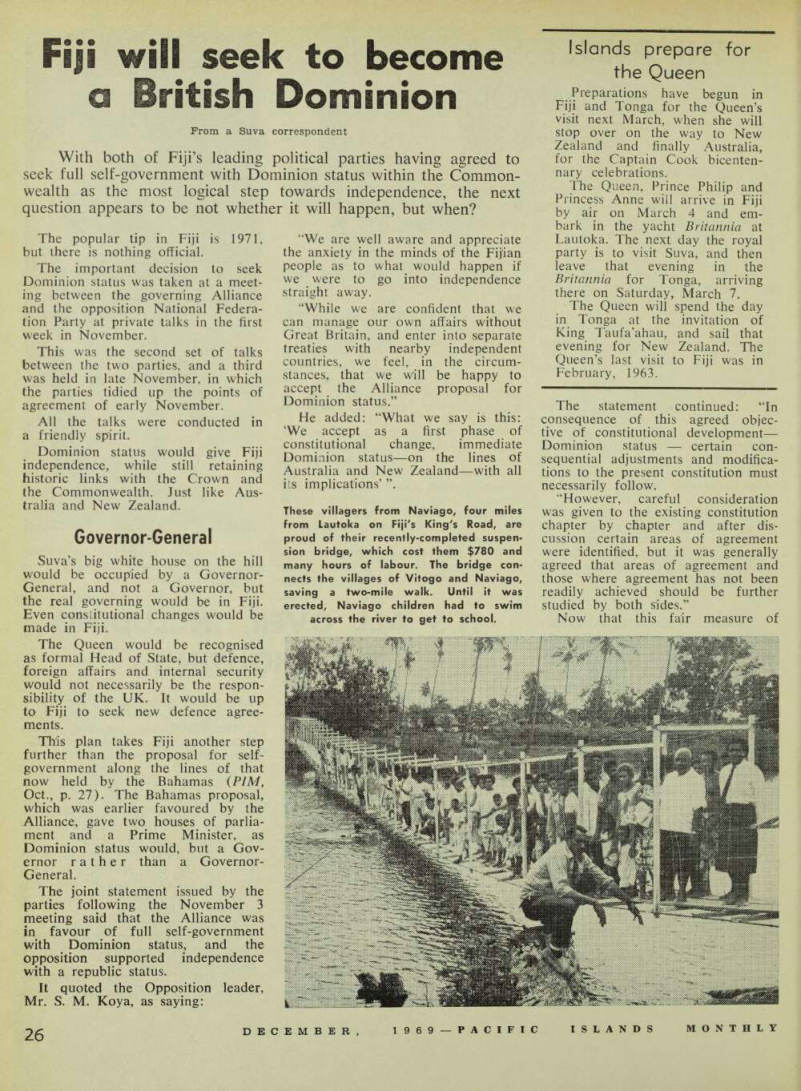
These villagers from Naviago, four miles from Lautoka on Fiji's King's Road, are proud of their recently-completed suspen sion bridge, which cost them $7BO and many hours of labour. The bridge con nects the villages of Vitogo and Naviago, saving a two-mile walk. Until it was erected, Naviago children had to swim across the river to get to school.
agreement has been reached, when will the constitutional talks be held?
Miss Eleanor Emery, the senior British diplomat who knows perhaps more than most about the situation, is believed to require a very large measure of agreement between the Alliance and the NFP before ap proval to a conference could be obtained.
During a recent visit to Fiji, how ever, she said that Britain does not regard common roll as a prerequisite for granting full independence.
Miss Emery, who is in charge of the Pacific and Indian Ocean depart ment of the Foreign and Common wealth Office, said that Britain would follow no hard and fast rules regard ing the granting of independence.
This would seem to indicate that the Alliance Party need have no fear that “one-man one-vote” must come before independence and certainly not before Dominion status. But this is one of the many problems that must be ironed out in the next few months. There is the Queen’s visit to Fiji in March to consider —it would hardly be politic for all LegCo members to be out of the country while she is here.
It’s reasonable to assume, then, that the London talks will be held about April or May, 1970.
Past experience has shown that it takes about 12 months following agreement on a new constitution for the constitution to be drafted and elections to be held.
This timetable means it would be mid-1971 before a new government is in power in Fiji. It would also be likely that this government would not have full independence, because such an important step as achieving Dominion status is likely to be undertaken in two steps. The first step would be internal self-gov ernment, with full independence to follow by executive action a few months afterwards.
If all goes smoothly, then, it would be the end of 1971 before Fiji would achieve Dominion status.
There is no reason why Dominion status should greatly affect present policies in Fiji. Fiji already has a large measure of self-government.
In the Council of Ministers, which is Fiji’s cabinet, seven ministers are elected out of a total of 11.
In January the number of elected ministers will rise to eight, following the retirement of Ratu Penaia Ganilau and his replacement by Ratu George Cakobau.
The Governor must act on the advice of his Council of Ministers, and can appeal to London only in special and serious circumstances, which have not arisen and are not likely to.