Happening Political Month
pp. 24-26 · Read in the full issue
In New Guinea It's Been A
From JOHN RYAN in Port Moresby
New Guinea’s limited form of ministerial government has been jerked unexpectedly into second gear—with six elected MHA’s behind the wheel and six Australian departmental directors nervously in the seat alongside.
The ministerial vehicle (in Aus tralian political colours) took to the road on November 19 when the six native MHA’s called Ministerial Members were given departmental status equal to the directors.
And if MHA’s and directors squabble behind the wheel, the Administrator Mr. D. O. Hay is in the back seat to settle arguments.
A seventh elected MHA, Member for New Britain, Mr. Roy Ashton (Ministerial Member for Public Works) has been elevated to direc tor’s status but, because of back ground and an Australian education, is well into the second phase of his new ministerial driving test.
The Canberra decision by Minister for External Territories, Mr. Barnes (or was it from Mr. Gorton?) to elevate the seven came entirely with out official warning: a letter from Mr. Barnes to Mr. Hay, passed on to Speaker of Parliament, Mr. Guise, and read from the chair in Nov ember.
Another step
Several elected MHA’s were late into the chamber, and by 11 p.m. some still did not know that Mr.
Guise, hours before, had announced what was a momentous political move, setting New Guinea another step on the way to political indepen dence.
The elevation to director status for the seven MHA’s is the newest phase in the serial that began with the first House of Assembly in 1964, and the creation then of the highly unwork able system of 10 Parliamentary under-secretaries.
In 1967, chairman of the first Parliamentary Select Committee on Political and Constitutional Develop ment, Mr. Guise, tabled a report resulting in last year’s limited form of ministerial government—seven elected MHA’s as Ministerial Mem bers and working with (in a vaguely defined area) the departmental direc tors, plus eight Assistant Ministerial Members with lesser duties.
A few weeks ago, amid intense
lobbying, the new House established its new Parliamentary Committee on Political and Constitutional Develop ment with pro-Pangu Papuan, Mr.
Paulus Arek, as chairman . . . and with a full scale review lying ahead in 1970, of the entire system of the limited ministerial government.
Mr. Arek’s committee was anticipa ting with relish (the native members were, at least) the opportunity of taking the system a step further in 1970 by giving the Ministerial Mem bers greater departmental power.
But on November 19, Canberra cut the ground from under them . , .
The ministers will have authority to write Public Service votes each valued up to S2o,ooo—that is if the project is approved, the money available, and the vote written within general government and departmental policy.
What was Canberra’s motivation?
In the past few months, the West minster system of government intro duced here by Australia has been under increasingly heavy attacks as unworkable, confusing and in need of overhaul . . . and many sub stantial people, including Mr. Guise, have been appealing for a Presidential system instead.
Britain’s former Labour Party Foreign Secretary Mr. Patrick Gordon Walker, on a recent visit, put himself on the wrong side of Mr. Guise with
a monologue extolling Westminster.
The Administration is still plumping for Westminster.
Many here think that the elevation of the seven Ministerial Members was Canberra’s attempt to show that the seven are not stooges (as alleged by Pangu Party’s general secretary Mr.
Albert Maori Kiki) and that they have real power.
The elevation, say some, is simply to give the Westminster system greater credibility and to make it harder for the pro-Presidential critics.
And, with Leader of the Parlia mentary Labour Opposition, Mr.
Gough Whitlam, due on a New Guinea tour, many observers were satisfied that this was the reason for the considerable and unexpected Canberra speed on November 19.
Political party changes
Meanwhile the big Independent Group in New Guinea’s House of Assembly has almost reached take off point: it’s about to become a formal political party.
A platform may be hammered out in time for parliament’s next meeting in February.
If everything goes according to tentative planning, it will be New Guinea’s 14th political party in 30 months. Pangu in May, 1967, was the first—followed by a veritable rash of regional and district parties or “political societies”.
Three at most—Pangu, the United Political Society (Kavieng) and the Democratic Party at Wewak—are about the only recognisable survivors.
The oldest, strongest and best financed party of course, is the “Government Party” within and with out parliament. Within are 10 official members of the House of Assembly, up to 15 Ministerial and Assistant Ministerial Members ex pected (traditionally) to not oppose the government publicly, plus as many as 25 of the more conservative
elected MHA’s, mostly Highlanders.
Pangu has declared nine men in parliament, and the Independent Group sometimes boasts up to 57 members—including many of those from government benches . . . these with ministerial rank who cross the floor on anti-Pangu issues that do not commit the government party either way.
The Independent Group, variously led by Mr. W. A. Lussick (Manus and New Ireland), and ministerial men Mr. Oala Oala-Rarua and Mr.
Tei Abal, could have enough votes to “run” parliament.
By holding so many private mem bers together for so long, Mr.
Lussick now finds himself at the political crossroads: to go on hold ing the unofficial reins or, if enough elected MHA’s want it, to form a genuine party.
Businessmen made an approach several months ago, and offered sup port and a platform—and uninten tionally sparked off the parliamentary privileges row involving Pangu general secretary Mr. Albert Maori
Kiki, who claimed the businessmen were trying to “buy” the Independent Group.
Now, Mr. Lussick confirms that he will form his party IF the elected MHA’s receive during the next two months a clear mandate from their constituents.
“We Europeans do not want to tell the elected native MHA’s what the platform should be, or whether there even be a party—we want them to tell us,” Mr. Lussick says.
Middle path?
What sort of a party?—perhaps a Conservative Group treading a “responsible” middle path between what are seen as “radical” Pangu politicals, and the “ultra-conserva tism” of the Government Party.
And now that the seven elected MHA’s with ministerial rank have been given greater departmental power, will they join the new party?
Or will they see their future in the powerful government party?.
A leading member of the Indepen
dent Group says; “Too late for Can berra to try to wean the Ministerial Members away from us—they’re already members, and likely to stay that way”.
Gazelle inquiry
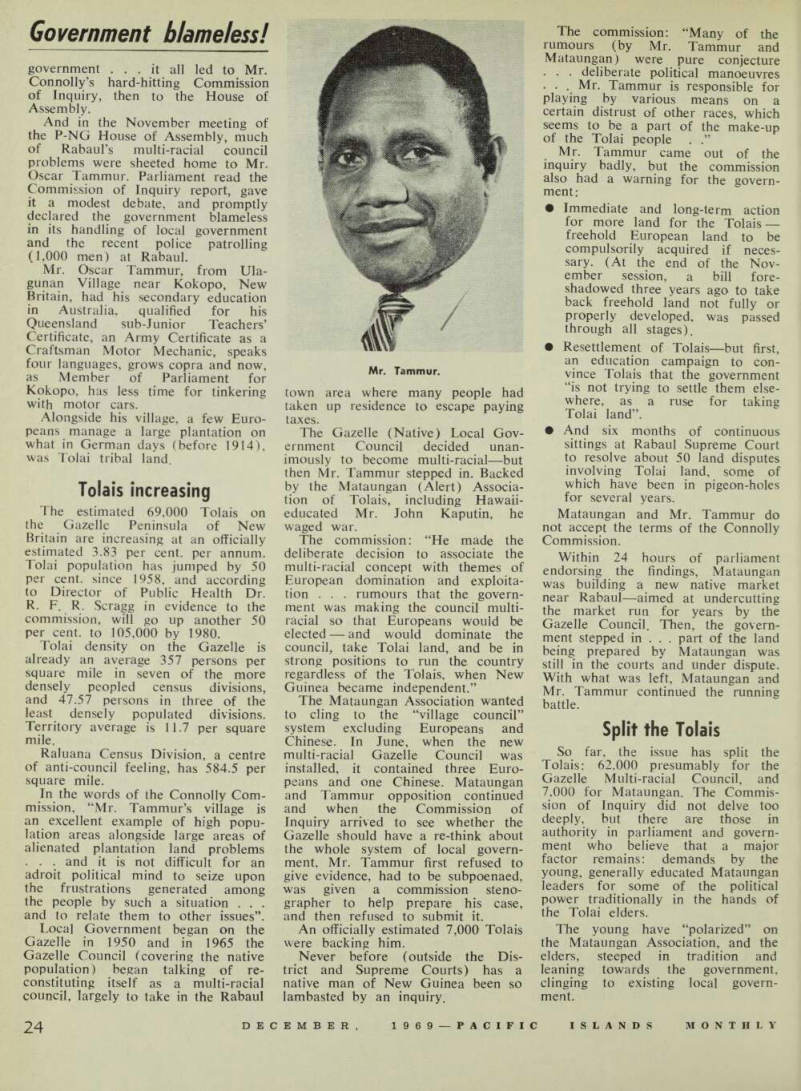
Mr. Oscar Tammur, MHA, has been identified by a Commission of Inquiry as New Guinea’s foremost political agitator.
His accusers:: Brisbane Queen’s Counsel Mr. P. D. Connolly and two of Mr. Tammur’s fellow-Tolai tribes men, United Church Bishop, Bishop Saimon Gaius, and a government teacher, Mr. A. Taviai.
They were the Commission of Inquiry called in by the government to track down the real cause of six months of growing opposition (with threats of violence) to the Rabaul and Gazelle Multi-racial Local Gov ernment councils.
Protest marches, a growing split for and against multi-racial councils, land problems, racist sentiment, rumours of pro-white activity by the
Government blameless!
government ... it all led to Mr.
Connolly’s hard-hitting Commission of Inquiry, then to the House of Assembly.
And in the November meeting of the P-NG House of Assembly, much of Rabaul’s multi-racial council problems were sheeted home to Mr.
Oscar Tammur. Parliament read the Commission of Inquiry report, gave it a modest debate, and promptly declared the government blameless in its handling of local government and the recent police patrolling (1,000 men) at Rabaul.
Mr. Oscar Tammur, from Ula gunan Village near Kokopo, New Britain, had his secondary education in Australia, qualified for his Queensland sub-Junior Teachers’
Certificate, an Army Certificate as a Craftsman Motor Mechanic, speaks four languages, grows copra and now, as Member of Parliament for Kokopo, has less time for tinkering with motor cars.
Alongside his village, a few Euro peans manage a large plantation on what in German days (before 1914), was Tolai tribal land.
Tolais increasing
The estimated 69,000 Tolais on the Gazelle Peninsula of New Britain are increasing at an officially estimated 3.83 per cent, per annum.
Tolai population has jumped by 50 per cent, since 1958, and according to Director of Public Health Dr.
R. F. R. Scragg in evidence to the commission, will go up another 50 per cent, to 105,000 by 1980.
Tolai density on the Gazelle is already an average 357 persons per square mile in seven of the more densely peopled census divisions, and 47.57 persons in three of the least densely populated divisions.
Territory average is 11.7 per square mile.
Raluana Census Division, a centre of anti-council feeling, has 584.5 per square mile.
In the words of the Connolly Com mission, “Mr. Tammur’s village is an excellent example of high popu lation areas alongside large areas of alienated plantation land problems . . . and it is not difficult for an adroit political mind to seize upon the frustrations generated among the people by such a situation . . . and to relate them to other issues”.
Local Government began on the Gazelle in 1950 and in 1965 the Gazelle Council (covering the native population) began talking of re constituting itself as a multi-racial council, largely to take in the Rabaul
town area where many people had taken up residence to escape paying taxes.
The Gazelle (Native) Local Gov ernment Council decided unan imously to become multi-racial—but then Mr. Tammur stepped in. Backed by the Mataungan (Alert) Associa tion of Tolais, including Hawaii educated Mr. John Kaputin, he waged war.
The commission: “He made the deliberate decision to associate the multi-racial concept with themes of European domination and exploita tion . . . rumours that the govern ment was making the council multi racial so that Europeans would be elected and would dominate the council, take Tolai land, and be in strong positions to run the country regardless of the Tolais, when New Guinea became independent.”
The Mataungan Association wanted to cling to the “village council” system excluding Europeans and Chinese. In June, when the new multi-racial Gazelle Council was installed, it contained three Euro peans and one Chinese. Mataungan and Tammur opposition continued and when the Commission of Inquiry arrived to see whether the Gazelle should have a re-think about the whole system of local govern ment, Mr, Tammur first refused to give evidence, had to be subpoenaed, was given a commission steno grapher to help prepare his case, and then refused to submit it.
An officially estimated 7,000 Tolais were backing him.
Never before (outside the Dis trict and Supreme Courts) has a native man of New Guinea been so lambasted by an inquiry.
The commission: “Many of the rumours (by Mr. Tammur and Mataungan) were pure conjecture . . . deliberate political manoeuvres . . . Mr. Tammur is responsible for playing by various means on a certain distrust of other races, which seems to be a part of the make-up of the Tolai people .
Mr. Tammur came out of the inquiry badly, but the commission also had a warning for the govern ment : • Immediate and long-term action for more land for the Tolais freehold European land to be compulsorily acquired if neces sary. (At the end of the Nov ember session, a bill fore shadowed three years ago to take back freehold land not fully or properly developed, was passed through all stages). • Resettlement of Tolais—but first, an education campaign to con vince Tolais that the government “is not trying to settle them else where, as a ruse for taking Tolai land”. • And six months of continuous sittings at Rabaul Supreme Court to resolve about 50 land disputes involving Tolai land, some of which have been in pigeon-holes for several years.
Mataungan and Mr. Tammur do not accept the terms of the Connolly Commission.
Within 24 hours of parliament endorsing the findings, Mataungan was building a new native market near Rabaul—aimed at undercutting the market run for years by the Gazelle Council. Then, the govern ment stepped in . . . part of the land being prepared by Mataungan was still in the courts and under dispute.
With what was left, Mataungan and Mr. Tammur continued the running battle.
Split the Tolais
So far, the issue has split the Tolais: 62.000 presumably for the Gazelle Multi-racial Council, and 7,000 for Mataungan. The Commis sion of Inquiry did not delve too deeply, but there are those in authority in parliament and govern ment who believe that a major factor remains: demands by the young, generally educated Mataungan leaders for some of the political power traditionally in the hands of the Tolai elders.
The young have “polarized” on the Mataungan Association, and the elders, steeped in tradition and leaning towards the government, clinging to existing local govern ment.
Mr. Tammur.