The Practical Planter
pp. 143-147 · Read in the full issue

New dairy'beef breeds thrive in tropics
By Geoff Little
An interesting new phase of the great changeover to tropical cattle breeds in northern Australia has come. It is the move into Sahiwal type cattle or Red Sindhis by dairymen and beef producers. The trend draws canegrowers a step closer to the beef industry, with molasses in focus as a feed supplement.
RECENTLY I visited the Ayr Cattle Field Research Station of Queens land’s Department of Primary In dustries where research into Sahiwal type cattle has been going on since 1960. Cows, which are good foragers, do well on a wide range of rough forage, are heat tolerant and tick re sistant, with a great hardiness in drought, are obviously good breed ing value.
Milk producers
Research in Queensland by the CSIRO and the DPI has brought the Sahiwals now to the stage where they are being used in commercial pro duction of milk. The advantages of milking-cows with the Bos indicus strain are showing out, not only in the tropics but also in the sub-tropical dairying country of Queensland.
The disposal of the CSIRO herd of Sahiwal-type cows and calves at “Bel mont”, Rockhampton, in July has given a big impetus to the develop ment of herds of dairy cattle speci ally bred for tropical Australia. Those animals were 18 dry cows and 10
cows with calves at foot, all of the Sahiwal-Shorthorn cross with which CSIRO has been experimenting at “Belmont”.
The Sahiwal breed was tried in New Guinea before being introduced into Australia in 1952. At the Ayr Research Station we saw some un usually fine cows of Sahiwal cross type.
Cattle Husbandry Officer Mr. Ian Byford told PIM the Sahiwal cattle had a most important role to play in milk production for human con sumption in trppical Australia as well as their obvious role as beef mothers.
The Ayr station, with 130 acres of irrigated sandy clay to silt loams, is in the “dry tropics” with a 42 in. summer rainfall. It runs between 200 and 300 head of cattle comprising Sahiwal cross dairy stock, Brahman and Afrikander bulls and Shorthorn and Brahman cross steers.
Strain begins
In 1960, a foundation herd of Jersey and Australian Illawarra Shorthorn heifers was mated with Sahiwal x Jersey bulls. The object was to develop a dairy cow with a great degree of heat tolerance and tick resistance, also capable of an economic yield of high-quality milk from tropical pastures and forage crops.
In 1964, the first of the Sahiwal cross-bred heifers calved and produc tion performance measurements were begun. The purpose of subsequent
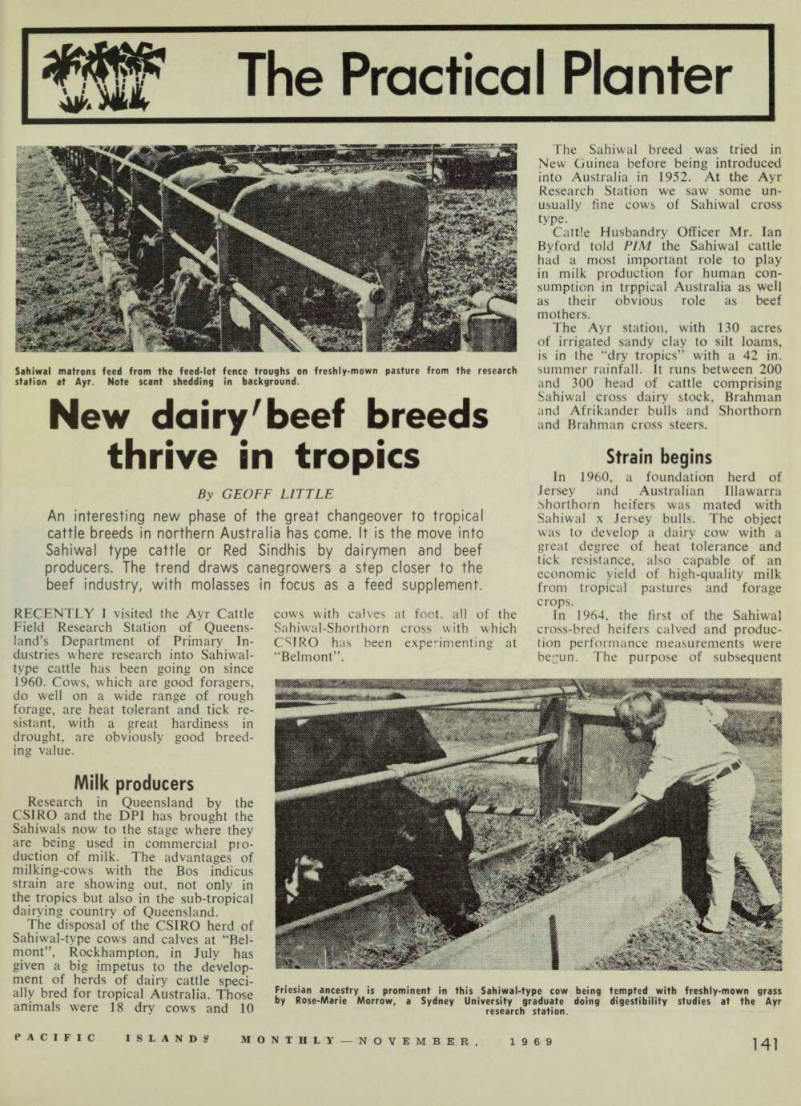
Sahiwal matrons feed from the feed-lot fence troughs on freshly-mown pasture from the research station at Ayr. Note scant shedding in background.
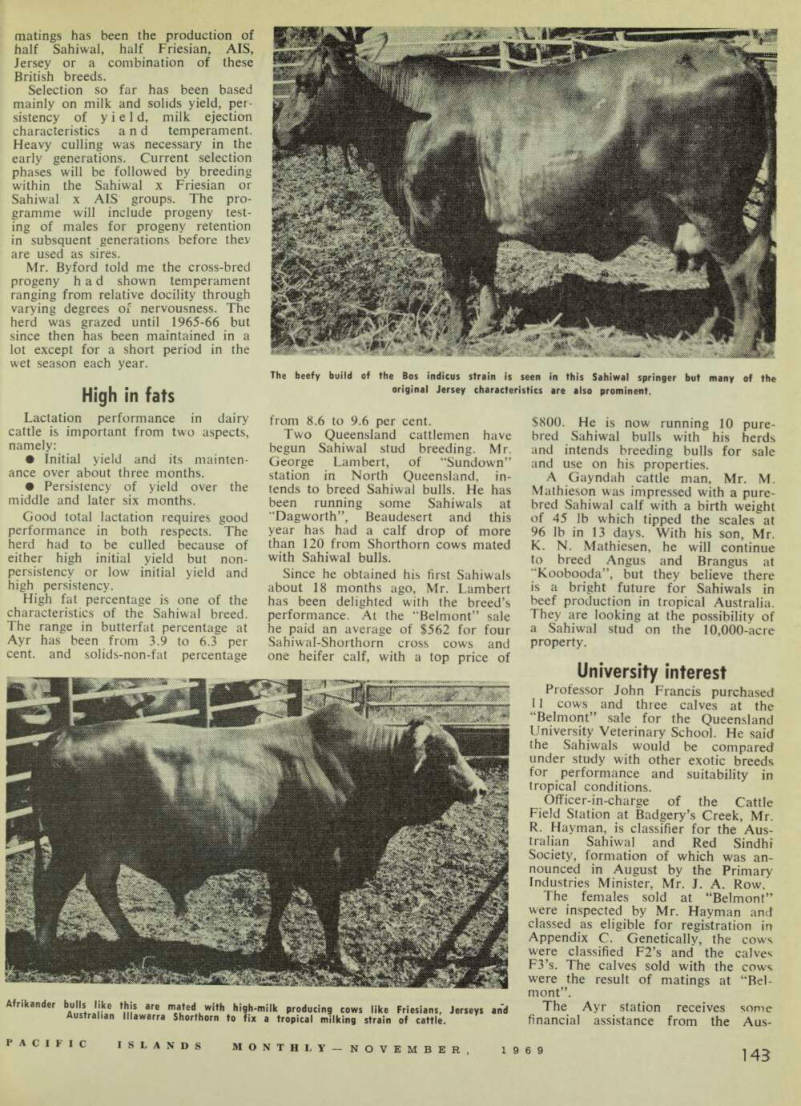
Friesian ancestry is prominent in this Sahiwal-type cow being tempted with freshly-mown grass by Rose-Marie Morrow, a Sydney University graduate doing digestibility studies at the Ayr research station.
matings has been the production of half Sahiwal, half Friesian, AIS, Jersey or a combination of these British breeds.
Selection so far has been based mainly on milk and solids yield, per sistency of yield, milk ejection characteristics and temperament.
Heavy culling was necessary in the early generations. Current selection phases will be followed by breeding within the Sahiwal x Friesian or Sahiwal x AIS groups. The pro gramme will include progeny test ing of males for progeny retention in subsquent generations before they are used as sires.
Mr. Byford told me the cross-bred progeny had shown temperament ranging from relative docility through varying degrees of nervousness. The herd was grazed until 1965-66 but since then has been maintained in a lot except for a short period in the wet season each year.
High in fats
Lactation performance in dairy cattle is important from two aspects, namely: • Initial yield and its mainten ance over about three months. • Persistency of yield over the middle and later six months.
Good total lactation requires good performance in both respects. The herd had to be culled because of either high initial yield but non persistency or low initial yield and high persistency.
High fat percentage is one of the characteristics of the Sahiwal breed.
The range in butterfat percentage at Ayr has been from 3.9 to 6.3 per cent, and solids-non-fat percentage
from 8.6 to 9.6 per cent.
Two Queensland cattlemen have begun Sahiwal stud breeding. Mr.
George Lambert, of “Sundown” station in North Queensland, in tends to breed Sahiwal bulls. He has been running some Sahiwals at “Dagworth”, Beaudesert and this year has had a calf drop of more than 120 from Shorthorn cows mated with Sahiwal bulls.
Since he obtained his first Sahiwals about 18 months ago, Mr. Lambert has been delighted with the breed’s performance. At the “Belmont” sale he paid an average of $562 for four Sahiwal-Shorthorn cross cows and one heifer calf, with a top price of
SBOO. He is now running 10 pure bred Sahiwal bulls with his herds and intends breeding bulls for sale and use on his properties.
A Gayndah cattle man, Mr. M.
Mathieson was impressed with a pure bred Sahiwal calf with a birth weight of 45 lb which tipped the scales at 96 lb in 13 days. With his son, Mr.
K. N. Mathiesen, he will continue to breed Angus and Brangus at “Koobooda”, but they believe there is a bright future for Sahiwals in beef production in tropical Australia.
They are looking at the possibility of a Sahiwal stud on the 10,000-acre property.
University interest
Professor John Francis purchased 11 cows and three calves at the “Belmont” sale for the Queensland University Veterinary School. He said the Sahiwals would be compared under study with other exotic breeds for performance and suitability in tropical conditions.
Officer-in-charge of the Cattle Field Station at Badgery’s Creek, Mr.
R. Hayman, is classifier for the Aus tralian Sahiwal and Red Sindhi Society, formation of which was an nounced in August by the Primary Industries Minister, Mr. J. A, Row.
The females sold at “Belmont” were inspected by Mr. Hayman and classed as eligible for registration in Appendix C. Genetically, the cows were classified F2’s and the calves F3’s. The calves sold with the cows were the result of matings at “Bel mont”.
The Ayr station receives some financial assistance from the Aus
Afrikander bulls like this are mated with high-milk producing cows like Friesians, Jerseys and Australian lllawarra Shorthorn to fix a tropical milking strain of cattle.
The beefy build of the Bos indicus strain is seen in this Sahiwal springer but many of the original Jersey characteristics are also prominent.
tralian Meat Research Fund for in tensive beef cattle investigations and their work in this field includes: • Cultural and fertiliser practices on crops and pastures to increase yield and nutrient quality. • Digestibility and ruminal re search to ascertain suitability of crops or supplements for beef production. • Feeding experiments of yarded cattle using tropical-origin rations.
Sorghum yields
Work done at Ayr has shown that Sugardrip type forage sorghums are capable of high yields and are suit able for intensive beef production.
And yields can be increased by re ducing the inter-row spacing from 3 ft to 2 ft.
Yield is influenced even more by the stage of maturity at harvest time.
Later work on the forage sorghum, Zulu, shows it has a higher protein content than maize or other forage sorghums.
The use of nitrogenous fertiliser on irrigated pastures in Queensland is increasing rapidly. The effect of nitrogenous fertiliser levels up to 600 lb an acre per annum has been ex amined at Ayr using Elephant grass as the test species.
From these tests it has become apparent that yields could be in creased still further with higher fer tiliser levels. The feed produced at the highest fertiliser application would be capable of yard-feeding five beasts to the acre.
Nitrogen fertiliser also gave in
creased protein levels in the grass.
Even with high fertiliser levels pasture production is still very seasonal with only 16 per cent, of the year’s feed being produced be tween May and August. The soil at Ayr became more acid with the high nitrogen levels used and this will re quire correction in time by the addi tion of lime.
Crops must be grazed at an early stage for high beef production be cause as a plant matures it becomes less digestible. But supplements can be used to minimise the quality de cline. However, if yard feeding is employed with energy and/or nitrogen supplements, harvesting can be de layed to take advantage of increased yields.
Molasses cheaper
Molasses is the most readily avail able energy supplement for North Queensland cattle and, on an equalised energy basis, is much cheaper than grain. For any feedlot project con templated for the tropical Queens land region it seems molasses must form an integral part of the feed ration.
In trial feedings of roughage and grain compared with roughage and molasses it was shown at Ayr that live weight gains of about 2 lb a day can be achieved with comparatively simple rations.
Subsequent studies with rumen fistulated steers suggested that higher levels of molasses may be success fully incorporated in the rations if calcium/phosphate supplement is fed.
Cattle were fed with a legume and a non-legume to give the follow ing results: Legume: Malabar cowpeas Percentage roughage Live-weight in ration gain lb per day 100% 1.4 90%, 10% grain 1.6 75%, 10% grain 1.8 90%, 10% molasses 1.8 75%, 25% molasses 2.0 Non-legume (forage-harvested sweet sorghum) Molasses, per cent 0 11 22 33 Nitrogen Liveweight gain supplement lb per day Urea (3 oz day) 0.8 1.1 0.8 0.7 Bloodmeal (1 lb day) 1.2 1.3 1.2 1.5 Urea (3 oz) plus bloodmeal (1 lb) 1.3 1.6 1.9 1.6