Business and Development
pp. 121-128 · Read in the full issue
New Hebrides retains place with trade-surplus minority
Only five of the Islands territories have a favourable balance of trade. These, and their exports which make them pay their way, are: American Samoa, fish; Gilbert and Ellice Islands Colony, phosphate; Nauru, phosphate; New Caledonia, nickel, and the New Hebrides, a combination of copra, fish and manganese.
Territories with varying deficits are the Cook Islands, Fiji, French Poly nesia, Guam, Niue, Papua-New Guinea, Solomon Islands, Tonga, US Trust Territory and Western Samoa.
Of the “insolvent 10”, whose budgets are bolstered by allocations from Britain, Australia, France, NZ, and the United States, four—French Polynesia, Guam, P-NG and the US Trust Territory—have parti cularly large and serious import export gaps.
Fortunate reserves of minerals on hand explain why four of the five “solvent elite” pay their way. In the case of American Samoa, the surplus is explained by preferential status to export fish foods competitively to the US.
The fifth “elite”, and one of the world’s few condominium govern ments, the French-British New Hebrides, has a more complex trade picture, with ups and downs in various imports and exports.
To get an idea of current Islands trade trends, a close look at the Hebrides results for 1968 is worth while.
Australia dominated
Imports in 1968 were valued at $9,080,643; exports at $10,432,050.
Main suppliers were Australia, 46.66 per cent., France, 15.29 per cent., Japan, 10.26 per cent, and Hong Kong, 5.94 per cent.
Australia’s share remained constant over the past four years; but France’s share in 1968 dropped about 16 per cent; Japan’s jumped 70 per cent.; and Hong Kong’s share improved slightly, replacing Britain as the Hebrides’ fourth supplier.
The UK’s share of the trade fell over 20 per cent., to a new low of 3.24 per cent.
New Zealand is the newcomer to the Hebrides top 10 suppliers, re
placing Holland. This reflects im proved shipping connections between NZ and the Hebrides over the past two years.
In motor vehicle imports, Japan captured the honours from France in 1968. Imports from Japan exactly doubled from 72 in 1967 to 144 vehicles in 1968. French imports increased by 28 per cent., to 109, in 1968, but imports from Australia decreased by half.
Overall, the 1968 figures show that, at the beginning of 1969, Japan was supplying 46.7 per cent, of the New Hebrides’ motor vehicle market; France, 35.4 per cent.; UK, 8.2 per cent.; Australia, 4.5 per cent.; and Italy 4.2 per cent.
Australia dominated other markets, including live animals, vegetables, prepared foodstuffs, chemicals, paper products, pearls and coins, base metals, machinery, and miscellaneous manufactured articles. France did best with animal and vegetable fats and oils, plastic materials, vehicles, aircraft, and vessels.
Japan was tops with vehicles and optical and photographic equipment;
Hong Kong led with textiles and footwear.
Intriguing imports were the $3,900 worth of works of art from Hong Kong and the UK, and $81,600 worth of pearls, precious and semi precious stones and coins (mostly from Australia). Coins worth $74,300 were imported to replace Australian pounds and pence with dollars and cents, and also to introduce the new French coinage.
France, Japan, the US and South America were the New Hebrides main customers in 1968.
Australia, the condominium’s big gest supplier, took a mere 1.59 per cent, of total exports, making a huge unfavourable trade balance between
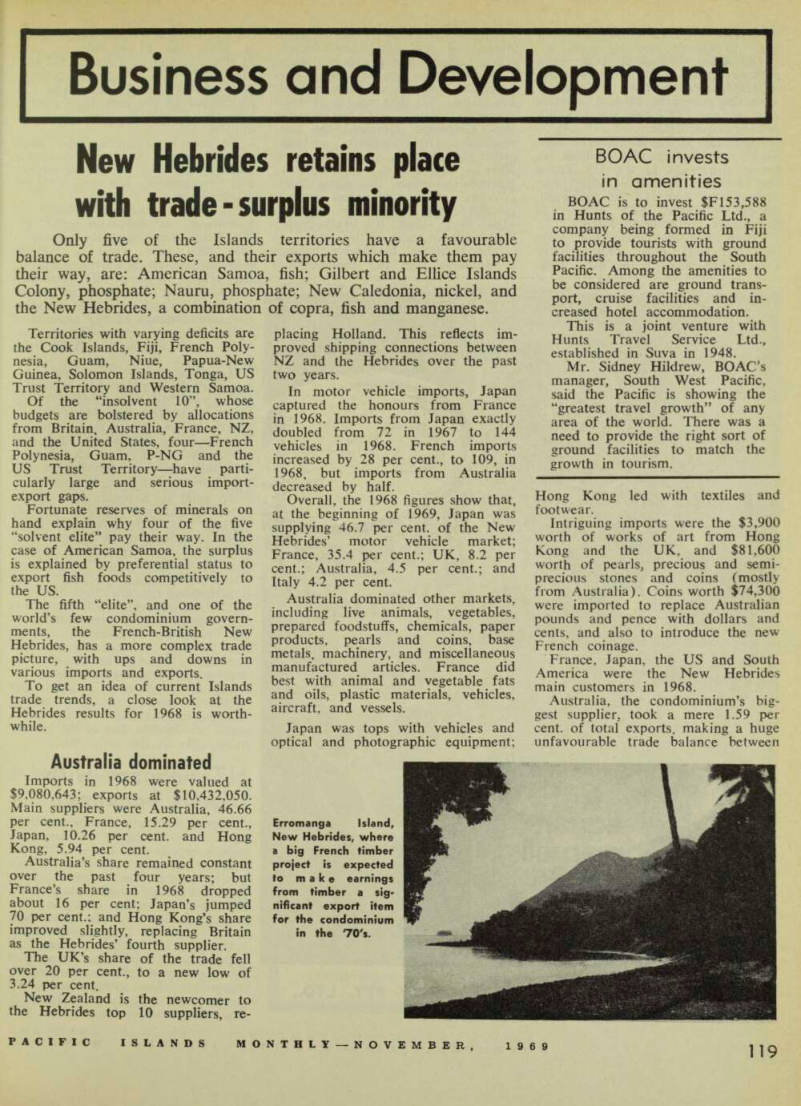
Erromanga Island, New Hebrides, where a big French timber project is expected to make earnings from timber a sig nificant export item for the condominium in the '70's
these two countries—a situation that tends to worsen year by year.
The Islands’ number two copra producer (after P-NG), the Hebrides collected $5.6 million in revenue from this source in 1968. Customers were France (78.7 per cent.), South America and Japan.
From the Japanese managed fish works on Santo, $2.4 million in frozen fish went to the US, Japan and France; and from the now defunct, but soon to be re-opened, mines on Efate, $1.5 million of manganese ore went to Japan.
Copra, fish and manganese were the Hebrides’ only million-dollar earners but next on the list, cocoa,
was the fastest-rising of the lot. High prices and best production for 11 years, gained 536,456 export dollars.
Number five earner—meats—dis appointed, with export tonnage well down on ’67. Exports to French Polynesia ceased and neighbouring New Caledonia remained the only customer. Other exports included coffee (production and prices well down). sandalwood, coconuts, greensnail, trochus, and cattle hides.
Value of miscellaneous exports jumped from $36,465 in 1967, to $143,794 in 1968. It’s likely timber logs made up most of this total.
The Hebrides’ favourable balance is declining, but the condominium
has a few cards to play yet. Balance in 1966 was $1,993,350; in 1967 $1,988,787; and in 1968 $1,351,407.
This year, with manganese produc tion almost non-existent and an anticipated 15 per cent, fall in copra earnings, it will be well under $1 million.
To counter a further and more serious drop in its favourable balance, the big hopes are timber and manganese, and to a lesser extent, meat.
On the southern island of Erromanga, an ambitious timber ex port programme began in earnest in May this year when a 500-ton freighter arrived to start transporting log ( PIM, Aug., p. 47). Operated by a leading European maker of laminated woods, Societe Rougier, the result should be big exports of Hebridean logs, especially to Aus tralia (according to the ANZ Bank Ltd.).
As reported last month (p. 121) an Australian miner has bought a half share in Efate’s Forari mang anese mines, for over $440,000, and exports at an annual rate of 60,000 tons are to be running by April next year. (These mines were closed down late last year and production this year will be little or nothing).
To build up a bigger meat export industry, European planters are un grading and increasing their cattle herds on several major islands. They are doing this rather than replant coconuts, which require more labour —and an adequate pool of labour is something that the New Hebrides lack. With increased meat production it is hoped that a bigger share of the lucrative Caledonian market can be won. Producers have their eyes on a market in near-by ter ritories for higher-grade meat for European customers. Tourism, the “invisible export”, is just starting and the condominium should win a small but sizeable slice of the Islands’ travel cake in the early ’7os.
NZ unhappy with
Islands bananas
Recent reports that some Welling ton, New Zealand, retailers are being urged to ban Samoan bananas because of alleged poor quality, drew the comment from Tonga’s Produce Board Manager, Mr.
Adolph Johansson, that it was entirely possible that the same thing could happen to Tongan shipments.
Under the present system of inspection, in order to keep costs down, the producer is made partially responsible for seeing that only quality fruit is packed. If he fails, then the market could also fail.
should NZ decide to look for alternative sources of supply.
Tonga is going through a tough period with its bananas, having survived two tropical storms during the summer only to run into the worst infection of black leaf spot after the young plants became re established.
The disease, which causes leaf curl and drying out of the half grown plant—for which there is no im mediate local technical solution—has discouraged most of the small growers who normally fill approx imately 50 per cent, of the export quote.
The result is that the forecast total export by the end of this year is now placed as low as 200,000 cases, only a third of what it was two years ago. This would represent a loss to the country, for that period, of more than $1 million.
On the other hand, urgent steps are being taken by the Minister of Agriculture to urge farmers to con tinue to replant, while his depart ment and produce board officers have been ordered to intensify the inspection and spraying programme. • Meanwhile in October, Aus tralian South Pacific aid programme expert, Mr. Gordon Jeater, visited Tonga to advise on methods of improving banana exports, look into effects of diseases, advise on control methods, and advise on handling methods. Of all the problems, he said, handling and packaging needed the most urgent attention.
Farmers are to be assisted with a new fertiliser subsidy scheme in an effort to arrest the effects of the disease and stabilise the industry at a satisfactory level. At the same time, it is understood that the three territories of Fiji, Samoa and Tonga, who share the same disease problems, are negotiating for the visit of UN experts before the end of the year.
P-NG coffee producer,
Kinjibi, made a loss
Plantations in the Wahgi Valley (Western Highlands of New Guinea) are difficult to sell at the present time because with the decline in coffee prices during the last few years, values have fallen. Hence the value of the fixed assets of Kinjibi Hold ings Ltd. of $214,749 were over valued.
So said the directors of Kinjibi, Highlands coffee producer, recently, when announcing a $7,159 loss for the year ended December 31, 1968.
As reported earlier (PIM, May,
p. 119), Kinjibi sold one of its two
coffee plantations—Norikori—during
1968, for a small loss, to Goroka based Bena Coffee Lands Ltd. Its $7,159 loss contrasts with a profit of $20,159 for 1967. Directors explained that combined coffee production of Norikori (before the sale) and Kin jibi plantations was 91.74 tons, as compared with 136.14 tons in 1967.
The decrease was due, they said, to the late arrival of the pre- Christmas flush. Coffee that was ex pected to be picked during the months of October-November-De cember was not ready to be picked until January-February-March this year.
Company 'restraint':
A. Samoa trade claim
Standard Oil Company of Cali fornia, sole supplier of petroleum products to American Samoa since 1956, has been charged in the US with “monopolisation and restraint of trade” in Samoa.
US Attorney-General, Mr. J. N.
Mitchell, using the Sherman Anti- Trust Act, said Standard had entered long-term contracts for the suply of fuel to the two tuna canning com panies (Star Kist and Van Camp) whose fishing fleets constituted the
largest customers for diesel fuel in Samoa.
He also charged that Standard had “eliminated and suppressed” com petition by reducing prices to dis courage competitive distributors from entering the market, so depriving the territorial and federal govern ments and all other consumers of the benefits of free and open com petition in the purchase of petro leum products.
Mr. Mitchell’s suit called for ter mination of Standard’s 50-year “exclusive” lease of government storage facilities and its “require ment contracts” with Van Camp and Star Kist.
In a statement from its head offices in California, Standard denied the charges. The company said it had neither the “power nor desire” to control prices or “exclude com petitors”.
In 1956 Standard was one of several companies invited by the Governor of American Samoa (Mr.
P. T. Coleman) to bid for a lease on the US Navy petroleum storage facilities.
It was awarded the lease, and the lease agreement was approved at the time by the Department of the Interior, the Bureau of Budget and the US Navy.
“We look forward to a complete
vindication when this matter is heard before a court,” the company said.
World copra trend
is steady
Mr. K. G. Oliver, deputy chair man of the Papua-New Guinea Copra Marketing Board gave the following report on the world copra market on October 16: The firmness evident in September continued with Lauries remaining firm throughout, apart from a few days when there was a slight decline in prices. At the present, buyers are offering the equivalent of SAIBS (approximate) for Philippine copra and there is every indication that this level will be maintained, at least for some little time.
In the food sector of the world market, boom conditions were obtained for the last two weeks with substantial gains in rape seed oil (up SUS3O), sun oil (up SUS2O-23), palm oil (up SUSI 6), etc. It is felt that the current price level has been caused, at least in part, by technical factors and may begin to ease with the announcement, during the last few days, that the Eastern European sunflower cron is expected to be ap proximately 250,000 tons above last year’s record.
Also, there are indications that the Soviet crop will reach last year’s level and may even exceed it.
Burns Philp increases
Island profits
Burns Philp (South Sea) Co. Ltd., diversified Islands retailer, planter and shipper based in Suva, Fiji, made a net profit of 5F546,933 for the year ended June 30. This result is a slightly better earning rate than the £F347,962 profit earned for the 17 months, ended June 30, 1968.
Dividend for 1968-69 is held at 10 per cent, and directors announce that 5150,000 has been added to reserves, making a total reserve of $2,350,000.
They said conditions generally in the main Island centres, particularly Fiji, proved satisfactory and resulted in higher sales. This was due in no small part to the further increase in tourism in the areas concerned, as well as relatively steady produce prices.
The past year had been one of con solidation following a period of modernisation of premises and diversification of interests, the benefits from which were now becoming apparent.
Carpenter makes a
record profit
The $3OO million copper develop ment complex underway on Bougain ville is a “closed field at the moment” for retailers. It is going to be “rather a restricted area” and Conzinc Riotinto, main shareholder in the complex, has indicated to W. R.
Carpenter that it intends to operate its own counterpart of the American PX stores to cater for a township of 5,000 people. There will be little need for extra participation.
Mr. C. H. V. Carpenter, chairman and managing director of W. R.
Carpenter, said this when announcing the company’s results for 1968-69, in Sydney in mid-October. He said that nevertheless Carpenters was moving into Bougainville; a small branch had been opened. But CRA were operating their own stores at this stage, he said.
Carpenter, for 1968-69, achieved a 13.4 per cent, increase in net profits, to a record $5,859,063.
Dividend for the year ended June 30 was increased from 18 to 20 per cent, on capital increased by a one for-five bonus (from $l5 million to $lB million).
Last year’s result was $4,985,344.
Profit for 1968-69 excludes a surplus of $872,270 on the sale of invest ments, arising mainly from the sale of 300,000 shares in the Burns Philp Group for about $1.5 million (PIM, Apr., p. 117).
Merchandising turnovers showed a further worthwhile increase in 1968- 69, while continued profitable prices for cocoa and copra were factors behind the profit rise.
Revenue from the Wahgi Valley, New Guinea, tea project showed progress and production of desiccated coconut from the new plant outside Rabaul, increased and the quality of the product had gained wide ac ceptance as being of high standard.
Pacific Pools to
be wound up
Pacific Sporting Pools Ltd., pro moters of an unsuccessful attempt to begin football pools, an airline and a luxury hotel on Nauru, will be wound up.
Acting Chief Justice of Nauru, Mr.
Justice Thompson, ordered the com pany wound up following petitions by two creditors, the Bank of New South Wales and the British Phosphate Commissioners.
The bank said PSP owed it
$114,819 and the commissioners said a PSP subsidiary, Central Pacific Hotels Ltd., owed them $23,764.
No company representative of PSP was at the hearing on Nauru.
Mr. Thompson appointed Messrs.
R. F. Hughes and G. Brooke, of Coopers and Lybrand, Melbourne, liquidators, and authorised the sale of PSP’s property (the partly-com pleted hotel on Nauru).
Directors of PSP are Messrs. Bill Mayberry, Alan Newbury (a Sydney investor with real estate interests, of Alan Newbury and Associates) and Raymond Lord, a Port Moresby
based beer tavern owner associated with this territory’s proposed second brewer, United Brewery Pty. Ltd.
A former director was Mr. George Pearce, who recently has been interested in launching a racing pools scheme in Fiji (PIM, Oct., p. 122).
Mr. Pearce told PIM in May over $500,000 had been subscribed by Australian shareholders, including Mr. L. J. Hooker, former head of the Australia-wide Hooker Corpora tion (with Fiji interests) to finance PSP’s operations.
The operations collapsed after less than two months (PIM, Aug., p. 127).
Islands COVIIDanieS
r ■■
mostly do well
. ror the second time, directors of Australia-New Guinea Holdings Ltd., New Guinea timber, real estate, rubber, tea and coffee group, have dropped hints that dividends could soon be paid.
In their report for the year ended June 30 (a profit of $6,140, contrasted with a loss of $104,739 for 1967-68) they say; “Dividend policy will be reviewed after the financial
results for the current six months become available.’
For 1968-69, they said the result reflected losses in the timber division during the first nine months, because of the delay in the completion of the final stages of the works contract, This operation was earning a “modest profit” during the fourth quarter and was now achieving its target. “All indications point to a satisfactory year”, The year would have to be a little more than “satisfactory” for the firm to pay a dividend in early 1970.
Last year’s loss wiped out two modest profits beforehand and 1968-69’s tiny profit leaves the firm still with a loss on its books of about $29,000.
With a paid-up capital of $914,000, ANG would need a profit of about $75,000 in the first six months of 1969-70 to pay a five per cent, dividend, with no change. Recently, ANG’s $1 shares slumped to their lowest-ever price of 70 cents. • Koitaki Para Rubber Estates Ltd. became the second Papuan rubber producer to show marked profit increases due to the greatly improved prices for rubber over the past year (Lolorua result— PlM, Oct., p. 122).
Koitaki’s profit for the year ended June 30 was $68,395, an $18,864 improvement, or about a 35 per cent., better result than last year’s.
Annual dividend stays at 12£ per cent. • At the annual meeting of Em peror Mines Ltd., Fiji goldminer, on December 5, directors will recom mend an unchanged dividend of 2.5 cents per 10 cents share (absorbing $55,675).
For the year ended June 30, the subsidiary, Emperor Gold Mining Company Ltd., increased its profit by $10,138 to $147,984 and the other subsidiary, Tavua Power Ltd., im proved its profit $20,566 to $49,064.
Listed on Australian stock ex hanges, Emperor’s paid-up capital is $222,700, in 2,227,000 10 cent shares. Its price on the Sydney ex change has varied widely this year, from $4.80 to $1.60.
Moresby development
The W. R. Carpenter Group and an Australian construction company will jointly build a $2 million-plus shopping-office complex and a new industrial estate at Boroko, the Port Moresby suburb, early next year.
Carpenters and T. C. Whittle Hold ings have formed a company—Capital City Developments (New Guinea) Pty. Ltd.—to be responsible for the two projects and also engage in pro perty development, not necessarily limited to New Guinea.
The shopping-office complex, on Carpenter land on the Hubert Murray Highway, will include a supermarket/ department store, several small shops and parking space. Two floors in the major building will offer the largest office area yet available in the ter ritory—about 30,000 square feet on each floor.
The industrial estate, on Racecourse Road, will include several small fac tories designed to enable New Guinea tradesmen to start their own busi nesses.
Papuan gas compared
to Pakistani
Japan is comparing Papua’s gas reserves with similiar reserves in East and West Pakistan before starting price negotiations with owners of one of the three fields. If negotiations are successful with Papua’s owners, Oil Search, BP and Mobil, gas contracts with Papua will be a major economic leap for this depressed section of New Guinea.
The Japanese comparison follows the visit to Papua in September of a 12-man Japanese team, which in spected underground and offshore prospects in the Gulf ( PIM , Oct., p. 34).
Oil Search has meantime begun work on a U mile access road from the Pie River, in the Gulf, to the site of its next well, Ipigo No. 1.
Contract for the work has gone to the Dillingham Corporation of New Guinea Pty. Ltd. and it expected to take 3J months to complete the road.
BP and Mobil also will have interests in the well, which, when sunk, will be Oil Search’s first in Papua since March, 1967 (Muabu).
Tahiti's second bank
opens for business
French Polynesia’s long-heralded second bank, the Banque de Tahiti, opened for business in the Rue Paul Gauguin, Papeete, at 8 a.m. on October 15.
The foundation of the bank was first announced last November ( PIM, Dec., 1968, p. 129). Its establish ment means that the Banque de ITndo-Chine, which has been opera ting in Papeete for more than 60 years, no longer has a monopoly over French Polynesia’s banking business.
The new bank has both French and American capital. The major shareholder is Mr. Jean Breaud, a French banker, who has lived in Tahiti since 1946 and has big land holdings. He owns a little over 25 per cent, of the stock.
The remaining stock is divided among the Bank of Hawaii, 25 per cent.; French metropolitan share holders, about 25 per cent.; and local shareholders, 23 per cent Mr. Jean Lalanne, of Tahiti, is the bank’s president and director general. The Bank of Hawaii is represented on the board by Messrs.
Clifton Terry, Charles B. Klenske, Francis Moore and Rudolph von Pestel. Mr. Terry is president of the Bank of Hawaii; the other three are vice-presidents.
Mr. Lalanne told a Press con ference in October that the new bank
would aim to give quick service— dealing with each client in less than five minutes. He said all employees had been trained in all types of banking operations, rather than as specialists in individual fields.
Other features were: • The interest rate on deposits would be 4 per cent. —the same as that offered by the Banque de I’lndo- Chine and local credit organisation,
Socredo.
• The bank would offer a reduced service at lunch time, 12 noon to 1 p.m. • A statement of account would be sent to all clients each month, together with all cheques drawn so that clients could take an active interest in the “life” of their accounts.
Trade briefs
• Air-NZ, New Zealand’s inter national air carrier, with its main operations in the South Pacific, made a profit of $NZ1,019,533 for the year ended March 31. Chairman, Mr.
G. N. Roberts, said the result was up from a $66,492 profit for the previous year. The year’s operations were “satisfying”, he said, but in terms of capital invested or turn over, the profit was “not substantial”. • Qantas, Australia’s international air carrier made a net profit of $7.1 million for the year ended March 31—almost three times the
-196- profit of $2.8 million. Chairman, Sir Roland Wilson, said the 1968- result was “the most successful in the companys 49-year history”.
Qantas’ prospects for 1969-70 were “bright”, but in the two years ahead of this prospects were “somewhat dimmer” because of anticipated American competition with jumbo jets. • The French-controlled Liquid Air Australia Ltd. has bought for an undisclosed sum 60 per cent, of South Pacific Oxygen Acetylene Co.
Pty. Ltd., one of New Guinea’s two industrial gas suppliers. Liquid bought
its interest from Societe d’Oxygene et d'Acetylene d’Extreme-Orient; the remaining 40 per cent, of South Pacific continues to be held by Steamships Trading Co. Ltd. Liquid Air France has a second industrial gas plant in the Islands—at Papeete, Tahiti, • Merger plans between PanAm, the world’s biggest international air line, and Continental Airlines, an internal US air carrier and operator in the US Trust Territory, appear to be off. A PanAm statement in mid- October said: “PanAm and Con tinental had a preliminary conversa
tion late in August as to whether merger discussion should be under taken. There are no plans for further discussion on the subject”.
But, PanAm has stated a merger would “do much to solve the airlines’ problems. PanAm is in a position to investigate opportunities that may arise for either acquisition or merger”. • A New Zealand firm, Beazley Homes Ltd., of Mt. Maunganui, has won a contract worth over SNZ2 million to build 284 two-, three- and four-bedroomed prefabricated houses near Kieta, Bougainville. The houses are for engineers and construction teams who will be working on the nearby $300 million copper project for Bougainville Copper Pty. Ltd.
The contract was awarded by Bechtel WKE, an American firm representing Bougainville Copper. • A company has been recently formed in Australia which could take a hand in financing future mineral, oil or gas ventures in the Islands.
It’s called Newaim Pty. Ltd., and is owned, equally, by five share holders—the AMP Society, Bank of New South Wales, ICIANZ, Engle hard Minerals and Chemicals Cor poration and Newmont Pty. Ltd.
Newaim’s aim is to “assist mining developments in Australia and ad jacent areas”. • New Hebrides Airways Ltd., the condominium’s internal air carrier, incurred a $7,228 loss in the year ended December 31, 1968. Sir Roland Wilson, chairman of Qantas, re vealed this in Qantas’ 1968-69 re port. He said Qantas paid $17,917 (13,371 shares) for its 25.7 per cent, interest in the airline. BOAC held another 25.7 per cent, and paid-up capital of NHA was $107,846.
Sir Roland said Fiji Airways Ltd., Suva based regional Islands carrier, would show a “satisfactory profit” for 1968-69. Fiji Airways made a profit of $F4,072 in the year ended March 31, 1968. Its paid-up capital was now $F 1,020,000. • New Guinea Goldfields Ltd., goldminer, timber operator, freight hauler, coffee planter and trader, lifted a profit of 31.6 per cent., to $289,908, for the year ended June 30, despite a $122,196 loss from logging operations at V a n i m o.
Premium prices for gold (profits $240,250) did best of the company’s diversified activities; trading profits dropped $820 to $179,867. Dividend is unchanged at 10 per cent, tax free.