Pacific Shipping
pp. 109-116 · Read in the full issue
Png Ports Are Neglected
And Ignored' Says Shipper
Are New Guinea’s ports being run properly? More than a few coastal shippers in the territory had their doubts in October follow ing heated clashes with Administration port authorities over wharf facilities, navigational aids and port extensions.
Mr. W. Cunningham, president of the Small Shipowners’ Association, representing 24 companies and in dividuals, started it all with an at tack—from Lae—on the Harbours Board of New Guinea.
He said the board “couldn’t see past Basilisk Passage,” the entrance to Port Moresby Harbour, the im plication being that ports other than Moresby were being ignored.
Mr, Cunningham’s statement, and his subsequent detailed criticism of several aspects of NG outer ports, brought denials and explanations from Captain G. A. Hawley, chair man of the board, and Mr. G.
McDonell, Co-ordinator of Admin istration Transport.
The subsequent verbal gymnastics didn’t provide results. They did, however, bring to the surface the dis agreement which exists between business and government in NG shipping.
Mr. Cunningham said current port facilities were completely inadequate.
There was no unified shipping ordin ance for Papua and New Guinea.
Papua had different requirements for the licensing and operations of ships than NG.
No co-operation
Navigational lights and other aids were neglected to such an extent that some ports could not be utilised at night.
Administration had ignored the experts who had constantly called for better wharf facilities for the small ships. There was no co-operation from the Administration. ‘The ad ministration has ignored the present plight of the small shipowner. Lae is crippling the coastal vessel operators economically, with its in adequate wharf,” Mr. Cunningham said.
“The Australian Government put
up, at a cost of hundreds of thousands of dollars, good wharf facilities in most main ports. Since then many of these have been allowed to fall into disrepair. ‘The Lorengau wharf is rotted, the same at Kieta, and at Killerton the wharf was never replaced after fire.
At Moti, the port has been closed, purely because the wharf facilities collapsed due to the lack ofr pre ventive maintenance.
“At Wewak, a private individual offered to build a wharf for small ships. But he was knocked back by the Administration—despite the fact that he was willing to pay for it him self and had already bought land and erected a small first stage. Wewak
cargo damage amounts to thousands of dollars to the customers.”
He said there were no storage facilities provided for coastal vessel ships despite constant to Capt. Hawley.
“In reply to representations all we get is vague promises of harbour board plans. Freight rates could be stabilised if storage facilities were available,” he added. ‘There is also a possibility that some small ports will have to be closed off, because masters of ships are objecting to tak ing their vessels through some of the straits where there are inadequate navigational aids.”
He said the Lae smallships wharf at Voco Point was now “almost im-
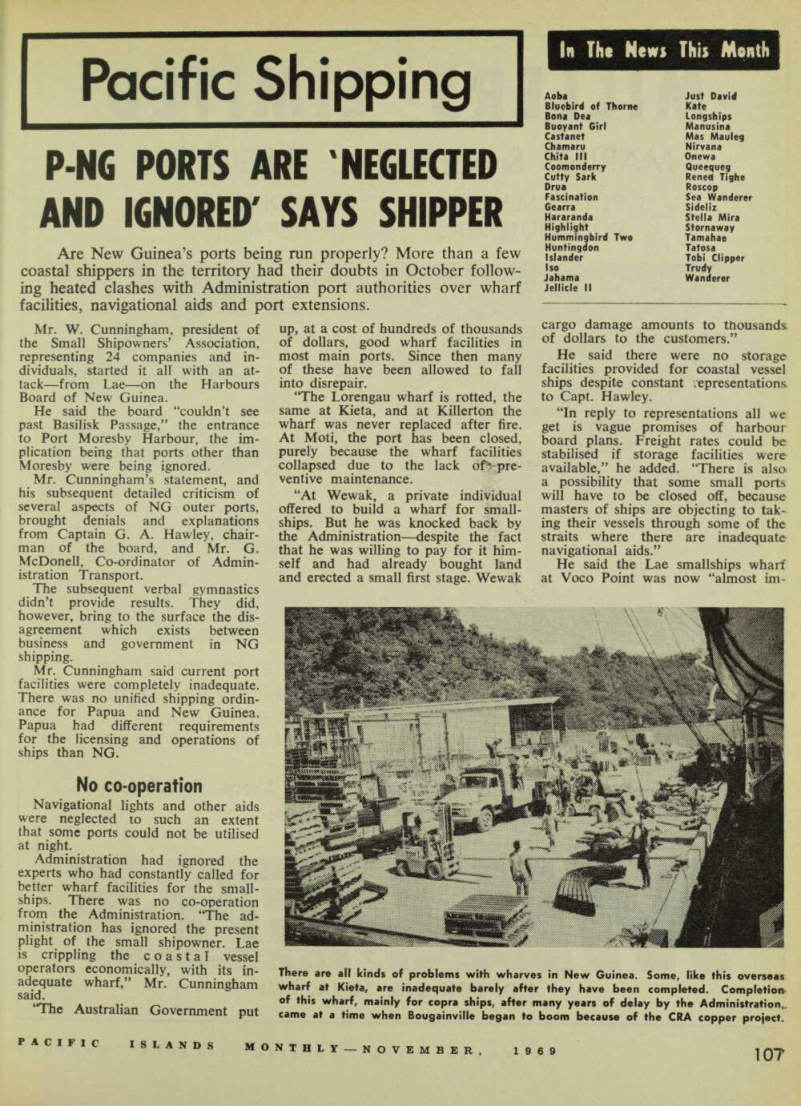
There are all kinds of problems with wharves in New Guinea. Some, like this overseas wharf at Kieta, are inadequate barely after they have been completed. Completion of this wharf, mainly for copra ships, after many years of delay by the Administration came at a time when Bougainville began to boom because of the CRA copper project.
passable” to rowing boats. His com pany, Pacific Islands Shipping Com pany, had lost 25 per cent, of its earnings last year because of various delays. In September, PISC has lost 23 days waiting for berths.
Capt. Hawley was first to answer Mr. Cunningham’s brickbats. He said a capital works’ programme for 1969-70 had been submitted to the Administration. It included continu ation of the new overseas wharf at Rabaul, and a new Lae shed, a new berth at Lae, improvement of Moresby facilities, extension of small ship facil ities at Rabaul (including provision of storage facilities) and the ex pansion of the storage shed at Kavieng. The board also intended to improve Samarai wharf, as a main tenance project.
A day later, Mr. McDonell replied more directly to several of Mr.
Cunningham’s criticisms. Work on navigational aids hadn’t been lagging, he said. In the last two years two lights had been constructed, six were programmed and four were under investigation.
Within the current five-year plan, NG would possess a first-class system of modern overseas and coastal ports and navigational facilities. It was “doubtful” that the territory would have a modern coastal shipping fleet by then.
Visiting experts had adversely com mented on the age of some ships ply ing around NG. A recent investiga tion had shown that out of 138 coastal vessels, 83 were over 20 years old.
Mr, McDonell said Administra tion policies had aided the develop ment of territory shipowners. Proof of this was the growth of cargo carried in territory coastal ships, in stead of overseas ships, over the last three years between main ports, mainly in three or four larger conventional ships of between 500-1,000 tons.
He discounted suggestions of the need for freight rate increases. “The way to reduce costs, and hence freight rates, is to use modern ships and modern unitised methods,” he said,
Treacherous Minerva Reef
Claims Another Victim
Tonga’s treacherous Minerva Reef made headlines in early October, when six fishermen—four Australians and two Tongans—were dramatically plucked from the reef’s lagoon by rescuers in an amphibian aircraft.
The fishermen had been stranded on the reef nearly 12 hours after their 83-year-old crayfishing boat, Coomonderry , was grounded on the reef “head on” on October 6.
They were flown by the aircraft— a Mallard operated by Suva-based Air Pacific—to Fiji, from where, a couple of days later, the Australians flew home to Sydney and the Tongans, returned to Nukualofa.
The Australians were Messrs. Chris Fenner (skipper), Vincent Clancy, Rob McGill and Ron Toy; the Tongans were Molofili Moehala and Pita Fifita, both of Nukualofa. Mr.
Fifita is a brother of David Fifita, captain of the cutter Tuaikaepau, which was wrecked on the southern end of the reef ( Coomonderry went fast on the northern end), in July, 1962.
It was 102 days before 14 survivors of the Tuaikaepau’s crew
of 17 were rescued. The story of the Tongans is one of the greatest castaway stories of the Islands in recent years.
Coomonderry left Cairns, Queens land, in early August for Nukualofa to ask permission from the Tongan Government to fish for crayfish in Tongan waters. Permission was not granted and after two weeks in Tonga, she left Nukualofa for Suva, having taken on the two Tongans as temporary crewmen.
En route, the boat was diverted to Minerva Reef, 260 miles west of the Tonga group, 380 miles south of Suva. Coomonderry went aground about 4 a.m. in “bad weather”, ac cording to Chris Fenner. She sent
out distress signals on her radio transmitter until about 9 a.m., after which the wheelhouse and radio room were damaged by rising seas.
She started to list badly, and the crew transferred into three dinghies inside Minerva’s lagoon. Two ships —the crayfisher Just David, out of Nukualofa, and the New Zealand Shipping Company vessel Hunting don—were alerted and steamed towards Minerva, but shipping authorities in Suva decided no ship could reach Minerva by nightfall and the amphibian, out of Suva, was ordered to rescue the men.
With pilots Russ Hilder and Gary Wrathall, the Mallard reached Minerva about 3 p.m. A diverted RNZAF Hercules transport aircraft circled overhead to locate the fisher men in the dinghies. Captain Hilder landed the Mallard in the lagoon and 41 minutes later took off with the six men, returning to Nausori Airport, Suva.
In Fiji, Mr. Fenner, 20, of Mel bourne, said the Coomonderry was owned by a Cairns businessman, Mr.
Peter Goodlich. In late October the 83-year-old vessel remained stuck on Minerva and reports were it was breaking up. No salvage attempts were made.
"Mas Mauleg" Is Biggest
Ship Yet For Saipan
A new addition to the growing fleet of small ships owned by Micronesian shipowners is the M.V.
Mas Mauleg {‘‘more good”) recently purchased by the Saipan Shipping Company Inc., of Saipan.
On her arrival at Saipan, Marianas, a christening ceremony and recep tion was held on board attended by the management and shareholders of Saipan Shipping, senior officials of the Trust Territory Government
Headquarters, the District Admin istrator and members of the staff of the Mariana Islands District Admin istration.
Mas Mauleg (formerly Naha Maru ) was built by Onomichi Shipyard Cos. Ltd., Japan, in 1954 for the RKK Line of Naha, Okinawa.
Of 1,095-tons gross tonnage (577 net tonnage), Mauleg is the largest ship ever purchased by a wholly-owned Micronesian shipping company and reflects the increasing interest in ship ping by Micronesians.
This all-steel vessel is 224 ft long.
The "Mas Mauleg".
35 ft wide and her diesel engine develops 1,800 hp and a speed of 14 knots. She is registered in ter ritory waters to carry a crew of 24 and 176 passengers (maximum).
Her master is Tinian resident, George Flemming, whose father was wellknown in the Marshalls; chief engineer is the popular Lorenzo (Larry) Leon Guerrero.
Mauleg’s schedule is to run between Saipan, Tinian, Rota and Guam. Later it’s planned to trade between Japan and territory ports.
"Tobi Clipper" Starts
New Guinea Run
The seven-month W. R. Carpenter- Thomas Nationwide Transport freighting service between Sydney and Brisbane to Lae, New Guinea, got into full stride on October 10 when the 299-ton motor vessel Tobi Clipper left Sydney on its first monthly run to Lae.
Tobi has been taken on time charter by PNT (Australia) Pty.
Ltd., the Australian company jointly set up by the two companies for their door-to-door freighting service from Australia to the NG Highlands ( PIM, Mar., p. 117). Her owners are Frank and Tobiesen, of Copen hagen, Demark.
Carpenters say Tobi can carry up to 1,300 tons of general cargo. She has no refrigeration or passenger space. All cargo is pre-palletised and she has a Danish crew of six.
The vessel can carry consignments of logs and, Carpenters say, arrange ments have been made with timber people in NG to fill holds for all backloadings trips to Australia. Ad ditional calls, besides Lae, could be made on return trips to pick up timber and a call at Brisbane, Queens land, will also be made on initial return trips.
"Onewa" Settles Its
Tow Claim
Former New Zealand vessel Onewa, which had been stranded in Noumea since Easter over an in surance dispute, finally pulled up anchor and departed on October 15.
The Onewa with five Australians aboard ran adrift in the Coral Sea on its way to Sydney in April, when its propeller inexplicably fell off.
After drifting for three days, it was taken in tow by the Messageries Maritimes vessel Caledonien, on its way from Sydney to Noumea. The tow took three days, including the last lap by the local tug, Pegasus.
The Onewa had originally come to Noumea from Auckland to help tow the stricken NZ vessel Matipo which was left stranded nine months on the coral reef off Noumea.
Dispute in the Caledonien rescue affair arose over insurance coverage of the Messageries Maritimes tow charge. The Onewa was left moored off He Nou in Noumea harbour for six months before the claim was settled.
In September, Bill Martin, part owner of the vessel, arrived from Sydney. Accompanied by a fellow Australian and two New Hebrideans he finally departed for Vila then Santo, where the vessel was to go on the slips before proceeding to further salvage work.
Shipping Briefs
• Two inter-island traders recently went aground in the New Hebrides and one, Aoba, appeared to be a complete wreck. Aoba, owned by Mr.
Michel Lerous, was returning from a charter trip to the Banks Islands when she hit a reef off Pilot Island, north of Santo. Her cargo was off loaded but efforts by another trader, Tamahae, to refloat her were un successful. Pacifique was grounded on a reef off Bognaun Point, near Tisman, Malekula, and was refloated
10 hours later. Her passengers were transferred to the Taswegion. • American Samoa’s second master of inter-island vessels, Peter Lagarejos, recently received his certificate. Captain John Calver, head of the government’s Division of Water Transportation, said Captain Lagarejos would command the 59 ft inter-island vessel Manusina, which has been operating in Samoa since February, 1968 ( PIM, Mar., 1968, p. 105). Captain Maalona Elisara, Samoa’s first qualified master, has been transferred to command of the Pago Pago tug Tatoso. • Trudy, a New Hebrides inter island trader, recently began work for her new owner, Mr. Bob Paul.
Mr. Paul bought her from business man, Mr. Robin Cook, of White sands, Tanna, and put her on regular fortnightly trips, based out of Vila, Efate, to the Hebrides southern islands.
Mr. Paul, 46, born at Melbourne, has been trading and planting in the Hebrides for over 20 years. A member of the condominium’s Advisory Council, he’s based on Tanna, runs his own tourist opera tions and is a director of New Hebrides Airways, the condomin ium’s internal airline. • Reichelmann Brothers Ltd., of Nukualofa, Tonga, is experimenting building concrete boats and hopes to build its first—a 16 footer with a four ft beam—for ST2B, in Nov
ember. Another—s 2 ft —is planned.
• For the second time in October, Tonga was visited by Korean fish ing vessels based in Pago Pago.
Nam Hae 217 called at Nukualofa on October 11 for repairs. She was fully loaded with fish and on her way to Pago Pago.
Two weeks earlier Nam Hae 230 limped into Eua Island for repairs.
According to her captain, fishing lines were caught in the propellers and causing engine trouble. She was granted permission to anchor in the stream while two local divers were hired to disentangle the lines. The crew of 20 were not allowed ashore.
This was the fourth Tonga visit within a year from these fishing vessels. In December last, Nam Hae 255 was wrecked off the south coast of Tongatapu while fishing in the area, resulting in their equipment being confiscated. Also in October an unidentified foreign vessel was seen by villagers fishing in the Ha’apai group.