Australia's Part In
p. 102 · Read in the full issue
The 1939-1945 War
A week before a major American landing in the Russell Islands, American reconnaissance parties reconnoitred the Islands.
Their arrival was anticipated by two Australian coastwatchers, Lieutenant Campbell, RANVR, and Sub-Lieutenant Andresen, RANVR, who reported that the area was clear of Japanese.
Some days later the Americans arrived in the Russells, armed to the teeth, magazines charged and fingers on triggers, to be greeted by Campbell with the prosaic invitation to a cup of tea.
This is one of many incidents des cribed in the second of two naval volumes of the Australian Official History of the 1939-1945 War.
The first volume traced the events in which the Australian Navy played a part in the Pacific, Atlantic and Indian Oceans and in the Mediterra nean from 1939 to 1942. This second volume deals mainly with the naval operations against Japan in the Pacific and Indian Oceans commenc ing in March, 1942, and culminating in the Japanese surrender in Tokyo Bay on September 2, 1945.
The author, George Hermon Gill, himself a wartime Naval Intelligence Officer, seems closest to his subject in the earlier chapters of the book dealing with those grim months of 1942 and 1943 when all the Allies could do was delay the Japanese advance and establish avenues of intelligence, while the US recovered from the shock of Pearl Harbour and Australia recalled her small force of cruisers and destroyers from their duties in the Atlantic and Mediterranean.
Gill draws heavily upon published works to which acknowledgment is
made in footnotes. One such work is Eric Feldt’s The Coast Watchers.
Feldt, who died in March last year (. PIM, Apr., 1968, p. 22; May, 1968, p. 77), was responsible for the re cruitment and training of many of the plantation managers, bank clerks, shipping clerks and district officers, many of whose names appear in this work, and who made the Coast watchers a unique intelligence group.
American naval tributes to the Coastwatchers abound in this book, particularly in relation to their work which contributed to the American success in the Bismarck Sea.
The attack with limpet mines on Japanese ships in Singapore Harbour by agents of the Allied Intelligence Bureau who were, in the main, Aus tralian naval and military personnel based on the Krait, forms a com plete chapter. I found this to be one of the more interesting parts of the book.
Extracts from the Krait’s log tell the official story of this hazardous and ultimately successful voyage from Exmouth Gulf on Australia’s western coast to Singapore in the disguised 70 ft motor sampan, through waters which were com pletely in enemy control. One such extract describes these camouflage precautions.
“To lend an air of verisimilitude to what would otherwise be a pos-
sibly bald and unconvincing Krait if sighted in enemy waters by aircraft or other vessels close to, colouring matter had been provided to darken the skins of her company and on the 4th the first experiments with it were made.
“At first the disguises didn’t work, but after the crew had persevered at their make up one of their number was able to record: ‘The crew now resembled blackamoors, a more desperate looking crowd I have never seen’.”
For naval pundits there are ap pendices setting out peak strengths and casualties in ships and personnel and details of mine-sweeping and mine-disposal operations.
It may surprise younger readers of this work as well as many Aus tralians with a memory of these years, to read of the ease with which the Japanese Navy carried the war, previously so distant, to Australia’s vast and indefensible doorstep.
The account of the raid by midget submarines on Sydney Harbour in May. 1942, which was prefaced by the unmolested and almost undetected flight over Sydney of a Japanese re connaissance aircraft, serves to show that not only was Australia lacking in naval and military force but had not, even after two years of war, established anything like an adequate internal defence communication system, even in the area of the country’s biggest city and a major
naval installation.-
Swc.
(Australian Official History Op
THE 1939-1945 WAR. Angus and Robert son. $4.)
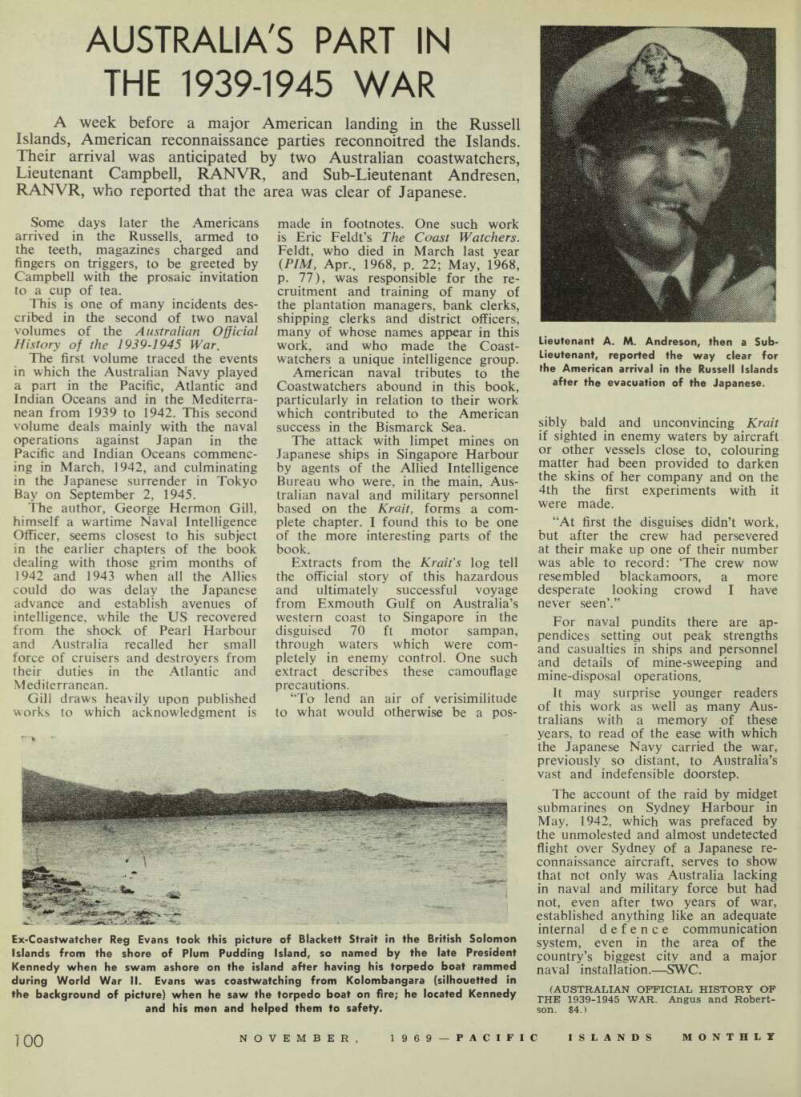
Ex-Coastwatcher Reg Evans took this picture of Blackett Strait in the British Solomon Islands from the shore of Plum Pudding Island, so named by the late President Kennedy when he swam ashore on the island after having his torpedo boat rammed during World War 11. Evans was coastwatching from Kolombangara (silhouetted in the background of picture) when he saw the torpedo boat on fire; he located Kennedy and his men and helped them to safety.
Lieutenant A. M. Andreson, then a Sub lieutenant, reported the way clear for the American arrival in the Russell Islands after the evacuation of the Japanese.