To the Point
pp. 43-45 · Read in the full issue
PROBLEMS OF THE NAME, THE FLAG, THE
Anthem, And, Of Course, The Language
Last month I referred briefly to the metamorphosis of our mid-September holiday into National Day. Starting as Annexation Day, when pre-war Papua remembered the annexation of south-eastern New Guinea to the British Crown in September, 1888, it became Commemoration Day after the war, gathering under its umbrella the capture of Rabaul by Australian troops in September, 1914, and several military successes by Australian and American forces during the 1941-45 war.
It has therefore a fairly strong colonial flavour. However, I don’t think that this matters. We need a National Day, and the middle of September is as good a time to celebrate it as any other. Those who wish to do so can still gather together to toast the colonial past, while a new generation of Niuginians, to whom the names of Commander Erskine and Colonel William Holmes are either unknown or without interest, will no doubt develop a new legend to rationalise the occasion.
Perhaps when our charismatic leader—the Great Father of Niu ginian Unity—appears it will be dis covered that in the beneficence of providence he was born in the middle of September; and thereafter we shall annually celebrate his birthday with song and dance and the music of drums and, I would like to think, bamboo flutes—but more probably it will be guitars. Let’s hope, any way, that this is the way it will be celebrated, and not by the rumble of field guns and the tramp of marching feet in the big parade.
So much for national day. What of our other props of nationhood?
Popular verdict
Well, there’s our national name.
I’ve done my best to popularise one of the suggested solutions of this problem, and I’m glad to notice that an increasing number of people, in cluding our university’s vice-chancel lor, are doing the same. There is probably no better way of solving this problem than by the verdict of popular usage, though ultimately, of course, a choice so made will have to be ratified by the House of Assembly and the Australian Parlia ment.
The problem of a national flag is bedevilled by the difficulty of finding any natural or cultural object which might be featured on it and which is
To the Point with Percy Chatterton
common to every part of Niugini.
John Guise ran into this problem in another form when he was inducted as Speaker of the House of Assembly.
The Army in Niugini has adopted a device featuring a coconut tree with a crocodile at its base. I’m not quite sure what the crocodile is doing there—perhaps it thinks it saw someone going up the tree for a nut and is waiting for him to come down.
It’s an attractive device, but soldiers from the Highlands, where there are neither crocodiles nor coconut trees, may well resent it, even if they don’t go to the length of striking over it.
On the other hand, the New Guinea Islanders seem to have reservations about the bird of paradise.
We shall probably end up by sett ling for a tricolour, if there is any colour combination left which has not already been adopted by one or other of the world’s new nations.
The suggestion of green for our vegetation, gold for our beaches and blue for our seas has been made by someone, and I rather like it—pro vided that someone else has not got in first.
A number of attempts have been made to write words for a national anthem. Those I have seen struck me as enshrining banal sentiments in doggerel verse. Perhaps, as I think
I suggested once before, we should commission a poet such as James McAuley to write one for us.
Anyway, whoever writes it and in whatever language it is written it should be set to the tune Papua, which has already established itself in the affections of people all over Niugini. It might be a good idea to have alternative words in English, Pidgin and Motu, so that people can sing whichever they prefer.
Pidgin mystique
And this brings us to the stickiest problem of all—a national language.
As I have been trying to promote “Niugini” as a national name, I suppose I have no grounds for com plaint if others are trying to promote Pidgin as a national language. This is certainly happening. Some academics are hard at work creating a kind of mystique around Pidgin; others talk of “engineering” it, whatever that may mean. Father Mihalic, our real authority on Pidgin, is more modest in his claims for it.
Pidgin, of course, stinks of colonialism, so much so that recently a very distinguished personage indeed has been hovering over it squirting it with deodorant.
I don’t think that Pidgin’s colonial
background matters any more than that of our mid-September holiday.
If Pidgin does become Niugini’s national language, a new legend will probably be invented to account for it. Future generations of Niuginian children will be taught that Proto- Pidgin was the mother tongue of the stone-age hunters who first oc cupied their land 50,000 years ago.
They will be told of how the wicked colonialists stole this fine old language and taught it, in a debased form, to the people of their home land, and then, to conceal their theft, invented a bogus history and a bogus literature for their pidgin Pidgin, to which they gave the name of English. Fanciful? Not a bit of it.
It is claimed that, allowed enough circumlocution, you can say any thing in Pidgin. I believe this to be true. It is also true that you can say nothing in Pidgin at greater length than in any other language.
During the last five years I have listened to many speeches in Pidgin.
Some have been very good indeed, and a really good speech in Pidgin is a delight to listen to. Some have been not so good. And some have been plain awful.
Best speeches
With very few exceptions the best speeches I have heard in Pidgin have been made by speakers New Guinean, Papuan and European who could have made equally good speeches in English, but chose Pid gin for purely political reasons.
Some psychologists claim that too much circumlocutory speech leads to
muddled thinking. They could be right. But let’s put aside the theories of the psychologists and the phan tasies of the pisinophiles and look at some figures derived from the 1966 census.
In Papua, excluding the Southern Highlands, 40 per cent, of the popu lation of 10-years-old and over can speak Police Motu, 29 per cent, can speak English and 15 per cent, can speak Pidgin. (12,000 New Guineans living in Papua, once again excluding the Southern Highlands, help to swell this latter figure).
In New Guinea as a whole, 45 per cent, can speak Pidgin, 10 per cent, can speak English and one per cent, (mostly Papuan migrants, no doubt) can speak Police Motu.
In the Southern Highlands less
than 10 per cent, can speak any of the three linguae francae. Since the Southern Highlands’ lines of com munication are wholly with New Guinea and not at all with Papua, it is entirely misleading to aggregate the Southern Highlands figures with those for the rest of Papua.
Taking a closer at the New Guinea figures we find that the percentage of Pidgin speakers in the New Guinea lowlands and islands ranges from 47 per cent, in the Morobe District to 95 per cent, in New Ireland, In the Highlands it ranges from 8 per cent, in the Southern Highlands to 26 per cent, in the Eastern High lands.
Motu a rival
Pidgin emerges, therefore, as the regional lingua franca of the New Guinea lowlands and islands. Police Motu emerges, rather less success fully perhaps but as the only serious contender, as the lingua franca of Papua.
The claim of some of the pisino philes that Pidgin is gaining ground in Papua at the expense of Police Motu is sheer poppycock. It is true that Papuans exposed to Pidgin learn it easily, and are quite willing to use it when in the company of New Guineans or Pidgin-speaking Euro peans. But among themselves they always prefer to use Police Motu or English. One has only to dawdle in Musgrave Street on a Saturday morning and listen to the conversa tion of passing groups of Papuans to realise the extent to which Police Motu is used by all age groups, even by the children who are being schooled solely in English.
This impression is confirmed bv the census figures. Out of 40,000
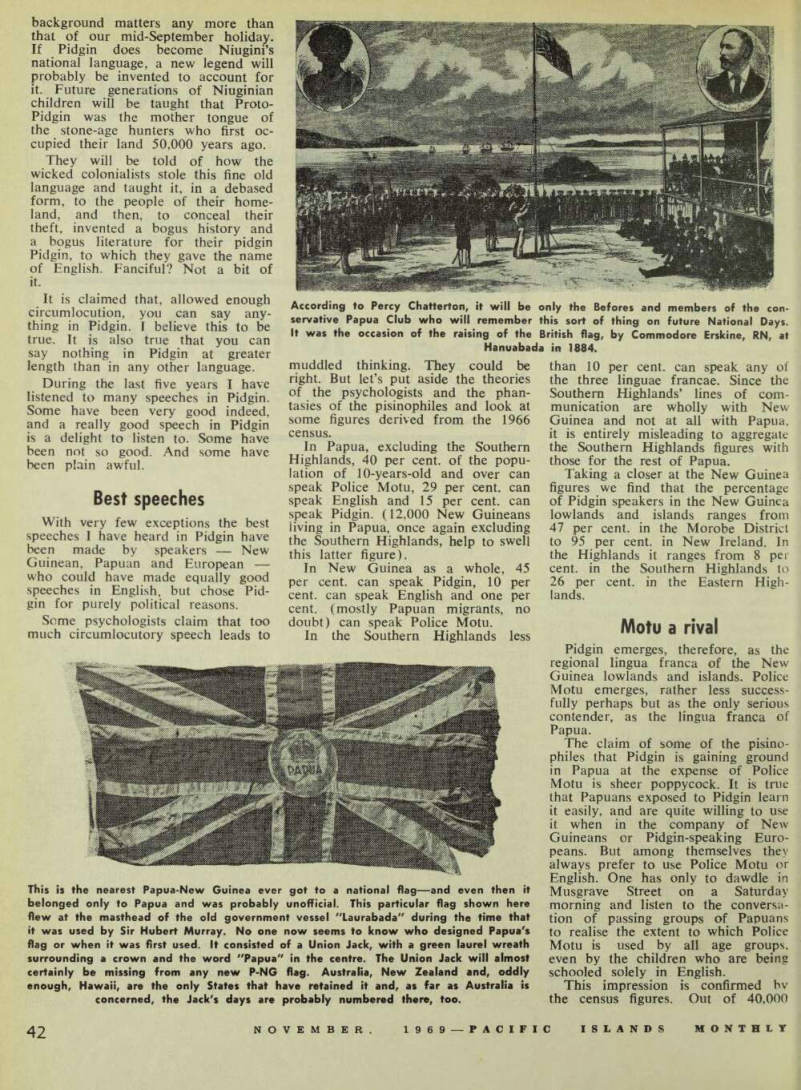
This is the nearest Papua-New Guinea ever got to a national flag—and even then it belonged only to Papua and was probably unofficial. This particular flag shown here flew at the masthead of the old government vessel "Laurabada" during the time that it was used by Sir Hubert Murray. No one now seems to know who designed Papua's flag or when it was first used. It consisted of a Union Jack, with a green laurel wreath surrounding a crown and the word "Papua" in the centre. The Union Jack will almost certainly be missing from any new P-NG flag. Australia, New Zealand and, oddly enough, Hawaii, are the only States that have retained it and, as far as Australia is concerned, the Jack's days are probably numbered there, too.
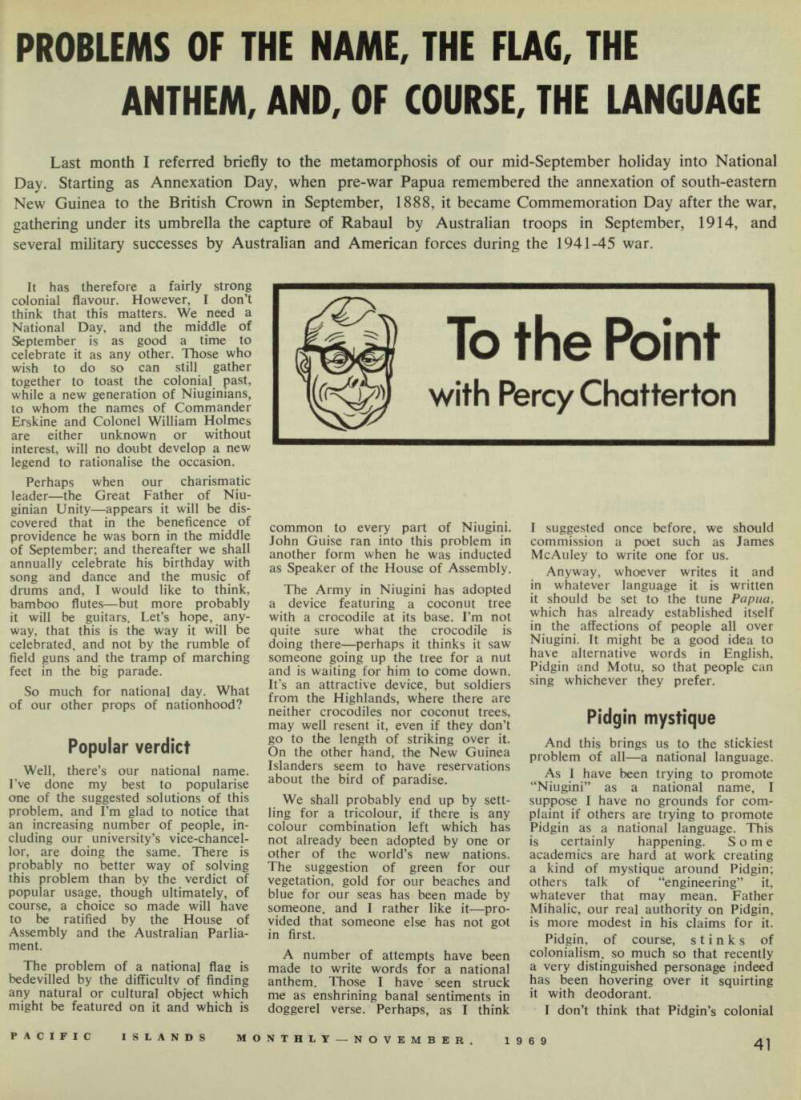
According to Percy Chatterton, it will be only the Befores and members of the con servative Papua Club who will remember this sort of thing on future National Days.
It was the occasion of the raising of the British flag, by Commodore Erskine, RN, at Hanuabada in 1884.
More speak English
people in Papua, excluding the Southern Highlands, who claimed to be able to speak Pidgin, 28,000 claimed to be able to speak Police Motu too. Not so oddly, the dif ference between these two figures is equal to the number of New Guineans living in Papua, if we once again exclude the Southern Highlands.
Taken district by district the census figures also show that in every district of Papua except the Southern Highlands there are more English speakers than Pidgin speak ers. Of course, we don’t know how much English the 29 per cent, who claim to be able to speak it really know; but then we don’t know how much Pidgin the 15 per cent, who claim to be able to speak Pidgin really know either. For what they are worth these figures suggest that if Papuans ever do abandon Police Motu as a lingua franca they will be more likely to abandon it for English than for Pidgin.
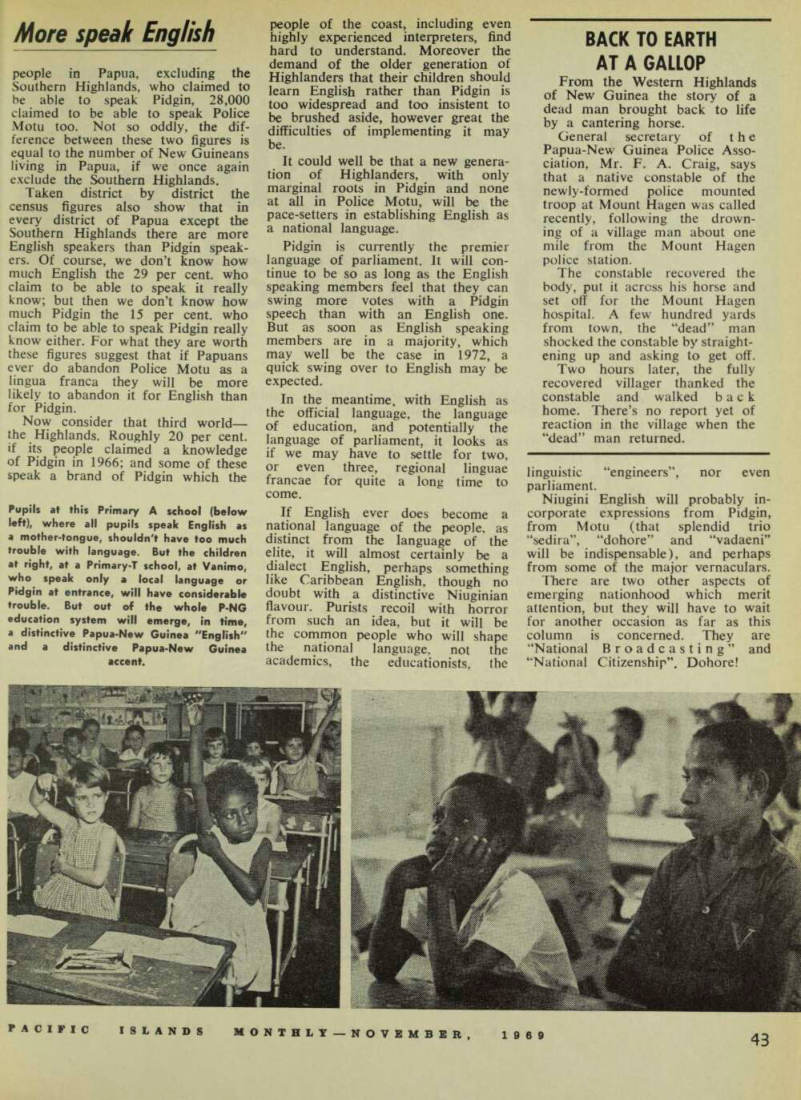
Now consider that third world— the Highlands. Roughly 20 per cent, if its people claimed a knowledge of Pidgin in 1966; and some of these speak a brand of Pidgin which the Pupils at this Primary A school (below left), where all pupils speak English as a mother-tongue, shouldn't have too much trouble with language. But the children at right, at a Primary-T school, at Vanimo, who speak only a local language or Pidgin at entrance, will have considerable trouble. But out of the whole P-NG education system will emerge, in time, a distinctive Papua-New Guinea "English" and a distinctive Papua-New Guinea accent.
people of the coast, including even highly experienced interpreters, find hard to understand. Moreover the demand of the older generation of Highlanders that their children should learn English rather than Pidgin is too widespread and too insistent to be brushed aside, however great the difficulties of implementing it may be.
It could well be that a new genera tion of Highlanders, with only marginal roots in Pidgin and none at all in Police Motu, will be the pace-setters in establishing English as a national language.
Pidgin is currently the premier language of parliament. It will con tinue to be so as long as the English speaking members feel that they can swing more votes with a Pidgin speech than with an English one.
But as soon as English speaking members are in a majority, which may well be the case in 1972, a quick swing over to English may be expected.
In the meantime, with English as the official language, the language of education, and potentially the language of parliament, it looks as if we may have to settle for two, or even three, regional linguae francae for quite a long time to come.
If English ever does become a national language of the people, as distinct from the language of the elite, it will almost certainly be a dialect English, perhaps something like Caribbean English, though no doubt with a distinctive Niuginian flavour. Purists recoil with horror from such an idea, but it will be the common people who will shape the national language. not the academics, the educationists, the
linguistic “engineers”, nor even parliament.
Niugini English will probably in corporate expressions from Pidgin, from Motu (that splendid trio “sedira”, “dohore” and “vadaeni” will be indispensable), and perhaps from some of the major vernaculars.
There are two other aspects of emerging nationhood which merit attention, but they will have to wait for another occasion as far as this column is concerned. They are “National Broadcasting” and “National Citizenship”. Dohore!