This Is How The South Pacitic
pp. 33-161 · Read in the full issue
Territories See Their Problems
JN addresses at the South Pacific Conference in Noumea, the territories of the South Pacific each outlined their special needs and problems. This is what they said:
Waiik And Futuna
U Xt T Y , ,
wr ir S ' j e ", a delegate for Walhs and Futuna, said the population of Walhs was 6,000, of Futuna Island 3,000. But 6,000 People had aiready emigrated to New Caledonia, and 2,000 to the New Hebrides. This emigration seemed to help the ter- , °{T , as “ a , no resources and .ould have problems of housing and . .. , ...
Ine i te [ n . y bttle problems were similiar to those of the “\x/‘ .
We would like a course on family education, she said.
Wallis and Futuna was also interested in research into filariasis, a disease which was widespread, “And we would like to have a specialist on water supplies. The creation of SPIFDA interests us greatly,” she said.
Fqqi/
Luuiv 'Jlmnlo
Mr. William Estall, from the Cook Islands pointed out that, although the provision of education was proceedi ng we ll, there were not enough job opportunities available. “The overwhelming proportion of our population is in the process of being educated,” he said, “and for what?
To climb coconut trees?” .
He continued: “We must absorb our young people into useful and
rewarding occupations, or export them, if we can find somewhere to export them to . . .”
There was a great need for tech nical expertise and for an environ ment conducive to effective trading between territories. The Cooks needed experts in the field of citrus and pine apple growing and there was also the problem of disease and weed control.
There was a reluctance among ter ritorial governments to trade with each other. The Cooks had a surplus of citrus: Oranges, mandarins, tangerines and grapefruit were rotting on the trees because the NZ market was saturated. But neighbouring territories were importing citrus and canned juice from distant parts of the world. Equally South Pacific ter ritories were producing commodities wanted by the Cooks, but the Cooks
were unable to get them “even on a barter basis”.
“It is rather ironical,” he said, “that the territories of the South Pacific which meet every year under the auspices of the SPC are unable to facilitate trade between themselves, thereby increasing the productive capacity of the land and the general wealth of the region.”
He concluded: “There is one other matter which I consider of great im portance to the morale of the ter ritories of the South Pacific. I am always happy to see indigenous people serving on the SPC staff. However I cannot help but feel that the time has come when more indigenous representatives of the territorial governments can now be appointed to the commission staff, not only at secretarial level, but also to senior key positions.
“Surely we now have the right people in our respective territories for possible secondment to the SPC?”
Tonga
The Premier of Tonga, Prince Tu’ipelehake, said Tonga considered family planning important—it had launched a family planning scheme.
But he stressed that a country’s most valuable asset was its people, and this especially so in the Pacific, He said: “Are we here to decrease our population or to help our people?
The everlasting resources in the Pacific are the people. It is not minerals, coconuts or bananas that count: what we must do is prepare our people to take their place in the world.”
New Hebrides
Mr. lolu Abbil, of the New Hebrides, said co-operative develop ment in the territory was progressing well—an overall turnover of SAU million but expert advice was urgently needed. Officers had to be trained to be better equipped to involve themselves in the co-operative field. Every year there was an in crease of about 30 societies and the work required was going beyond the territory’s capabilities—especially considering a shortage of staff.
He also said “I think we are all aware that some synthetic com modities have been discovered and are now competing with the coconut.
Therefore, a substitute should be found in order to maintain the level of our exports”. People were being encouraged to breed cattle for export, and short courses were needed to train breeders in modern agricultural methods and management.
He continued: “We are also developing tourism, which, of course, we regard as another source of income for the territory and its people, but do not want to keep on importing people to serve in the hotels; we would rather like to train our own people to become involved in hotel affairs, and also to teach the language understandable by the tourists.”
New Caledonia
The Reverend Father Jacob Kapea, delegate for New Caledonia, said his territory was something of an ex ception in the Pacific because of its important mineral resources “we are a bit spoilt—it is not our fault— do not take offence if we are nickel plated,” he commented.
The development of the mineral resources involved important econo mic and social evolution of the island, which was fast developing into an industrial society.
“We would like to ask the com mission to act practically and realis tically in the working out of its programme in order to adapt its activities to the different needs of the various territories,” he said.
French Polynesia
Mr. Jean Juventin, a delegate for French Polynesia, said his territory was currently living with all its economic and social problems, a very fragile equilibrium—a situation provoked by the installation of the CEP—the atomic centre in the ter ritory.
“We feel the inconvenience of this —the capital inflow is not going to be lasting. So many workers come
to find jobs among the ‘nickel-plated’
Caledonians,” he said.
“We would like to achieve a Poly nesian economy less showy, but more stable.
“At the moment we put all our hopes on tourism—hotels, airport, etc. But tourism is a ‘balloon of oxygen’ which could burst at any moment. So we should try to develop fishing, cattle raising and agri culture.”
Western Samoa
Mr. Pito Fa’alogo of Western Samoa, said the needs of his country were similar to those of its Pacific neighbours; they broadly lay in public health service improvement, and further development of an education structure which would serve both the needs of the country without forgetting the rest of the Pacific.
In Western Samoa the people had “long been aware of vulnerability in having only three eggs in our economic basket”. They had attempted to rectify this by encouraging diversification of export crops, at the same time providing incentives for the establishment of import sub stitution industries with a view to conserving much-needed foreign ex change.
In education, rural public health and economic policy, plans had been laid with the help of overseas agencies and governments. But finance to implement the plans was limited and “some of our aims may be frustrated”.
American Samoa
Mr. Palauni M. Tuiasosopo, of American Samoa, said although his territory’s fishing industry had made considerable advancement since its inception in 1953, the resource of raw material had become a major concern.
Two canneries had had to cut operations and experts believed that the drop in the catch might be directly related to the magnitude of the source. And with increasing demand and scientific means of harvesting, the resource might be tapped at its maximum level in the near future.
It was necessary to find alternative products in the fisheries industry to help maintain the territory’s most valuable item. The tuna industry was responsible for about 83 per cent, of the working population of Amer ican Samoa, while fish products amounted to about 99 per cent, of ex ports in the past few years. Govern ment revenue from fishing resulted
Prince Tu'ipelehake, Premier of Tonga, at the conference.
in almost 75 per cent, of total in come.
Continued Mr, Tuiasosopo; “I think that one of the natural resources of the Pacific Islands is the water that surrounds them. It might therefore be worthwhile for the SPC to consider directing some of its expert research and planning in this area, with definite programmes and goals. It may also act as co-ordinat ing agency for the collating of data and statistics that might be available from other sources.
“Related to this need is the neces sity to develop lobster fishing. It is a must for every tourist resort . . . and it is something close to the way of life of every Pacific Islander.
“The problem of water and air pollution will become more and more evident. Coming into Noumea from the airport I noticed that the nickel factory was pouring out smoke into the air and other wastes into the water of that beautiful bay. I could not help but feel that we must make some attempt to gear our long term programmes towards this impending need.”
Nauru
Buraro Detudamo, of Nauru, said his territory had “a lot of problems”.
Some were similar to those in other Pacific islands, others were just to ■he contrary; Nauru did not have a Potential commercial agriculture, because there was little land to mltivate; it did not grow citrus fruits )r vegetables, but there was a jotential market for them.
It stood to reason, he said, that rade activities should be promoted hroughout the Pacific. In this way, yhat was lacking in a territory might •e got from another, where there /as an abundance.
He continued: “Apart from many ther problems which we may have □ much in common, Nauru has one dnch is unique, and perhaps the irgest of its kind. Contrary to what ou may have read from the papers, re need money, lots and lots of it, nd very badly too.”
Nauru’s only natural resource, hosphate, had a limited life. “In 10 ;ars,” he added, “roughly 4/5 of fauru’s total area will be quite un habitable . . . and Nauruan popu tion is increasing now at a rate f 6 to 7 per cent, of the overall >oulation, which is approximately 500 people.
“The consequence of the mining ocess is that lands are left physic ly inaccessible because we are left ith the exposed, rueged pinnacles hich make very difficult access to ese worked out areas, let alone
rehabilitation which is necessary for residential, agricultural and com mercial developments.”
Mr. Detudamo continued; “This is where we need money—lots of it— we need help to rehabilitate these worked out areas ... we have been wondering if any of the participating territories and the metropolitan gov ernment have a spare hill or two to help us rehabilitate these worked out areas.
“Apart for careful conservation and investment of the money we receive from the phosphate royalties, we are also concerned with whether such investment and conservation of the money will perpetuate a stable economy after the phosphate is ex hausted. We are therefore investigat ing other ways and means of secur ing the future.”
Another big problem was water; there was no means of conserving it apart from the very small proportions received on roofs. The bulk of the water was imported from Australia.
British Solomons
Mn Gordon Siama, delegate from the British Solomon Islands Protec torate, said: “The protectorate has started on a programme of develop ment which is aimed at increasing the overall productivity. At present we rely upon a generous grant-in-aid from the United Kingdom to balance our budget.
“We must try above all to bring into production the land which at present is undeveloped. To do this we require capital and expert advice.
For a small territory such as we are, it is not economical for us to empJoy a full range of experts and therefore we look towards the South Pacific Commission to assist us in providing specialist services which are supported by experience drawn from many parts of this region.
“We would welcome increased op portunities for training which is aimed at meeting our rather special Pacific problems and for increased opportunities for the islanders to visit other territories in the region and study problems of common interest.
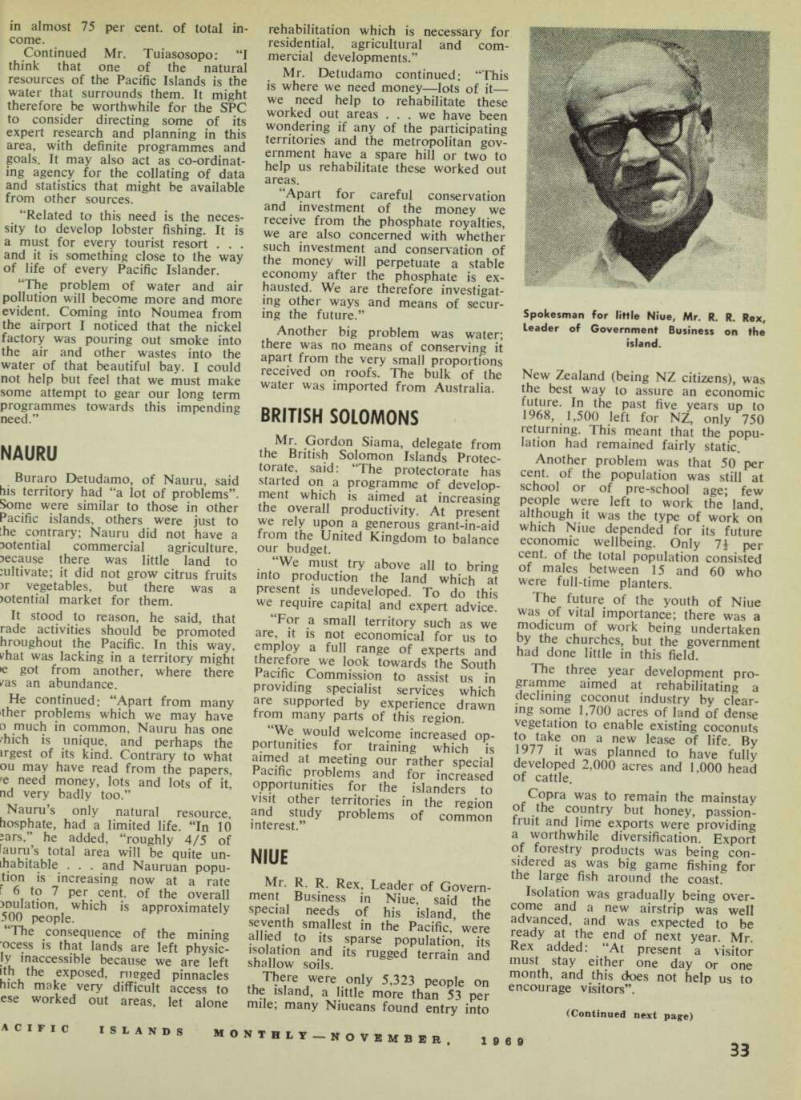
Mr. R. R. Rex, Leader of Govern ment Business in Niue, said the special needs of his island, the seventh smallest in the Pacific, were allied to its sparse population, its isolat ion and its rugged terrain and shallow soils, ™ e , re J were only 5 ’ 323 P eo Ple on the island, a little more than 53 per mile; many Niueans found entry into
New Zealand (being NZ citizens), was the best way to assure an economic future. In the past five years up to 1968, 1,500 left for NZ, only 750 returning. This meant that the popu lation had remained fairly static.
Another problem was that 50 per cent, of the population was still at school or of pre-school age; few people were left to work the land, although it was the type of work on which Niue depended for its future economic wellbeing. Only 7J per cent, of the total population consisted of males between 15 and 60 who were full-time planters.
The future of the youth of Niue was of vital importance; there was a modicum of work being undertaken by the churches, but the government had done little in this field.
The three year development pro gramme aimed at rehabilitating a declining coconut industry by clear ing some 1,700 acres of land of dense vegetation to enable existing coconuts to take on a new lease of life. By 1977 it was planned to have fully developed 2,000 acres and 1,000 head of cattle.
Copra was to remain the mainstay of the country but honey, passion rruit and lime exports were providing a worthwhile diversification. Export of forestry products was being con sidered as was big game fishing for the large fish around the coast.
Isolation was gradually being over come and a new airstrip was well advanced, and was expected to be ready at the end of next year. Mr.
Rex added: “At present a visitor must stay either one day or one month, and this does not help us to encourage visitors”.
(Continued next page)
Spokesman for little Niue, Mr. R. R. Rex, Leader of Government Business on the island.
Gilbert And Ellice Islands
Mr. Rabona Raieta of the Gilbert and Ellice Islands, emphasised the colony’s bleak economic future after phosphate resources run out in five or six years. He also brought up health and social problems.
“We have many problems in com mon with most Pacific territories— overpopulation, lack of land, lack of mineral resources, (we could do with some of the nickel here), poor communications, geographical isola tion and our soil in particular is nothing but coral sand which, apart from the hardy coconut trees, will grow practically nothing of com mercial value,” he said.
“In addition to all these, we in the GEIC have another problem, and this is that in a matter of five or six years half our present annual revenue will cease, due to the exhaustion of phosphates on one of our islands, namely Ocean Island, and 600-700 people will lose their jobs.
“This means that we in the GEIC merely in order to maintain our present standards have got to find over the next few years alternate sources of revenue to replace this big loss.
“We realise that we ourselves have to tackle this problem and we are keenly investigating all possible alternative sources of revenue. We will shortly decide on our develop ment plan in detail for the next three years and in principle for the next decade and its main facet is likely to be the concentration on agri cultural development with a high percentage of capital expenditure on
the copra industry which is our only other natural resource.”
On health, he said the GEIC would need more environmental sanitation to continue the campaign against TB and diarrhoea, it needed to curb the rising population by an extensive family planning campaign, and have water brought to villages, more health education and preventive medicine.
On social needs the problem was to cope with urbanisation, which had resulted in overcrowding, unemploy ment, drunkenness and delinquency.
Us Trust Territory
Mr, Polycarp Basilius, of the Trust Territory of the Pacific Islands, said most pressing problems in Micro nesia were health, social needs and economic policy.
Through Micronesia there was a desperate need for electric power, water and sewage disposal facilities; less than 10 per cent, of the popula tion had a protected water supply and there were no sanitary disposal systems on any island. Consequently a high number of people suffered from parasitic worms, gastro-enteric disease and amoebic dysentery.
The territory needed a programme for the better training and super vision of health aids, for the early detection of cancer in women and for prevention and control of epidemics. There still existed prob lems of maternal and child health, particularly in the outer islands. Of all live births last year, only 38 per cent, were attended by doctors.
No mental health specialist was available in Micronesia and the pollu tion of lagoons was becoming a serious problem.
In the field of economics, the op portunities for business and, com mercial and industrial development in the territory were “many, varied and substantial”. He said: “They exist in marine resources, agriculture, light industry, and in travel and tourism.
“But unless there are specialists to identify specific local economic development opportunities, locate those of our people who are potential, risk-taking businessmen, guide the organising of business establishment, provide direct assistance in obtaining financing, furnish advice on opera tions, help to develop and exploit markets, and monitor firms’ activities to assist them before they get into financial or operational difficulties, it will be impossible for the territory to talk about developing its economic potentials”.
It would be impossible to talk about economic development unless good
(Continued on p. 157)
Also at the conference, Mr. John Kite, Assistant Secretary to the Government of Tonga.
roads were built, electricity installed and better water systems and sewage systems found. Economic develop ment was non-existent in the territory at the moment. Efforts to date had been directed at controlling and regulating existing business.
He added: “Many of the people would like to reverse the economic trend presently existing in the ter ritory, whereby exports of goods and services are exceeded by our imports, A great need exists in the survey of private lands to determine the boundary lines between privately held lands and the public lands. There are said to be about 348,000 parcels of land privately held. But for all these holdings, not one certificate of title has been issued and not one lot has been officially registered.
“A survey by metes and bounds has been made of only 16 per cent, of these thousands of privately held lands, and a re-survey will probably be necessary once the rights and titles to these lands have been adjudicated. Micronesians consider their lands as their most important natural resource. However, the land is almost completely underdeveloped.”
He continued: “No significant agricultural development has taken place, and as a result, Micronesians in the district centres are being forced to import a larger percentage of their food supply. And I may say at this point that with bread fruit dishes in the districts, Micronesians are be coming dependent on rice and flour imported from outside the territory.
“If the base for the development of private enterprise is not strength ened, the goal of self-sufficiency will not be achieved and the grant of funds by the administering authority will be ‘self-perpetuating’ rather than
‘self-replacing’. The Congress of
Micronesia and the Micronesian people do not want to remain depen dent upon the metropolitan country forever.”
Papua-New Guinea
Mr. Gala Oala-Rarua, of Papua- New Guinea, said the rugged terrain of his territory made communication between the three ethnic groups— Melanesian, Micronesian and Papuan —very difficult, and had led to a wide diversity of some 700 different languages.
There was still some antipathy
between various groups but this was breaking down “as a need for co operation is realised”. The use of lingua franca such as Pidgin in P-NG and Motu in Papua was assisting to some degree a feeling of unity among the people.
The development of light industries was accelerating and it was expected that the Bougainville copper project would add greatly to the territory’s economy. Benefits were expected to include revenue to the Administra tion of between SA2OO and SA3OO million in the first 10 years, the pro vision of jobs for some 2,500 New
Guineans, a S 2 million training
programme and a township of 10,000 people.
Education was moving ahead, especially in the field of higher education, in fact there were 230 students from other South Pacific countries currently undergoing train ing in the territory.
A main problem was land tenure, he said. “A system of customary ownership of land means that an individual may retain ownership of trees he plants and has usage rights over the land. But the land’s owner ship remains vested in the community.
This leads to problems associated with the planting of permanent crops such as coconuts, coffee, rubber and tea”.
He continued: “Ideally the planter’s
requirements permit tenure of land for periods which may well exceed his lifetime in order that he may grow the crops and have negotiable title in order to obtain credit. Reluctance of owning groups to provide exclusive rights to individuals undoubtedly hampers the progress of agricultural development in the territory and creates difficulties with respect to the acquiring of land for urban development.”
Urbanisation was another big problem; though 85 per cent, of the people still lived in villages, the large towns were growing rapidly. Current estimates were that Port Moresby would grow from its present 50,000 to 120,000 in the next 10 years, bring ing problems of housing, finding work and social adjustment.
Lastly, P-NG had an immense task ahead in giving its people the means of taking over from expatriates at all levels; this involved obtaining the education, skills and experience, as well as the business and administra tion opportunities.
Fiji
Chief Minister of Fiji, Ratu Sir Kamisese Mara, said problems of his country were those of a multi-racial
society and the “need to find constitutional forms which will reflect the aspirations and rights of the various communities.
“This is not a problem where we look to the SPC for assistance but simply for recognition of the situation, and for sympathetic understanding,” he added.
A related problem was one of attracting foreign capital without which Fiji’s resources could not develop “at the pace, particularly industrially, which will create 8,000 job opportunities a year”.
Of the total fixed investment figure of $30.4 million in 1967, $21.4 million was in the private sector and of this, 70 per cent, could be attributed to foreign capital. About 50 per cent, of Fiji’s total fixed investment could be attributed to foreign capital; it was not therefore a question of whether Fiji needed foreign capital, but on what terms it came in.
With 300 scattered islands making up Fiji, communications were a top problem to be solved. Said Ratu
Mara: “It is of little use encouraging increased agricultural production if the farmers cannot reach the markets with their produce.
“Government cannot afford to perform this service, nor is it really jt s function to do so, though it can supplement services. * ~r . . *. . . . , , . “ .P ma tf ente rpnse is to do this job, then it must be profitable to “* .f* 1 © answer may be m goveminent studies of the patterns of trade, the provisions of good slip- P. ing f acill ties, jetties, reef passages, licensing of routes, or subsidies, or Pf, a j? s a combination of some or of experience of thes ® P r °blems would be useful and could lead on to the next step of regional communications and trade.
Development in Fiji, said Ratu Mara, had placed very little business and commerce in the hands of the Fijians. Co-operative societies were offering business training and opportunities, but more needed to be done in training individual Fiji busi-
nessmen and assisting them with capital and supervision in the early years.
He added: “With this is coupled the general position of the have-nots of Fiji, and there is a need for special measures to bring them up to the I© V ©l °f the haves. This will fil volve special measures in their favour understanding from those who not benefit from these, that they are ma( j e j n f av our of people who are behind in the economic race and that their objective is the elimination of occupation by race—in fact a move t o a more integrated society.”
Over half of Fiji’s population was un( j er 20, an asset in its fullest potential. “World experience shows that one 0 f t be reasons for unrest an( j discontent,” he added, “is the lack of opportunity to participate (not only among youth). But it is not enough simply to provide op portunity to participate; if they are to be satisfied they must participate in policy making and decision making.”