Mr. R's negative report gets
pp. 32-33 · Read in the full issue
a positive reaction
The South Pacific territories are not, by any means, in agree ment with each other that there are advantages to tourism. Even territories which are earning big incomes from tourism are far from happy about the impact of the trade on the Islands people.
This became obvious during a debate at the South Pacific Con ference, touched off by a report made for the South Pacific Commis sion by a United Nations adviser, Mr.
Pierre Rhonheimer.
Mr. Rhonheimer, UN Inter-regional Adviser on Tourism, made his survey —which was meant to be a pre liminary one—between June 16 and July 9 this year. In that time he visited Hawaii, Pago Pago, Apia, Suva, Noumea, Vila, Santo, Honiara and Port Moresby.
Big things had been hoped for in Mr. Rhonheimer’s report; it had been awaited by South Pacific tourist organisations in the expectation that it would give some lead on how tourism could be developed to every body’s advantage. He was expected to propose that a full survey be undertaken, and to lay down guide lines for it.
"Negative" report
But when the matter came up in the conference agenda, delegates found they didn’t have Mr. Rhon heimer’s report in front of them. It was still in New' York, and instead the UN had supplied the commission with a five paragraph precis.
The SPC’s economist, Mr. R. M.
Watson, said the UN had explained that the report was “somewhat negative in nature”, and therefore it had decided not to release it in full.
The precis said Mr. Rhonheimer had recommended against a UNDP (Special Fund) tourist survey jas being “premature”. He proposed that tourist experts advise individual ter ritories on what they should do.
The territories could meanwhile establish one tourist organisation for the area, in which each territory would be represented by its Director of Tourism. Its task would be to standardise procedures, consider transport matters, such as frequency of carriers, and engage in joint market promotion.
Mr. Watson said that the UN had
recommended in forwarding the precis that the commission consider arranging another survey by an out side consultant. Mr. Watson himself felt this wasn’t a bad idea, despite “the negative nature” of the survey that had just been completed.
In the next hour of debate, when the conference got its teeth into the whole matter of tourism, it grew obvious that Mr. Rhonheimer’s survey had not been negative so much as extremely positive.
From what was said by some delegates whose territories had been visited by the UN expert, Mr.
Rhonheimer wasn’t very impressed with either the standards or the potential of South Pacific tourism, and had no doubt said so in his report.
An attack on him was led by the Senior US Commissioner, Mr. Carlton Skinner, who has interests in the airline business. Mr. Rhonheimer’s trip wasn’t necessary, he said.
“It was an inadequate project, poorly prepared by the wrong agency of the United Nations. The man who came here was from Europe and he had no sympathy nor understanding of Pacific problems.
Doubt and disrespect
“He left a trail of doubt and dis respect everywhere he went, and the best thing we can do with this report is wrap it up and put it away.”
Mr. Skinner said the Pacific Area Travel Association would never do what Mr. Rhonheimer had done— that is, go into Western Samoa and tell them they had to reduce the number of church services on Sundays, or tell the hotel people in the Solomons that they must change their men waiters for women waiters.
“I think we should write to the UN and say, ‘We have received your report’. We should not even say thank you for it!” Mr. Skinner added.
Now that the tourist expert had been publicly labelled as un sympathetic to the problems of the South Pacific, delegates got up and talked of the dangers of tourism to the South Seas. The Islands, they said,
would lose their soul once the view point that Mr. Rhonheimer ap parently represented was allowed to get control.
Fiji’s Chief Minister, Ratu Sir Kamisese Mara, was the most stinging in his comments. Mr. Rhonheimer’s conclusions were actually of help to the South Seas, he said, because they were a warning.
“In Fiji we learnt from him what the tourist plant operators expect from tourism,” he said. “They want to squeeze as much money as they can from their investment and they could not care less what happens to the culture and the customs of the people.
“If we think that PATA will be able to produce a better survey then with great respect I would point out that they are the same group of people—owners of tourist plant who have the intention of making as much money as they can from it and who won’t pay too much attention to the customs and the traditions of the country, “I think this is what concerns most of the territories. We in Fiji are beginning to learn the cost of tourism, not only in money but in many other ways, so I would not dismiss this survey out of hand.”
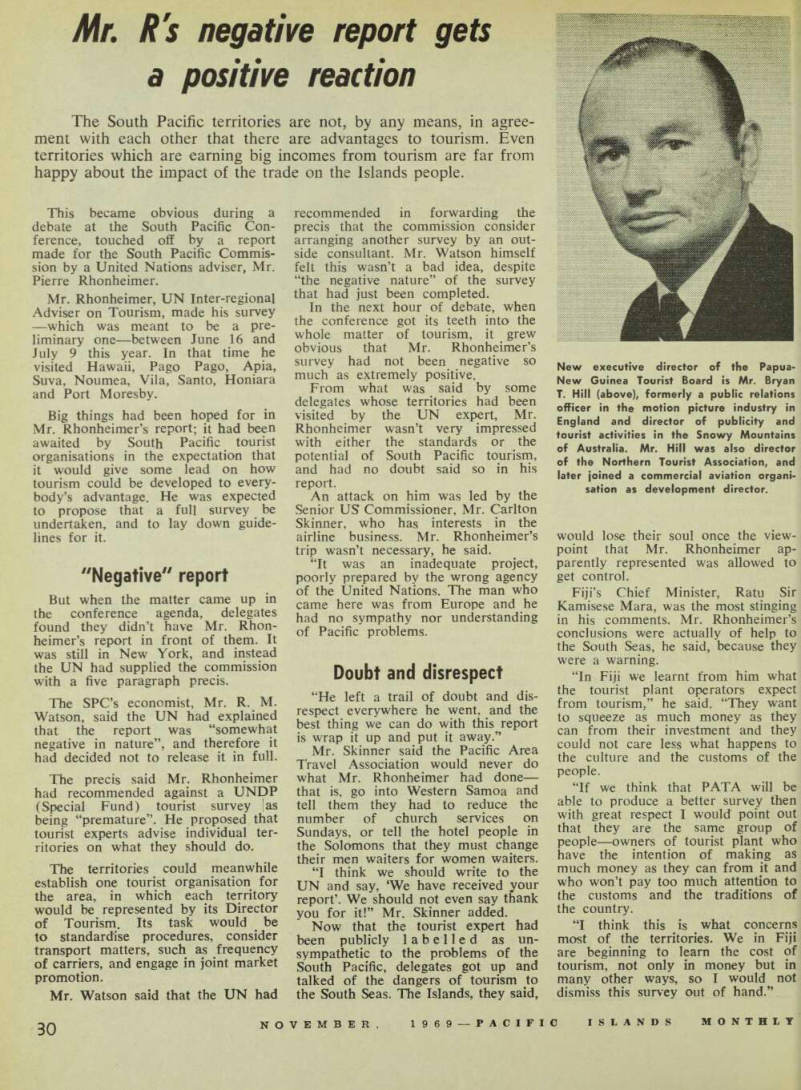
New executive director of the Papua- New Guinea Tourist Board is Mr. Bryan T. Hill (above), formerly a public relations officer in the motion picture industry in England and director of publicity and tourist activities in the Snowy Mountains of Australia. Mr. Hill was also director of the Northern Tourist Association, and later joined a commercial aviation organi sation as development director.
Western Samoa took the same view.
“Everything has a price,” said Pito Fa’alogo. “It comes down to a question of cost not only in money but in intangible effects . . . the report of the UN adviser confirms what we have been thinking all along.
“We hope we have no tourists in Western Samoa, but only visitors who come to see us and take us how we are. If we are hesitant in ac cepting these visitors, it is only because we have a fair idea of what the total cost will be. I have an idea that all the territories think along these lines.”
French Polynesia did not object to tourism, but it said two points worried the territory about tourism.
One was the need for a more liberal attitude to the investment of outside capital, which was welcome; the other was that tourist agencies were now selling package tours for which all the money was paid in the country of origin—hotels, transport, entertain ment. This had no advantage to the mass of local people.
Carlton Skinner said he wanted to make it clear he was not against another survey. He merely suggested it should have careful terms of reference so that all the viewpoints of the territories could be looked at.
The conference decided to recom mend that the commission apply for a UNDP (Special Fund) tourism survey of the region, to be undertaken in 1970, and that the SPC contribute $ A 1,000 towards expenses.