New Boss
pp. 29-30 · Read in the full issue
Of The South
Pacific
Commission
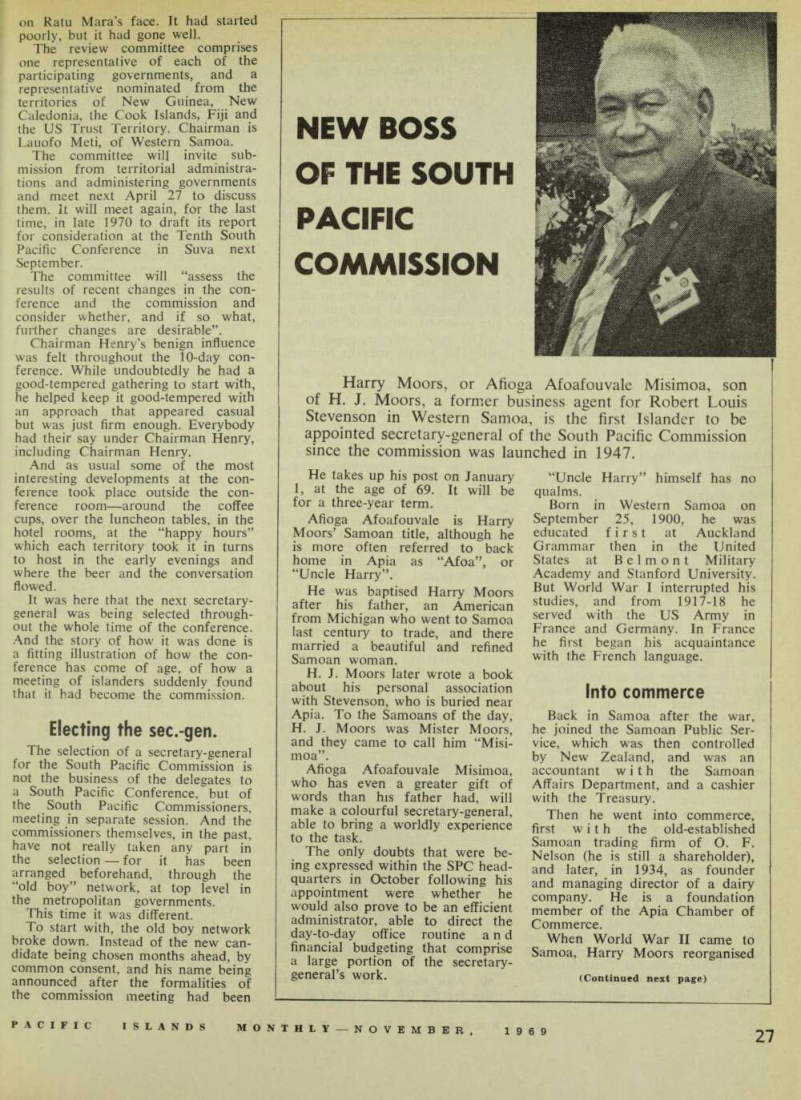
Harry Moors, or Afioga Afoafouvale Misimoa, son of H. J. Moors, a former business agent for Robert Louis Stevenson in Western Samoa, is the first Islander to be appointed secretary-general of the South Pacific Commission since the commission was launched in 1947.
He takes up his post on January 1, at the age of 69. It will be for a three-year term.
Afioga Afoafouvale is Harry Moors’ Samoan title, although he is more often referred to back home in Apia as “Afoa”, or “Uncle Harry”.
He was baptised Harry Moors after his father, an American from Michigan who went to Samoa last century to trade, and there married a beautiful and refined Samoan woman.
H, J. Moors later wrote a book about his personal association with Stevenson, who is buried near Apia. To the Samoans of the day, H. J. Moors was Mister Moors, and they came to call him “Misi moa”.
Afioga Afoafouvale Misimoa, who has even a greater gift of words than his father had, will make a colourful secretary-general, able to bring a worldly experience to the task.
The only doubts that were be ing expressed within the SPC head quarters in October following his appointment were whether he would also prove to be an efficient administrator, able to direct the day-to-day office routine and financial budgeting that comprise a large portion of the secretary general’s work.
“Uncle Harry” himself has no qualms.
Born in Western Samoa on September 25, 1900, he was educated first at Auckland Grammar then in the United States at Belmont Military Academy and Stanford University.
But World War I interrupted his studies, and from 1917-18 he served with the US Army in France and Germany. In France he first began his acquaintance with the French language.
Into commerce
Back in Samoa after the war, he joined the Samoan Public Ser vice, which was then controlled by New Zealand, and was an accountant with the Samoan Affairs Department, and a cashier with the Treasury.
Then he went into commerce, first with the old-established Samoan trading firm of O. F.
Nelson (he is still a shareholder), and later, in 1934, as founder and managing director of a dairy company. He is a foundation member of the Apia Chamber of Commerce.
When World War II came to Samoa, Harry Moors reorganised (Continued next page)
the Samoa Defence Force, com manded the first contingent of West Samoan troops to join the New Zealand Maori Battalion and was seconded to the US Marine Corps as instructor at the Sata puala base.
As Samoa began to move to wards independence he took an interest in politics. He was a European member of the Legis lative Assembly from 1951-57 and Associate Member for Works. He was a Samoan member of the Assembly, under his Samoan title, from 1961-66.
His business interests today in clude that of owner-manager of Apia’s popular Nineteenth Hole Club. He’s a keen golfer, and
even today spends Tuesday after noons coaching newcomers to the game. He built Apia’s first golf course in 1923.
Harry Moors has always been active in civic and sporting affairs in Samoa. He introduced and organised Rugby football from NZ, organised regular boxing, is a foundation member of the Re turned Servicemen’s Association.
He’s still a keen swimmer, and most mornings during the Noumea conference he got up for a swim at 5.30 before the meeting started.
He admits to missing a game of golf in Noumea, for there is no course there, but he hopes that New Caledonia will soon go ahead with its plans to build one on a site reserved outside of Noumea.
The new secretary-general will bring his young wife to Noumea,
in January, and their two children, Johnnie, 12, and Stella, 7. He says he’s looking forward to having them all learn French. He will leave a grown-up family back in Samoa.
Harry Moors is a strong be liever in co-operation Samoa fashion—that is, gentle persuasion through discussion.
He thinks that the SPC has it self come to understand this system in recent years, in the way that it has listened to the voice of the territories at each South Pacific Conference, and debated, discussed and moved accordingly.
He’s looking forward to his new job, and believes his age will be an asset, not a handicap. “In Polynesia, a man with some years on him earns more respect, not less,” he says.