Togetherness comes to the SPC
pp. 27-31 · Read in the full issue
By STUART INDER. who was in Noumea for the Ninth South Pacific Conference
An odd thing happened in Noumea in October. A large roomful of Islanders from 16 Pacific territories sat around a conference table for 10 days at the invitation of the South Pacific Commis sion, and when they finally got up to go home it suddenly occurred to everyone that they had be come the commision.
That, in a sentence, is the story of what happened at the Ninth South Pacific Conference.
The islands of the South Pacific have won the fight that Ratu K. K. T.
Mara of Fiji launched on their behalf at the Sixth South Pacific Con ference in New Guinea in 1965 when he bitterly attacked the “exclusive club” that was then the commission.
And it’s been a bloodless fight, with the combatants walking off with their arms about each other.
As a result of the final consolida tion work put in by the territories at Noumea in October, the territories themselves now: • Contribute to the SPC budget.
• Discuss fully among themselves the way this money, and the larger sums put in by the seven member governments, will be spent. • Can virtually guarantee that their majority decisions, on money or any other matter, will be approved by the SPC. • Have established a review com mittee on which they are all repre sented, charged with assessing results of the recent changes in the con ference and the commission, and able to suggest more changes.
Only one of the objectives sought in the Mara Revolt has not even tuated—that of having delegates to the conference elected by their
legislatures. But, as virtually all the representatives at this Noumea con ference were in fact elected mem bers of their legislatures, who could and did speak with authority, this little matter was not pursued, Ratu Mara, Fiji’s Chief Minister, who since last year has received a knighthood and become Ratu Sir Kamisese Mara, did however pursue other matters with his usual rare combination of energy, intelligence, stubborness, dedication, wit and moodiness.
One or several of these traits led him into supporting early in the con ference a move to save the SPC’s health educator from losing her job.
The secretary-general had decided she was to be replaced by somebody with different qualifications.
The storm that followed, in which just about every delegate became embroiled, revolved around the prin ciple of whether the secretary-general or the conference controlled the SPC staff.
Wanted to go home
Sir Gawain Bell left no doubt in the conference’s mind that as sec retary-general he controlled the staff and that he was responsible to the commissioners. He implied that if every staff appointment, from the gardener up, had to run the gauntlet of conference approval, the whole secretariat might as well return from
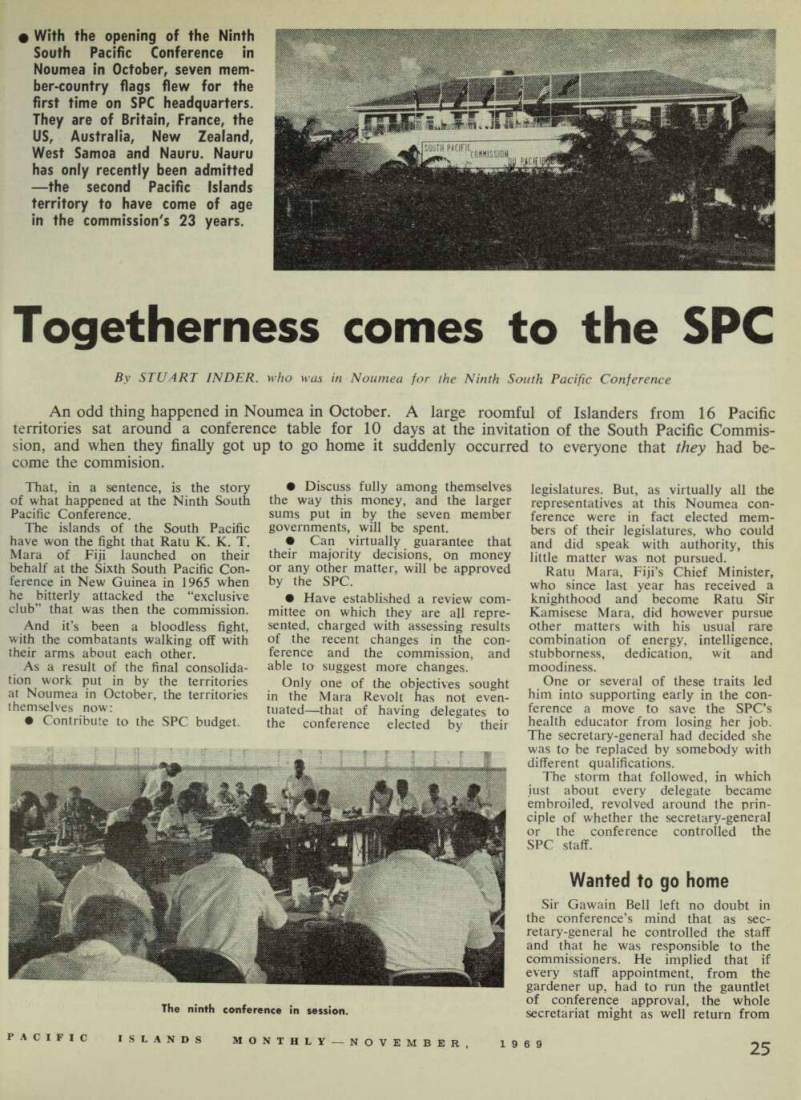
• With the opening of the Ninth South Pacific Conference in Noumea in October, seven mem ber-country flags flew for the first time on SPC headquarters.
They are of Britain, France, the US, Australia, New Zealand, West Samoa and Nauru. Nauru has only recently been admitted —the second Pacific Islands territory to have come of age in the commission's 23 years.
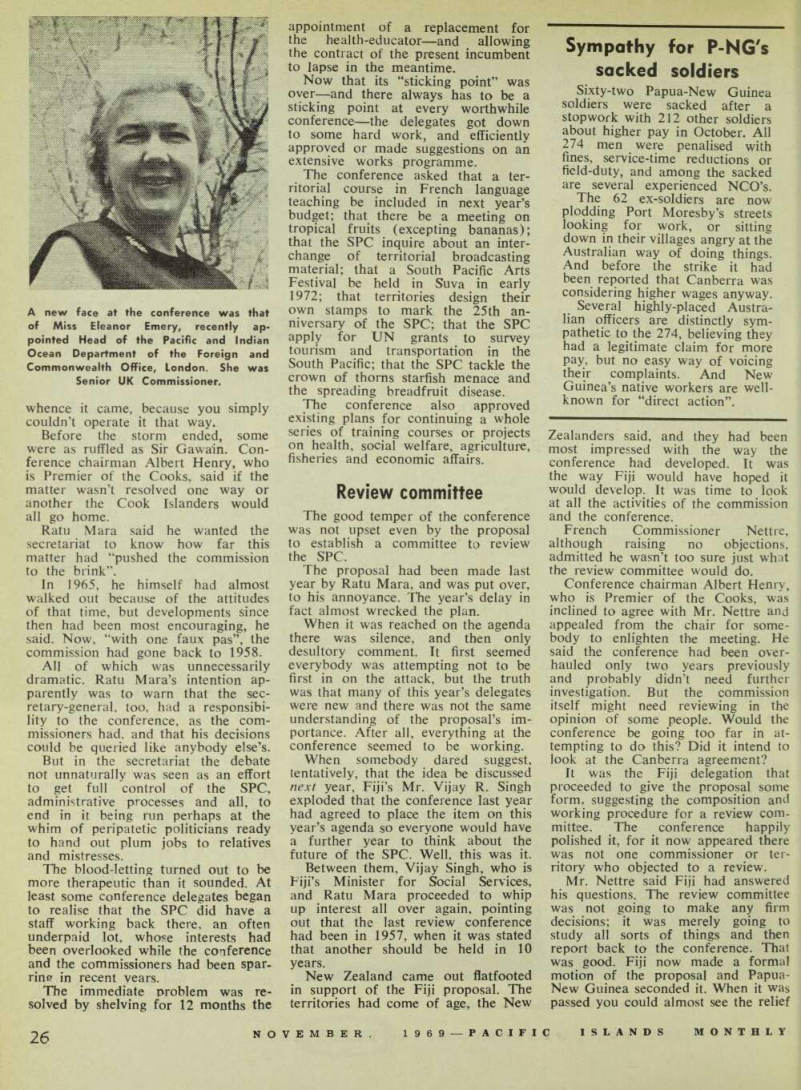
The ninth conference in session.
whence it came, because you simply couldn’t operate it that way.
Before the storm ended, some were as ruffled as Sir Gawain. Con ference chairman Albert Henry, who is Premier of the Cooks, said if the matter wasn’t resolved one way or another the Cook Islanders would all go home.
Ratu Mara said he wanted the secretariat to know how far this matter had “pushed the commission to the brink”.
In 1965, he himself had almost walked out because of the attitudes of that time, but developments since then had been most encouraging, he said. Now, “with one faux pas”, the commission had gone back to 1958.
All of which was unnecessarily dramatic. Ratu Mara’s intention ap parently was to warn that the sec retary-general, too. had a responsibi lity to the conference, as the com missioners had. and that his decisions could be queried like anybody else’s.
But in the secretariat the debate not unnaturally was seen as an effort to get full control of the SPC, administrative processes and all, to end in it being run perhaps at the whim of peripatetic politicians ready to hand out plum jobs to relatives and mistresses.
The blood-letting turned out to be more therapeutic than it sounded. At least some conference delegates began to realise that the SPC did have a staff working back there, an often underpaid lot, whose interests had been overlooked while the conference and the commissioners had been spar ring in recent years.
The immediate problem was re solved by shelving for 12 months the
appointment of a replacement for the health-educator—and allowing the contract of the present incumbent to lapse in the meantime.
Now that its “sticking point” was over—and there always has to be a sticking point at every worthwhile conference—the delegates got down to some hard work, and efficiently approved or made suggestions on an extensive works programme.
The conference asked that a ter ritorial course in French language teaching be included in next year’s budget; that there be a meeting on tropical fruits (excepting bananas); that the SPC inquire about an inter change of territorial broadcasting material; that a South Pacific Arts Festival be held in Suva in early 1972; that territories design their own stamps to mark the 25th an niversary of the SPC; that the SPC apply for UN grants to survey tourism and transportation in the South Pacific; that the SPC tackle the crown of thorns starfish menace and the spreading breadfruit disease.
The conference also approved existing plans for continuing a whole series of training courses or projects on health, social welfare, agriculture, fisheries and economic affairs.
Review committee
The good temper of the conference was not upset even by the proposal to establish a committee to review the SPC.
The proposal had been made last year by Ratu Mara, and was put over, to his annoyance. The year’s delay in fact almost wrecked the plan.
When it was reached on the agenda there was silence, and then only desultory comment. It first seemed everybody was attempting not to be first in on the attack, but the truth was that many of this year’s delegates were new and there was not the same understanding of the proposal’s im portance. After all, everything at the conference seemed to be working.
When somebody dared suggest, tentatively, that the idea be discussed next year, Fiji’s Mr. Vijay R. Singh exploded that the conference last year had agreed to place the item on this year’s agenda so everyone would have a further year to think about the future of the SPC. Well, this was it.
Between them, Vijay Singh, who is Fiji’s Minister for Social Services, and Ratu Mara proceeded to whip up interest all over again, pointing out that the last review conference had been in 1957, when it was stated that another should be held in 10 years.
New Zealand came out flatfooted in support of the Fiji proposal. The territories had come of age, the New
Zealanders said, and they had been most impressed with the way the conference had developed. It was the way Fiji would have hoped it would develop. It was time to look at all the activities of the commission and the conference.
French Commissioner Nettie, although raising no objections, admitted he wasn’t too sure just what the review committee would do.
Conference chairman Albert Henry, who is Premier of the Cooks, was inclined to agree with Mr. Nettre and appealed from the chair for some body to enlighten the meeting. He said the conference had been over hauled only two years previously and probably didn’t need further investigation. But the commission itself might need reviewing in the opinion of some people. Would the conference be going too far in at tempting to do this? Did it intend to look at the Canberra agreement?
It was the Fiji delegation that proceeded to give the proposal some form, suggesting the composition and working procedure for a review com mittee, The conference happily polished it, for it now appeared there was not one commissioner or ter ritory who objected to a review.
Mr. Nettre said Fiji had answered his questions. The review committee was not going to make any firm decisions; it was merely going to study all sorts of things and then report back to the conference. That was good. Fiji now made a formal motion of the proposal and Papua- New Guinea seconded it. When it was passed you could almost see the relief
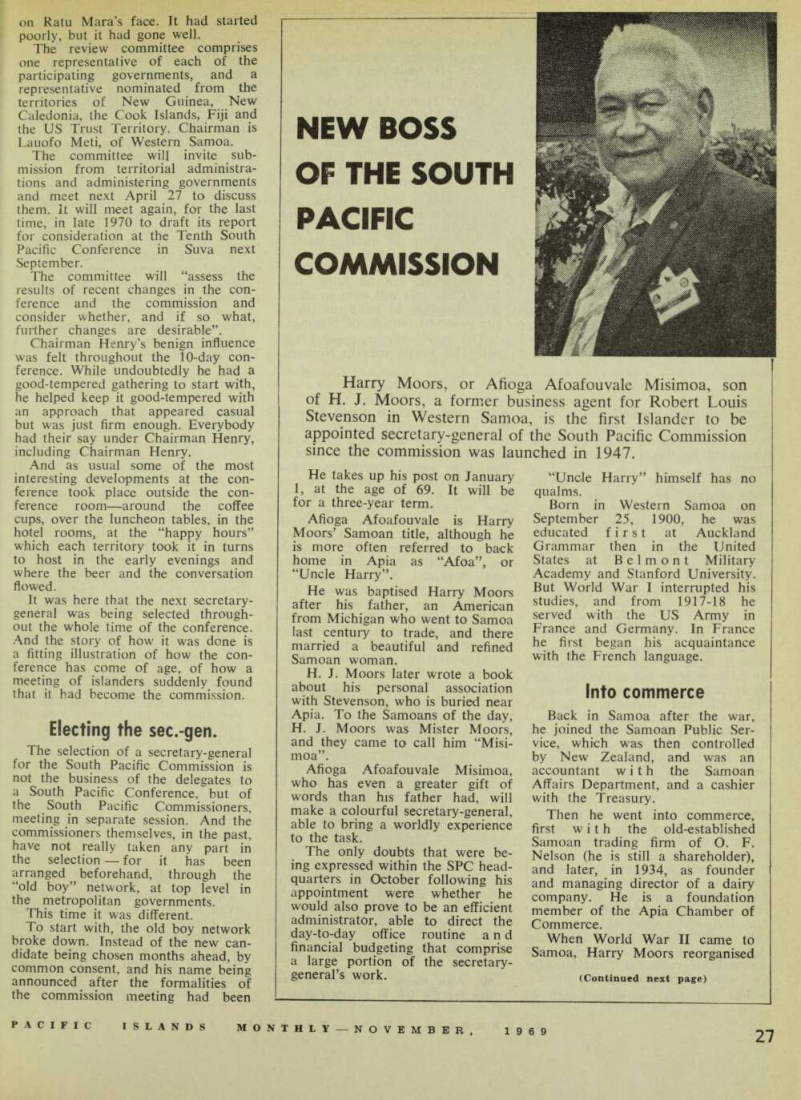
A new face at the conference was that of Miss Eleanor Emery, recently ap pointed Head of the Pacific and Indian Ocean Department of the Foreign and Commonwealth Office, London. She was Senior UK Commissioner.
on Ratu Mara’s face. It had started poorly, but it had gone well.
The review committee comprises one representative of each of the participating governments, and a representative nominated from the territories of New Guinea, New Caledonia, the Cook Islands, Fiji and the US Trust Territory, Chairman is Lauofo Meti, of Western Samoa.
The committee will invite sub mission from territorial administra tions and administering governments and meet next April 27 to discuss them. It will meet again, for the last time, in late 1970 to draft its report for consideration at the Tenth South Pacific Conference in Suva next September.
The committee will “assess the results of recent changes in the con ference and the commission and consider whether, and if so what, further changes are desirable”.
Chairman Henry’s benign influence was felt throughout the 10-day con ference. While undoubtedly he had a good-tempered gathering to start with, he helped keep it good-tempered with an approach that appeared casual but was just firm enough. Everybody had their say under Chairman Henry, including Chairman Henry.
And as usual some of the most interesting developments at the con ference took place outside the con ference room—around the coffee cups, over the luncheon tables, in the hotel rooms, at the “happy hours” which each territory took it in turns to host in the early evenings and where the beer and the conversation flowed.
It was here that the next secretary general was being selected through out the whole time of the conference.
And the story of how it was done is a fitting illustration of how the con ference has come of age, of how a meeting of islanders suddenly found that it had become the commission.
Electing the sec.-gen.
The selection of a secretary-general for the South Pacific Commission is not the business of the delegates to a South Pacific Conference, but of the South Pacific Commissioners, meeting in separate session. And the commissioners themselves, in the past, have not really taken any part in the selection for it has been arranged beforehand, through the “old boy” network, at top level in the metropolitan governments.
This time it was different.
To start with, the old boy network broke down. Instead of the new can didate being chosen months ahead, by common consent, and his name being announced after the formalities of the commission meeting had been
completed, the commissioners this time had the names of three dif ferent candidates in front of them, nominated by three different govern ments Worse, two of the candidates were embarrassingly on the scene.
Worse still, every delegate to the conference knew who the candidates were, and for the whole period of the conference there was active, almost joyous lobbying by the terri tories, intent on helping the com missioners make the right choice.
Goodwill
At other conferences I have at tended, most of the commissioners would have gone red in the face with ire at being put into such a situation by conference delegates. It was symptomatic of the goodwill of this session that the commissioners took it all in good heart and admitted in private conversation that they were as perplexed about what to do for the best as everybody else.
Nauru went further. It didn’t know enough about any of the three candidates to be able to give a worth while vote, so it planned to abstain from voting at all.
A change of plans by Manuel Guerrero, a former Governor of Guam, had brought this whole situa tion about. Earlier this year Guerrero had lost his governorship as a re sult of the change in the American Administration, and America put forward his name as candidate for the secretary-general’s post.
The old boy network began to
work, and Guerrero could have had the job. Then he decided to run for Governor of Guam when that post becomes an elected one for the first time next November, and he withdrew from the SPC stakes.
So on to the course came three late starters: Afioga Afoafouvale Misimoa, 69, of Western Samoa, nominated by Western Samoa; Aus tralia’s Alan Harris, 52, nominated by Australia; and the Earl of Oxford and Asquith, 53, nominated by Britain.
Misimoa, or Harry Moors (see p. 27 for details), is Western Samoa’s senior commissioner on the SPC, and was attending the conference.
Alan Harris, who from 1956 to
1969, was First Secretary of the Com monwealth Treasury in Canberra, and from February has been the SPC’s Programme Director (Economic), was also at the conference.
The Earl, Julian Edward Asquith, is an experienced British Colonial administrator, his last post, 1962-67. being the Governorship of the Seychelles. He was still in Eng land—fortunately, because in his absence he was referred to unkindly and without any justification as “the Duke of Plaza Toro” and given no hope at all of getting any vote but Britain’s.
Early opinion among the delegates was that Britain was mad for pro posing another ex-Governor with a handle to his name, directly after having had ex-Governor Sir Gawain Bell in the job. And that Australia was mad for proposing a new SPC staff member whose sudden elevation might cause ructions among more senior people within the commission.
And that Western Samoa was mad for suggesting anybody aged 69, and who had not been tested in this kind of responsibility..
Yet the betting in the conference appeared to favour Harry Moors, 69 or not.
His best bet
As one influential delegate said: “You can only bet on the horses that are running, and he’s my bet!”
Influential or not, the conference delegates were not the commissioners.
But they set about the task of elect ing the right man as if they were.
The delegates soon decided among
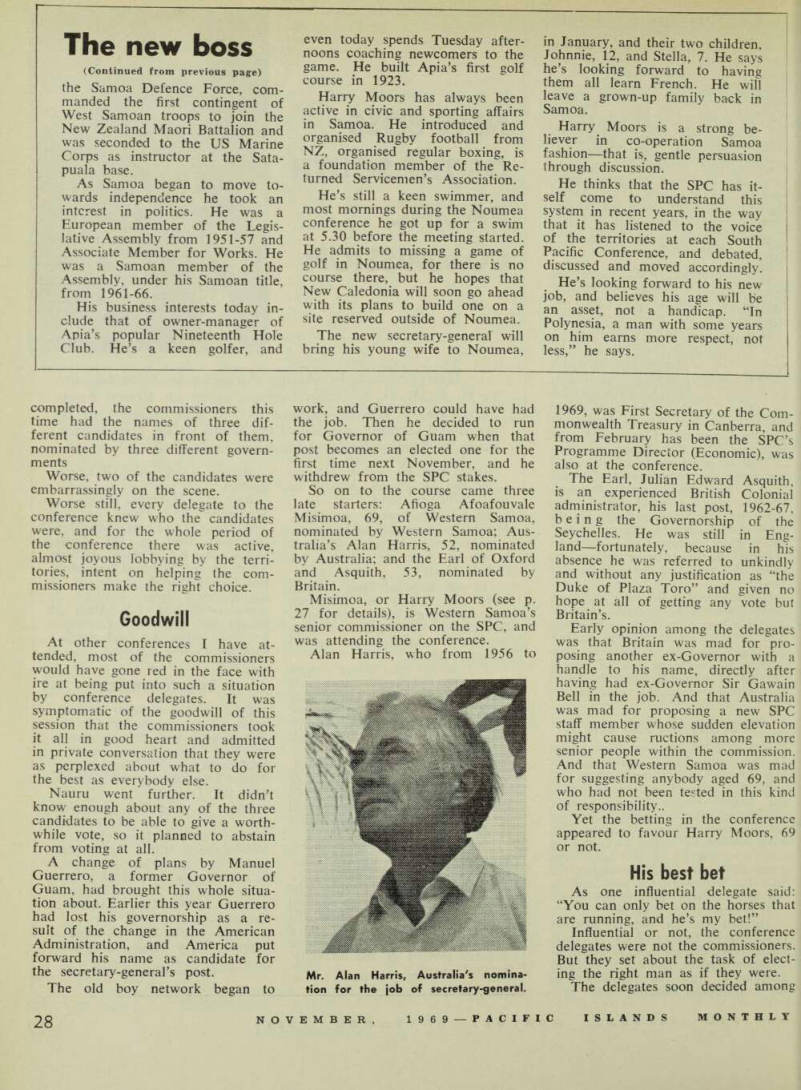
Mr. Alan Harris, Australia's nomina tion for the job of secretary-general.
themselves that Australia could ex pect the support of France for its man (this assumption being made on the basis that the French are not supposed to favour Islanders for positions of responsibility). Also that Western Samoa could naturally expect the support of New Zealand, and also the US (on the assumption that Americans always go out of their way to favour Islanders).
With Nauru abstaining, this line up would give a vote of nine each for Messrs Harris and Moors on the first count, and four for the Duke of Plaza Toro. Britain presumably would then move to break the dead lock by giving its vote to either Aus tralia or Samoa. [Under the SPC agreement, Aus tralia is entitled to 5 votes, France, the UK, the US and NZ 4 each, W.
Samoa and Nauru 1 each].
At tea-breaks and at lunch the pos sible variations to the voting were discussed at length. As new intel ligence was collected it was passed down the line for its significance to be analysed.
Somebody had heard that the French were planning to support Britain. (True or false?) That the US had specific last-minute orders from Washington to support Australia. (Was US Commissioner Skinner play ing a double-game?). That the UK wasn’t really fielding a rank outsider, but a dark horse who would romp home because the rest of the field was badly ridden.
As each apparent crisis appeared, the various lobbies got to work on the opposition.
The Fiji and Cook Islands delega-
tions were the strongest and possibly the most effective lobbyists for Harry Moors, but the Cook Islanders almost outsmarted themselves in his cause on the very last day of the confer ence. Pushed by Fiji, they were anxious to make a decisive, last minute bid.
They submitted a motion which asked the full conference to (a) ex press its warm appreciation to Sir Gawain Bell for his devoted services as secretary-general, (b) extend its best wishes to Sir Gawain and Lady Bell for the future, and . . . wait for it . . . to (c) “express the view that in accordance with the provisions of paragraph 42 of article XIII of the Canberra Agreement, and the fact there is now available a suitable can didate for the post of secretary-gen eral who is a local inhabitant of the territories within the scope of the commission, that the commission should give full and careful consider ation to the appointment of a local inhabitant to the post of secretary general.”
This section of the Canberra Agree ment of February, 1947 (which estab lished the commission), says that in appointing the secretary-general and the staff of the secretariat, primary consideration should be given tech nical qualifications and personal in tegrity of candidates, but, to “the fullest extent consistent with this con sideration”, the staff should be appointed from among local inhabit ants of the territories.
It was another Islander, Gala Oala-Rarua, of New Guinea, who promptly got up and protested that the Cook’s double-ended resolution was a bit under the belt. Tongan Premier, Prince Tuipelehake supported Gala, in one of his rare addresses.
At one stage in the lively debate that followed it looked as though the
Cooks would lose the whole of section (c) from their cheeky motion. But— surprisingly—it was French Com missioner Nettre who saved it. He said he couldn’t see why the confer ence shouldn’t point out that para graph 42 did exist, but then leave it at that.
So in the end the conference agreed to “draw the attention of commissioners to paragraph 42, article XIII of the Canberra agreement con cerning the selection of a secretary general and other senior officers in the secretariat.” Not that it mattered at this stage what the wording was, because the Cook Islanders had got their message across.
How they voted
The voting on the new secretary general came when nearly all the delegates had gone home, and the commissioners did indeed give the appointment full and careful consid eration.
The voting on the first round fol lowed exactly the line-up that had been predicted around the tea-cups— -9 votes for Harris (Australia and France), 4 for the Earl of Oxford (UK), 9 for Moors (NZ, US, West Samoa).
In the second round, the UK with drew its nomination and gave its votes to Moors, the result being Harris 9, Moors 13.
With the position now clear, there was nothing for Australia to do but to withdraw her nomination.
In the third round, Moors now got the Australian and French votes, and at this stage, Nauru’s too. Vot ing: 23 to nil.
And that’s how Harry Moors was elected the first Islander secretary general of the South Pacific Com mission—unanimously.
Mr. Albert Henry, Premier of the Cooks and chairman of the conference, discusses a point with Mr.
Oala Oala-Rarua, who is Assistant Minis terial Member for the Treasury in P-NG, and led the P-NG
delegation.