The Practical Planter
pp. 147-153 · Read in the full issue


Christmas Island is an atoll situated at two degrees north and 157 degrees west in the Central Pacific. It experiences very uniform temperatures throughout the year with a daily range of 72 to 90 degrees F.
The average rainfall of only 32 inches is irregular and occasionally there are prolonged droughts during which less than 10 inches falls in a 12-month period. Currently, there is a big replanting scheme for the island.
Mr. AA. A. Foale, a coconut agronomist in the joint coconut research scheme, Yandina, BSIP, examines the potential and discusses the special problems of Christmas Is. in this article. Text and pictures from the South Pacific Commission.
Planting Coconuts On
Christmas Island
The soils of Christmas Island differ from the average atoll soils because, evidently, two stages oc curred in the raising of this atoll above the sea. Around the outer edge are white calcareous sands with the fresh-water lens at li to three metres. This soil type has a dark surface layer 15 to 25 cm thick, due to the addition of organic matter, and below that the sand is almost pure-white. The water lens is of low salinity, generally less than 200 parts per million chloride.
On the lagoon side of this soil zone are shallow lagoon mud soils with .5 metre to about one metre of fine calcareous sand particles firmly compacted above a water lens of salinity in the range of 1,000 to 3,000 ppm chloride. This soil type was apparently formed in a shallow lagoon and has been raised above sea level more recently than the deep sands. There are variations in the lagoon mud soils, with layers of hardpan and higher salinities in the water-table, but these other types are of no interest for coconut growing.
Several thousand acres of coconuts were established on lagoon mud soils between 1912 and 1935 by Central Pacific Plantations Ltd., directed by Father Emile Rougier. Planting might also have been done on other soils, but if so, the palms did not survive.
Close control
On the lagoon muds the salinity of the water exerts close control over productivity of the coconuts. For example, with a water-table contain ing 1,000 ppm chloride the palms are highly productive, while at 3,000 ppm there are very few nuts. Salinity varies with rainfall, and several inches of rain can greatly reduce the salinity of the top few inches of the water-table and stimulate increased growth in the coconuts. Gradually
the salinity rises again as water is lost through transpiration by the coconuts, and by evaporation through the relatively thin layer of soil.
It appears that average salinity varies in some measure with the
thickness of the soil layer. There would, for example, be less direct evaporation through two metres of soil than one metre, resulting in lower salinity.
The density of vegetative cover
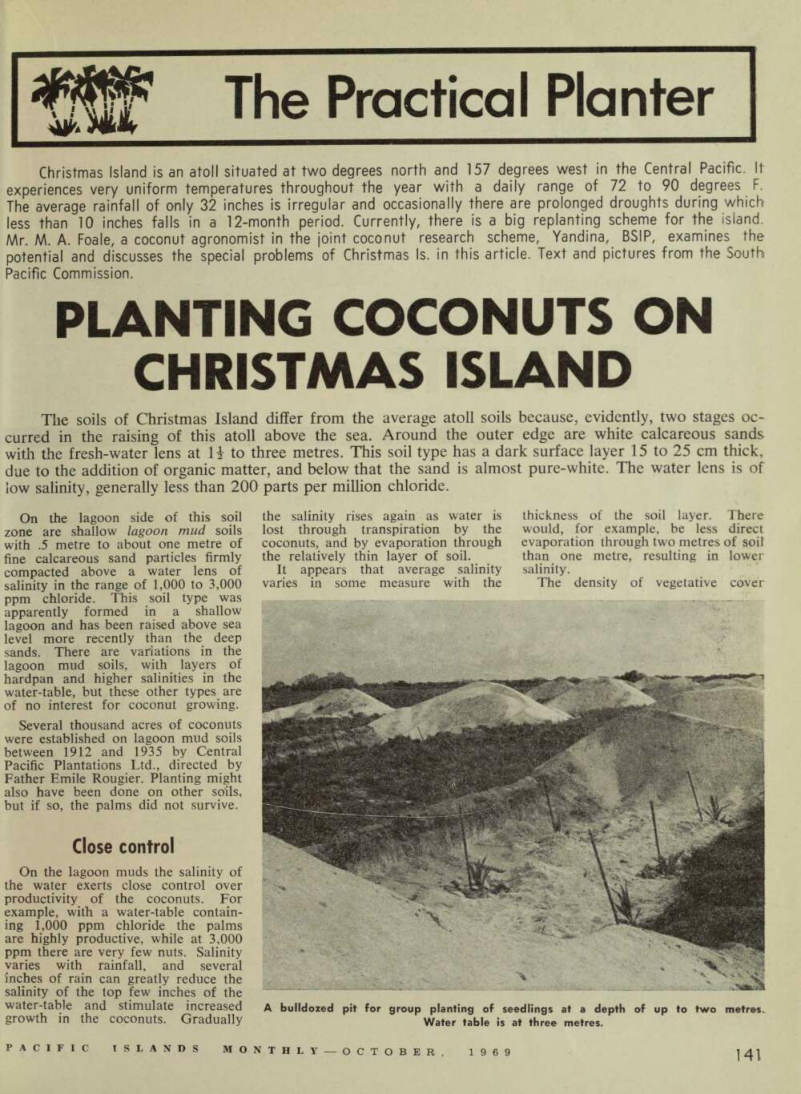
A bulldozed pit for group planting of seedlings at a depth of up to two metres.
Water table is at three metres.
also affects moisture loss. A dense stand of coconuts will transpire more water than a thin stand, causing a faster rise in ground water salinity.
The total moisture loss from the soil is termed evapotranspiration, and in tropical climates where the soil is fully covered with vegetation the loss is around 50 to 60 in. per annum if the soil is always moist. Under Christmas Island conditions, with a layer of dry sand over the water table and with a cover of coconuts only, within a few weeks the evapotranspiration would certainly be well below 50 in., but, so far, no measurements have been made.
If the average salinity in a certain area of Christmas Island remains constant over a period, then evapotranspiration from this area equals the average annual rainfall, namely 32 in. There may be a tem porary rise in salinity in a dry year and a similar fall in a wet year.
But if evapotranspiration exceeds the average rainfall for several years there will be an overall rise in salinity, which would result in the declining health of the coconuts and their eventual death.
The above discussion would appear to indicate that the most moisture will be available for plant growth where the soil layer is thickest, thereby resulting in least loss of moisture through direct evaporation.
This is, in fact, borne out by actual measurements, as the water-table under areas of unplanted shallow lagoon mud is always more saline than that under the deep sands nearby.
This leads us to the present phase in the development of Christmas Island, which is an attempt to exploit the vast reservoir of low-salinity water beneath the deep sands. There is some evidence that the fresh-water lens is thicker than 10 metres in some areas. If coconuts were planted on these soils in the early days, the reason for their disappearance has been demonstrated by some further plantings made on them in the early 1960’5.
These plantings failed because most of the palms died before their roots could reach the moist layer of sand which occurs just above the water table—at a depth of H to three metres below the soil surface.
An attempt to overcome this establishment problem was made in 1965 during the visit of a Directorate of Overseas Surveys team. The basic idea was to plant coconut seedlings
closer to the water-table by digging very deep planting holes.
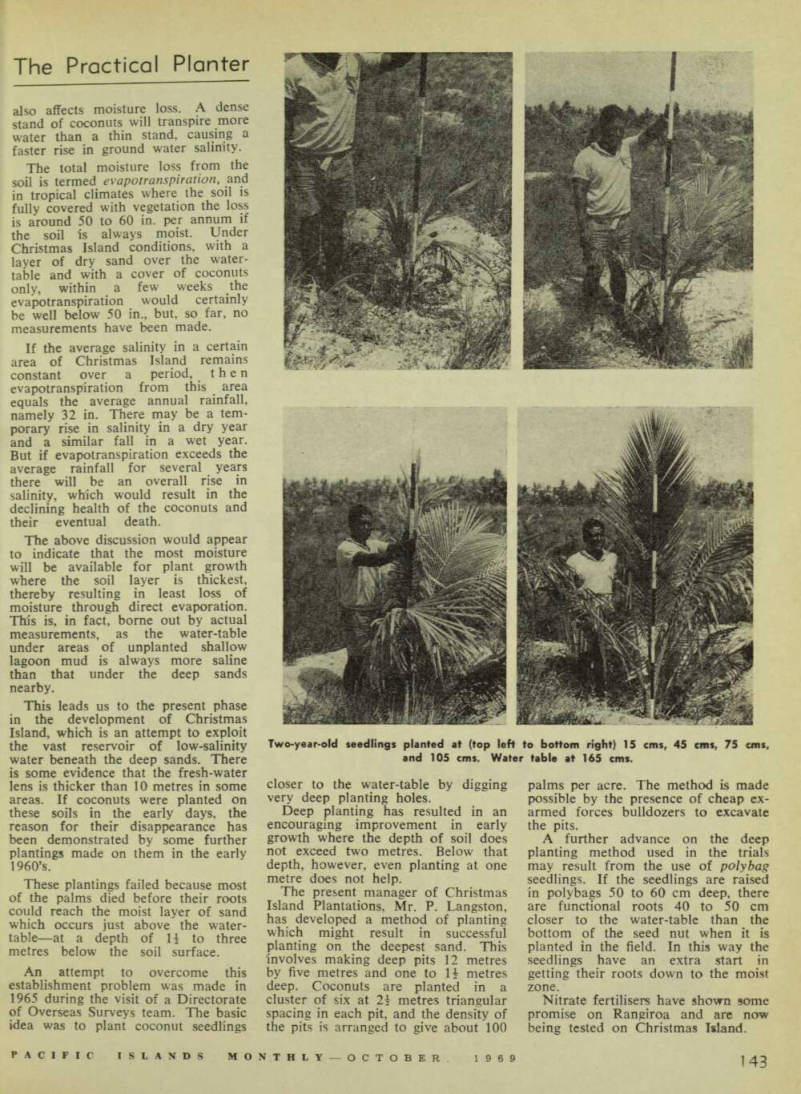
Deep planting has resulted in an encouraging improvement in early growth where the depth of soil does not exceed two metres. Below that depth, however, even planting at one metre does not help.
The present manager of Christmas Island Plantations, Mr. P. Langston, has developed a method of planting which might result in successful planting on the deepest sand. This involves making deep pits 12 metres by five metres and one to H metres deep. Coconuts are planted in a cluster of six at metres triangular spacing in each pit, and the density of the pits is arranged to give about 100
palms per acre. The method is made possible by the presence of cheap ex armed forces bulldozers to excavate the pits.
A further advance on the deep planting method used in the trials may result from the use of polybag seedlings. If the seedlings are raised in polybags 50 to 60 cm deep, there are functional roots 40 to 50 cm closer to the water-table than the bottom of the seed nut when it is planted in the field. In this way the seedlings have an extra start in getting their roots down to the moist zone.
Nitrate fertilisers have shown some promise on Rangiroa and are now being tested on Christmas Island.
Two-year-old seedlings planted at (top left to bottom right) 15 cms, 45 ems, 75 cms, and 105 cms. Water table at 165 cms.
The insect species culicoides, better known as the biting midge or ‘nono (A a pest species notorious for the nuisance caused by its unpleasant bites. It is a normal inhabitant of Fiji and Samoa where for some reason, it presents little if any problem and until the introduction of modern high-speed aircraft, it was confined to these islands. Now however, it has been introduced to the Society Islands, islands of the Tuamotu group and Aitutaki in the Cook Islands.
In these islands, it has found conditions which favour its multiplication and, there, it has become a major pest. Dr. E. J. Reye, Research Officer of the Department of Entomology, University of Queensland, has recently concluded a three-month investigation in French Polynesia on the problem.
Aircraft Spread "Biting
Midges" In The Islands
Members of the species were introduced from Fiji to Bora Bora in 1959 as the result of the opening of air services. From there they became established through the Society Islands by 1961 and some of the islands of the Tuamotu group by 1968. Spread from Bora Bora was relatively easy by way of inter-island aircraft and by natural means.
Up to 1959, the long journeys involved in passage from one island to another had conferred a large measure of protection against the introduction of “foreign” insect species such as culicoides, as few could survive. Modern high speed aircraft have largely invalidated this protection and it is clear that other spedes of mosquito may be introduced to island groups and that culicoides will spread further unless preventive action is taken. , ~. •, The biting midge or nono is ap y named foftts bites are v el y pamful, producing oe , , .’ easny P penetrates mosquito nets ’of and, it :Jn becon* so munity life practically impossible, particularly in rural areas. Where the specie' exists, the nuisance caused to local inhabitants is very great and it thus acts as a considerable deterrent to tourism; on both these S tS econom 8 y a Pr ° n ° UnCed 0 " 00 y '
A nuisance
The species in French Polynesia is not known to have any other than nuisance activity. However, it does act as vector to viruses and to some filarial worms in other parts of the world. In the Southern Caribbean area, it, with aedes and culex mosquitoes, acts as vector for Venezuelan encephalitis, especially in coastal areas. The filarial worm (■Mansonella ozzardi ) transmitted is
principally a parasite of animals not man.
The species breeds in brackish water, neither frankly salt nor frankly fresh. Semi-tidal pools, coastal marshes and roadside ditches near the coast are highly favoured but any body of water, small or large, is suitable provided that there is some salt content.
This type of breeding place makes control extremely difficult once the species is established. The conversion of brackish to fresh or sea water by suitable works is effective but is neither easy nor cheap on an ex tensive coastline. The draining of swamps is effective, but again presents difficulties. Such measures may re duce the density but are unlikely to eliminate the insects from an island.
Island biological communities are delicately balanced and the intro duction of anew species has effects which cannot be foreseen and which can be very undesirable. Once the balance is disturbed, it is very difficult to restore and it is a great deal easier to prevent further introduction of new species such as culicoides than to deal with the situation which arises if this is not done.
At the present time, aircraft on international flights are disinsecticised by aerosol spray of passenger com partments on arrival; few inter-island aircraft are subject to any dis insectisation procedure.
To prevent the introduction and internal spread of the culicoides and other “foreign” insects, it is strongly recommended that all international and inter-’island aircraft within the
Pacific area be required to undergo appropriate effective disinsectisation procedures for all flights. At its 18th plenary session in 1968, the World Health Organisation made the follow ing recommendations for the dis insectisation of international air craft:— 1. For pressurised aircraft: (a) Disinsectisation by vapour during flight, or (b) Disinsectisation by aerosols on arrival. 2. For non-pressurised aircraft: (a) Disinsectisation by aerosols at “blocks away”, or (b) Disinsectisation by aerosols on arrival. 3. That the WHO—approved vapour disinsectisation system and formula for aerosols be used. 4. That the recommendations for disinsectisation be implemented by December 31, 1970.
These procedures can be used for inter-island aircraft but it is recom mended that the “blocks away” system is used as insects can be liberated immediately on arrival and as this provides protection in the event of diverted flight or forced landing. The undercarriage and cargo compartments must receive adequate application of the insecticide. A suitable pattern for the disinsectisa tion of inter-island aircraft would consist of:— (a) Placement of dichlorvos strips in cabin and baggage compart ments to deal with insects harbouring in grounded aircraft. (b) “Blocks away” dichlorvos spray applied to cabin, baggage com partments and undercarriage wells and components.
It is strongly recommended that these procedures for international and inter-island flights be adopted as soon as possible in the Pacific islands area in view of the particular vulnerability of the scattered communities it con tains. • The $8.3 million Rouna No. 2 power station on the Laloki River, for supplying Port Moresby and surrounding areas an assured power supply until 1973, was completed in July. Next step for increasing power potential is raising of the local Sirinumu Dam from 76 ft to over 100 ft, which would guarantee water for the Laloki’s hydro-electric project during the dry season. No decision to go ahead with this project has yet been made.