Pacific Shipping
pp. 111-115 · Read in the full issue
Columbus Line spearheads German drive in the Pacific
To celebrate its centenary next year, Hamburg Sud, the diver sified German shipper and food processor, is fast building up its shipping services and general influence in the Islands.
The company’s subsidiary, Columbus Line, is spearheading its Islands expansion by winning a big chunk of the $l5 million trade between New Guinea and West Ger many and taking on more and more Islands-trained seamen from the Central Pacific.
Last month’s news (PIM, Sept., p. 114) of a direct six-weekly service from Europe to New Guinea and New Caledonia is now followed by an announcement that a third ship will be added to the Columbus’ year-old NZ to Melanesia run by December and that a non-profit making company has been formed in Germany to encourage other German shippers to employ Islands trained seamen.
Columbus has undertaken to employ Islanders trained at the Teraka Training School, at Tarawa, capital of the Gilbert and Ellice Islands. So far, about 110 Islanders have secured jobs on six of Hamburg Sud’s 92 ships.
Since forming the company, Columbus in Sydney told PIM, inquiries had been received from six German shippers interested in employing Tarawa-trained seamen.
Several of these companies indicated they would loan personnel to help train Islanders at Tarawa.
For the company’s Europe-Mela nesia run, Columbus said the chartered 1,600-ton Hinrich Witt would leave Hamburg on October 5, and call at Rotterdam, London, Dunkirk, Le Havre, Panama, Noumea (Nov. 14), Port Moresby (Nov. 20), Lae (24), Madang (27), Rabaul (29) and return via Panama. A second ship, Jupiter, leaves Hamburg on November 7.
Exports from NG to West Ger many are running at about $lO mil lion yearly and imports to the ter ritory at about $5.5 million.
Columbus hopes are this trade will continue to accelerate at the same rate as recent years. NG imports
such as cars, manufactured goods and mining equipment for the Bougainville copper project haven’t been forgotten by Columbus, and as its parent company is a major buyer of cocoa and other foods, chances of exporting NG coffee, tea and passionfruit to Germany are also possibilities.
A call at Kieta, Bougainville, for the Hinrich Witt is probable at a later date when the six-weekly service becomes monthly.
Hamburg Sud is unlisted on Ger man Stock Exchanges as it is wholly owned by Mr. Rudolf A. Oetker, of Bierlefeldt. West Germany. Founded in 1871 to begin a shipping route from Europe to Brazil and Argen tina, the group built up big fleets of ships, which were decimated in both World Wars.
The company re-entered shipping in 1951 when it obtained its first ship. Today there are 92 ships with a deadweight tonnage of 841,500.
Annual income is between $4OO mil lion and $5OO million and 18,000 people are employed.
Columbus entered the South Pacific for the first time in 1959 after the Argentina-US East Coast meat trade collapsed when a foot and mouth epidemic struck Argentina.
The US wanted meat and Columbus immediately set up an Australasia-US run, carrying Austra lian and NZ meat northwards. Four years later two separate services by Columbus were plying this route.
German political influence in the Islands has long gone—her com mercial links are still very much alive through companies such as Hamburg Sud.
Stranded Seamen
On Pukapuka
Pukapuka, perhaps the most isolated of the Northern Cook Islands, made news in early Sep tember when the 127 ft cargo and passenger vessel. Magic Isle, went
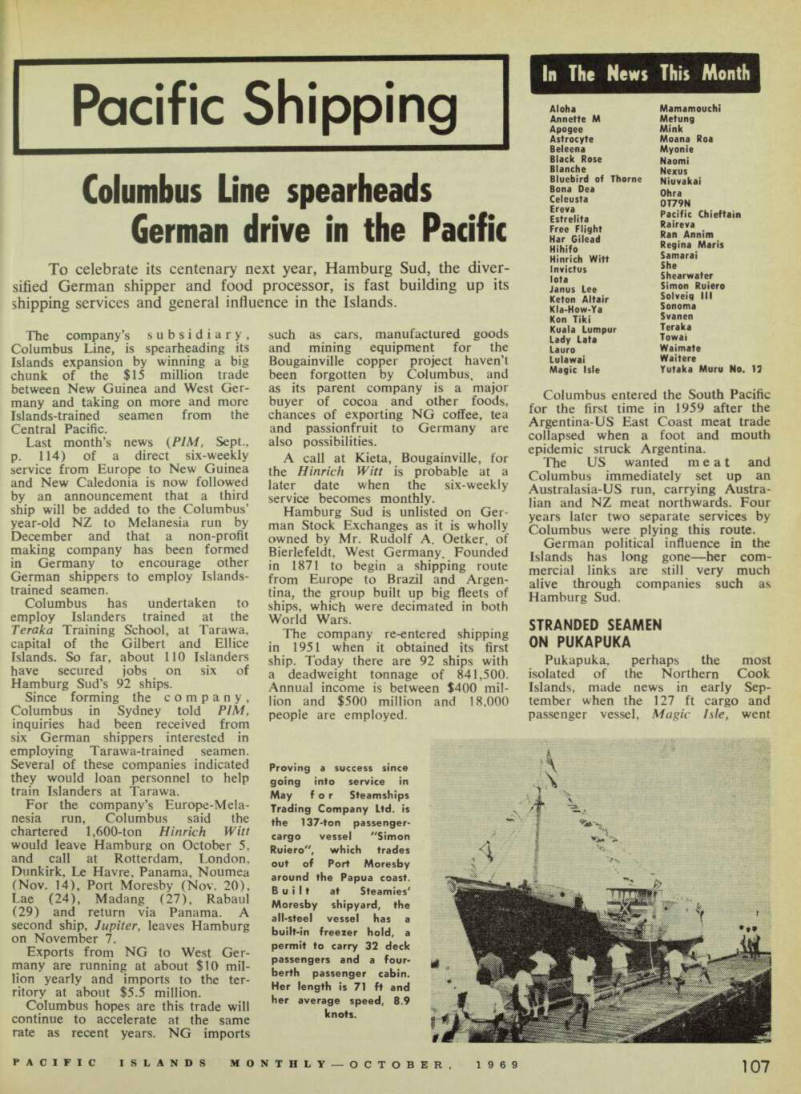
Proving a success since going into service in May for Steamships Trading Company Ltd. is the 137-ton passenger cargo vessel "Simon Ruiero", which trades out of Port Moresby around the Papua coast.
Built at Steamies' Moresby shipyard, the all-steel vessel has a built-in freezer hold, a permit to carry 32 deck passengers and a four berth passenger cabin.
Her length is 71 ft and her average speed, 8.9 knots.
aground on a reef off the island.
Magic Isle's five-man crew escaped to the island and afterwards she slipped off the reef and sunk in deep water.
Magic Isle, formerly an American tourist carrier, was bought recently by an American Samoan business man, Mr. Pila Patu, for a reported SUSISO,OOO. She could carry 99 tons of cargo or over 300 passen gers. Mr. Patu had planned to base her out of Pago Pago, Samoa, and operate passenger and cargo trips amlong various Islands territories.
One round-trip to Hawaii a year with a cargo of Islands artefacts was also scheduled.
When Magic Isle grounded on September I she was on her delivery voyage from Los Angeles, California, via Hawaii to Pago Pago, where she was to be re-christened Lady Lata before local officials. Her loss at seldom-visited Pukapuka posed big problems of picking up the stranded seamen.
Pukapuka, a small atoll with a population of 500-odd Islanders, 380 miles northeast of Pago Pago and 720 miles northwest of Raro tonga, is way off normal sea routes and is visited by government vessels out of the Cooks’ capital of Raro tonga about once a year.
A government vessel was not due until November and officials at Pago Pago at first tried to get the Matson freighter Sonoma to divert and pick up the men but this idea was abandoned when Sonoma’s captain said the pickup would mean a 20hour delay for his ship and would cost about SUS6,OOO.
Then, the 47 ft ketch Naomi (at SUSSO a day) set out from Samoa to pick up the seamen. The ketch is owned by New Zealander Darcy Gilberd, who is working in Samoa’s neglected Manua Islands group drill ing water wells. The round trip to Pukapuka was expected to take about six days.
Lord Howe Island Loses And
Gains A New Tourist Boat
Lord Howe Island has lost and gained a new tourist boat in recent weeks. Clive Wilson, the island busi nessman known to almost every visitor because of his boating and bicycle activities, lost a new 36 ft aluminium boat, designated OT79N, while on its delivery trip from Syd ney to Howe.
OT79N suffered serious engine and flooding faults off Newcastle. A Qantas plane located the boat and the China Navigation liner Kuala Lumpur picked up the two pas sengers, Lance Wilson (Clive’s brother) and George Bowtell (a Sydney publican). The boat, which
cost $30,000 was abandoned as it was not practical to take her aboard the Lumpur or tow her back to Sydney. It was insured.
Clive had hoped to replace another of his vessels, the Pacific Chieftain, which was wrecked off Howe, with the OT79N, for fishing and sight seeing expeditions around the island.
OT79N had been built by De Havilland Marine of Sydney and had passed Marine Services Board requirements.
Another tourist boat, the 37 ft Lulawai, was launched successfully several weeks later on the island.
Designed for carrying groups of tourists around Howe’s four-mile lagoon and around the island itself, it was built for Leanda Lei guest house owner, Mr. Roy Wilson (a relative of Clive Wilson) by Bill and Tom Fisher, Jim Fitzgerald, Kevin Wyborne and Don Payten, with added help from locals.
Lack Of Support Halts Uss
Service To The Islands
The Union Steam Ship Co’s Aus tralia-Pacific Islands service has ended abruptly, although not altogether unexpectedly. Officially, the Waimate has been withdrawn, but the company has announced it would consider re-entering the trade should there be sufficient busi ness.
The scheduled mid-September sailing was abandoned. Lack of sup port, coupled with the almost com plete absence of return cargo from the islands, led to the decision to withdraw.
The service was not entirely satisfactory to shippers because it was rarely possible to give firm sailing dates, a month or two in advance, from Australian ports.
To protect bookings previously made for Apia and Nukualofa, the USS Co. made arrangements with Burns Philp to allocate space in the Niuvakai, which left Sydney early in September. BP’s is agents for the Niuvakai, which is owned by the Tongan Copra Board.
The withdrawal of the service, however, will not mean that the Niuvakai will suddenly be guaranteed a full load each time she leaves Sydney, for she has already reached that desirable state.
Fiji importers will have to make some readjustments with the with drawal of the USS Co. service, and because of the strong likelihood of the Niuvakai excluding Fiji from outward trips from Sydney, except for two calls a year at Vatia Point to unload explosives for the Vatu koula goldmines.
She will still call at Labasa on trips from Tonga to Sydney to pick up timber for Melbourne.
West Irian's Shipping
Fleet To Be Enlarged
The United Nations has begun the heart-breaking job of trying to restore West Irian’s coastal ship ping fleet frittered away by the Indo nesians since 1963.
When the Dutch left Irian in 1962, there were 76 coastal ships. In 1967, when 26 experts from the Fund of the United Nations for the Develop ment of West Irian toured the province, there were only 37 ships left in the water, and many others should have been beached.
Executive Secretary of FUNDWI, Mr. Thomas F. Power Jr., passing through Port Moresby in September, said there were now 47 in the water, including four private boats chartered by the Indonesian Government for one year beginning last August.
FUNDWI, using Dutch dollars, has ordered eight new ships for delivery from November to March.
Two of the ships under charter, (about 1,800 tons) are plying Djakarta-Djayapura monthly, and two are trying to keep open the supply lifelines between Merauke, Sorong and Biak.
Mr. Power says there’ll be no marked improvement in West Irian shipping at least until June, 1970.
In addition, many of the Dutch wharves, piers, beacons and other navigational aids have to be restored or improved.
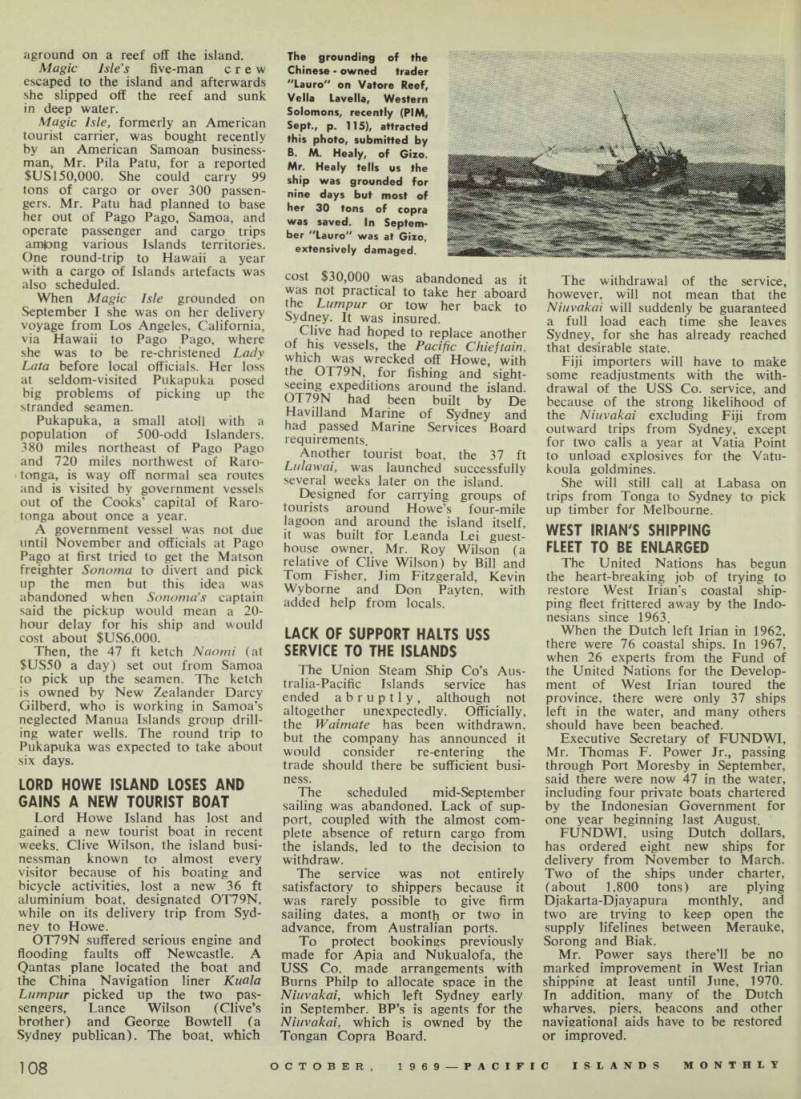
The grounding of the Chinese-owned trader "Lauro" on Vatore Reef, Vella Lavella, Western Solomons, recently (PIM, Sept., p. 115), attracted this photo, submitted by B. M. Healy, of Gizo.
Mr. Healy tells us the ship was grounded for nine days but most of her 30 tons of copra was saved. In Septem ber "Lauro" was at Gizo,
extensively damaged.
More Shipping Poses Port
Problems In Trust Territory
Big inceases in shipping cargo tonnages in the US Trust Territory have emphasised the inadequate port and warehouse facilities in the area.
The result has too often been expen sive vessel delays with big cargo exposures and damages.
MILI, the US shipper which began a 10-year contract to service the territory from the US West Coast and Japan as well as operating inter island services from September 2 last year, reports that 110,000 revenue tons of cargo were carried, an in crease of 35 per cent, over the previous year’s total.
The increased volume, the com pany admits, produced “more prob lems than profits”.
Short-term improvement in facilities at territory ports has since been made, it says, but “permanent improvements” are needed. In adequate port facilities could place a stranglehold on the territory’s economic development.
MILI said 23 round-trip voyages had been made and six more were in progress. Two extra ships, the 6,415-ton Har Gilead and the Ran Annim, had been chartered to maintain services from the Far East and Guam.
Introduction of direct service from the US West Coast had changed buying habits so drastically that shipping requirements had to be “carefully revalued”. “Valuable les sons” had been learned in schedul ing and space requirements.
Despite failure to get US Govern ment aid for a scheme to train Micronesian deck and engine hands, MILI was proceeding with a smaller, company-orientated program. Cap tain C. A. Trueman had been hired as training officer to upgrade standards of skills aboard the three MILI ships as part of a long-range plan of certification and licensing which will produce competent local crews for all six MILI ships.
Shipping Briefs
• The RAN patrol boat HMAS SAMARAI in early September picked up 21 survivors of a wrecked Japan ese fishing vessel, Yutaka Muru No. 12, which went agiound on a reef off Rossel Island. Louisiades, Papua.
The fishermen jumped from their wrecked craft into a liferaft then transferred to a workboat from a trader standing out to sea. The work boat took the men to the open sea outside the reef where they trans ferred to the SAMARAI. • New Guinea’s Bogia Wharf, in the Madang District (mentioned in PIM, Aug., p. 109), will cost
$50,000 and be built by June next year, “subject to budget approval”, Mr. L. W. Johnson, the Assistant Administrator (Services), said re cently. He also said design of an overseas wharf for Wewak was com plete, and it was hoped work would start before 1970. No tender has yet been let for Wewak. • The NZ Government owned passenger and cargo vessel Moana Roa, which makes regular monthly trips out of Auckland to the Cook Islands, lost $NZ229,101 in 1968-69 over $50,000 more than the previous year. The average number of pas sengers carried dropped, as did cargoes carried from the Cooks to NZ. Cargoes from NZ to the Cooks were the highest for the past four years. • Towai, a New Zealand 567-ton coastal vessel, has been sold by her owners. Anchor Shipping and Foundry Company, to a New Guinea-based company and was to leave Wellington for NG in Sep tember to start a 30-day shipping service from NG to other Islands territories. • Beleena, a 65 ft motor vessel was due at Rarotonga, Cook Islands, in late August from Niue to begin a mineral survey of Rarotonga, Aitutaki, Manuae. Mitiaro, Mauke and Nassau, to be carried out by an Australian-registered company.
Avian Mining Pty. Co. Ltd., which has recently been granted permission by the Cook Islands Cabinet to search for minerals.
O Japanese tuna long-line ships will continue to fish within the three to 12-mile zone off the coast of Papua-New Guinea, except in “certain specified areas off south Papua”, until November, 1972.
This is one of the conditions under the Australia-Japan fisheries agree ment, which came into effect in late August. • Fiji’s Fisheries Division is attaching yellow plastic streamers to kalia fish in an effort to trace their movements and develop greater knowledge of possibly productive fish ing grounds. A number of kalia caught by the division have been tagged with a special plastic marker supplied by the CSIRO in Australia.
The tag is a small arrowhead inserted in a muscle of the fish and yellow plastic streamer which is visible externally. Fishermen are asked to help in the research work by returning any tags on fish caught to the Fisheries Department, Suva, or the nearest office of the Depart ment of Agriculture, stating where and when the fish was caught.