These "Savages" Could
pp. 69-71 · Read in the full issue
Not Be Friendlier
By Lema Low
Travelling on board the Tofua from Suva bound for Niue can be quite an adventure.
As the only ship which regularly does the Auckland-Fiji-Niue-Samoa- Tonga-Fiji-Auckland trip, the Tofua’s limited cabin accommodation is usually booked out months ahead, ex cept for a few berths allotted to each Islands group.
You are therefore in doubt until just before the ship leaves whether you’ve drawn a berth in a cabin with a complete stranger or are destined for a deck passage along with approxi mately 190 other souls. (The deck passengers, I should add, are carried only between islands and not in the colder temperate zone.) In theory, it sounds highly romantic to bunk on deck in the tropical moon light. But decks are hard, the wind can be chilly and the sea rough, and your companions may snore like the dickens and babies will cry.
Excellent food
Apart from deck passages, the Tofua gives pleasant and comfortable travel and suits most tastes. The food is excellent, the service, the slickest imaginable—almost too slick.
Ones plate is whisked away and the table cleared before one has time to say “cheese and crackers”.
Passengers adjourn to the lounge to drink coffee, take a guess on the day’s run, and read a book, play deck games or simply scan the sea, looking for some land.
The only island sighted while travelling through the Fiji Group was Oneata. Then we passed very close to the northern tip of Vavau in the Tongan Group and saw a rugged coastline indented with large caves and crescents of golden sand.
At 5 a.m. on the morning of the third day out from Suva, the Tongan girl sharing my cabin put her head out of the porthole and exclaimed, “There’s Niue!” Someone had told me that Niue from the sea resembled an inverted soup plate, but I thought it looked like a softly-green, wide brimmed sun-hat.
The ship erupted into action.
Everyone had the same idea—bath room, breakfast, packing and disem barkation. A haze of hair oil, talcum powder and perfume quivered above the Tofua.
When she dropped anchor in the blue waters of Alofa Bay, a mountain of luggage had already accumulated in the ship’s foyer and a queue of smartly-dressed people awaited break fast and immigration officials.
Men, in terylene suits and brightly polished shoes, were hardly recognis able as the casual, lava-lava clad songsters of the previous evenings.
Women and girls in modish linen suits and frocks, beautiful shoes and elegant hair-styles, bore no resemb lance to the shock-headed females in muu-muus and flip-flops who had lounged around the ship for two days.
It’s all very well, I thought, to im press people, but, after one look at the swaying gangway, I settled for an old frock and canvas sneakers!
Health, immigration and Customs officials gave us a cordial welcome.
They came out to the ship in a launch, because there is no wharf at Niue, only a concrete jetty and load ing ramp. They were closely fol lowed by the island’s lighterage fleet of whale-boats and flat-bottomed steel barges which idled around until the ship was cleared and unloading could commence.
We passengers leaned over the rail, watching operations. Then we looked at each other and gasped with amaze ment. “Good gosh!” said one, “Don’t tell me they have women working on the boats at Niue!”
The “women”, we discovered, were actually young Niuean men with the traditional long hair which is
assiduously groomed from boyhood in the hope that it will develop abundantly. Then, after a family consultation, invitations are sent out for a hair-cutting party.
A feast is provided by the proud parents and the guests usually con sist of other parents of long-haired sons who no doubt will reciprocate with a similar party later on.
Each guest is given food and a lock of the son’s hair, for which pay ment is made and is carefully recorded by the scribe/treasurer —a donation could be $1 or $2O and such dona tions at a single party could total SBOO. No wonder the parents regard the boy’s luxuriant hair as money in the bank!
The lighterage crews, from long experience, were expert at their hazardous task. The sea-swell was enough to make work tricky, if not dangerous.
Disregarding the captain’s warning that “passengers go ashore at their own risk”, numbers of Tofua passen gers of all ages and conditions ven tured ashore to see Niue, braving the bucking gangway and stumbling into the leaping launch.
The local population were not per mitted onto the jetty, which was buzzing with cargo trucks, directed by a policeman on traffic duty on the road above the landing-place.
However, they crowded every vantage
Brilliant colour
point at the top of the cliffs to wel come visitors and residents.
A luncheon and Niuean fiafia (en tertainment) had been arranged for the passengers, who saw as much as possible during their brief visit and also bought the beautiful Niuean woven ware.
As this was boat-day, the big day of every month for Niue, the main town, Alofi, had come alive like a disturbed ants’ nest, and one’s first impression was of colour, brilliance and action, washed by waves of dazzling sunshine and the heat which radiated from the white limestone roads.
Before coming to Niue, we could find out very little about the island.
Friends murmured vaguely, “Niue?
That’s the phosphate island, isn’t it?”
Well—if Niue’s limestone outcrops were phosphate deposits, it would be the richest island in the world. It has an area of approximately 100 square miles and is an elevated coral outcrop with a shore reef fringing a pre cipitous coastline.
Submarine eruption
When somebody told me that it is the largest coral island in the world, that it was thrust upwards by a terrific submarine eruption and that it is part of an underwater mountain 2i miles high, I felt like clutching the cliffs and saying, “Don’t rock the boat!”
I also appreciated the wisdom of Antione St. Exupery’s “Little Prince”, who lived alone on his planet with three volcanoes which he cleaned carefully every day, because —“one never knows”.
In general formation, Niue consists of two terraces, the lower 90 ft and the higher 200 ft above sea level.
Apart from the rise from the lower to the upper, there are no hills, and no running streams or surface water.
Niue was unlucky enough to ex perience a severe hurricane in February, 1968—and is just recover ing from the extensive damage.
The natural resources of Niue lie in the soil which, though fertile, is not plentiful. This fact, together with the rocky and broken nature of the terrain, makes cultivation difficult. It is almost impossible, for example, to cultivate a nice lawn. Residents have a strong suspicion that the more they cultivate, the more the rocks grow, like mushrooms!
However, the arable areas of soil grow excellent fruit and vegetables including enormous papaws and de liciously sweet kumeras, and the
island is well-wooded with trees and shrubs common to all Pacific Islands.
Coconuts grow throughout the island.
The Niueans are New Zealand citizens and have all rights and privileges, including free education and medical services. Many Niueans reside in New Zealand—more, it is said, than in Niue itself.
Niue is believed to have been in habited for over a thousand years.
Captain Cook called at the island in 1774 and, receiving a hostile recep tion, named it Savage Island, a name which is no longer in general use.
If Captain Cook were to visit Niue today he would have no cause to complain of his reception. The people
are overwhelmingly kind and friendly.
They drop in with gifts and invite you to their homes, their parties and their feasts. They delight in showing their island, in which they have a loving, possessive pride.
Under New Zealand’s benign pro tection and guidance, Niueans are a happy, healthy, vigorous people, in tent on working out their destiny and solving problems in their own way.
Life goes on at a dizzy pace— there are days set aside for going to the bush and cultivation of gardens; there are parties going on all the
time, mostly in peoples’ homes; hardly an evening goes by without a dance somewhere, either to raise money, or to have a good time.
Movies are popular and each time the Tofua arrives there is a new pn> gramme of old favourites, such as “The Ten Commandments”. “Mutiny on the Bounty ”, or “Tarzan”. When Tarzan’s on the go, the excited shrieks can be heard all over Niue.
Niueans have taken to every form of modern transport like ducks to water and the only working quadru peds left on the island are two horses and a donkey—which flatly refuses to give rides to the children.
Motor-bikes and the “go-go” spirit have really hit Niue—so have mini skirts, pipe-stem pants and pop music as played by “The Mustangs”.
Momma on bike
It isn’t only poppa and big brother who ride the motor-bikes, but also momma, big sister and grandma!
Take a Niue flapper with a flashing smile, put a creamy frangipani flower in her black hair, or a snazzy Niue hat on her head, dress her in a pareu mini-skirt and seat her on a motor-bike—no doubt about it, sales would zoom!
To reduce isolation and attract visitors, an airstrip large enough to take jet planes is being built across the higher plateau of the island and is due for completion in late 1971.
Owing to the unstable nature of the terrain, work is slow and difficult.
Niue certainly needs comfortable, high-class accommodation and if it could be built of Niue rock to har monise with the landscape, so much the better. One visualises Niuean artistry decorating the building and tropical trees and flowers filling the gardens.
Guests should be given a Niue menu—the uga (coconut crab), turtle, baked bonita, chicken, delicious kumera and Niue puddings—the good, simple food of the island—at reasonable rates; then they will really appreciate their Niuean holiday.
When we are back home in Fiji we shall always have a warm place in our hearts for Niue. We shall remember the cool breeze sweeping over the plateau, and the terraces, down to the indigo-blue sea—that wide, empty, lovely sea, from which the sunsets glow in unbelievable splendour.
We shall remember the sounds of Niue—of enormous waves thunder ing against the cliffs, cargo cranes grinding under heavy loads, the in cessant buzzing of motor-bikes, peoples’ strong, melodious voices and constant laughter.
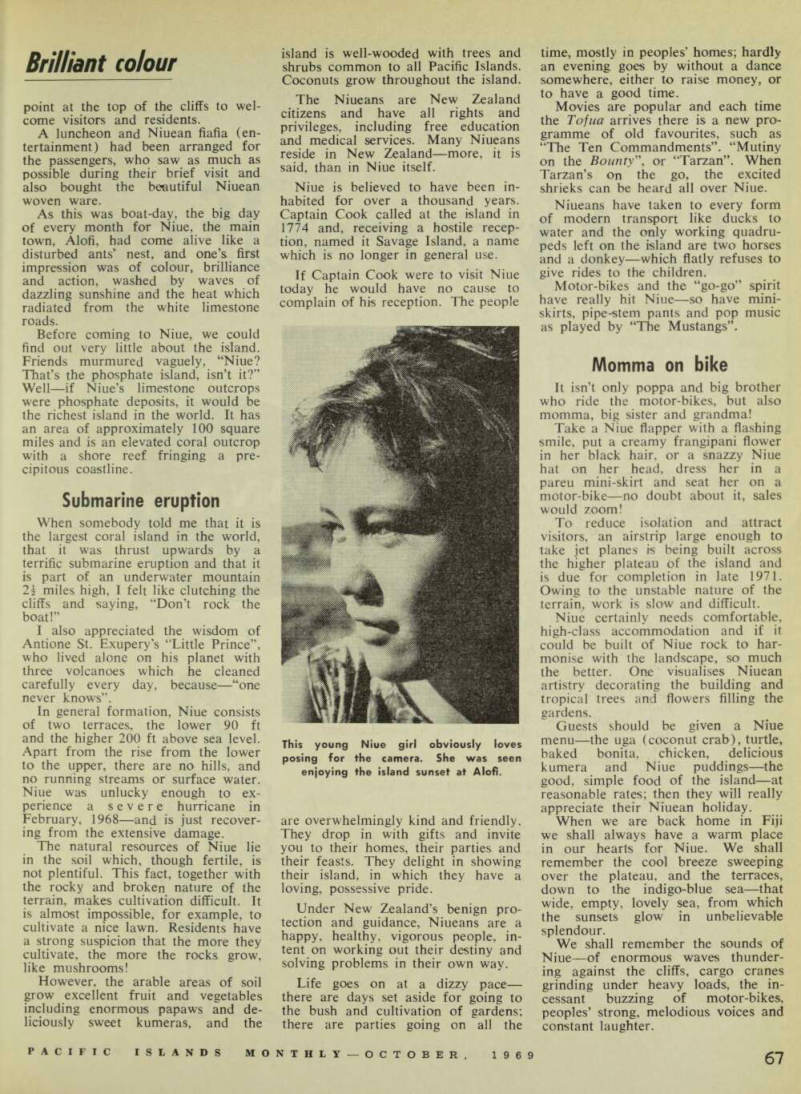
This young Niue girl obviously loves posing for the camera. She was seen enjoying the island sunset at Alofi.