To the Point
pp. 45-47 · Read in the full issue
Some thoughts on the freedom of New Guinea's Press (and radio)
“This gives the future for democracy and freedom of speech little hope,” said Dr. John Gunther, Vice-Chancellor of the University of Papua and New Guinea. He was referring to the report of the House of Assembly’s Committee for Privileges in the much publicised Kiki case, and the subsequent action of the House in ejecting the representatives of Niugini’s only newspaper, the Papua New Guinea Post-Courier, from the House’s Press gallery and precincts.
The quite memorable occasion on which Dr, Gunther spoke these words was a forum organised by the Politics Club of the University of Papua and New Guinea. The audience which packed the univer sity’s lecture theatre heard some of the best oratory I have ever heard in Port Moresby from the quartette of speakers—Dr. Gunther, Post- Courier editor John Lawrence, law lecturer Ikenna Nwokolo and Pangu Pati member Toni Voutas.
One of the fringe benefits of having our own university is that of having a number of first class brains around, housed in persons not inhibited by being public servants and therefore allowed to say out loud what they think. One wonders, in passing, what Dr. Gunther him self would have had to say on this issue if he had still been Assistant Administrator for Services.
It is not always realised what an enormous handicap this situation was before the establishment of the university. The situation is quite different here from what it is in Australia. Here in Niugini, overseas officers of the public service com prise a very substantial proportion of the expatriate community, and its local officers, although a small minority of the total indigenous population, include an overwhelming majority of its best educated sector.
Thankful for university
The British tradition that civil servants should stand aside from public controversy is no doubt sound enough; but its effects in Niugini can be inhibiting of free discussion to an extent often not realised in Australia. So let’s be thankful for the university.
Taking a backward look at the Kiki case I find myself wondering whether for Niugini the concept of parliamentary privilege may not be as great an anachronism as are wigs and gowns. It all started, apparently, with the Mother of Parliaments finding that it had to protect itself from the oppressive acts of the
To the Point with Percy Chatterton
King, and maybe Niugini’s parlia ment needs some way of protecting itself from the oppressive acts of the Department of Territories.
But if its integrity is impugned, its remedy should surely be through the courts, either by actions initiated by individual members or, where the circumstances warrant it, by action initiated by the House as a whole through its Speaker. We politicians do enough harm as it is by enacting laws which give power to petty officials to bullyrag the citizenry and act as prosecutors and judges rolled into one. We do worse when, with out either training or experience in the administration of the law, we set ourselves up as a kind of super court, and hand out penalties for acts which we ourselves judge to be derogatory to our own dignity.
"Black and White" dead
It has been suggested that the recently deceased magazine Black and White sometimes laid itself open to the charge of contempt of parlia ment. Perhaps it did, but parliament surely dealt with the situation more wisely by tightening up a law which applies to everyone rather than by taking action under a law which applies only to itself.
It seems fairly certain that the House’s handling of the Kiki incident has diminished rather than enhanced its dignity. But with all due respect to Dr. Gunther it is open to doubt whether the penalty imposed on the Post-Courier has in fact substantially diminished free dom of speech. Actually, of course, it didn’t even stop the Post-Courier from obtaining and publishing quite a lot of information about what was going on in the House.
I suggest that the real danger to freedom of speech, and so to democracy, in Niugini lies in the control of news media. The right of free speech is of little use to the man who can’t make himself heard; and in Niugini, with its high pro portion of illiterate and marginally literate people, the vital news medium is not the Press but the radio.
The bally-hoo over the ban on the Post-Courier tends to overlook the fact that this journal, Niugini’s only newspaper, has a circulation of under 10,000 in a population of 2i million, and a substantial pro portion of this circulation is among expatriates. It is to be doubted whether more than a few hundred copies circulate among Niuginians, and these only among the more sophisticated Niuginians. In the light of this consideration the Committee
Radio is a two-edged sword
for Privileges’ conclusion that the House’s image in the eyes of Niuginian villagers had been damaged by the publicity given to Albert Maori Kiki’s verbal fireworks by the Post-Courier’s publication of them seems a bit silly.
If the image was tarnished, it was rather through the diffusion of Mr.
Kiki’s innuendoes by the ABC. and presumably (a point which every body seems to have overlooked) by the Administration radio stations which pick up and rebroadcast the ABC news bulletins. Yet the ABC got off lightly and the Department of Information and Extension Services wasn’t even put in the dock.
Role of broadcasting
Radio broadcasting in Niugini is in the hands of the ABC and the Department of Information and Extension Services which operates the Administration radio stations.
The ABC operates stations at Port Moresby and Rabaul, and plans to operate one in Lae. The Admin istration currently operates eight stations: at Daru, Kerema and Samarai in Papua; at Goroka, Mount Hagen and Wewak on the New Guinea mainland; and at Rabaul and Kieta in the New Guinea islands.
Nine further stations are planned: at Lae, Madang, Kavieng, Port Moresby, Popondetta, Mendi, Kun diawa, Vanimo and Kimbe.
It is further planned to increase substantially the power of some of the stations. The general rationale is that the ABC provides programmes aimed at the expatriate and sophis ticated indigenous sectors of the community, while the Administration stations provide programmes for the people of the villages. It seems clear that in a few years time, with more stations and increased power, the Administration network will be a dominant force in shaping public opinion in Niugini.
The Administration’s view of its role in broadcasting has been stated in parliament by the Assistant
Administrator for Services as fol lows— “ Administration stations have been set up essentially as a channel of communication between the govern ment and the people, to explain what the government is doing and to help people prepare for and parti cipate in an informed way in the changes that take place. . . . The programmes make very extensive pro vision for reporting (people’s) reac tions and presenting listeners’ views on matters which concern them. . . .
Administration broadcasting is con cerned with communicating with people, helping them to express their views and to understand the govern ment.”
They plug the government
In other words these stations are mainly concerned with plugging the government line, and criticism of that line only receives publicity by grace and favour of the criticised.
I wonder whether those members of the House of Assembly who have clamoured for Administration radio stations in their electorates realise that these are weapons which could be turned against them later if they step out of line, as has been reported to have happened to Bougainville’s Paul Lapun and Kokopo’s Oscar Tammur. We have been warned.
Since 1966 a Broadcasting Co ordinating Committee, under the chairmanship of Mr. Warwick Smith has been deliberating (apt word!) on the future of broadcasting in Niugini, heading with what Francis Thompson called “deliberate speed, majestic instancy” towards an un disclosed goal.
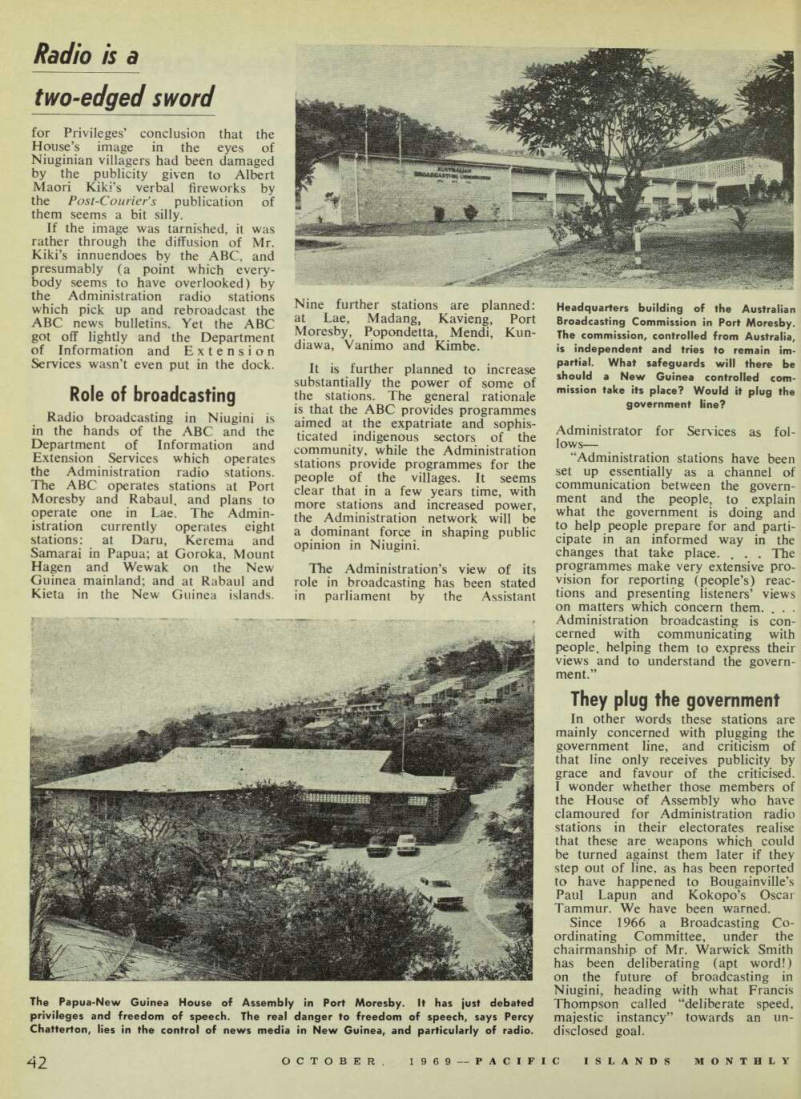
The Papua-New Guinea House of Assembly in Port Moresby. It has just debated privileges and freedom of speech. The real danger to freedom of speech, says Percy Chatterton, lies in the control of news media in New Guinea, and particularly of radio.
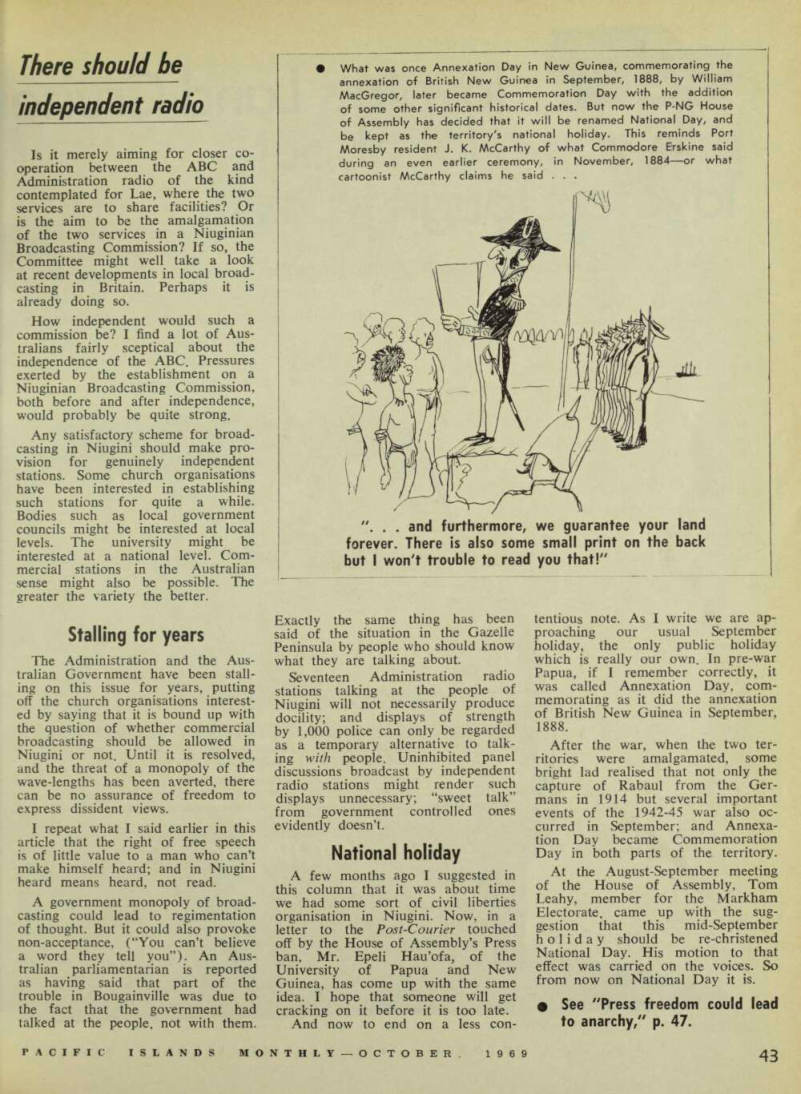
Headquarters building of the Australian Broadcasting Commission in Port Moresby.
The commission, controlled from Australia, is independent and tries to remain im partial. What safeguards will there be should a New Guinea controlled com mission take its place? Would it plug the government line?
There should be independent radio
Is it merely aiming for closer co operation between the ABC and Administration radio of the kind contemplated for Lae, where the two services are to share facilities? Or is the aim to be the amalgamation of the two services in a Niuginian Broadcasting Commission? If so, the Committee might well take a look at recent developments in local broad casting in Britain. Perhaps it is already doing so.
How independent would such a commission be? I find a lot of Aus tralians fairly sceptical about the independence of the ABC. Pressures exerted by the establishment on a Niuginian Broadcasting Commission, both before and after independence, would probably be quite strong.
Any satisfactory scheme for broad casting in Niugini should make pro vision for genuinely independent stations. Some church organisations have been interested in establishing such stations for quite a while.
Bodies such as local government councils might be interested at local levels. The university might be interested at a national level. Com mercial stations in the Australian sense might also be possible. The greater the variety the better.
Stalling for years
The Administration and the Aus tralian Government have been stall ing on this issue for years, putting off the church organisations interest ed by saying that it is bound up with the question of whether commercial broadcasting should be allowed in Niugini or not. Until it is resolved, and the threat of a monopoly of the wave-lengths has been averted, there can be no assurance of freedom to express dissident views.
I repeat what I said earlier in this article that the right of free speech is of little value to a man who can’t make himself heard; and in Niugini heard means heard, not read.
A government monopoly of broad casting could lead to regimentation of thought. But it could also provoke non-acceptance, (“You can’t believe a word they tell you”). An Aus tralian parliamentarian is reported as having said that part of the trouble in Bougainville was due to the fact that the government had talked at the people, not with them.
Exactly the same thing has been said of the situation in the Gazelle Peninsula by people who should know what they are talking about.
Seventeen Administration radio stations talking at the people of Niugini will not necessarily produce docility; and displays of strength by 1,000 police can only be regarded as a temporary alternative to talk ing with people. Uninhibited panel discussions broadcast by independent radio stations might render such displays unnecessary; “sweet talk” from government controlled ones evidently doesn’t.
National holiday
A few months ago I suggested in this column that it was about time we had some sort of civil liberties organisation in Niugini. Now, in a letter to the Post-Courier touched off by the House of Assembly’s Press ban, Mr. Epeli Hau’ofa, of the University of Papua and New Guinea, has come up with the same idea. I hope that someone will get cracking on it before it is too late.
And now to end on a less con
tentious note. As I write we are ap proaching our usual September holiday, the only public holiday which is really our own. In pre-war Papua, if I remember correctly, it was called Annexation Day, com memorating as it did the annexation of British New Guinea in September, 1888.
After the war, when the two ter ritories were amalgamated, some bright lad realised that not only the capture of Rabaul from the Ger mans in 1914 but several important events of the 1942-45 war also oc curred in September; and Annexa tion Day became Commemoration Day in both parts of the territory.
At the August-September meeting of the House of Assembly, Tom Leahy, member for the Markham Electorate, came up with the sug gestion that this mid-September holiday should be re-christened National Day. His motion to that effect was carried on the voices. So from now on National Day it is.
• See "Press freedom could lead to anarchy," p. 47.
What was once Annexation Day in New Guinea, commemorating the annexation of British New Guinea in September, 1888, by William MacGregor, later became Commemoration Day with the addition of some other significant historical dates. But now the P-NG House of Assembly has decided that it will be renamed National Day, and be kept as the territory's national holiday. This reminds Port Moresby resident J. K. McCarthy of what Commodore Erskine said during an even earlier ceremony, in November, 1884 —or what cartoonist McCarthy claims he said...
". .. and furthermore, we guarantee your land forever. There is also some small print on the back but I won't trouble to read you that!"