Tropicalities
pp. 39-41 · Read in the full issue
The biggest single resort development in the South Pacific is planned by a Canadian company on land at Deuba about 30 miles from Suva on Fiji’s main island of Viti Levu. Known as Pacific Harbour, it will cover 7,500 acres.
There are plans for hotels, motels, aquatels, commercial sites and a large number of single family, estate and home unit lots, and the working plan has been drawn up by Project Planning Associates Limited, the group responsible for the master plan of Canada’s Expo 67.
Construction of the first stage, at an estimated cost of more than $5 million, is scheduled to begin towards the middle of next year and is pro grammed for completion 18 months later. It will cover 1,150 acres and include all major facilities.
Public take part
The design includes a system of navigable interlinking inland water ways, and over 100 acres of artificial lakes. A number of strategically located marinas will facilitate water sports with special emphasis on yacht ing and deep sea fishing. Also in cluded in the recreational complex will be polo fields, tennis courts, rid ing stables and the first Robert Trent Jones championship golf course in the South Pacific. . . . .
Construction of the first hotel, designed to international resort standards, is scheduled for commence ment in mid-1970. A Canadian public company, Southern Pacific Properties Ltd., has been formed to allow public participation in the new development. The underwriting will be handled by an international group headed by Cochran Murray and Co.
Ltd., members of the Toronto Stock Exchange. . . , Strong support in principle tor the project was announced by the Fiji Government on September 22 by Fiji’s Minister for Communications, Works and Tourism, Mr. C. A. Stinson, who described it as an imaginative pro ject and said it was the type of planned development in Fiji which he had wanted to see go ahead for some time.
Meanwhile, in another major hotel development, an American company, International Leisure Hosts Ltd., of Arizona, announced a merger with Makita Holdings Ltd., owners of Suva’s Isa Lei Hotel. International
Mammoth $5
Million Resort
In Fiji
said the Isa Lei, which has reportedly been up for sale in recent months, would be enlarged to 200 rooms, making it the colony’s biggest hotel.
The American group, with hotel and air charter interests in the US, said it would build two new hotels in Fiji within three years. Its Fiji investment in this time would be between SF6 million to SFB million Plans were to change the name Makita Holdings to Polynesian Resorts Ltd.
Fiji Council gets
a lady's touch
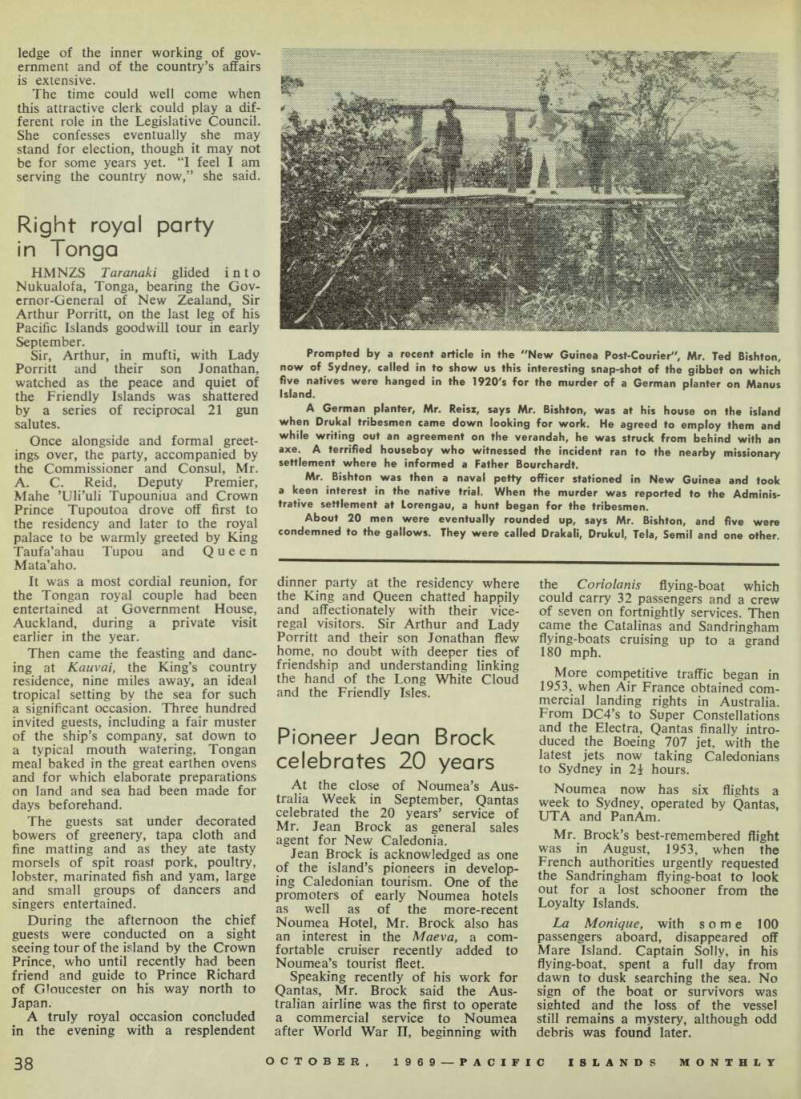
Acting Clerk of Fiji’s Legislative Council is tall, attractive Lavinia Ah Koy, the first woman in Fiji to hold the position, and one of the few, if not the only woman in the world to hold a similar posting. Previous Clerks to the Legislative Council have all been highly qualified academically, many with legal degrees. Lavinia left school at 15 years of age.
The 29-year-old Acting Clerk is the wife of Suva businessman Jim Ah Koy, and the mother of three small children. An expert Hansard re porter, she began her working career as secretary to the Deputy Commis sioner of Police in Fiji, and it was not long before she was seconded to the Legislative Council reporting staff.
She had some experience report ing in the Supreme Court in Suva when she went to Australia for six months and there enrolled at the Syd ney Technical College. At the Sydney Tech, she brought her shorthand speed up from 140 to 160 wpm. She then went to Canberra to observe parlia mentary procedure there and a second visit followed in 1967.
In 1961 she was made acting re-
porter to Fiji’s Legislative Council, and in 1963 the appointment was con firmed. It was at this time she helped perfect a new system of taping mem bers’ speeches. Under the new system a cassette records voices for half an hour, and then is quickly replaced by a fresh cassette while the used one is taken to a typist. Simultane ous reports of proceedings are then available almost immediately.
Part of Lavinia’s many respon sibilities as clerk is having the minutes which members pass printed and ready for members’ perusal the fol lowing morning. She works in close co-operation with the government printer, sending him minutes as soon as they are passed. At the end of the day she proof-reads his printing after she finishes her own work which is usually about 7 p.m. or 8 p.m. when council is in session.
As Clerk of Council she prepares the agenda for each Legislative Council session, pays members their allowances, processes questions with notice and handles replies; records decisions, rulings and daily minutes, and generally attends to the smooth running of council.
Lavinia is secretary to the Fiji branch of the Commonwealth Parlia mentary Association, and recorder of minutes at almost all committees formed within council. Her know
Lavinia Ah Koy.
ledge of the inner working of gov ernment and of the country’s affairs is extensive.
The time could well come when this attractive clerk could play a dif ferent role in the Legislative Council.
She confesses eventually she may stand for election, though it may not be for some years yet. “I feel I am serving the country now,” she said.
Right royal party
in Tonga
HMNZS Taranaki glided into Nukualofa, Tonga, bearing the Gov ernor-General of New Zealand, Sir Arthur Porritt, on the last leg of his Pacific Islands goodwill tour in early September, Sir, Arthur, in mufti, with Lady Porritt and their son Jonathan, watched as the peace and quiet of the Friendly Islands was shattered by a series of reciprocal 21 gun salutes.
Once alongside and formal greet ings over, the party, accompanied by the Commissioner and Consul, Mr.
A. C. Reid, Deputy Premier, Mahe ’Uli’uli Tupouniua and Crown Prince Tupoutoa drove off first to the residency and later to the royal palace to be warmly greeted by King Taufa’ahau Tupou and Queen Mata’aho.
It was a most cordial reunion, for the Tongan royal couple had been entertained at Government House, Auckland, during a private visit earlier in the year.
Then came the feasting and danc ing at Kauvai, the King’s country residence, nine miles away, an ideal tropical setting by the sea for such a significant occasion. Three hundred invited guests, including a fair muster of the ship’s company, sat down to a typical mouth watering, Tongan meal baked in the great earthen ovens and for which elaborate preparations on land and sea had been made for days beforehand.
The guests sat under decorated bowers of greenery, tapa cloth and fine matting and as they ate tasty morsels of spit roast pork, poultry, lobster, marinated fish and yam, large and small groups of dancers and singers entertained.
During the afternoon the chief guests were conducted on a sight seeing tour of the island by the Crown Prince, who until recently had been friend and guide to Prince Richard of Gloucester on his way north to Japan.
A truly royal occasion concluded in the evening with a resplendent
dinner party at the residency where the King and Queen chatted happily and affectionately with their vice regal visitors. Sir Arthur and Lady Porritt and their son Jonathan flew home, no doubt with deeper ties of friendship and understanding linking the hand of the Long White Cloud and the Friendly Isles.
Pioneer Jean Brock
celebrates 20 years
At the close of Noumea’s Aus tralia Week in September, Qantas celebrated the 20 years’ service of Mr. Jean Brock as general sales agent for New Caledonia.
Jean Brock is acknowledged as one of the island’s pioneers in develop ing Caledonian tourism. One of the promoters of early Noumea hotels as well as of the more-recent Noumea Hotel, Mr. Brock also has an interest in the Maeva, a com fortable cruiser recently added to Noumea’s tourist fleet.
Speaking recently of his work for Qantas, Mr. Brock said the Aus tralian airline was the first to operate a commercial service to Noumea after World War 11, beginning with
the Coriolanis flying-boat which could carry 32 passengers and a crew of seven on fortnightly services. Then came the Catalinas and Sandringham flying-boats cruising up to a grand 180 mph. ... x _. , More competitive traffic began in 1953, when Air France obtained com mercial landing rights in Australia.
From DC4’s to Super Constellations and the Electra, Qantas finally intro duced the Boeing 707 jet, with the latest jets now taking Caledonians to Sy dne y in u hours.
Noumea now has six flights a week to Sydney, operated by Qantas, UTA and Pan Am.
A , , .’ , , t i r ‘. s best-remembered flight 2^ as l n 4 ug V s . t ’ w^en *be authorities urgently requested * he t Sandringham flying-boat to look £ or T a i st schooner from tbe Loyalty Islands * La Monique, with some 100 passengers aboard, disappeared off Mare Island. Captain Solly, in his flying-boat, spent a full day from dawn to dusk searching the sea. No sign of the boat or survivors was sighted and the loss of the vessel still remains a mystery, although odd debris was found later.
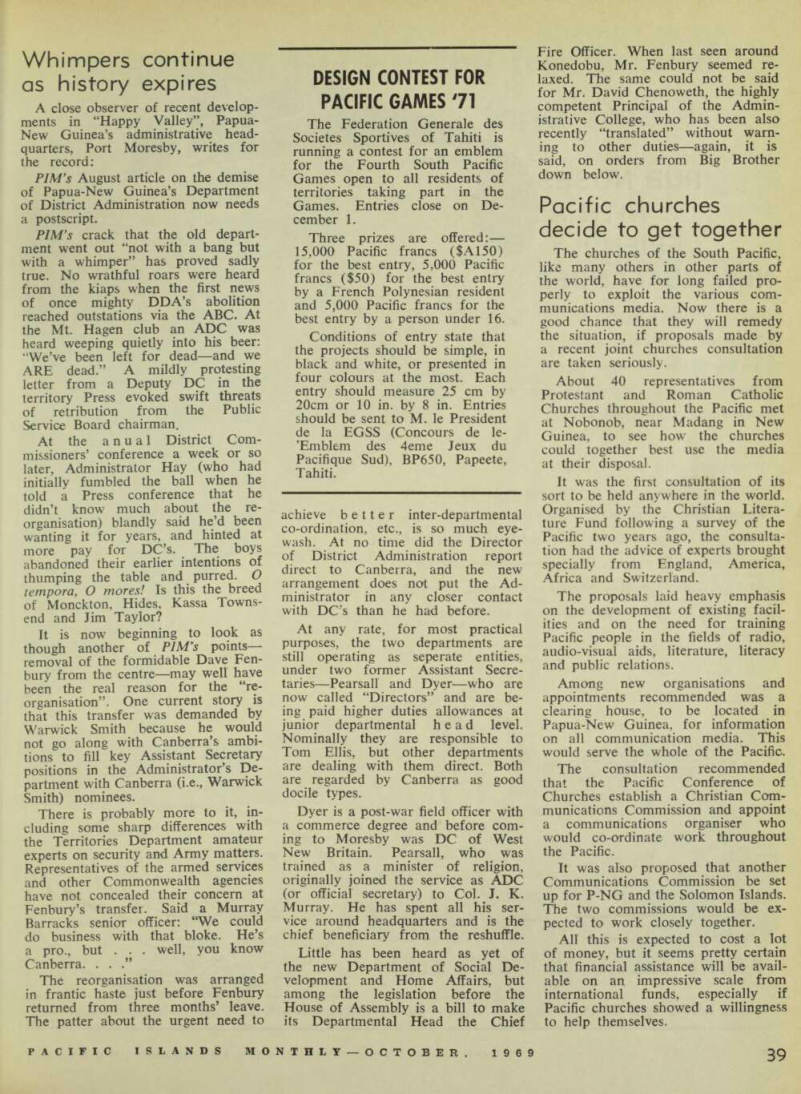
Prompted by a recent article in the "New Guinea Post-Courier", Mr. Ted Bishton, now of Sydney, called in to show us this interesting snap-shot of the gibbet on which five natives were hanged in the 1920's for the murder of a German planter on Manus Island.
A German planter, Mr. Reisz, says Mr. Bishton, was at his house on the island when Drukal tribesmen came down looking for work. He agreed to employ them and while writing out an agreement on the verandah, he was struck from behind with an axe. A terrified houseboy who witnessed the incident ran to the nearby missionary settlement where he informed a Father Bourchardt.
Mr. Bishton was then a naval petty officer stationed in New Guinea and took a keen interest in the native trial. When the murder was reported to the Adminis trative settlement at Lorengau, a hunt began for the tribesmen.
About 20 men were eventually rounded up, says Mr. Bishton, and five were condemned to the gallows. They were called Drakali, Drukul, Tela, Semil and one other.
Whimpers continue
os history expires
A close observer of recent develop ments in “Happy Valley”, Papua- New Guinea’s administrative head quarters, Port Moresby, writes for the record: PlM’s August article on the demise of Papua-New Guinea’s Department of District Administration now needs a postscript.
PlM’s crack that the old depart ment went out “not with a bang but with a whimper” has proved sadly true. No wrathful roars were heard from the kiaps when the first news of once mighty DDA’s abolition reached outstations via the ABC. At the Mt. Hagen club an ADC was heard weeping quietly into his beer: “We’ve been left for dead—and we ARE dead.” A mildly protesting letter from a Deputy DC in the territory Press evoked swift threats of retribution from the Public Service Board chairman.
At the anu a 1 District Com missioners’ conference a week or so later, Administrator Hay (who had initially fumbled the ball when he told a Press conference that he didn’t know much about the re organisation) blandly said he’d been wanting it for years, and hinted at more pay for DC’s. The boys abandoned their earlier intentions of thumping the table and purred. O tempora, O mores! Is this the breed of Monckton, Hides, Kassa Towns end and Jim Taylor?
It is now beginning to look as though another of PlM’s points— removal of the formidable Dave Fen bury from the centre —may well have been the real reason for the “re organisation”. One current story is that this transfer was demanded by Warwick Smith because he would not go along with Canberra’s ambi tions to fill key Assistant Secretary positions in the Administrator’s De partment with Canberra (i.e., Warwick Smith) nominees.
There is probably more to it, in cluding some sharp differences with the Territories Department amateur experts on security and Army matters.
Representatives of the armed services and other Commonwealth agencies have not concealed their concern at Fenbury’s transfer. Said a Murray Barracks senior officer: “We could do business with that bloke. He’s a pro., but . . . well, you know Canberra. . . .”
The reorganisation was arranged in frantic haste just before Fenbury returned from three months’ leave.
The patter about the urgent need to
achieve better inter-departmental co-ordination, etc., is so much eye wash. At no time did the Director of District Administration report direct to Canberra, and the new arrangement does not put the Ad ministrator in any closer contact with DC’s than he had before.
At any rate, for most practical purposes, the two departments are still operating as seperate entities, under two former Assistant Secre taries—Pearsall and Dyer—who are now called “Directors” and are be ing paid higher duties allowances at junior departmental head level.
Nominally they are responsible to Tom Ellis, but other departments are dealing with them direct. Both are regarded by Canberra as good docile types.
Dyer is a post-war field officer with a commerce degree and before com ing to Moresby was DC of West New Britain. Pearsall, who was trained as a minister of religion, originally joined the service as ADC (or official secretary) to Col. J. K.
Murray. He has spent all his ser vice around headquarters and is the chief beneficiary from the reshuffle.
Little has been heard as yet of the new Department of Social De velopment and Home Affairs, but among the legislation before the House of Assembly is a bill to make its Departmental Head the Chief
Fire Officer. When last seen around Konedobu, Mr. Fenbury seemed re laxed. The same could not be said for Mr. David Chenoweth, the highly competent Principal of the Admin istrative College, who has been also recently “translated” without warn ing to other duties—again, it is said, on orders from Big Brother down below.
Pacific churches
decide to get together
The churches of the South Pacific, like many others in other parts of the world, have for long failed pro perly to exploit the various com munications media. Now there is a good chance that they will remedy the situation, if proposals made by a recent joint churches consultation are taken seriously.
About 40 representatives from Protestant and Roman Catholic Churches throughout the Pacific met at Nobonob, near Madang in New Guinea, to see how the churches could together best use the media at their disposal.
It was the first consultation of its sort to be held anywhere in the world.
Organised by the Christian Litera ture Fund following a survey of the Pacific two years ago, the consulta tion had the advice of experts brought specially from England, America, Africa and Switzerland.
The proposals laid heavy emphasis on the development of existing facil ities and on the need for training Pacific people in the fields of radio, audio-visual aids, literature, literacy and public relations.
Among new organisations and appointments recommended was a clearing house, to be located in Papua-New Guinea, for information on all communication media. This would serve the whole of the Pacific.
The consultation recommended that the Pacific Conference of Churches establish a Christian Com munications Commission and appoint a communications organiser who would co-ordinate work throughout the Pacific.
It was also proposed that another Communications Commission be set up for P-NG and the Solomon Islands.
The two commissions would be ex pected to work closely together.
All this is expected to cost a lot of money, but it seems pretty certain that financial assistance will be avail able on an impressive scale from international funds, especially if Pacific churches showed a willingness to help themselves.