They're studying a blueprint
p. 29 · Read in the full issue
for Fiji self-government
Now that Lord Denning, Britain’s leading jurist, has (in Sep tember) completed his marathon arbitration hearing on Fiji’s new sugar-cane contract and returned to London to compile his report, Fiji’s political leaders are looking at the next vital problem on the horizon —a new constitution to take this British colony of a half million people into an era of independence.
Lord Denning’s sugar decision is expected to be announced in Fiji in December, and there is not much use local politicians and union leaders attempting to anticipate re actions. Meanwhile the problem of Fiji’s constitution has to be faced, for it won’t wait much longer for solution.
It became an active issue last year, when it was decided that London would again be the venue for a con stitutional conference. But Britain made it clear that she didn’t want a repeat of the 1965 London con stitutional punch-up, when Opposition and Government members fought out their differences in public, and the constitutional changes which followed were an uneasy compromise. All nine members of the Opposition later boycotted the Legislative Council as a protest against the constitution.
Sugar politics
So it’s been agreed that this time there will have to be a measure of unanimity between Government and Opposition beforehand, and earlier this year both Government and Opposition leaders were making some progress in behind-the-scenes talks.
Then things ground to a halt. The feeling of lack of urgency followed realisation by the Government that if agreement could be reached in time to hold a London conference towards the end of this year, then it might all explode into nothing later because the cane contract also had to be negotiated this year. Sugar cane is highly political in Fiji, and mis handled negotiations could rock the boat alarmingly.
Hence the mid-year slackening of efforts towards an early constitutional solution. The latest date for a London conference is now popularly supposed to be about the middle of next year, but in fact no date has been set.
In the meantime there is at least a constitutional blueprint available for study and the governing Alliance Party is studying it hard before mak ing any public statement.
Those members of the public who would like to study for themselves the future framework of a self governing Fiji may do so by paying 7/- Sterling to Her Majesty’s Stationery Office, London, and ac quiring their own copy of the Bahama Islands (Constitution) Order 1969.
This constitution was drawn up at a conference in London in September last year between the UK and repre sentatives of the Bahama Islands.
It confers on the Bahamas the title of the Commonwealth of the Bahama Islands.
This constitution gives the Bahamas internal self-government almost to the point of independence, and this looks like the path the British Crown Colony of Fiji will travel in 1971 when its Legislative Council comes
up for re-election. The Queen would be the head of an autonomous state within the Commonwealth.
New constitution
In detail: The new Bahama Islands con stitution provides for a Governor, who is also commander-in-chief, ap pointed by the Queen; and a Deputy Governor.
There is a Senate (in the Bahamas, 16 members, all appointed), and a
Ratu Sir Kamisese Mara, Chief Minister.
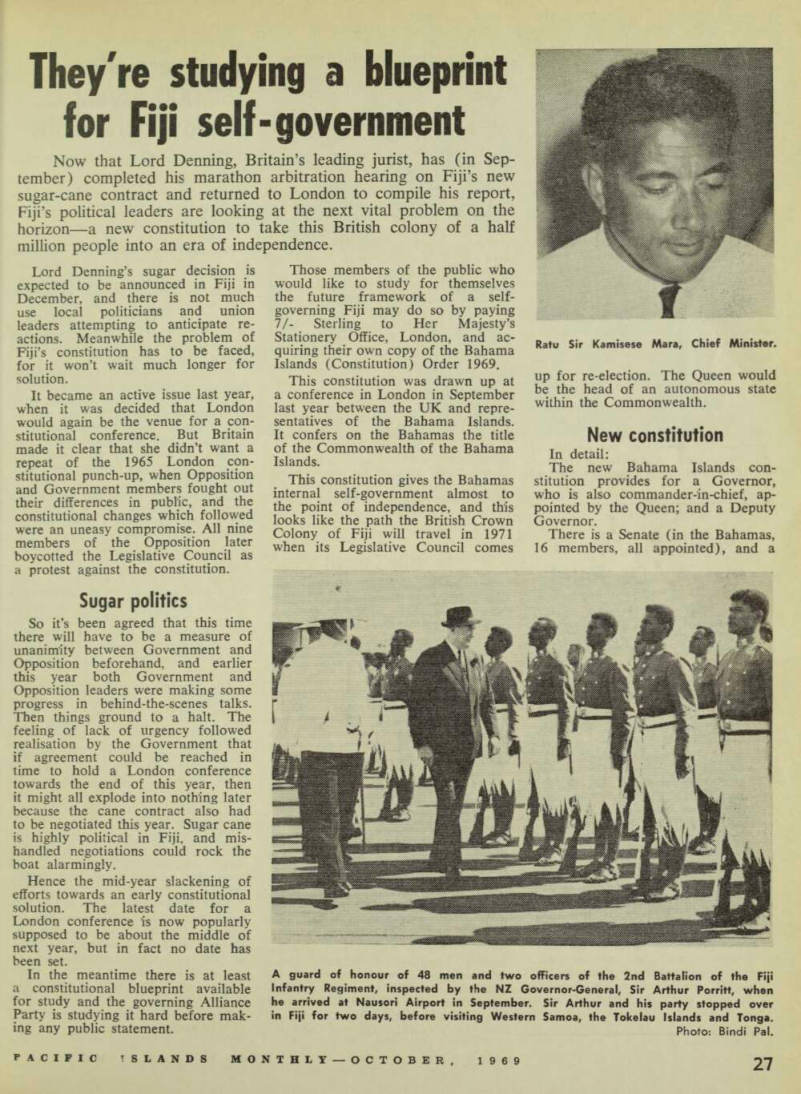
A guard of honour of 48 men and two officers of the 2nd Battalion of the Fiji Infantry Regiment, inspected by the NZ Governor-General, Sir Arthur Porritt, when he arrived at Nausori Airport in September. Sir Arthur and his party stopped over in Fiji for two days, before visiting Western Samoa, the Tokelau Islands and Tonga.
Photo: Bindi Pal.