The Practical Planter
pp. 151-159 · Read in the full issue


The potential for tea growing in Papua-New Guinea
Specially written for PIM by W. H. W. COULTAS, tea expert with the UK’s Minstry for Overseas Development.
The arrival in 1968 in the London tea auction rooms of the first regular consignments of tea from New Guinea was significant for two reasons. Firstly, it demonstrated to the other producing countries that NG tea could compete with high grown Ceylons, Nilgiris, Assams and Kenyas, though not, of course, with seasonal Uvas or Darjeelings.
Furthermore, that it was possible to maintain an acceptable standard has been demonstrated by the fact that the teas have sold, since the beginning of 1969 in depressed market conditions, at prices varying from Stg.3/8 to 4/- per lb which contrasts with an average of 3/8i for all teas sold in London since then.
The consignments have included a full range of teas comprising orthodox rotovane and CTC manu facture.
The second significant factor, and probably the more important, is that New Guinea growers preferred to sell their teas in London, necessitating the long sea haul round the Cape, instead of selling direct to Australia which is on their doorstep.
This would appear to confirm the unpalatable truth that the Australian tea drinking public has become so used to drinking an inferior brew that the housewife is not prepared to pay more for a quality drink at prices which would enable the New Guinea grower to take advantage of the proximity of this large market.
If therefore New Guinea is to compete with the major producing countries on the London market, what advantages, if any, does she have over her competitors?
Confined
For the present the infant tea in dustry is confined to the Wahgi Valley, a large flat floor valley in the Western Highlands, some 5,500 ft above sea level. The only other tea in the territory is the Department of Agriculture’s experimental station at Garaina, half way between Port Moresby and Lae. at an elevation of 2,100 ft and reached only by air.
Here there are some 300 acres of mature tea comprising a remarkably even type of Assam hybrid, which lends itself to high yields and CTC manufacture. The area is now being ted almost exclusively to supply tea seed for the new plantings in the Wahgi Valley.
The policy of the Australian Goveminent is to assist in the development of a cash economy for the people of the territory and at the same time to attract a substantial investment of private capital for expatriate sources as, quite rightly, this is considered essential for rapid development.
The history of the tea industry in other countries has shown that it is possible only following the successful establishment of large units to persuade the indigenous popula tion to undertake tea cultivation on a small-holder basis. In the years up to 1968 capital investment in the Western Highlands of New Guinea has heen estimated at SAS million, Up to the same time some 16,000 acres of land had been purchased by the Administration for tea grow ing in the Western and Southern Highlands. Of this, approximately 10,800 acres have been allocated for large estates which will form the
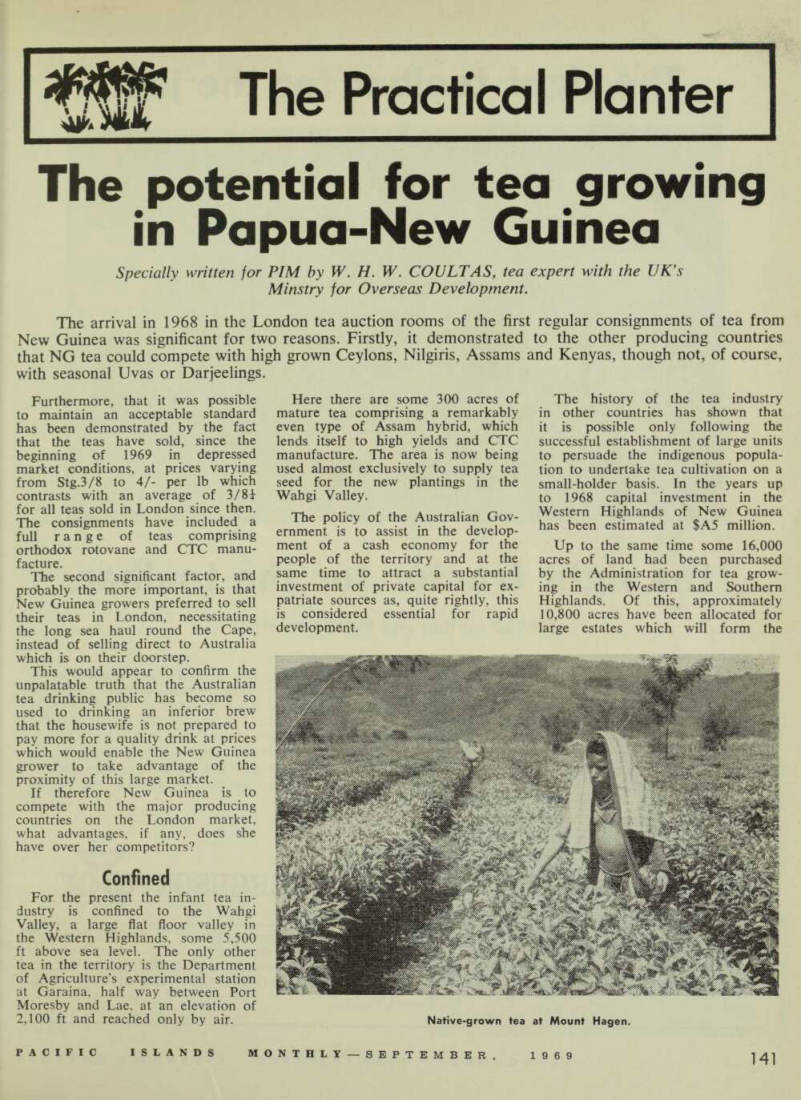
Native-grown tea at Mount Hagen.
nucleus around which the industry will grow, while 3,000 acres have been allocated for indigenous small holder blocks to be interspersed among the larger units. An additional 3,000 acres have been set aside for further indigenous small-holder tea development.
Balance
The government policy is thus to establish a balance in the industry’s early years between the proportions of ownership by expatriate enterprises and New Guineans.
Land is leased to companies or individuals in blocks of about 1,000 acres on two conditions —firstly, that a factory is constructed large enough to process the potential crop, and, secondly, that the factory will also undertake the processing of green leaf from the surrounding small-holders.
Exports are expected to reach 2i million lb made tea in 1970-71 and approximately 13 million lb in 1974- 75. The average rainfall varies from 75 in. at Garaina to 100 in. at Mount Hagen. The so-called dry season (in fact rain falls in every month) extends from May to August and the wet season from September to April.
Mean maximum temperatures are in the vicinity of 75 deg. Fahr., with a five degree variation over the year, and the mean minimum temperatures are approximately 55 deg. Fahr, with a similar variation.
These climatic conditions are highly conducive to a continuous and vigorous tea production throughout the 12 months of the year.
The soils of the Wahgi Valley fall into three groups— • Predominately grass land areas which, under natural conditions, are poorly drained. The soils are generally clay loams, silty clay loams and peaty clay. • Soils developed on volcanic intrusive materials which give rise to deeply weathered acid orange and yellow clays on a rolling topography. • Peaty swamp soils which occur extensively in all areas, and in their natural conditions are swamps. These are essentially deep peaty layers over lying pale yellow silty clays.
Indignities
Over much of the valley the water table is just a few inches below the surface, and although the species Camellia Sinensis is probably one of
the hardiest of domestic plants and continues to survive the utmost in dignities perpetrated on it by the human race, it will not tolerate wet feet.
There is no doubt that the tea bush owes its ability to survive droughts, floods, collar-pruning, hard plucking (euphemistically known as “ strip ping”), being grown on steep land or smothered in weeds, to a deep and penetrating tap-root often four to five ft in length.
This shows how important proper drainage is, and will be, to the Wahgi Valley tea soils if the plant is to flourish. However, while adequate routine drain maintenance will no doubt be taken care of by the big producer, will the same be done by the small-holder whose aims are focused on short term profits rather than long term appreciation of his land?
This brings one on to the relative merits of vegetatively propagated tea and seedling tea because apart from all else a VP tea bush has little if any tap-root. The inference, there fore, is that VP tea is less likely to suffer from wet feet than seedling tea in areas with a high water table as found in the Wahgi Valley.
No one yet knows what the economic life of a tea bush is, whether it is seedling or VP, but it is fair to assume that once planted and properly fed and protected from pest and disease, it will continue to provide a steady income for up to 80 years. It would appear to be common sense, therefore, that only
the very best of planting material should be used.
It is often said that in a seedling field of tea 40 per cent, of the bushes produce 80 per cent, of the crop, and this is probably not far from the truth. However in the case of vegetatively propagated tea, 100 per cent, of the crop is produced by 100 per cent, of the bushes, which explains the spectacular increases in yields by the use of clonal material.
Bankruptcy
Departmental reports on New Guinea tea continue to refer to yields of 1,000 lb made tea per acre as being desirable targets, whereas today in the major producing countries a yield of only this magnitude from re planted tea probably means bank ruptcy.
It has now become customary to think in terms of 2,500 lb made tea per acre as being normal for VP tea, and if New Guinea tea is to survive the fierce competition from the rest of the tea producing world then growers must start thinking in terms of 2,000 to 3,000 lb per acre.
Then not only has the New Guinea producer to contend with the problems of a high water table in the Wahgi Valley but also the dominant importance of soil re-action. Soil scientists agree that under normal circumstances there is an upper limit to the pH value of soils in which tea will thrive. The limit occurs be tween pH 6.0 and 6.5. At the other
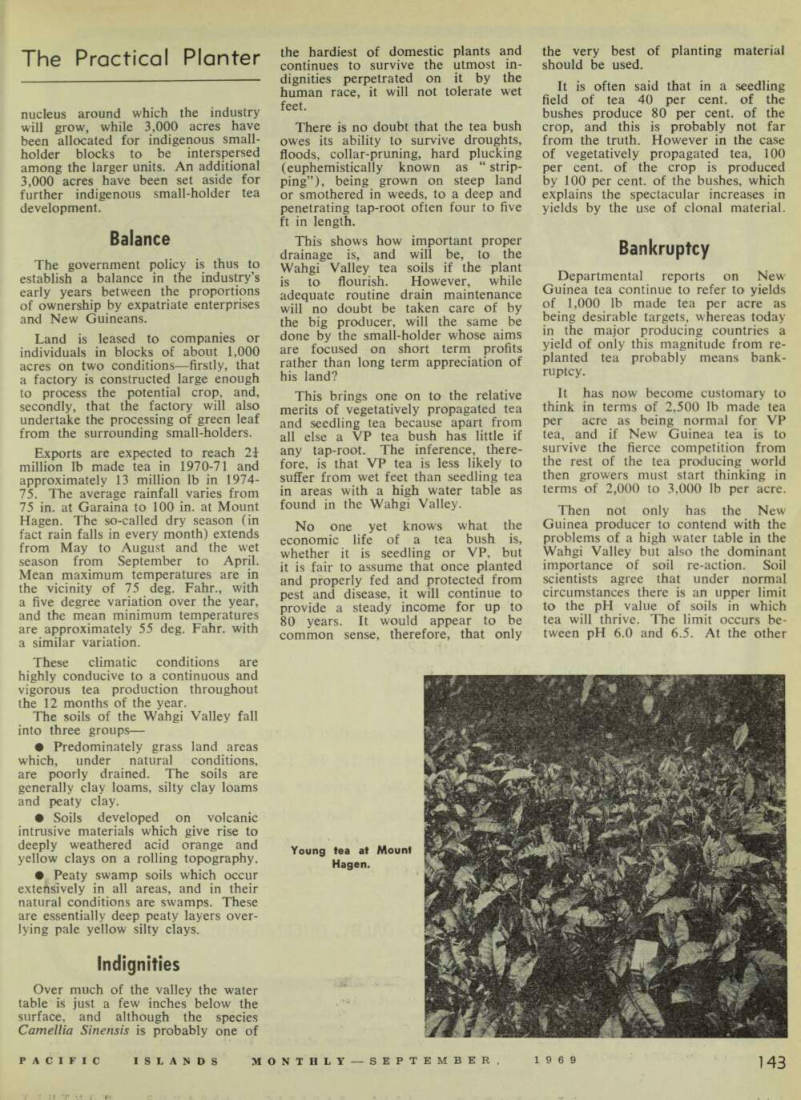
Young tea at Mount Hagen.
end of the range there appears to be no limiting factor and moderately good tea can be found growing at pH values of 4.5.
A feature of the lake bed and peaty swamp soils is the generally high pH levels. The range of pH is 5.5 to 7.0 with the majority in the range of 6.0 to 6.5, or, in other words, at the extreme end of the high tolerance for tea. Whether environmental conditions of the Waghi Valley result in a lessening of the significance usually placed on the pH of tea soils remains to be seen.
There is also a potential sulphur deficiency throughout the Wahgi Valley which is quite significant in local areas, while experience in coffee has already shown up deficiencies in boron, zinc and magnesium.
Pests
So far New Guinea tea has been relatively free from serious pests and diseases, in particular from the fungus of blister blight (Exobasidium vexans-massee) which is now endemic throughout the tea growing areas of Asia, and which during epidemic attacks can cost up to 2d a lb made tea to control.
A major consideration for the New Guinea planter is that of plant density, and in this respect there are three fundamental assumptions that brook no denial, except perhaps from the greatest diehards.
These are:— • The best cover crop for tea is tea. • There is a straight line relation ship between yields and the number of bushes per acre, subject of course to practical limitations. • The tea bush possesses a strong apical growth, which means that the production of tea producing shoots diminishes from the centre towards its periphery.
The first consideration, therefore, is for an adequate number of bush centres in contra-distinction to a smaller number of well spreading bushes, even though they may cover the area.
What then is the most advan tageous planting density? The answer appears, in the light of experience in other countries to be in the region of 5,000 to 5,500 bushes per acre in a system of hedges. Two considera tions influence present trends towards hedge planting, namely the increasing statutory insistence on soil conserva tion, and the possible development of
mechanical cultivation and harvest ing.
It is difficult to understand, there fore, why much of New Guinea tea has been planted with only 3,500 bushes per acre using seedling tea and not VP.
As the yields are 300 to 400 per cent, greater for VP than seed, surely it is only common sense to overcome these difficulties, however great they may be. Surely it is better to have 100 acres of VP tea than 200 acres of scrubby looking seedling bushes!
Labour problem
Undoubtedly the biggest problem is labour. Of the three beverages tea, coffee and cocoa, tea is by far the most difficult to cultivate, and, unlike the others, labour requirements for tea are not seasonal but remain steady throughout the year, of the order of one to li labourers per acre depending on the yield and the degree of cultivation.
The next problem facing the grower who wants to use only VP material for his plantings is that of selection, and here probably the two most important characteristics to be taaken into account in deciding the type of bush from which to take clonal material are (a) the good fermenters and (b) the high number of plucking points.
It is generally accepted that a bright copper coloured infusion is indicative of a good quality tea.
There are of course exceptions, due to definite genetical factors, of accept able teas having only green infusions though they are bright in appearance.
If, therefore, the initial tests prove that the infusions are bright and coppery then one may confidently expect the bush will produce a good quality tea.
Fermentation
A simulated process of fermenta tion in tea leaves by the use of chloroform was developed by Dr.
Bendall, of Cambridge, in 1958 and has been used since then as a selec tion test for fermentable clones. The tests are simple to carry out in the field and marks ranging from zero to five are afforded to the varying colours ranging from green (non fermenter) to bright reddish brown (excellent-fermenter). Bushes giving readings of zero to two are dis carded and only those in groups three to five are considered further.
As mentioned earlier, the produc tion of flush producing shoots diminishes from the centre of the bush to its periphery, and the selec tion of bushes with a high number of plucking points is best done by
eye at the end of the pruning cycle.
In practice, however, the principle is one of rejection rather than selec tion based on discarding bushes exhibiting unsatisfactory characteris tics. These characteristics are lax plucking tables, an upright instead of a spreading stand, scarcity of maintainance foilage below the pluck ing table, tendency to flowering; prevalence of dormant buds and close internodes with a narrow angle be tween leaf and stem.
From the remainder a further discard is needed of those bushes which are growing under abnormally favourable conditions such as in pockets of good soil or adjoining roads and vacancies.
Success
In this manner potentially high yielding bushes are reserved for further consideration such as suscep tibility to disease or pest.
From this stage, the techniques of successfully producing an adequate number of well-grown clonal plants, by a given time, can only be found by trial and error. Practices vary from country to country and even from district to district. Apart from following a few basic principles, therefore, success depends on the man on the spot.
In case the reader infers from all this that the preparation of clonal material is a difficult, chancy and time-consuming process he may take heart from the success achieved by the tea industry in Ceylon where re planting other than with approved clonal material is no longer permitted by law.
Advantage
Notwithstanding the employment of personnel with tea experience elsewhere, the New Guinea tea in dustry has seemingly failed to take advantage of the agricultural break throughs in other countries and has planted most of its tea with un selected seed at stands per acre which are now considered inadequate.
These factors will prevent the NG planter achieving the high yields now being obtained from replanted tea in India and Ceylon. To these handicaps must also be added the high comparative cost of unskilled labour and the expensive transporta tion charges from the interior to the ports of shipment, both of which will inhibit the territorys ability to com pete on equal terms, in terms of cost, with the major producing countries.
There is, however, one bright side, at the moment; namely the P-NG industry’s freedom from penal taxa tion in the form of cesses, excise levies and export duties which are threatening, during the present period of low prices, the very existence of many producers in India and Ceylon, While these circumstances prevail.
New Guinea tea enjoys a consider able advantage over tea from these countries.
So far the subject of harvesting methods has not been touched upon in this article, and it is one which affects New Guinea to a much greater degree than in either Ceylon or India.
It may be said that there are three methods of plucking—namely, mechanical, semi-mechanical and hand.
The dream of a self-propelled plucking machine has been with planters since the birth of the in dustry and appears to be still with a number of growers in New Guinea.
The two most famous prototypes are those built by the research institutes in Tocklai, Assam, and Georgia, USSR, and the reasons why they have failed to make headway are not difficult to appreciate.
Firstly, unlike the much larger grain and cotton industries, where highly sophisticated mechanical harvesters operate largely over suit ably flat land, the tea areas in Assam and East Africa which are thus topographically favoured are so small by comparison to me areas of broken land under tea, that the capital outlay for experiment and production of a prototype to benefit a relatively small part of the tea industry would not be justified.
Furthermore, as has already been pointed out, there is a definite correlation between yield and stand per acre, which would be a further limiting factor to the accommodation of planting distances to the needs of mechanised implements.
Labour force
Secondly, the statutory require ments in India and Ceylon for estate owners to find employment for their growing labour forces is perhaps the greatest factor operating against mechanised plucking. In addition, a machine powered by a self-contained internal combustion engine carried by the operator precludes the employ ment of women and children, because of weight and fatigue factors, and in these two countries it is these mem
bers of the labour force who are the principal wage earners.
It will be seen therefore, that for largely sociological reasons mechanised plucking is unlikely to have a future where there is a surplus of under-employed labour.
Nor is mechanised plucking likely to have much future in small-holding tea for the reasons that a successful small-holder employs as many mem bers of his family as possible, even, if necessary, his school-going children.
A form of semi-mechanised pluck ing by using shears has been developed on some estates in South India, while in Ceylon the use of shears for bush formation following pruning is becoming increasingly popular.
By contrast, hand plucking, though extremely labour-consuming, has the advantage of selection, and as there is a direct relationship between the quality of the made tea and the standard of plucking, it seems un likely, where labour is available, that the manual will be superseded by the mechanical.
Machines
However, in New Guinea as well as in parts of East Africa where labour is, at present, not plentiful, and particularly in areas where only the male labourers work on estates, there appears to be some scope for the development of self-contained plucking machines of the types used in Japan and Taiwan.
Summing up: The advantages which New Guinea possesses over its competitors are, at present, mostly of a fiscal nature; namely the in dustry’s freedom from penal taxa tion; the climatic conditions in the Highlands are almost ideal for a vigorous and sustained growth of tea throughout the year, and the industry is, by comparison to India and Ceylon and even East Africa, only an infant who, in the process of growing up may, in intelligent guidance and foresight, avoid many of the pitfalls experienced in the older countries.
New Guinea’s disadvantages, which need only be of a passing nature, are poor productivity, having regard to high basic wages and low yields due to seedling plantings, and ex pensive transportation costs from the interior to the outlet ports.